How to start day trading in 2026: a realistic plan
By Scalpel Team. , updated . 12 min read.
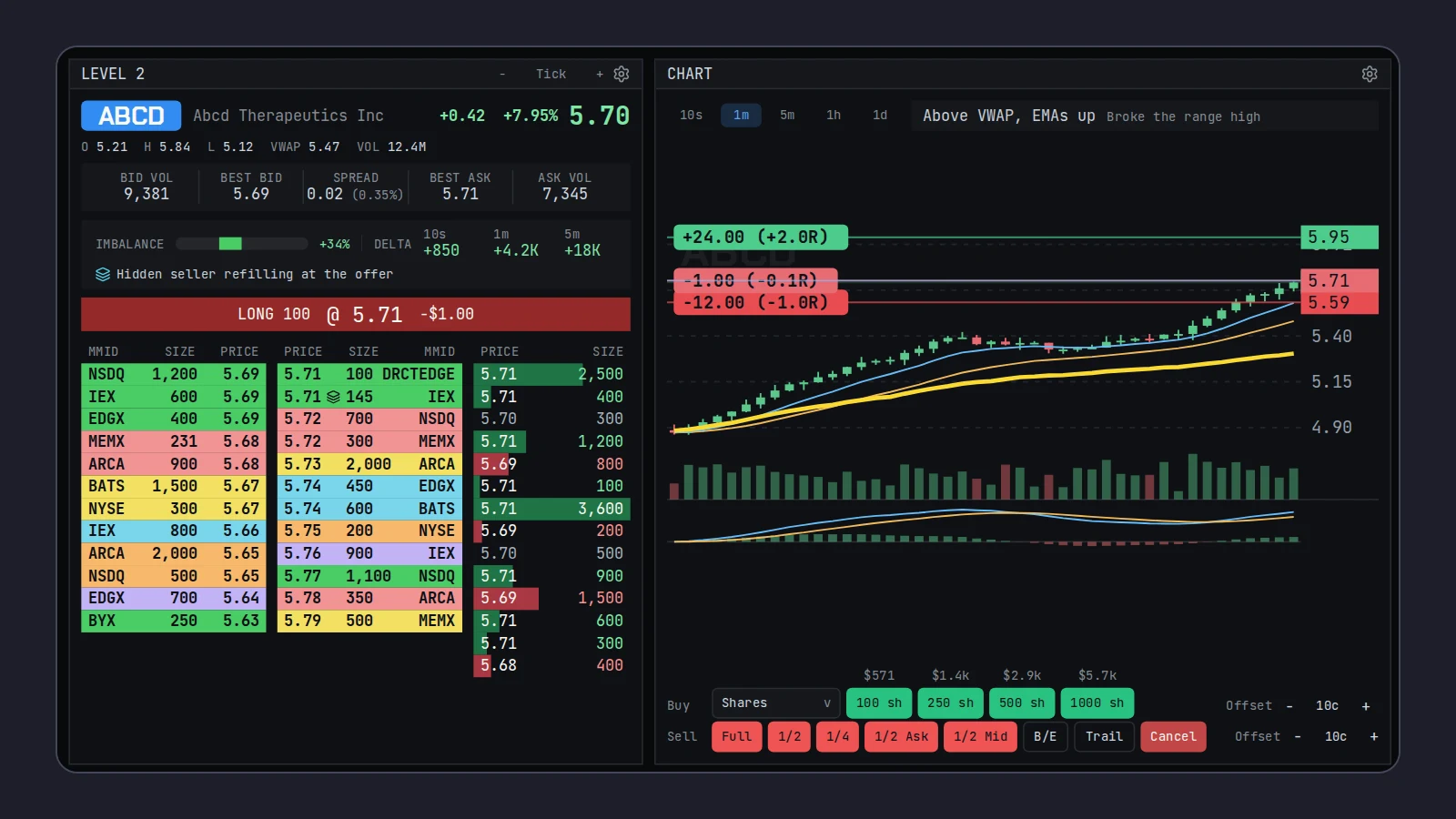
In short
To start day trading in 2026: accept the odds first (the research finds most day traders lose money), pick one style and one setup, open a broker account with real-time data, and practice in a simulator at your real account size with real costs for at least 100 trades. Keep a journal in R from the first trade, then go live with your smallest size and a hard daily loss limit. The $25,000 pattern day trader minimum is gone since June 4, 2026, but a margin account still needs $2,000.
Most guides on how to start day trading are written to sell you a course. They show a winning trade, skip the losing months and promise a path to a living. This one is written by people who build a day trading tool and use it, and the first thing we will tell you is the thing the courses leave out: most people who try this lose money, and the research is consistent about it.
If you read that and still want to learn, here is a realistic plan. It is the order we would do it in ourselves: the odds, the money, the broker, one setup, a long stretch of practice, a journal, a routine, and only then a small live account. Each step links to a post in our learning and psychology series that goes deeper.
Step 1: know the odds before you start day trading
Start with the evidence, because it should shape every decision after it.
- In Brazil, of 1,551 people who day traded index futures for more than 300 days, 97% lost money and only 1.1% earned more than the minimum wage (Chague, De-Losso and Giovannetti, "Day Trading for a Living?", working paper, 2019).
- In Taiwan, with every trade on the exchange from 1992 to 2006, less than 1% of day traders were predictably profitable after fees (Barber, Lee, Liu and Odean, Journal of Financial Markets, 2014, DOI 10.1016/j.finmar.2013.05.006).
- In the best-known US sample, 324 day traders in 1998 and 1999, 64.2% lost money after commissions (Jordan and Diltz, Financial Analysts Journal, 2003, DOI 10.2469/faj.v59.n6.2578).
- Among 66,465 US households from 1991 to 1996, those that traded the most earned 11.4% a year while the market returned 17.9% (Barber and Odean, Journal of Finance, 2000, DOI 10.1111/0022-1082.00226).
Our post on day trading statistics goes through each study: who was in the sample, what was measured and where the study is weaker than its headline. The short version: a small group of traders has real, persistent skill, and you cannot know in advance whether you are in it. The SEC's investor alert, Day Trading: Your Dollars at Risk, puts it bluntly: be prepared to suffer severe financial losses, and only risk money you can afford to lose.
So the first rule of the plan is about money you will not touch: day trade only with money whose loss would not change your life. Not rent, not savings, not borrowed money.
Step 2: decide what kind of day trading you mean
"Day trading" covers styles that have little in common beyond closing by the end of the day. A scalper holds for seconds to minutes and lives on Level 2 and the tape. A slower day trader might hold a position for an hour off a chart setup. A swing trader holds for days and does not need to be at the screen at 09:30. The tools, the costs and the time commitment are different for each; our post on scalping vs day trading vs swing trading lays them side by side.
Our own bias is open: Scalpel is built for long-only scalping of US small caps, pre-market first. That style is among the hardest. Small caps move 20% in minutes in both directions, books are thin and halts happen. If you have a full-time job and can only trade at lunch, a fast pre-market style is probably not for you, and swing trading or investing will fit your day better.
Whatever you pick, pick one. Beginners who try momentum scalping on Monday, options on Wednesday and crypto at the weekend learn nothing about any of them.
Step 3: the money and the rules
The pattern day trader rule is gone. For years a margin account needed $25,000 to make more than three day trades in five business days. The SEC approved FINRA's replacement on April 14, 2026, an intraday margin standard that removes the pattern day trader designation and the $25,000 minimum (SEC Release No. 34-105226), and it took effect on June 4, 2026. Brokers may phase it in, so check what yours applies today. Our post on the PDT rule change explains it on IBKR, and day trading rules covers everything else a US stock trader should know.
What still applies. A margin account still needs at least $2,000 of equity, the minimum in FINRA Rule 4210 that the same SEC release refers to. A cash account has no day trade count, but you can only trade with settled cash; our post on day trading in a cash account explains T+1 settlement and good faith violations.
How much to start with. There is no magic number. What matters is that your risk per trade is small against the account: many traders risk 0.5% to 1% of the account on a trade. On $5,000 that is $25 to $50 a trade. Our post on day trading a small account works through accounts from $2,000 to $10,000.
Costs eat small accounts. On IBKR Pro Fixed pricing, stock commissions are USD 0.005 a share with a USD 1.00 minimum and a maximum of 1% of the trade value (IBKR stock commissions, checked October 22, 2026). A 300-share trade costs $1.50 to buy and $1.50 to sell: $3.00 a round trip. Ten round trips a day for 21 trading days is $630 a month, before regulatory fees, data and slippage. On a $5,000 account that is 12.6% of the account every month that your trading has to earn back before you make a cent. The cost of day trading adds up every line.
Step 4: broker, platform and market data
You need a broker that executes fast, lets you trade in the pre-market if your style needs it, and gives you real-time data including Level 2, the book of bids and offers by price. We build on Interactive Brokers because of its API and its per-share pricing, so that is what we know best; our pillar on day trading on Interactive Brokers is the full setup, from the account type to TWS. Scalpel is independent and not affiliated with or endorsed by Interactive Brokers.
Three things beginners get wrong here:
- Delayed data. Free quotes are often delayed by 15 minutes or more. You cannot day trade on them. Subscribe to real-time US stock data; IBKR market data for day trading lists what to pick and what it costs.
- Market orders on thin stocks. Use marketable limit orders: a limit priced through the other side of the book, which fills like a market order but caps what you pay.
- Too many screens too soon. One chart, one Level 2 and one tape for one stock is enough to learn on.
Step 5: learn one setup, and size it by risk
Pick one setup you can describe in a sentence, with an entry, a stop and an exit. For small-cap momentum that might be "the first pullback after a pre-market gap on news, entered on the break of the pullback high, stopped under its low". Our pillar on momentum day trading describes how that style works and where it fails.
Then size every trade by the money at risk, not by the number of shares. The formula is risk in dollars divided by stop distance:
- Account $5,000, risk 1% = $50 a trade.
- Entry $4.00, stop $3.90: 10 cents of risk a share.
- $50 / $0.10 = 500 shares, a $2,000 position.
If the stop needs to be 25 cents away, the size drops to 200 shares, and the loss if it is hit is still $50. Measured this way, every result becomes a multiple of your risk, an R multiple: a stop-out is -1R, a trade that makes $100 on $50 of risk is +2R. Our pillar on day trading risk management covers stops, sizing and the daily limit in full.
Step 6: practice in a simulator first
Paper trading lets you learn the mechanics with no money at risk: the keys, the order types, the sizing, the stop, the routine. It cannot prove you will make money, because paper fills are friendlier than real ones and paper losses do not hurt. Our post on paper trading shows where paper lies and how to close the gaps.
On Interactive Brokers, every paper account starts with USD 1,000,000 of paper equity (IBKR: About Paper Trading Accounts). Reset it to your real account size before your first trade; practicing with a million teaches you sizes you will never trade. IBKR also notes that its paper fills are simulated from the top of the book, so a large order on a thin stock fills better on paper than it would live.
IBKR's short video shows how to log in to the paper account, customize it and place practice trades, which is all the setup this step needs.
The rules that make practice count:
- Your real account size, your real commissions.
- One setup only, with a written entry, stop and exit.
- The same daily loss limit you will use live.
- A fixed sample, at least 100 trades, judged only at the end.
Step 7: keep a journal from the first trade
A journal turns trades into evidence. For each trade, record the time, the symbol, the setup, the entry, stop and exit, the shares, the fees, the result in R and a tag for any mistake: chased, moved the stop, oversized. Once a week, sort it by setup, by hour and by mistake, and change one thing.
That is how you find out whether your setup has a positive expectancy, the average R per trade after costs, before you risk real money on it. Our post on the day trading journal has a template you can copy and the numbers worth computing.
Step 8: build a routine
Day trading rewards preparation and punishes improvisation. A routine moves the decisions to a calm part of the day: your risk numbers are set before you see a chart, your watchlist is two to four names with a reason to move, each has a written plan, and you stop by a rule. Nasdaq's pre-market runs from 04:00 to 09:30 ET, and momentum traders are usually scanning well before the open. Our day trading routine goes minute by minute from 06:00 ET to the late morning.
Step 9: plan for the psychology
Most blown accounts are not lost on a bad setup. They are lost on what happens after it. Two patterns cause most of the damage:
- Chasing. Buying a stock because it is moving, after your entry is gone. Our post on FOMO trading puts a number on what chasing costs and gives entry rules that stop it.
- Revenge trading. Trading bigger and faster after a loss to win it back. Our post on revenge trading explains why it happens and the hard stops that break the cycle.
A third is quieter: holding losers and selling winners. Odean's study of 10,000 brokerage accounts found investors were more than 50% more likely to sell a stock that was up than one that was down (Journal of Finance, 1998; our trading journal post has the figures). A day trader's stop exists to stop exactly that.
The defense against all three is the same: rules you set in advance and, ideally, a platform that enforces them, such as a daily loss limit that blocks new entries once it is hit (daily loss limit).
Step 10: go live small, and keep learning
Go live when your practice shows a process you can repeat: losers held to about 1R, no moved stops, the daily limit respected every time it tripped, and results spread across many trades rather than one lucky run. Then:
- Start with your smallest size, often a quarter of what you practiced.
- Keep the daily loss limit on, and set it before the first trade.
- Expect live results to be worse than paper. Fills, nerves and the queue are all harder.
- Keep the journal. Compare your first 100 live trades with your last 100 paper trades.
How long all of this takes varies widely, and the honest answer is longer than the courses say. Our post on how long it takes to learn day trading looks at what the research says about learning and at how many trades it takes before a win rate means anything.
How to start day trading: a realistic first 90 days
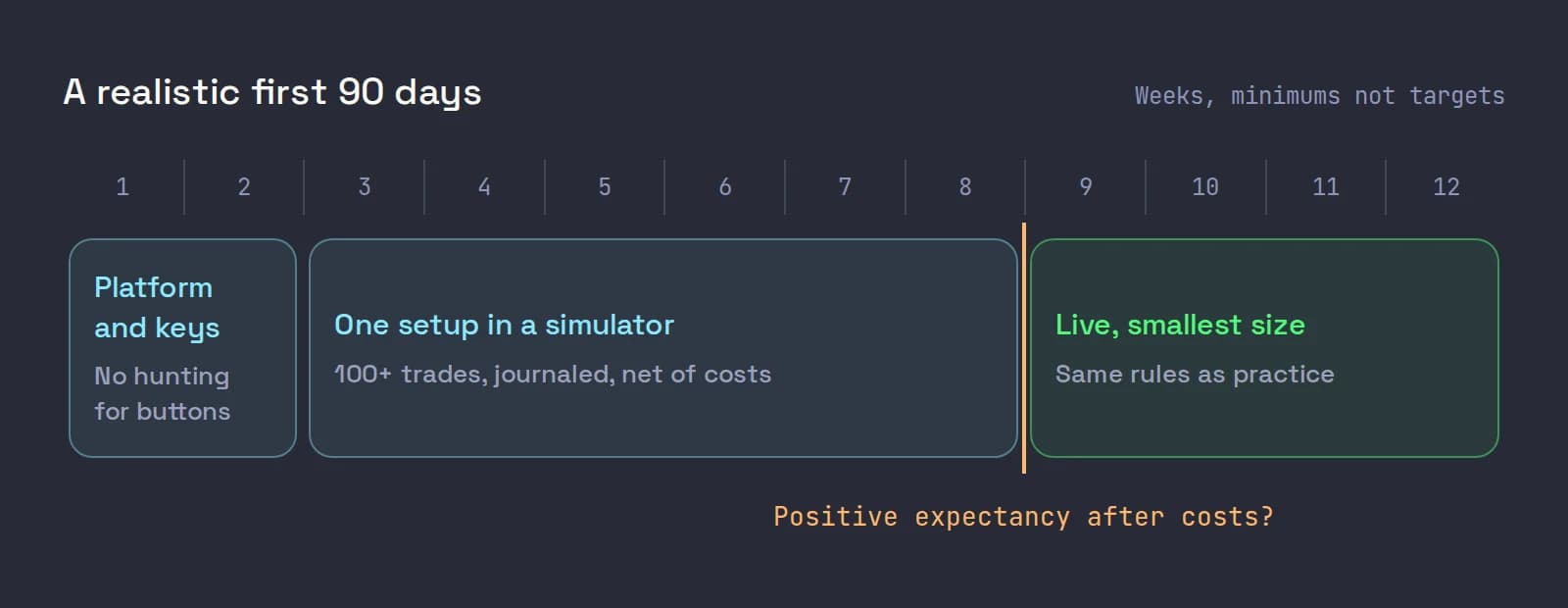
| Weeks | Focus | You are done when |
|---|---|---|
| 1 to 2 | The platform, the order types, the keys, the data | You can enter, size and exit without looking for a button |
| 3 to 8 | One setup in a simulator, at your real size, with a journal | You have 100 or more trades and an honest expectancy after costs |
| 9 to 12 | Live, smallest size, same rules | Your live process matches your paper process, whatever the P&L |
These are minimums, not targets. If the practice shows a negative expectancy, the plan is not to go live and hope. It is to change one thing and test again, or to stop. Stopping is a legitimate result: the research suggests it is the right one for most people.
Day trading for beginners: the mistakes to avoid
- Trading money you need. It changes every decision you make.
- Skipping practice because paper "is not real". Paper is where you make the cheap mistakes.
- Trading without a stop, or moving it once you are in.
- Sizing by shares instead of risk, so one loser costs five times another.
- Ignoring costs. Commissions and slippage are a large share of a scalper's results.
- Too many stocks, too many setups. Depth beats breadth.
- Paying for signals or a guru. The SEC's alert warns that day trading seminars and newsletters may not be objective.
The learning and psychology series
This post is the hub of our learning and psychology series. Every post in it, in the order a new trader might read them:
- Day trading statistics: what the primary research says about who makes money, with exact figures and each study's limits.
- Scalping vs day trading vs swing trading: holding times, costs, tools and time commitment, compared.
- Day trading a small account: sizing, costs and a risk plan for $2,000 to $10,000 after the PDT change.
- Paper trading: where simulated fills lie, IBKR's paper account, and how to make practice realistic.
- The day trading journal: the fields that matter, a template and a weekly review.
- A day trading routine: the morning from 06:00 ET to the late session, step by step.
- FOMO trading: what chasing costs in R and the entry rules that stop it.
- Revenge trading: why traders tilt after a loss and how to stop the spiral.
- How long it takes to learn day trading: the research on learning, and the sample sizes needed to judge a strategy.
Where Scalpel fits
Scalpel is a keyboard-first desktop cockpit for your own Interactive Brokers account, connected through TWS or IB Gateway. For someone starting out, three parts matter most. It opens in SIM, a paper mode that fills your orders against the live Level 2 book with your IBKR commissions, so practice feels like the real thing, and nothing reaches your broker until you switch MODE to LIVE. Every trade is sized by your dollar risk at the moment you press the key and gets an app-monitored stop and target on the chart. And Analytics journals every trade in R, net of fees, with a daily loss limit that locks new entries when the day goes wrong.
It is opinionated: long only, US stocks only, no automation, and it will not make trading easy or profitable (Scalpel's philosophy). Its stops only work while Scalpel runs and stays connected. If you want to see the loop, the first session in SIM takes 15 minutes, the first week in SIM is a day-by-day practice plan, and going live is the checklist for the switch. This video from our guides shows the first steps, from connecting to IBKR to the first SIM trade.
Rules, fees and prices checked on October 22, 2026.
Trading carries a significant risk of loss. Nothing here is financial advice.
Questions
- How do I start day trading as a beginner?
- Learn the odds first, then pick one style and one setup, open a broker account with real-time data, and practice in a simulator at your real account size with real costs for at least 100 trades. Keep a journal, then go live with your smallest size and a daily loss limit.
- How much money do you need to start day trading?
- Since June 4, 2026 there is no $25,000 pattern day trader minimum, but a margin account still needs at least $2,000. More important than the amount is risking a small share of it per trade, often 0.5% to 1%, and only using money you can afford to lose.
- Can you teach yourself day trading?
- You can learn the mechanics yourself with a simulator, a journal and primary sources. Whether you can make money is a different question: the research finds most day traders lose money, including most who persist.
- Is day trading worth it for beginners?
- For most people, the evidence says no: in the major studies most day traders lost money and very few earned a living wage. If you try, treat it as an experiment with a fixed budget, a practice period and a rule for when to stop.
- What is the best way to practice day trading?
- A simulator that fills against the live order book, with your real account size, your real commissions and the same daily loss limit you will use live. Trade one setup, journal every trade and judge at least 100 trades before going live.
- Do I still need $25,000 to day trade?
- No. FINRA's pattern day trader rule and its $25,000 minimum were replaced by an intraday margin standard that took effect on June 4, 2026, though brokers may phase it in. A margin account still needs $2,000.
Related guides
Guide 1.7Your first 15 minutes in SIMLoad a symbol, buy with a hotkey, watch the stop arm, scale out and flatten, all in SIM with no money at risk. The whole Scalpel loop in fifteen minutes.Guide 14.5Your first week: a SIM practice planA day-by-day SIM plan for your first week with Scalpel: keys, sizing, stops, scanning and review in Analytics, so you go live with habits, not hope.Guide 1.9What Scalpel is for, and what it is notScalpel is opinionated: long-only scalping of US stocks, pre-market first, by keyboard and sound. What it does, what it never will, and who it is for.
Keep reading
- Day trading statistics: what the research says about who makes moneyDay trading statistics from primary research: 97% of persistent Brazilian day traders lost money, under 1% in Taiwan profit reliably. Samples and limits.
- Paper trading: does it work, and how to make it countDoes paper trading work? Where simulated fills lie, IBKR's paper account limits, how to make practice realistic, and when to switch to live trading.
- A day trading journal that actually improves your tradingA day trading journal that improves your trading: the fields that matter, a template with worked R math, a weekly review and the numbers to compute.
Practice in SIM, against the live book.A lifetime license, every update included, with a 7-day refund guarantee.Ask in DiscordGet Scalpel