Revenge trading: why it happens and how to stop it
By Scalpel Team. , updated . 8 min read.
In short
Revenge trading is taking trades to win back a loss rather than because your setup is there: re-entering the stock that just stopped you out, doubling size, skipping the stop. It comes from loss aversion, which makes a loss hurt more than an equal gain feels good and pushes people to take more risk to get back to even. Researchers found Chicago Board of Trade traders with morning losses were about 16% more likely to take above-average risk in the afternoon. The way to stop revenge trading is to decide the limits before the open, when you are calm: a hard daily loss limit, a fixed size that never goes up after a loss, a cool-down break after two losers in a row, and a stop that is never moved.
You take a loss on a trade you were sure of. Within a minute you are back in the same stock, with twice the size, and no stop, because this time it has to work. That is revenge trading. Poker players call the same state tilt, and traders borrowed the word. It is the fastest way we know to turn an ordinary losing day into one that changes how you trade for a month.
This post covers what revenge trading looks like, the psychology research behind it, the math of why it does so much damage, and how to stop revenge trading with rules you set while you are calm. We build Scalpel, a day trading cockpit for Interactive Brokers, and the daily loss limit in it exists because of this exact problem.
What revenge trading looks like
It rarely feels like revenge from the inside. It feels like being right and unlucky. The pattern from the outside is consistent:
- Immediate re-entry. You buy the same stock again within minutes of being stopped out, often at a worse price.
- Size goes up after a loss. "One good trade gets it all back" is the thought behind most blown-up days.
- Lower standards. Setups you would normally skip start to look good enough.
- The stop moves or disappears. You cannot take another loss, so you do not.
- Trades get faster. Less time between trades, less time looking at the chart before each one.
- The goal changes. You stop trading the market and start trading your P&L number back to zero.
If you recognize three or more of these from your own last bad day, you have revenge traded. Nearly every active trader has.
Revenge trading psychology: what the research says
The urge has a long research history, and none of it is about weak character. It is about how people value losses.
Losses weigh more than gains. Daniel Kahneman and Amos Tversky's prospect theory (Econometrica, 1979) describes people valuing outcomes as gains and losses from a reference point, with a value function that is steeper for losses than for gains. The same paper found risk seeking in choices involving sure losses. Put plainly: once you are down, taking a big gamble to get back to even feels better than accepting the loss. Your reference point for the day is usually zero, so every dollar below it pulls you toward more risk.
Traders hold losers and sell winners. Terrance Odean studied 10,000 accounts at a discount broker from 1987 to 1993 in Are Investors Reluctant to Realize Their Losses? (Journal of Finance, 1998). Over the whole year investors realized 14.8% of their gains but only 9.8% of their losses, so a stock that was up was more than 50% more likely to be sold on a given day than one that was down. This is the disposition effect, and in a day trade it is the voice that says "it will come back" while you move your stop.
Professionals do it too, intraday. The closest study to revenge trading is Joshua Coval and Tyler Shumway's Do Behavioral Biases Affect Prices? (Journal of Finance, 2005), on proprietary traders in Treasury bond futures at the Chicago Board of Trade. In the paper's abstract, traders who had morning losses were about 16% more likely to take above-average afternoon risk than traders with morning gains. Their afternoon trades bought at higher prices and sold at lower ones than had prevailed, and the prices they set reversed quickly: other traders treated them as noise and traded against them.
That last finding is the uncomfortable one. These were full-time professionals with their own capital at risk, and the market still paid others to take the other side of their catch-up trades.
This short video from the University of Texas at Austin's McCombs School of Business explains loss aversion with everyday examples. It is aimed at ethics students, not traders, but the mechanism it describes is the same one behind a revenge trade.
Why revenge trades do so much damage
The problem is not one bad trade. It is that revenge trading changes your size and your stops at the exact moment your judgment is worst, so losses compound instead of adding.
Take a fictional $10,000 account that risks $50 a trade (1R) and has a $150 daily loss limit, three full losers. Here is the same morning, traded two ways.
| Trade | With the rules: risk | Running P&L | Revenge: risk | Result | Running P&L |
|---|---|---|---|---|---|
| 1 | $50 | -$50 | $50 | -$50 | -$50 |
| 2 | $50 | -$100 | $50 | -$50 | -$100 |
| 3 | $50 | -$150, done | $100, size doubled | -$100 | -$200 |
| 4 | $200, stop moved down | -$300 | -$500 | ||
| 5 | $250, back in the same stock | -$250 | -$750 |
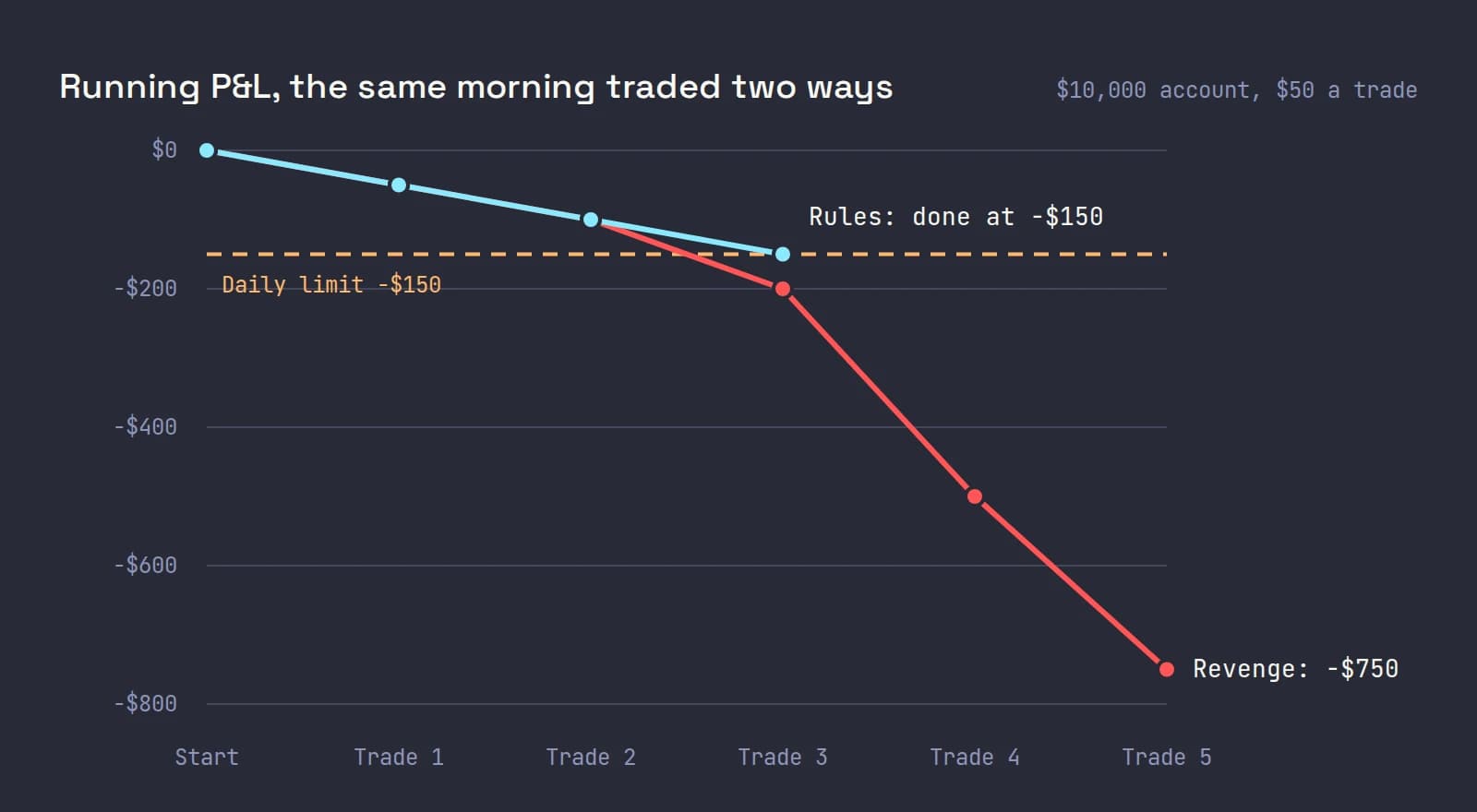
With the rules, the day costs $150, 1.5% of the account, three normal losers. The revenge path costs $750: 7.5% of the account, or 15 of the trader's normal 1R losses in one morning. Getting back now needs a gain of 8.1% on the $9,250 that is left, which at a normal 2R winner of $100 is eight clean winners with no losers in between.
The recovery math gets worse the deeper the hole:
| Account down | Gain needed to get back to even |
|---|---|
| 5% | 5.3% |
| 10% | 11.1% |
| 20% | 25.0% |
| 30% | 42.9% |
| 50% | 100.0% |
That is why the max daily loss rule matters more than any entry rule. A day capped at three losers is a bad day. A revenge day can be a bad quarter.
How to stop revenge trading
Every rule below has one thing in common: you decide it before the open, not at 10:15 after two losers. In the moment, you will always be able to argue yourself out of a rule you have to remember.
- Set a daily loss limit in dollars. Three to five full losers is common. When you hit it, you are done for the day, not for an hour. Our guide to setting a daily loss limit has the details.
- Never increase size after a loss. Size goes up after a run of good days or weeks, never to recover a loss. Write the number for each preset down and leave it.
- Take a cool-down after two losers in a row. Our suggestion: two consecutive full losers means 15 minutes away from the screen. Stand up, walk, drink water. It breaks the chain of fast trades where most revenge damage happens.
- No re-entry in the same stock for a set time. If a stock stopped you out, it needs a new setup, not the same one. A simple rule: no new trade in that symbol for 10 minutes.
- Never move a stop down. A stop is the price at which your idea is wrong. Losers should cost about 1R, and losers of 2R or 3R mean stops are being moved. Measuring every trade in R multiples makes this visible.
- Write the reason before each trade. One line: setup, entry, stop. If you cannot write it, you are not trading a setup.
- Log your state, not just your trades. Add a column to your trading journal for how you felt before the trade. After a few weeks, the pattern of which trades follow a loss tells you more than any chart.
Tilt signals and what to do
| You notice | Do this |
|---|---|
| You want back into the stock that just stopped you | Wait out the re-entry rule, then look for a new setup |
| You are reaching for a bigger size button | Stop. Size only changes before the session |
| You are thinking about the day's P&L, not the chart | Take the cool-down break |
| Your last loss was bigger than 1R | Check whether you moved the stop, and do not trade until you know |
| You hit the daily limit | Close the platform. Review tomorrow, not today |
Prevention starts before the loss
Most revenge trading is set up before the first trade. A trader who starts the day tired, risking too much, or needing a winner to pay a bill is already on tilt. A pre-market checklist covering sleep, the day's risk numbers and the plan for each stock is the cheapest protection there is; our post on a day trading routine has one.
It also helps to be honest about the odds. Most day traders lose money over time, and the research is in our post on day trading statistics. If you expect losing days as a normal part of the job, a loss is less of an insult that has to be avenged. New traders can find the wider plan in how to start day trading, and the same rules apply to chasing in our post on FOMO trading.
Where Scalpel fits
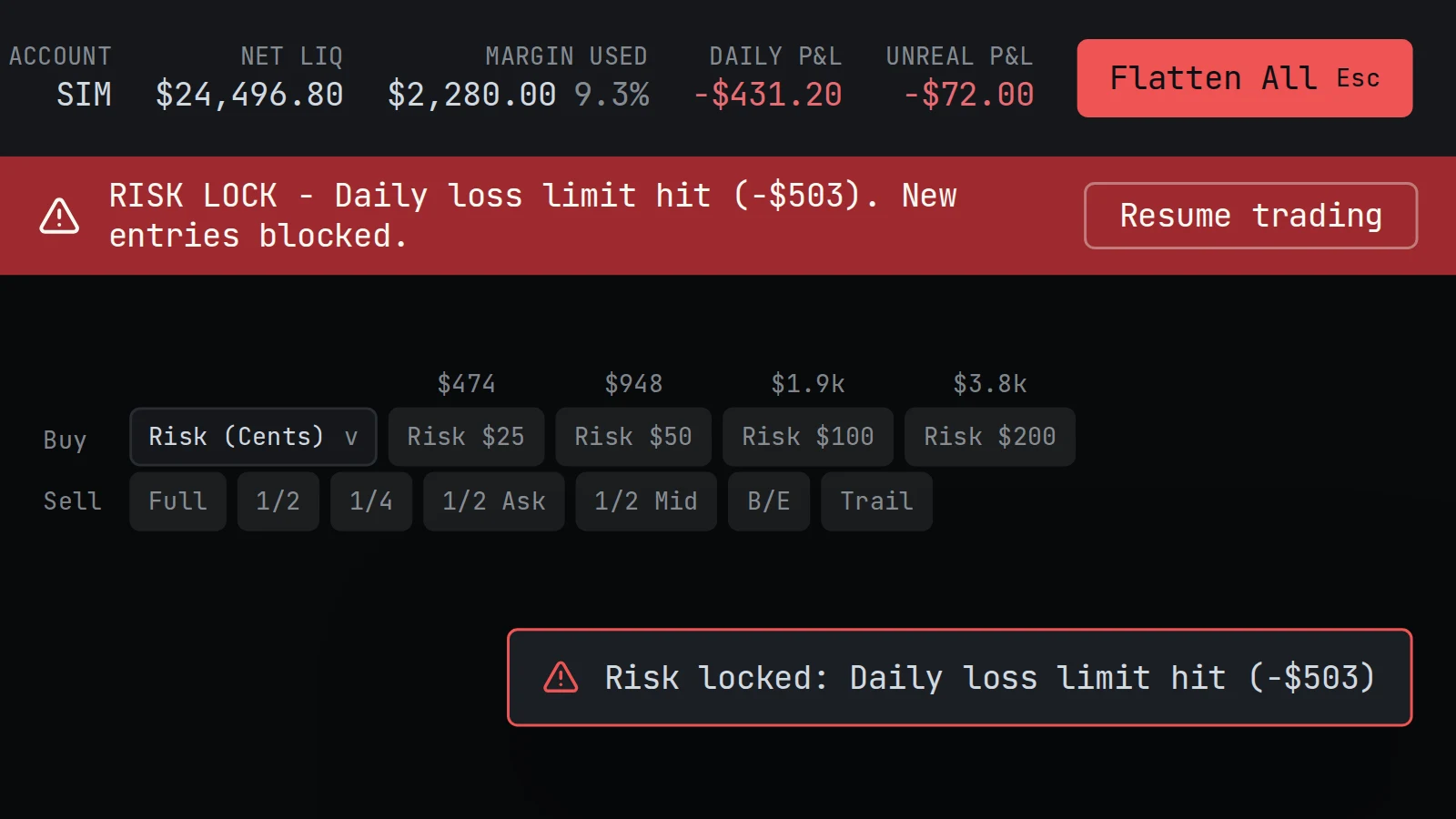
Scalpel enforces the limit so you do not have to win an argument with yourself after two losers. The controls are in Settings > Risk (every Risk tab option):
- Daily loss ($) trips a RISK LOCK when the day's realized plus open P&L reaches minus that amount. A red banner appears and every new buy is refused. Sells, stops and Flatten All keep working, so you can always get out.
- Auto-flatten on daily loss sells every open position the moment the limit trips, if you tick it.
- Resume trading on the banner lifts the lock. It comes back if the day's loss grows by another quarter of your limit, and the day starts over at midnight New York time.
- Fat-finger ($) and Max position ($) refuse any buy above the values you set, so a doubled-up revenge order is refused whole rather than sent (fat-finger and position caps).
The Resume trading button is deliberate: a hard lock with no way out would push some traders to trade from TWS instead. Our own guide says it plainly: if you find yourself reaching for it, that is usually the moment to close the platform for the day.
After the session, the orders panel and Analytics show every result in R, so a loser at -2R stands out as a moved or skipped stop. This video covers the risk controls:
Scalpel's stops are watched by the app, not resting at Interactive Brokers, so they only work while Scalpel runs with a live feed. Scalpel is independent and not affiliated with or endorsed by Interactive Brokers.
Research sources checked on October 22, 2026.
Trading carries a significant risk of loss. Nothing here is financial advice.
Questions
- What is revenge trading?
- Revenge trading is taking trades to win back a recent loss instead of because a valid setup is there. It usually means re-entering the same stock, increasing size, lowering standards and moving or skipping stops.
- How do I stop revenge trading?
- Set your limits before the open: a daily loss limit in dollars, a fixed size that never increases after a loss, a cool-down break after two losers in a row, and a rule never to move a stop down. Have your software enforce the daily limit if you keep overriding it.
- Why do traders revenge trade?
- Loss aversion. Losses hurt more than equal gains feel good, and people become more willing to gamble when they are below their reference point. Researchers found futures traders with morning losses were about 16% more likely to take above-average risk in the afternoon.
- What is tilt in trading?
- Tilt is a term from poker for an emotional state where frustration takes over decision making. In trading it describes the same thing as revenge trading: fast, oversized, low-quality trades after a loss.
- How much should my daily loss limit be?
- Many traders use three to five times their normal risk per trade. It should be an amount you can lose without it changing how you trade the next day.
Related guides
Guide 7.1Set a daily loss limit (the kill-switch)Set a max daily loss in Scalpel: when your P&L hits it, new entries stop, a RISK LOCK banner shows, and it can flatten everything. How to resume trading.Guide 11.4Settings: RiskEvery option on Scalpel's Risk tab: SIM balance and slippage, the commission plan, fat-finger, position and daily loss caps, auto-flatten and SIM reset.Guide 5.4R multiples: how Scalpel measures a tradeWhat R is, how Scalpel shows P&L in R on the chart and in the orders panel, how take-profit at N x R works, and why R makes trades on any stock comparable.
Keep reading
- How to start day trading in 2026: a realistic planHow to start day trading in 2026: the honest odds, the money and rules after the PDT change, one setup, simulator practice, a journal and going live small.
- Day trading statistics: what the research says about who makes moneyDay trading statistics from primary research: 97% of persistent Brazilian day traders lost money, under 1% in Taiwan profit reliably. Samples and limits.
- Paper trading: does it work, and how to make it countDoes paper trading work? Where simulated fills lie, IBKR's paper account limits, how to make practice realistic, and when to switch to live trading.
Practice in SIM, against the live book.A lifetime license, every update included, with a 7-day refund guarantee.Ask in DiscordGet Scalpel