Day trading a small account in 2026: sizing, costs and rules
By Scalpel Team. , updated . 8 min read.
In short
Day trading a small account got easier on paper in 2026: on June 4, FINRA replaced the pattern day trader rule and its $25,000 minimum with an intraday margin standard, though brokers may phase it in until October 20, 2027. You still need $2,000 of equity to trade on margin, and a cash account can only use settled cash. The hard part is not the rule, it is the math: risk 0.5% to 1% a trade ($10 to $100 on $2,000 to $10,000), cap the day at about three losers, keep every position under your cash, and expect costs to take 0.15R to 0.2R from every trade. A small account cannot replace an income, and most people who day trade lose money.
Day trading a small account used to start with a rule: three day trades in five business days, or find $25,000. That rule is gone. What is left is the part the rule used to hide: on $2,000 to $10,000, fixed costs per order, the spread and the size of a normal losing day are all large compared with what you can make.
This post covers what changed for small accounts in 2026, margin versus cash, how to size trades on $2,000, $5,000 and $10,000, what costs really do, a small account day trading strategy for risk, and what to expect. We build Scalpel, a day trading cockpit for Interactive Brokers, and many of the traders who ask us about it have small accounts. Scalpel is independent and not affiliated with or endorsed by Interactive Brokers.
Day trading a small account after the PDT change
On June 4, 2026, FINRA's new intraday margin standard took effect. In Regulatory Notice 26-10, FINRA says it replaces the old day trading margin requirements in their entirety, including the day trade count that designated a pattern day trader and the $25,000 minimum equity. Firms may phase it in until October 20, 2027.
What it means for a small account:
- No day trade count and no $25,000 minimum under the new rule. Your firm may still apply the old PDT rules to your account until it finishes the change. Interactive Brokers has said its accounts may stay under them during the transition, so check yours; our post on the PDT rule on Interactive Brokers shows how.
- $2,000 to use margin. FINRA's investor page on frequent intraday trading says you must maintain a minimum of $2,000 in equity in a margin account, and firms can set higher house requirements.
- Intraday margin deficits. If you borrow past your maintenance margin at any moment of the day, even if you are flat by the close, you create a deficit you must cover. Repeatedly unmet deficits can freeze margin trading for 90 days. The worked example is in our post on intraday margin on IBKR.
In this FINRA episode, two of its policy and credit regulation staff explain the new standard and why it replaced the old rule. It runs about 28 minutes and comes straight from the regulator that wrote the rule.
Margin or cash account for a small account
| Cash account | Margin account | |
|---|---|---|
| Minimum | None for the rule | $2,000 of equity to use margin |
| What limits day trading | Settled cash only | Intraday margin deficits |
| Reuse today's sale proceeds | No: they settle the next business day | Yes, within margin |
| Main way to get restricted | Selling a stock bought with unsettled money | Repeated unmet deficits |
| Can you lose more than you deposit | No | Yes |
In a cash account, most stock trades settle T+1, the next business day. A $3,000 cash account that buys and sells $3,000 of stock at 09:45 ET has no settled cash left for the rest of the day. Buying again with the unsettled proceeds and selling before they settle is a good faith violation.
Our view: on a small account, use margin for flexibility if you like, but never actually borrow. Keep the total value of your open positions under your cash. Then an intraday margin deficit cannot form, and a bad gap cannot cost you more than the account.
How to size a small account
Size every trade from your stop, so each loser costs the same dollars whatever the stock's price. A common convention is to risk 0.5% to 1% of the account per trade. It is a convention, not a rule; the point is that a run of ten losers, which happens to every trader, should cost 5% to 10%, not half the account.
With a 20-cent stop on a $4.00 stock:
| Account | Risk at 0.5% | Risk at 1% | Shares at 1% | Position at 1% | Daily limit (3 losers at 1%) |
|---|---|---|---|---|---|
| $2,000 | $10 | $20 | 100 | $400 | $60 |
| $5,000 | $25 | $50 | 250 | $1,000 | $150 |
| $10,000 | $50 | $100 | 500 | $2,000 | $300 |
Every position here is well under the account's cash, so none of them borrows. Watch for the cases that break that: a 5-cent stop at 1% on $10,000 asks for 2,000 shares, $8,000 of stock, and a cheap stock with a tight stop asks for even more. Our guide on how to trade a fixed dollar risk shows the method with presets.
What costs do to a small account
Costs are where small accounts struggle most, because Interactive Brokers' fixed plan has a minimum per order. From IBKR's stock commission page: IBKR Pro Fixed is $0.005 a share with a $1.00 minimum per order, and IBKR Pro Tiered is $0.0035 a share with a $0.35 minimum, plus exchange and clearing fees. The SEC also charges $20.60 per million dollars of sales, which is under a cent on a $400 sale.
Take the $2,000 account's trade: 100 shares at $4.00 with a 20-cent stop, so $20 of risk, on a stock with a 2-cent spread.
- Commission on Fixed: 100 shares x $0.005 is $0.50, under the minimum, so $1.00 each way, $2.00 round trip. That is 10% of the risk.
- Spread: buying at the ask and selling at the bid costs 2 cents a share, $2.00. Another 10%.
That is 0.2R gone on every trade, win or lose, before slippage. On the $5,000 and $10,000 accounts the commission is above the minimum ($2.50 and $5.00 round trip), so it falls to 5% of the risk, but the spread still takes 10%: about 0.15R a trade.
Now count trades. At five round trips a day for 21 trading days, that is 105 trades a month:
| Account | Commission a month (Fixed) | Spread a month (2c) | Total, as a share of the account |
|---|---|---|---|
| $2,000 | $210 | $210 | 21% |
| $5,000 | $262.50 | $525 | 15.75% |
| $10,000 | $525 | $1,050 | 15.75% |
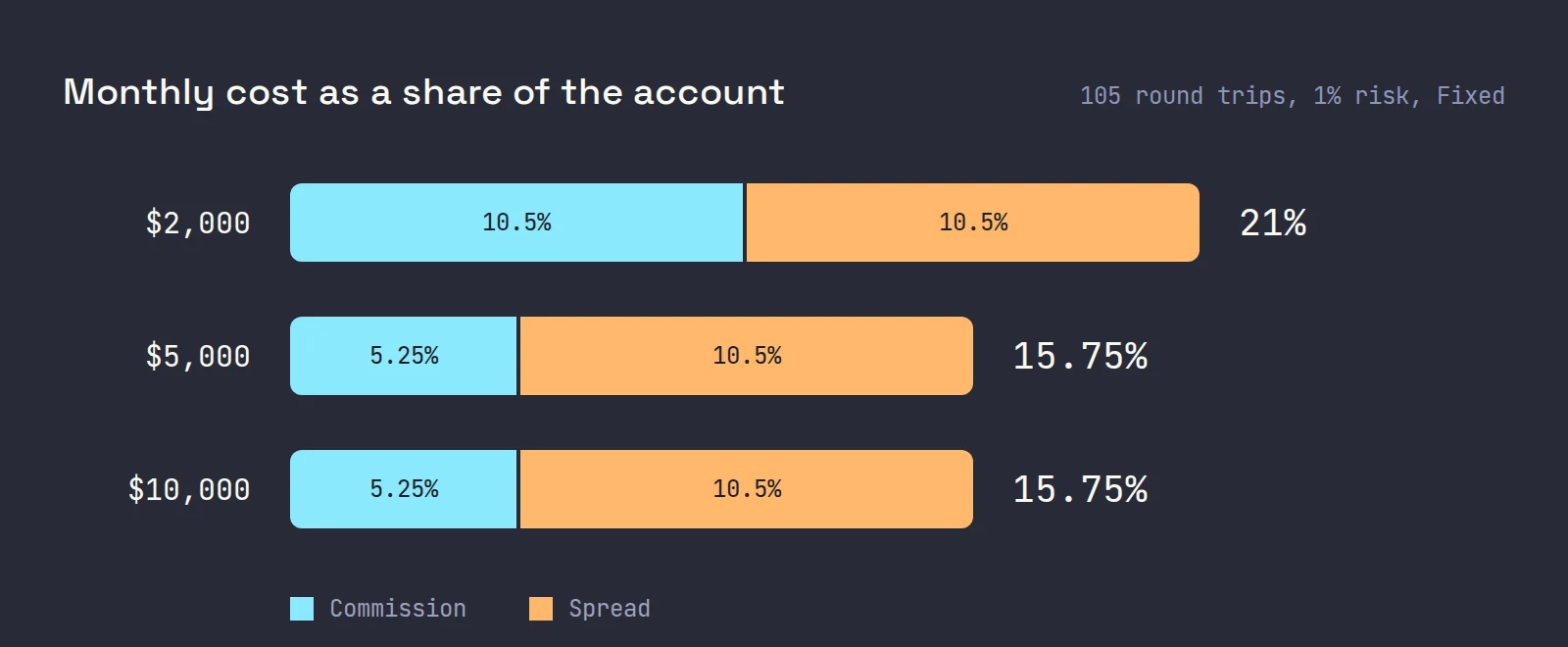
Read that table as a hurdle. To break even at five trades a day, your trading has to earn back about 16% to 21% of the account every month before it makes a cent. Fewer trades lower the hurdle in direct proportion. Tiered can cut the commission on 100-share orders: Scalpel's own SIM estimate is $1.34 a round trip on Tiered against $2.00 on Fixed (commission plans). Market data subscriptions are a monthly cost on top.
Day trading with $1,000
Below $2,000 you cannot use margin, so a $1,000 account is a cash account in practice. At 1% risk you are risking $10 a trade: 50 shares with a 20-cent stop. A $1.00 minimum commission each way is 20% of that risk, and a 2-cent spread another 10%: 0.3R a trade before you start. The settled-cash rule also limits you to roughly one full use of your cash per day.
You can learn on $1,000, and some people do. You cannot realistically grow it by day trading at that size. If you are at that stage, a simulator against live data teaches the same skills for nothing; see our guide to paper trading in SIM.
A small account day trading strategy for risk
This is the risk plan we would use on a small account. The entries are up to you; these rules decide whether one bad week ends the account.
- Fixed risk per trade: 0.5% to 1% of the account, set before the session and never raised after a loss.
- A daily loss limit of about three losers, set in dollars. When it hits, stop for the day, not for an hour.
- A weekly limit too: for example, five full losing days' worth. A weekly stop catches the slow bleed a daily one misses.
- A cap on trades per day, such as five. Every trade pays the cost hurdle above.
- Position value under your cash. No borrowing, ever, on a small account.
- Skip wide spreads. If the spread is more than about a fifth of your stop, the trade starts too far behind.
- No size increases until the account has grown, and then only in steps.
The emotional side matters more on a small account, because each loss feels larger. Our posts on revenge trading and FOMO trading cover the two habits that empty small accounts fastest.
Realistic expectations
Be blunt with yourself about the arithmetic. Replacing a $4,000 monthly income from a $5,000 account means making 80% a month, every month. No sound plan does that.
The research is not encouraging either. In Brazil, 97% of people who day traded futures for at least 300 days lost money, and only 0.4% earned more than a bank teller's starting pay. Among 66,465 US households at a discount broker, those that traded most earned 11.4% a year while the market returned 17.9%. FINRA's investor page says strategies that involve frequent trading on margin generally are not appropriate for investors with limited resources, limited experience or a low tolerance for risk. More of the research is in our post on day trading statistics.
A small account is a place to learn, cheaply, whether you can follow a plan and whether your setup has an edge. Treat the money as tuition you can afford to lose. The style choice matters too: holding longer means costs are a smaller share of each target, as our post on scalping vs day trading shows. The full beginner plan is in how to start day trading.
Where Scalpel fits
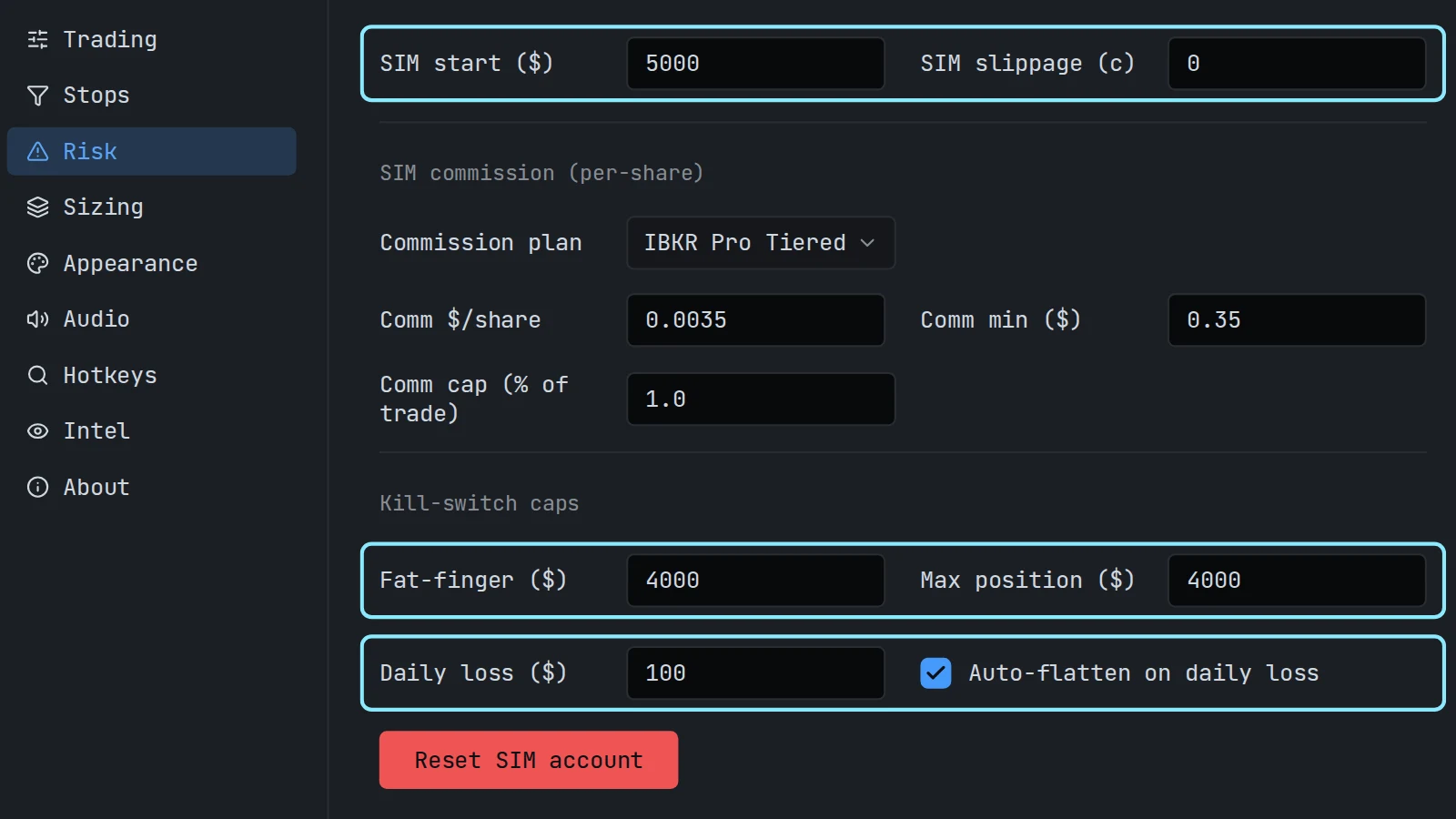
Scalpel's defaults are set for a larger account, so on a small one you change a handful of numbers. Our small account setup guide lists them:
- Risk (Cents) buy presets of, say, $10, $20, $30 and $50, so each button is the dollars you lose at the stop.
- Fat-finger ($) and Max position ($) set under your cash, so no single order or position can borrow (fat-finger and position caps).
- Daily loss ($) at a few losers, with Auto-flatten on daily loss on (daily loss limit).
- SIM start ($) set to your real balance, and Commission plan set to the plan your IBKR account is on, so practice shows the true cost drag.
Scalpel does not apply the PDT rule or the intraday margin rule: Interactive Brokers does, and Scalpel shows IBKR's reason when an order is refused. Its stops are watched by the app rather than resting at IBKR, so they only work while Scalpel runs with a live feed. This video collects habits that help on any account size:
Rules and fees checked on October 22, 2026.
Trading carries a significant risk of loss. Nothing here is financial advice.
Questions
- Can you day trade with a small account in 2026?
- Yes. FINRA replaced the pattern day trader rule and its $25,000 minimum with an intraday margin standard on June 4, 2026, though brokers may phase it in until October 20, 2027. Margin still needs $2,000 of equity, and a cash account can trade only with settled cash.
- How much should I risk per trade on a small account?
- A common convention is 0.5% to 1% of the account per trade, so $10 to $20 on $2,000 or $50 to $100 on $10,000. The aim is that a run of ten losers costs 5% to 10% of the account, not half of it.
- Can you day trade with $1,000?
- Only in a cash account, because margin needs $2,000. At 1% risk that is $10 a trade, and a $1.00 minimum commission each way plus the spread can take about 30% of that risk on every trade, so it is very hard to grow.
- Is a cash or margin account better for a small day trading account?
- A cash account cannot reuse sale proceeds until they settle the next business day. A margin account can, but you must avoid intraday margin deficits. Many small traders use margin for flexibility but keep positions under their cash so they never borrow.
- How much can you make day trading a small account?
- There is no reliable figure, and most day traders lose money. Costs alone can take 15% to 21% of a small account a month at five trades a day, so treat a small account as a place to learn rather than a source of income.
Related guides
Guide 14.4Settings for a small accountSettings that suit a small account: risk-based presets, tight caps, a daily loss limit you will respect, the right commission plan, and what to watch for.Guide 4.2Trade a fixed dollar risk with Risk (Cents)Risk the same dollars on every scalp: Scalpel works out the shares from your stop as you press. Set Risk (Cents), size your buttons and nudge the stop.Guide 7.1Set a daily loss limit (the kill-switch)Set a max daily loss in Scalpel: when your P&L hits it, new entries stop, a RISK LOCK banner shows, and it can flatten everything. How to resume trading.
Keep reading
- How to start day trading in 2026: a realistic planHow to start day trading in 2026: the honest odds, the money and rules after the PDT change, one setup, simulator practice, a journal and going live small.
- Day trading statistics: what the research says about who makes moneyDay trading statistics from primary research: 97% of persistent Brazilian day traders lost money, under 1% in Taiwan profit reliably. Samples and limits.
- Paper trading: does it work, and how to make it countDoes paper trading work? Where simulated fills lie, IBKR's paper account limits, how to make practice realistic, and when to switch to live trading.
Practice in SIM, against the live book.A lifetime license, every update included, with a 7-day refund guarantee.Ask in DiscordGet Scalpel