Paper trading: does it work, and how to make it count
By Scalpel Team. , updated . 8 min read.

In short
Paper trading works for learning the mechanics: your platform, your keys, your sizing, your stops and your routine, with no money at risk. It does not prove you can make money, because paper fills are kinder than real ones and fake money does not scare you. Make it count by trading your real account size with real commissions, filling against the live book, following the same risk rules you will use live, and judging a fixed sample of trades before you go live with your smallest size.
Paper trading is simulated trading: you place orders on live market data, and a simulator decides what would have filled, without a real order ever reaching the market. Almost every broker offers it, including Interactive Brokers. Almost every trader who has gone live after a good paper month has the same complaint: live was harder.
That is not a reason to skip paper trading. It is a reason to know exactly where it lies to you, and to close as many of those gaps as you can. We build Scalpel's SIM mode, a paper simulator, so we have had to think hard about every one of them.
Does paper trading work?
Yes, for some things, and it is the cheapest teacher you will ever have. It works for:
- Mechanics. Which key buys, which sells half, how the platform behaves when an order is partly filled or rejected. A wrong key in paper costs nothing.
- Process. Whether you can follow a written plan: one setup, a stop on every trade, a daily loss limit you respect.
- Sizing. Getting position size right by risk, every time, at speed.
- Finding obvious losers. If a setup loses money on paper over a hundred trades, it will not be rescued by real money.
It does not work for:
- Proving an edge. Paper results are an upper bound. Fills are friendlier and there is no fear.
- Emotions. Experiments on decisions under risk show why. Holt and Laury, "Risk Aversion and Incentive Effects", American Economic Review 92, no. 5 (2002), pages 1644 to 1655 (DOI 10.1257/000282802762024700), scaled the stakes of a lottery choice by 20, 50 and 90 times. With real cash, people became sharply more risk averse as stakes grew; with hypothetical money, scaling up had no significant effect. Their 2005 follow-up in the same journal, run without the order effects critics had pointed out, confirmed both results. In trading terms: what you do with paper money tells you little about what you will do when the money is real.
Keep the base rates in mind too. The research on day trading statistics finds most day traders lose money, including most who persist. A profitable paper month does not move you out of that group on its own.
Paper trading vs real trading: where paper lies
| Paper trading | Real trading | |
|---|---|---|
| Your order and the book | Your order takes nothing from the market, so the next order sees the same size | Your order takes liquidity; the next one gets what is left |
| Queue | Many simulators fill a resting limit as soon as price touches it | You wait behind every order already at that price |
| Slippage on exits | Often filled at the stop price | A fast drop can fill well below your stop |
| Size | Easy to trade size you could not afford | Sized to your real account |
| Fear and greed | Mild | Strong: hesitation, moved stops, revenge trades |
| Costs | Sometimes left out | Commissions, exchange and regulatory fees on every trade |
| Broker in the loop | Rarely rejects | Rejections, permissions, short locates, halts |
A worked example: one entry, two fills
ABCD is a $5.70 small cap moving pre-market. The book shows 245 shares offered at $5.71, 1,000 at $5.72 and 2,000 at $5.73. You buy 2,000 shares with a marketable limit at $5.81.
- A simulator that fills from the top of the book can give you all 2,000 at $5.71: $11,420.
- The real book fills 245 at $5.71, 1,000 at $5.72 and 755 at $5.73: $11,445.10, an average of about $5.723.

The difference is $25.10 on the entry alone. If your stop is 10 cents below a $5.71 entry, your planned risk is $200, so that one fill costs 0.13R (an R is the amount you planned to risk, explained in R multiples). Do that on the way in and again on the way out, a few times a day, and a strategy that shows a small profit on paper can lose money live. On a thinner book, or with a size closer to what is displayed, the gap is bigger.
Paper trading on Interactive Brokers
IBKR gives every client a paper trading account. The facts, from IBKR's own guide (About Paper Trading Accounts), checked on October 22, 2026:
- It starts with USD 1,000,000 of paper equity. You can reset paper cash in Client Portal to up to five times your production account's value; resets entered before 16:00 ET take effect the next business day.
- Trades never reach an exchange, but the simulated execution prices are "determined by real market prices and sizes".
- "Fills are simulated from the top of the book; no deep book access." That is the kind of gap the example above shows, so check your paper fills against the time and sales for the same seconds.
- Stops and other complex orders are always simulated, so they can behave slightly differently from a live account. VWAP, Auction, RFQ and Pegged to Market orders are not supported.
- You request it in Client Portal under Settings > Account Configuration > Paper Trading Account, and you can share your live market data with it. IBKR notes that with shared data you cannot use the data in the live and paper accounts at the same time (IBKR Campus: request a paper trading account).
- In TWS, you pick Paper Trading on the login screen before you log in.
This IBKR video walks through logging in to the paper account and what it looks like, which is worth five minutes if you plan to practice in TWS.
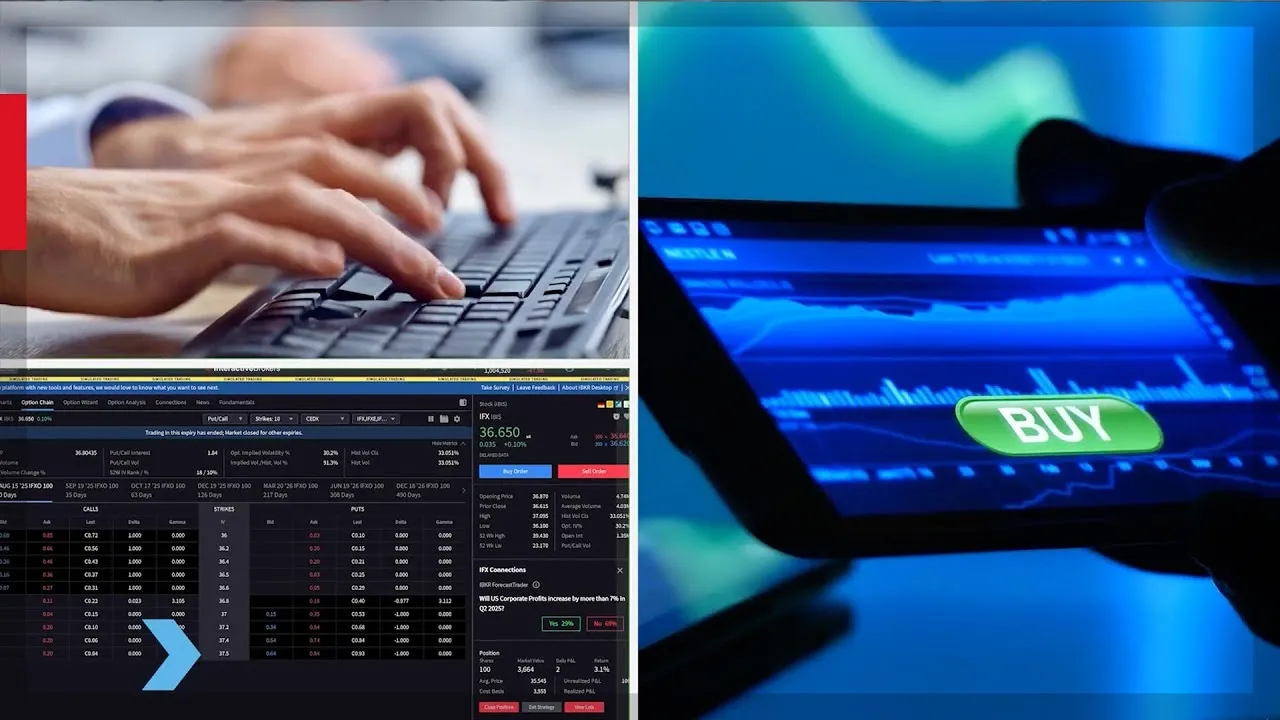
The first thing to change is the balance. Practicing a $5,000 account with $1,000,000 of paper money teaches you position sizes you will never trade. Reset it to your real account size.
Scalpel is independent and not affiliated with or endorsed by Interactive Brokers.
How to make paper trading count
Trade your real account size
Set the paper balance to the money you will actually trade. Size every trade by risk, not by shares, so a loser costs the same dollar amount each time (trade a fixed dollar risk).
Include every cost
Make sure commissions and fees come off every simulated trade. On IBKR Pro Fixed pricing that is USD 0.005 a share with a USD 1.00 minimum per order (IBKR stock commissions, checked October 22, 2026), and small trades pay the minimum more often than you think. Our post on the cost of day trading adds up the rest.
Make the fills harder, not easier
Use a simulator that fills against the depth of the book, or add a cent or two of slippage per share to every fill by hand when you journal it. Never take a fill you could not have got: if the paper platform gives you the high-of-day print, mark it down.
Trade one setup, with the rules you will use live
Pick one setup and write down the entry, the stop and the exit. Set the same daily loss limit you will use with real money, and stop for the day when it trips. Paper is where you build the habit of obeying it.
Journal every trade
Record the setup, entry, stop, exit, R and the mistake, if any, for every paper trade. A day trading journal is what turns a pile of paper trades into evidence.
Judge a fixed sample
Decide in advance: for example, 100 trades of one setup. Do not judge after 10 good ones or 10 bad ones.
When to go from paper trading to live
Small samples lie. With 50 trades and a 50% win rate, the true win rate could plausibly be anywhere from about 36% to 64% (a 95% confidence range of plus or minus 1.96 times the square root of 0.5 times 0.5 divided by 50). With 200 trades the range narrows to about 43% to 57%. Our post on how long it takes to learn day trading goes further into what a sample can and cannot tell you.
Go live when, over a large sample:
- Your losers are close to 1R: no moved stops, no "just this once".
- You followed the daily loss limit every time it tripped.
- Your results do not come from one lucky stock or one lucky day.
- Your expectancy is positive after costs and after the slippage you added.
Then start live with the smallest size you can, often a quarter of your paper size, and expect live results to be worse. Keep paper for anything new: a new setup, a new hotkey, a new time of day. The whole sequence is in our guide to how to start day trading.
Paper trading mistakes that ruin the data
- Resetting after a bad week. A reset wipes the evidence. Keep the journal even if you reset the balance.
- Sizing up because it is not real. A 5,000-share clip on a thin stock fills on paper and would not live.
- Trading every setup at once. You learn nothing about any one of them.
- Skipping the stop. Paper is where the stop habit forms. If you skip it on paper, you will skip it live, and our post on revenge trading describes what usually follows.
Where Scalpel fits
Scalpel starts in SIM, its own paper trading mode, and never switches to LIVE by itself. SIM was built to close the gaps in the table above:
- Fills walk the live Level 2 book level by level and stop at your limit. A remainder keeps working and fills from new prints on the tape, so a partial fill in SIM looks like one in LIVE.
- Your IBKR commissions come off every trade, using the plan you pick (IBKR Pro Tiered by default), and SIM slippage (c) in Settings > Risk can make every fill a cent or two worse.
- SIM start ($) sets the paper balance, so you practice your real account size. The default is $25,000.
- The same keys, stops and risk caps as LIVE, including the daily loss limit.
- Analytics keeps a SIM journal in R, net of fees, that survives a reset.
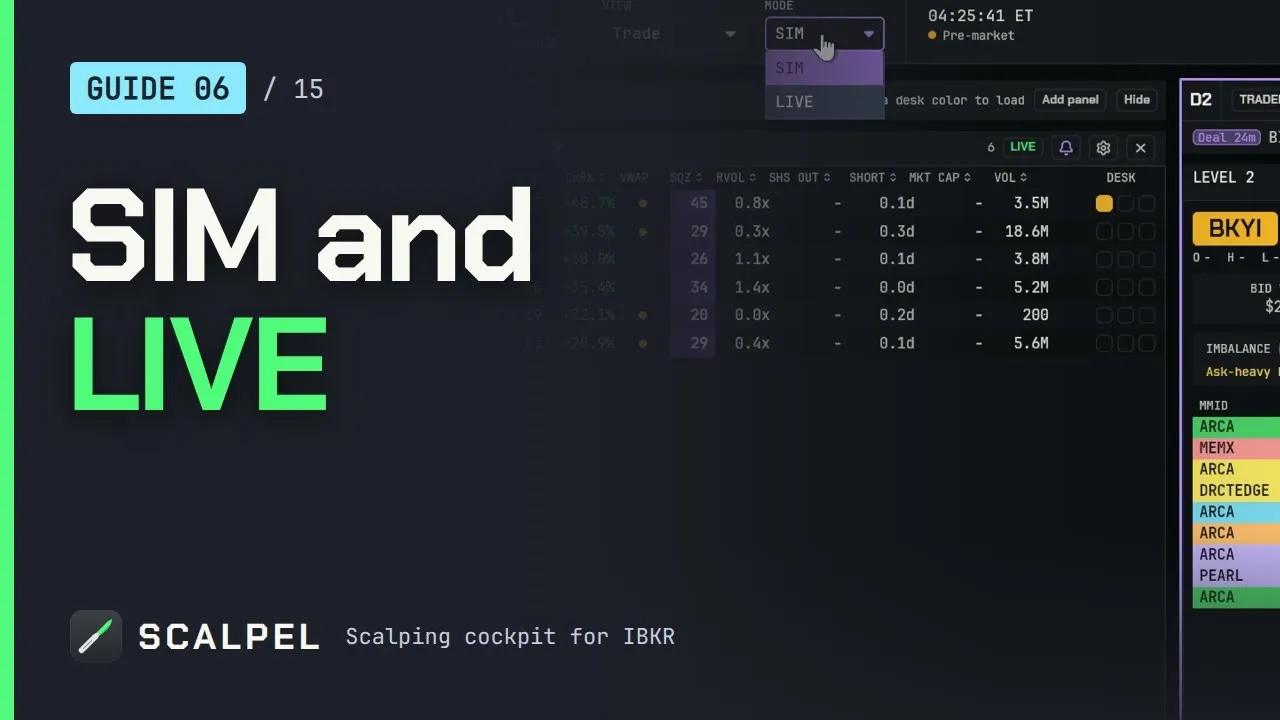
SIM is still kinder than reality in ways we say plainly in the SIM guide: your paper order does not move the book, there is no queue for resting orders, and hidden liquidity is invisible. The first session in SIM takes 15 minutes, and going live has the checklist for the switch. This short video shows SIM and LIVE side by side.
Trading carries a significant risk of loss. Nothing here is financial advice.
Questions
- Does paper trading work?
- It works for learning your platform, keys, sizing and rules without risking money. It does not prove you can make money, because paper fills are friendlier than real ones and fake money does not trigger the same fear.
- How long should you paper trade before going live?
- Until you have a large sample of one setup, ideally 100 trades or more, with losers held to about 1R and your daily loss limit respected every time. Then go live with your smallest size.
- Is paper trading harder or easier than real trading?
- Easier for most people. Paper fills ignore your effect on the book and the queue ahead of you, and losses do not hurt. Expect live results to be worse than paper.
- How much money does an IBKR paper trading account start with?
- IBKR's guide says paper accounts start with USD 1,000,000 of paper equity, and you can reset it in Client Portal to up to five times your live account's value. Reset it to your real account size.
- Does IBKR paper trading use real market data?
- Yes, if you share your live market data subscriptions with the paper account in Client Portal. IBKR notes you cannot use the shared data in the live and paper accounts at the same time.
- Why are my paper trading fills better than my live fills?
- IBKR's simulator fills from the top of the book with no deep book access, and paper orders do not wait in the queue or take liquidity from other traders. Live orders do.
Related guides
Guide 6.1Paper trading with SIMSIM fills your orders against the live Level 2 book, with partial fills, slippage and commissions. How it works, its paper ledger, and how to reset it.Guide 1.7Your first 15 minutes in SIMLoad a symbol, buy with a hotkey, watch the stop arm, scale out and flatten, all in SIM with no money at risk. The whole Scalpel loop in fifteen minutes.Guide 6.2Switch to LIVE safelyThe checklist before your first live order in Scalpel, how to switch modes, what happens to stops in the other mode, and the LIVE ORDERS badge.
Keep reading
- How to start day trading in 2026: a realistic planHow to start day trading in 2026: the honest odds, the money and rules after the PDT change, one setup, simulator practice, a journal and going live small.
- Day trading statistics: what the research says about who makes moneyDay trading statistics from primary research: 97% of persistent Brazilian day traders lost money, under 1% in Taiwan profit reliably. Samples and limits.
- A day trading journal that actually improves your tradingA day trading journal that improves your trading: the fields that matter, a template with worked R math, a weekly review and the numbers to compute.
Practice in SIM, against the live book.A lifetime license, every update included, with a 7-day refund guarantee.Ask in DiscordGet Scalpel