How long does it take to learn day trading? An honest answer
By Scalpel Team. , updated . 7 min read.
In short
How long does it take to learn day trading? Learning the mechanics (orders, hotkeys, your platform, the rules) takes a few weeks. Learning to follow a plan under pressure takes a few months. Finding out whether you have an edge takes several hundred trades, because a small sample cannot tell skill from luck: 50 trades at a 40% win rate fits anything from 26% to 54%. And for most people the honest answer to how long it takes to become a profitable day trader is never: in Taiwan, fewer than 1% of day traders could predictably earn positive returns after fees, and in Brazil 97% of those who kept at it for 300 days lost money, with no evidence that they learned.
How long does it take to learn day trading? Courses tend to answer with a number of weeks. The research answers with a warning. The truth is that "learning day trading" is three different things on three different clocks, and only the first one is guaranteed to finish.
This post separates those clocks, shows what the research says about traders learning over time, does the sample-size math that decides how long it takes to know whether you are any good, and ends with a realistic plan and a point at which to stop. We build Scalpel, a day trading cockpit for Interactive Brokers, and we would rather you read this before buying any tool, ours included.
How long does it take to learn day trading: three clocks
These are our estimates, not research findings. Your time will differ with how many hours a day you have, what you trade and how disciplined your practice is.
| Stage | What you learn | Rough time | How you know you are done |
|---|---|---|---|
| Mechanics | Order types, hotkeys, your platform, the rules for your account | 1 to 3 weeks | You place, size and exit trades without thinking about the keys |
| Process | One setup, fixed risk, stops honored, a daily limit, a journal | 1 to 3 months | Your losers are all about 1R and you have not broken a rule in weeks |
| Edge | Whether your process makes money after costs | Several hundred trades, often 6 months or more | Your results over a large sample stay positive after fees |
The first two are skills, and practice improves them. The third is not a skill you finish learning. It is a question about you and your strategy, and the answer can be no.
What the research says about learning to day trade
The largest studies of day traders come from markets where regulators can see every account. The pattern is consistent, and it is not encouraging.
- In Taiwan from 1992 to 2006, Brad Barber, Yi-Tsung Lee, Yu-Jane Liu and Terrance Odean found that less than 1% of the day trader population could predictably and reliably earn positive abnormal returns net of fees (Journal of Financial Markets, 2014).
- The same group, with Ke Zhang, tested whether day traders learn. In Learning, Fast or Slow (Review of Asset Pricing Studies, 2020) they found that unprofitable traders are more likely to quit, as learning would predict. But 74% of day trading volume came from traders with a history of losses, and 97% of day traders were likely to lose money in future day trading. The authors read this as overconfidence and biased learning: people keep going after evidence that should have stopped them.
- In Brazil, Fernando Chague, Rodrigo De-Losso and Bruno Giovannetti followed everyone who started day trading equity futures between 2013 and 2015 and kept at it for at least 300 days. In Day Trading for a Living? (working paper, 2019), 97% of them lost money, only 0.4% earned more than a bank teller's starting pay of US$54 a day, and the authors found no evidence of learning by day trading.
The SEC's own investor page, Day Trading: Your Dollars at Risk, puts it in one line: "Day traders typically suffer severe financial losses in their first months of trading." Our post on day trading statistics covers these studies and others in more depth.
So the real answer to "how long to become a profitable day trader" is that most people never do, and time alone does not change that. What time does is give you enough data to find out which group you are in, cheaply, before it costs you much.
Odean's short lecture on overconfidence explains why people keep trading after losses and why they overrate their own skill. It is the mindset that turns a few months of learning into years of losing.
The learning curve in day trading is a sample-size problem
Here is the part most beginners miss. Even a trader with a real edge cannot see it in a few weeks of results, because trading outcomes are noisy. A good week proves almost nothing, and so does a bad one.
Say your setup aims for a 2R winner against a 1R loser (R is the amount you risk to your stop; see R multiples). At 2R winners, you need to win more than 1 in 3 trades to break even, before costs. Now suppose your journal shows a 40% win rate. Is that above 33%?
The standard way to answer is a confidence interval for a proportion. The NIST engineering statistics handbook gives the usual formula: the measured rate plus or minus 1.96 times the square root of p times (1 minus p) divided by n, for a 95% interval. Applied to a 40% win rate:
| Trades in your sample | 95% range for your true win rate | Clears the 33% break-even? |
|---|---|---|
| 20 | 18.5% to 61.5% | No idea |
| 50 | 26.4% to 53.6% | No idea |
| 100 | 30.4% to 49.6% | Still unclear |
| 200 | 33.2% to 46.8% | Only just |
| 400 | 35.2% to 44.8% | Probably |
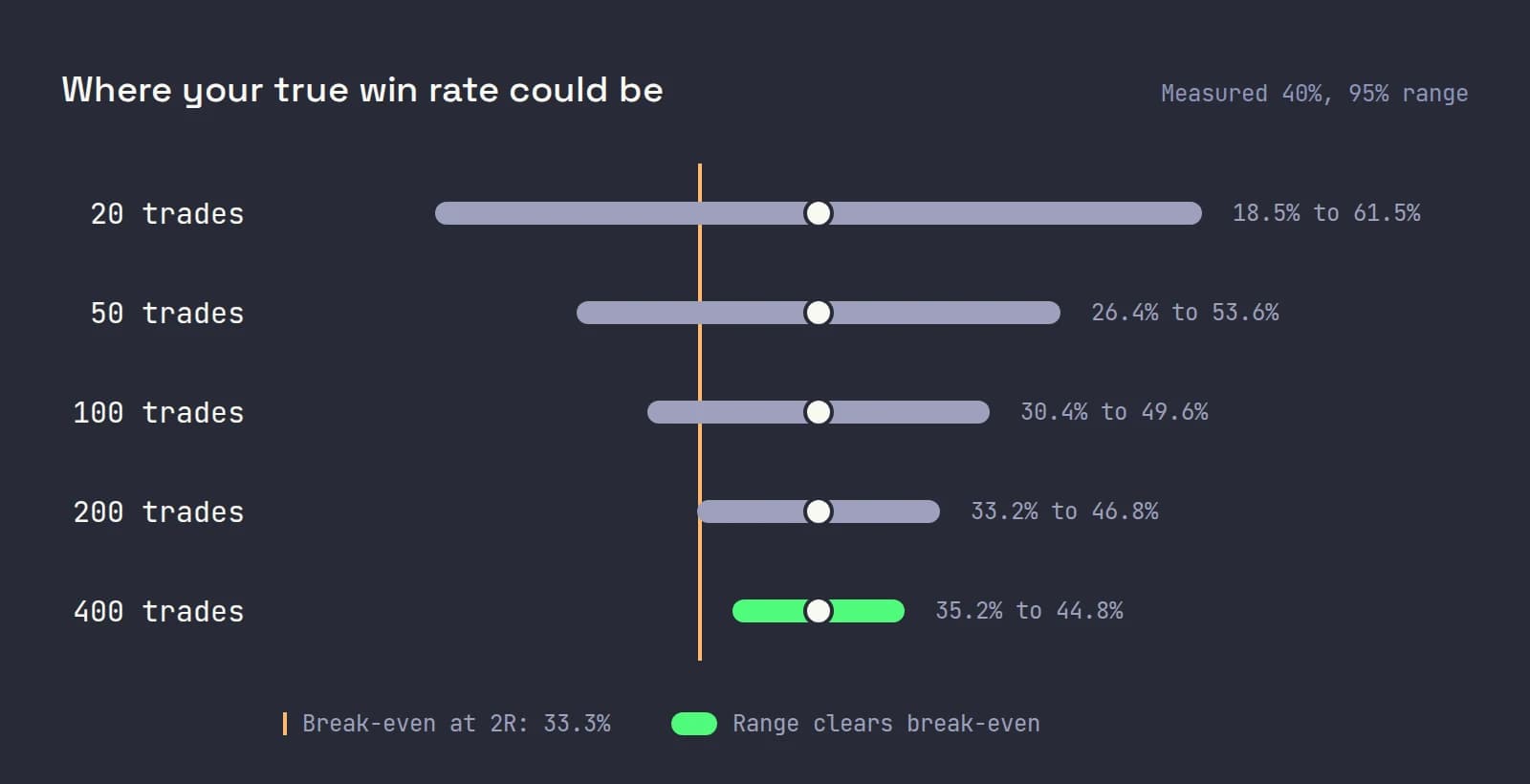
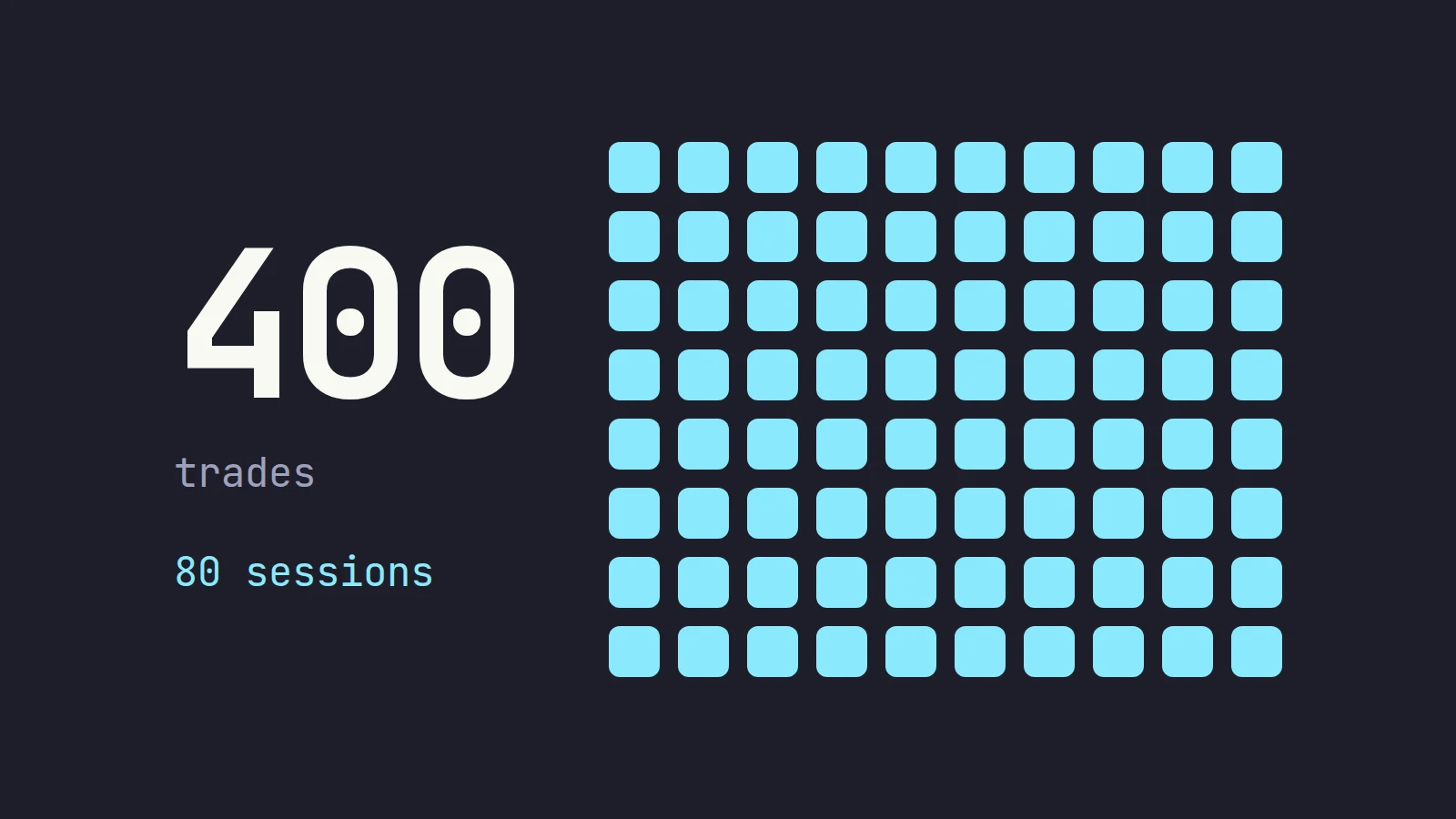
After 50 trades, your true win rate could be anything from a losing 26% to a strong 54%. After 400, it is very likely above break-even. At five trades a day, 400 trades is 80 trading sessions: close to four months of market days. That is the honest timescale for knowing whether one setup works for you, and it assumes you traded it the same way every time.
Three caveats make the real picture harder, not easier:
- Your trades are not all exactly -1R or +2R. Scratches, partial exits and slippage widen the spread of outcomes, so you need even more trades.
- Markets change. A setup that worked through a hot small-cap stretch can stop working when volume dries up. A sample from one kind of market tells you about that market.
- Changing the strategy resets the count. Every time you change your entry rules, the old trades stop being evidence for the new ones.
This is also why your process matters more than your P&L in the first months. If your trades are not consistent, there is no sample to measure.
A realistic plan for learning day trading
This is how we would spend the first six months. It leans on practice that costs nothing and caps what the rest can cost.
- Weeks 1 to 2: mechanics in a simulator. Learn your platform, keys and order types until they are automatic. Our post on paper trading covers what a simulator can and cannot teach.
- Weeks 3 to 12: one setup, fixed risk, in the simulator. Pick one setup and one time window. Size every trade by the same dollar risk. Log every trade in a trading journal, and review in R once a week.
- Go live small only when the process is boring. No broken rules for several weeks, losers held to about 1R. Then trade live at the smallest size your platform allows. Real money changes behavior, and that is a separate thing to learn.
- Judge the setup on a large sample. Several hundred trades, after commissions. Before that, judge only whether you followed the plan.
- Set a stop date and a loss budget before you start. For example: six months and a fixed dollar amount. If you reach either without a positive result over a large sample, stop. The Brazilian traders above persisted 300 days. Persistence alone is not a strategy.
A fixed daily schedule makes the practice consistent; our post on a day trading routine has one. The full beginner plan is in our guide to how to start day trading.
What speeds learning up, and what does not
Helps:
- One setup at a time, so each trade adds to the same sample.
- Reviewing in R rather than dollars, so a big share count does not hide a bad trade.
- Writing the reason for each trade before you take it.
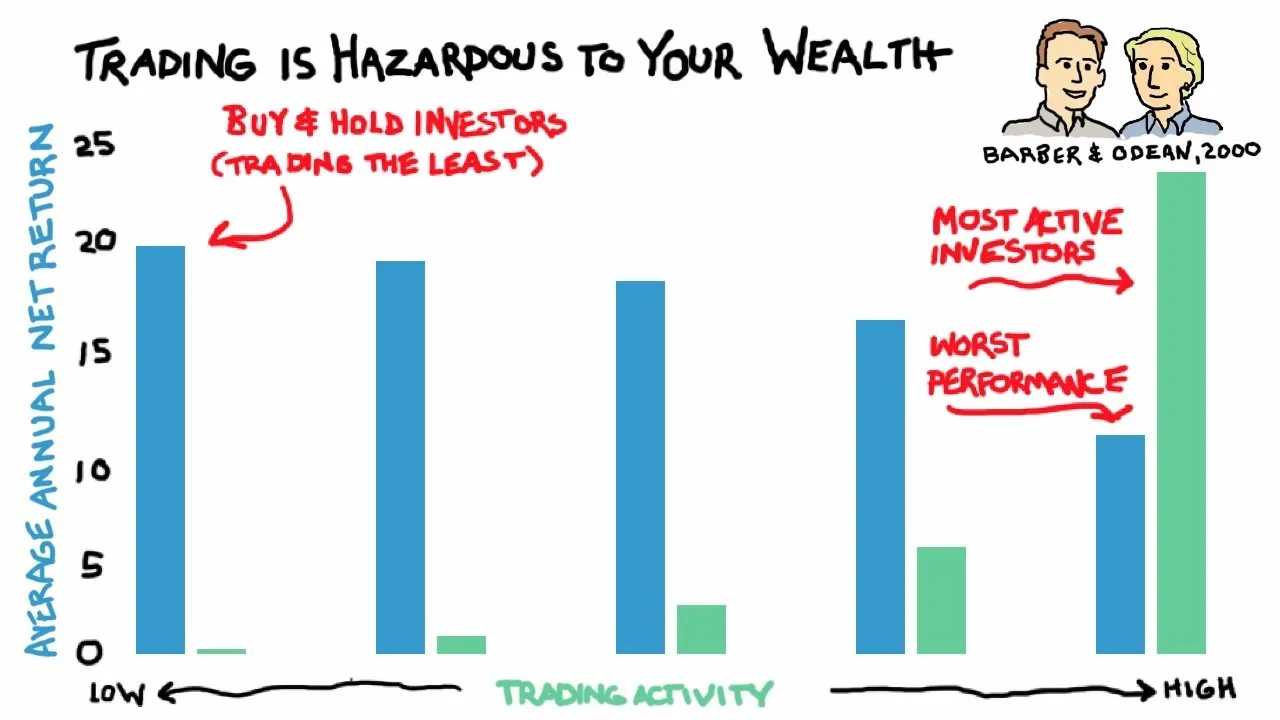
- Fewer, better trades. Barber and Odean's study of 66,465 households found the ones that traded most earned 11.4% a year against 17.9% for the market (Journal of Finance, 2000). More activity is not more learning.
Does not help:
- More indicators, screens or courses.
- Bigger size to "make it count."
- Switching strategies after every losing week.
- Counting a lucky month as proof.
Where Scalpel fits
Scalpel cannot make the learning curve shorter. It can make the data you collect cleaner.
- SIM practices against the live Level 2 book with IBKR commissions, so simulator results are closer to what live trading would cost (paper trading in SIM).
- Analytics keeps a journal of every closed trade and shows win rate, expectancy in R, profit factor and the R distribution, separately for SIM and LIVE (analytics).
- Risk (Cents) presets size every trade by the same dollar risk, so your R numbers mean the same thing from trade to trade.
If you are starting from zero, the first week in SIM guide is a day-by-day plan for the mechanics stage. This video collects small habits that help:
Scalpel is opinionated: long-only scalping of US small caps, pre-market first (what Scalpel is for). If that is not the style you want to learn, it is the wrong tool. Scalpel is independent and not affiliated with or endorsed by Interactive Brokers.
Research sources checked on October 22, 2026.
Trading carries a significant risk of loss. Nothing here is financial advice.
Questions
- How long does it take to learn day trading?
- The mechanics take a few weeks and following a plan consistently takes a few months. Finding out whether your strategy makes money takes several hundred trades, often six months or more, and for most people the answer is that it does not.
- How long does it take to become a profitable day trader?
- There is no reliable timescale, and most never do. In a study of Taiwanese day traders, fewer than 1% could predictably earn positive returns after fees, and in Brazil 97% of those who day traded for at least 300 days lost money.
- Can you learn day trading in 6 months?
- You can learn the mechanics and a consistent process in six months. Whether you will be profitable is a different question, and six months of results may still be too small a sample to answer it.
- How many trades do I need to know if my strategy works?
- Usually several hundred. With a 40% win rate, 50 trades gives a 95% range of about 26% to 54% for the true rate, while 400 trades narrows it to about 35% to 45%.
- Should I quit my job to learn day trading?
- No. The SEC describes day trading as an extremely stressful and expensive full-time job, and the research shows most day traders lose money. Learn in a simulator and with small size while you keep your income.
Related guides
Guide 14.5Your first week: a SIM practice planA day-by-day SIM plan for your first week with Scalpel: keys, sizing, stops, scanning and review in Analytics, so you go live with habits, not hope.Guide 1.9What Scalpel is for, and what it is notScalpel is opinionated: long-only scalping of US stocks, pre-market first, by keyboard and sound. What it does, what it never will, and who it is for.Guide 6.1Paper trading with SIMSIM fills your orders against the live Level 2 book, with partial fills, slippage and commissions. How it works, its paper ledger, and how to reset it.
Keep reading
- How to start day trading in 2026: a realistic planHow to start day trading in 2026: the honest odds, the money and rules after the PDT change, one setup, simulator practice, a journal and going live small.
- Day trading statistics: what the research says about who makes moneyDay trading statistics from primary research: 97% of persistent Brazilian day traders lost money, under 1% in Taiwan profit reliably. Samples and limits.
- Paper trading: does it work, and how to make it countDoes paper trading work? Where simulated fills lie, IBKR's paper account limits, how to make practice realistic, and when to switch to live trading.
Practice in SIM, against the live book.A lifetime license, every update included, with a 7-day refund guarantee.Ask in DiscordGet Scalpel