Day trading a cash account: T+1 settlement and good faith violations
By Scalpel Team. , updated . 8 min read.
In short
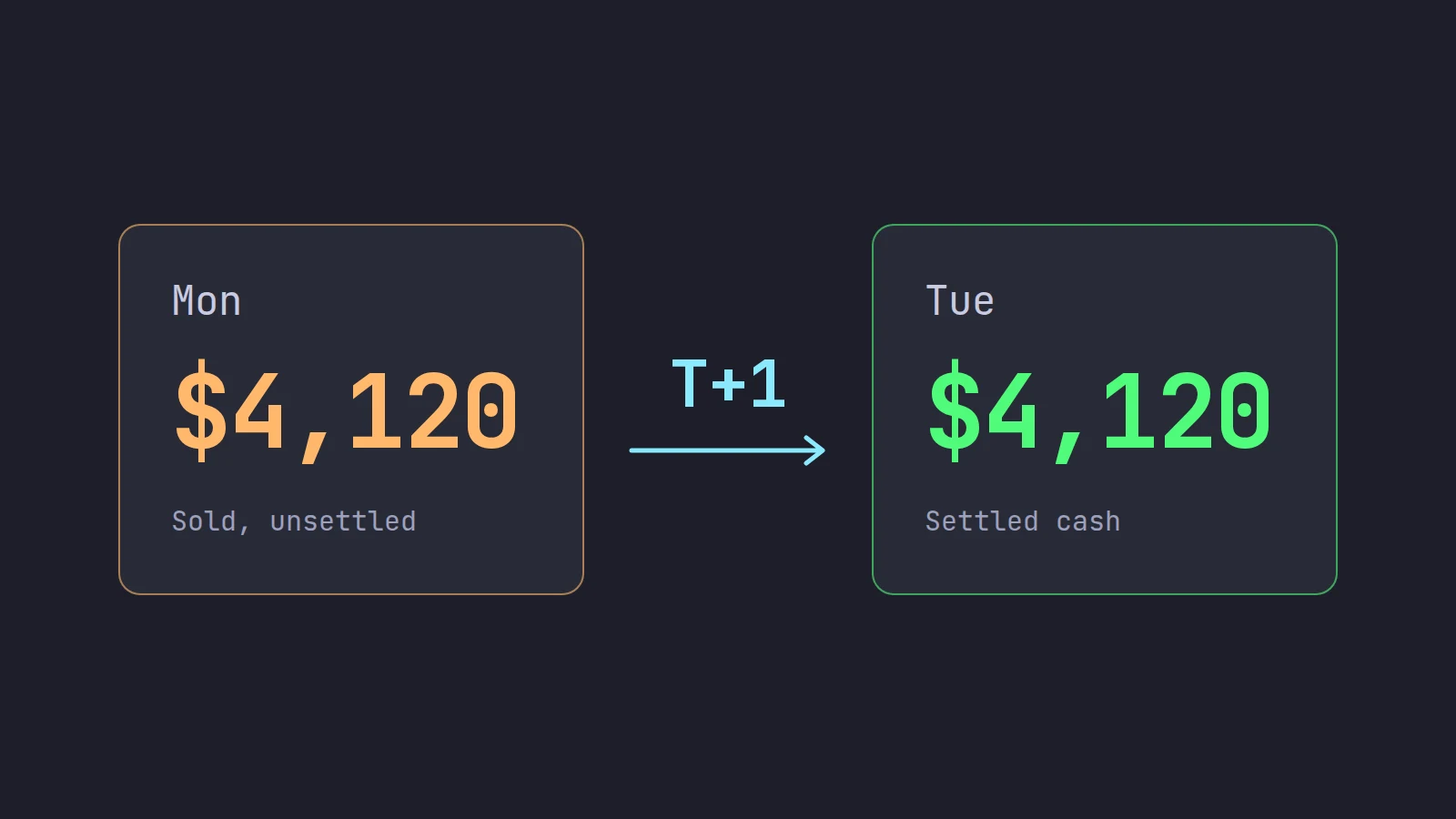
You can day trade in a cash account as often as you like: the pattern day trader rule never applied to cash accounts, and the new intraday margin rule does not either. The limit is settled cash. US stocks settle T+1, one business day after the trade, so each settled dollar can buy once per day and comes back the next business day. Buying with unsettled sale proceeds and selling before they settle is a good faith violation; buying and selling without paying in full is free riding, which brings a 90-day cash-up-front restriction, and IBKR checks for it every night.
A cash account is the simplest way to day trade a small account: no borrowing, no margin calls, no intraday margin deficits. The price is speed. Your money turns over once a day instead of as often as you like, and the violations that come with getting the timing wrong are easy to trigger by accident. This post covers how T+1 settlement works, the two violations with worked days, how Interactive Brokers enforces them, and when a margin account kept below your cash is the better tool.
Rules and IBKR pages checked on October 22, 2026. Scalpel is independent and not affiliated with or endorsed by Interactive Brokers.
What a cash account can and cannot do
In a cash account you pay for every purchase in full, with your own money. IBKR's FAQ on buying power puts it simply: in a cash account "buying power is equal to the amount of settled cash on hand," so an account holding $10,000 in cash may buy up to $10,000 of stock. No leverage, no short selling.
That also means:
- No PDT rule, old or new. FINRA's day trading page describes the intraday margin rule that replaced the pattern day trader rule on June 4, 2026. Both are margin rules. Neither counts day trades in a cash account.
- No margin minimum. IBKR's $2,000 minimum applies to "trades using margin or short sales," per its stock margin page. A cash account has no minimum for the rule.
- Almost no liquidation risk. IBKR says a cash account "must have a positive cash balance at all times." Long stock bought with your own cash cannot get you margin-called.
The constraint is that money from a sale is not yours to spend again until the sale settles.
Cash account settlement is T+1
The SEC adopted T+1 settlement on February 15, 2023, shortening the standard cycle for most broker-dealer trades "from two business days after the trade date (T+2) to one (T+1)," with a compliance date of May 28, 2024. FINRA's investor page confirms: "The current settlement time for most equity trades is T+1, or the next business day."
| You sell on | The proceeds settle on |
|---|---|
| Monday | Tuesday |
| Thursday | Friday |
| Friday | Monday |
| The day before a market holiday | The next business day after the holiday |
Settlement days are business days, so a Friday sale is not spendable cash until Monday.
One practical note: some of IBKR's own help pages still use older examples. Its glossary entry for a cash account says US stock cash "becomes available when the transaction settles (for example, US stock - three days," and one FAQ mentions T+2. The rule is the SEC's, and it is T+1.
Day trading a cash account: a worked week
ABCD and WXYZ are fictional. The account starts Monday with $4,000 of settled cash and no positions. Commissions are left out to keep the arithmetic clean.
| Day and time (ET) | Trade | Settled cash after | Unsettled cash | OK? |
|---|---|---|---|---|
| Mon 09:40 | Buy 1,000 ABCD at $4.00 with settled cash | $0 | $0 | Yes |
| Mon 09:55 | Sell 1,000 ABCD at $4.12 | $0 | $4,120, settles Tue | Yes: the buy was paid for |
| Mon 10:30 | Buy 500 WXYZ at $8.00 with the ABCD proceeds | $0 | $120 | Only if you hold WXYZ until Tuesday |
| Mon 11:10 | Sell 500 WXYZ at $8.20 | $0 | $4,220, settles Tue | No: a good faith violation |
| Tue | Monday's sales settle | $4,220 | $0 | Yes, if the account is not restricted |
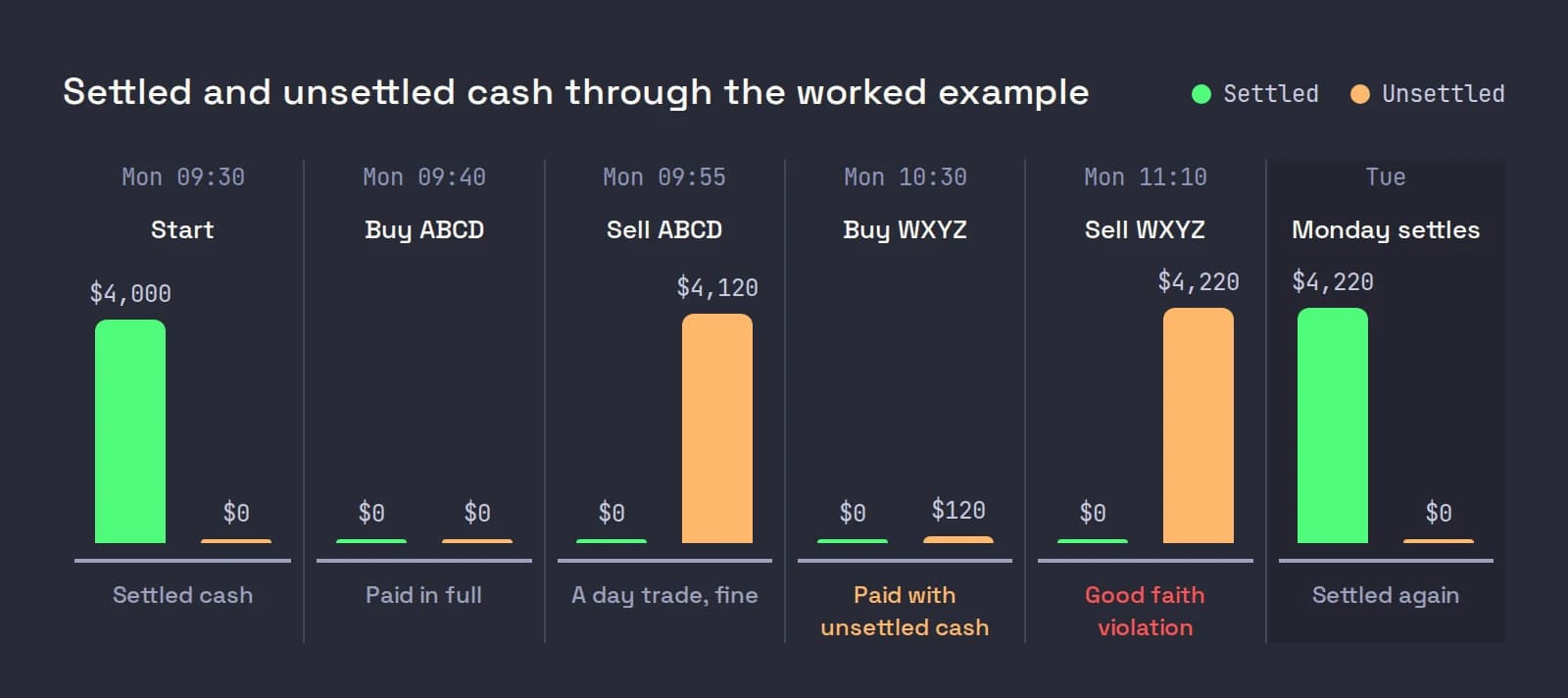
The first round trip is fine. You paid for ABCD with settled money, and selling it the same day is a normal day trade. The WXYZ buy at 10:30 is where it goes wrong: the money you used is the ABCD sale, which does not settle until Tuesday. Holding WXYZ overnight and selling on Tuesday would be fine. Selling it at 11:10, before the money that paid for it settled, is the classic good faith violation.
Under T+1 the old trick of splitting a cash account in halves no longer buys you anything. Each settled dollar can open one trade a day and is back the next morning. $4,000 of settled cash means up to $4,000 of buys a day, every business day, as many round trips as fit in that amount.
Good faith violations vs free riding
The two violations get mixed up constantly. FINRA defines both on its day trading investor page:
| Violation | What you did | Where the rule comes from | What happens |
|---|---|---|---|
| Good faith violation | Bought with cash from an unsettled sale, then sold that purchase before the funds used for it settled | Broker policy built on Regulation T | Set by each broker |
| Free riding | Bought and sold a stock without paying for the purchase in full | Regulation T, 12 CFR 220.8 | A 90-day freeze: you must pay in full on trade date for 90 days |
FINRA's wording on free riding: buying and selling the same security in a cash account before paying for it is "a violation of Regulation T" that can lead to strict account restrictions. The freeze itself is in Regulation T, section 220.8(c): if a security is sold without prior full payment, the right to delay payment past the trade date is withdrawn for 90 calendar days.
The difference in practice: a good faith violation uses money that is on its way but not there yet; free riding uses money that was never there. Brokers set their own penalties for good faith violations, so read your broker's cash account policy rather than a forum summary of someone else's.
How IBKR handles cash account violations
IBKR folds both into what it calls its free riding rule, and it is stricter than the minimum. From its FAQ "What is a Free Riding violation in a Cash account and what are its consequences?":
- IBKR's implementation "uses an end of day check to see if a position was closed prior to its opening trade settlement date."
- A violation places the account under a "Cash Up Front" or trading restriction for 90 days.
- During those 90 days "you can only place new orders using fully settled funds." You can always close positions.
IBKR also tries to stop the problem before it happens. After a closing trade, its credit check lets you place a new order when Available Funds (Equity with Loan Value minus initial margin) is positive, "as that represents your fully settled cash after a closing trade." In our worked week, IBKR's credit check would normally refuse the 10:30 WXYZ buy instead of letting you make the mistake.
To see where you stand, open the TWS Account Window: Total Cash Value includes settled and unsettled cash, while Available Funds in a cash account is the settled cash you can use now.
Cash vs margin for a small day trading account
This is where the June 2026 change matters. A margin account no longer means a day trade count or a $25,000 floor; it means the intraday margin rules covered in intraday margin on IBKR. And a margin account has one big advantage for a fast trader that has nothing to do with borrowing. IBKR's FAQ: "Under a margin type account, unsettled funds may be used for trading purposes but may not be withdrawn until settlement."
| Cash account | Margin account, positions kept under cash | |
|---|---|---|
| Minimum | None for the rule | $2,000 to use margin |
| Trade with today's sale proceeds | No | Yes |
| Good faith and free riding risk | Yes | No |
| Intraday margin deficits | Not possible | Not possible while you never borrow |
| Liquidation risk | Only a negative cash balance | Only if you go past your cash |
| Short selling | No | Allowed, if you choose to |
Our view: under $2,000, a cash account is the natural choice and the T+1 limit acts as a built-in brake. Between $2,000 and roughly $10,000, a margin account where you never let positions exceed your cash usually beats a cash account for active trading, because the money is usable again immediately and the violations disappear. The catch is discipline. Nothing in a margin account stops you from borrowing, so you need hard caps that do.
Before you switch, FINRA's own podcast episode on the June 2026 change is worth a listen: two of the FINRA staff behind it explain why the pattern day trader rule was replaced and what the intraday margin standard now asks of a margin account.
Switching at IBKR: in Client Portal open the user menu, then Manage Account, and under Configuration use the gear next to Account Type to request an upgrade from cash to margin. IBKR says approval "typically takes 24 to 48 hours," and if you recently downgraded from margin to cash, regulations require a 30-day wait before margin is available again. For which account type to open in the first place, see which IBKR account to open for day trading.
Where Scalpel fits
SIM, Scalpel's paper trading mode, is itself a cash account: a buy larger than your free SIM cash is refused with Insufficient buying power, and your fat-finger and max position caps apply on top (paper trading in SIM). One difference to know: SIM credits a sale's proceeds to your free cash at once. It does not hold them until T+1, so SIM will let you recycle money in a way a real cash account would not. If you trade a cash account live, count your own turns: one pass through your settled cash per day.
The caps are what make the "margin account under cash" approach safe. Set Max position ($) and Fat-finger ($) in Settings > Risk below your account's cash and no buy from Scalpel can borrow, in SIM or LIVE (fat-finger and position caps). Add a daily loss limit sized for the account (small account setup), and pick your IBKR commission plan so SIM charges what IBKR will (commissions). This video shows how SIM and LIVE differ and how to switch between them:
In LIVE, settlement and violations are Interactive Brokers' business: it decides what your cash account may buy, and Scalpel shows its reason when it refuses. Scalpel is long only, and its stops are app-monitored rather than resting at IBKR, so they only work while Scalpel runs with a live feed. Every other rule a US day trader works under is collected in our guide to day trading rules, and if you are still choosing a setup, day trading a small account covers the wider plan.
SEC, FINRA, Regulation T and IBKR sources checked on October 22, 2026.
Trading carries a significant risk of loss. Nothing here is financial advice.
Questions
- Can you day trade in a cash account?
- Yes. The pattern day trader rule and the intraday margin rule that replaced it apply to margin accounts only. In a cash account you can day trade as often as your settled cash allows.
- How long does it take for cash to settle after selling stock?
- Most US stock trades settle T+1, one business day after the trade date, since May 28, 2024. Cash from a Friday sale settles on Monday.
- What is a good faith violation?
- It is buying a stock with cash from a sale that has not settled yet, then selling that stock before the money used to buy it settles. Each broker sets its own penalty, which can include limiting the account to settled cash for a period.
- What is a free riding violation?
- Free riding is buying and selling a stock in a cash account without paying for the purchase in full. Under Regulation T it brings a 90-day freeze, during which you must pay for purchases in full on the trade date.
- How does IBKR handle free riding in a cash account?
- IBKR runs an end-of-day check and, if it finds a violation, puts the account under a 90-day Cash Up Front restriction where new orders can only use fully settled funds. Its credit check also refuses most orders that would use unsettled cash.
- Is a cash or margin account better for day trading a small account?
- Under $2,000 a cash account is the usual choice. Above that, a margin account lets you trade unsettled proceeds right away, and if you cap positions below your cash you never borrow and cannot create an intraday margin deficit.
Related guides
Guide 14.4Settings for a small accountSettings that suit a small account: risk-based presets, tight caps, a daily loss limit you will respect, the right commission plan, and what to watch for.Guide 6.3Commissions: pick your IBKR planMatch Scalpel's SIM fees to your Interactive Brokers plan: Pro Tiered, Pro Fixed, Lite or custom, plus exchange and clearing fees, and the FEE column.Guide 7.1Set a daily loss limit (the kill-switch)Set a max daily loss in Scalpel: when your P&L hits it, new entries stop, a RISK LOCK banner shows, and it can flatten everything. How to resume trading.
Keep reading
- Day trading rules in 2026: every rule a US stock trader should knowDay trading rules for 2026: the PDT rule replaced by intraday margin, T+1 settlement, LULD halts, SSR, wash sales and taxes, each with its source.
- The PDT rule is gone: what changed for day trading on Interactive BrokersYes: IBKR began dropping the PDT rule on June 4, 2026. No $25,000 minimum, no day trade count. What replaced it, a worked example and who is still on it.
- IBKR Tiered vs Fixed for scalpers: the math on real tradesTiered vs Fixed pricing explained simply: Fixed is one flat rate a share, Tiered a lower rate plus exchange fees. Which is cheaper on IBKR, worked out.
Practice in SIM, against the live book.A lifetime license, every update included, with a 7-day refund guarantee.Ask in DiscordGet Scalpel