Scalping vs day trading vs swing trading: the differences that matter
By Scalpel Team. , updated . 7 min read.
In short
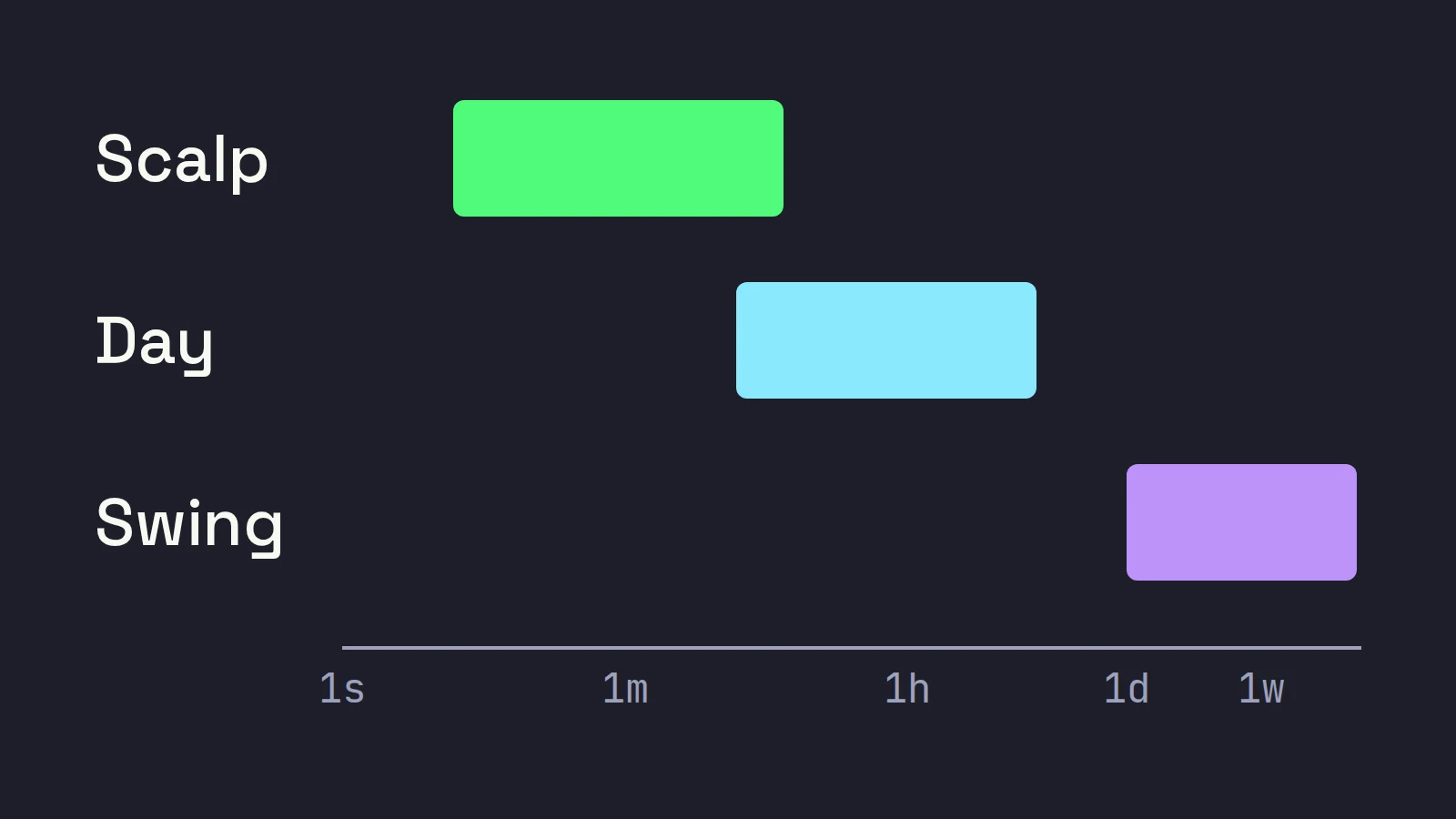
Scalping vs day trading comes down to holding time. Scalping is the shortest form of day trading: you hold for seconds to minutes and aim for a few cents to a few tens of cents a share, many times a day. Day trading in general means opening and closing within one session, with holds from minutes to hours. Swing trading holds for days to weeks. The difference that matters most is cost: on a 10-cent scalp, the spread and commissions can eat about 30% of the target, against about 6% on a 50-cent day trade and 2% on a $1.50 swing. Scalping needs the fastest execution and the most screen time; swing trading needs the least but carries overnight gap risk. None of the three is an easy way to make money, and most people who day trade lose.
Scalping vs day trading is not really a contest between two styles. All scalping is day trading; not all day trading is scalping. The real choice is how long you hold, and that one choice decides your costs, your tools, how many hours you need at the screen and which rules apply to your account.
This post defines each style, lines them up in one table, works through what costs do to each with Interactive Brokers' own prices, and ends with how to pick. We build Scalpel, a cockpit for long-only scalping of US small caps on Interactive Brokers, so we have an obvious bias toward the short end. We will say plainly where the other styles are a better fit.
What is scalping in trading?
Scalping means taking small, fast profits from short price moves, then getting out. A scalper on a momentum small cap might buy a break of $5.00, sell half at $5.10 and the rest at $5.20, all inside three minutes, and do that five to twenty times in a morning. The edge, if there is one, comes from reading the order book and the tape and from execution: getting in and out at good prices, quickly.
Because each win is small, scalping lives and dies on three numbers: the spread, the commission and the slippage. A scalper who pays 3 cents a share to trade and aims for 10 cents a share has given away almost a third of every win before the trade starts.
Day trading and swing trading
Day trading is any style that opens and closes positions within the same trading day. A day trade is buying and selling the same stock in the same session. Day trades can last a few minutes or most of the session. A trader who buys a breakout at 09:45 ET and sells into strength at 11:30 ET is day trading, but not scalping.
Swing trading holds for days to weeks, aiming at a larger part of a trend. Swing traders usually work from daily and hourly charts, place orders that rest at the broker, and accept that the stock can open well away from yesterday's close.
Scalping vs day trading vs swing trading: the comparison
| Scalping | Day trading (intraday) | Swing trading | |
|---|---|---|---|
| Typical hold | Seconds to minutes | Minutes to hours, flat by the close | Days to weeks |
| Typical target on a $5 stock | 5c to 30c | 30c to $1 | $1 or more |
| Trades a day | 5 to 30 or more | 1 to 5 | A few a week |
| Costs as a share of target | High | Moderate | Low |
| Main tools | Level 2, time and sales, hotkeys | Intraday charts, alerts, Level 2 | Daily charts, resting orders |
| Screen time | The whole active window, eyes on | Most of the session | An hour or so a day |
| Overnight gap risk | None if flat | None if flat | Yes, every night |
| Speed matters | Very much | Somewhat | Little |
These ranges are typical, not rules. A day trader in a liquid large cap might aim for 30 cents on a $150 stock, which is a scalp in percentage terms. Think in cents per share against the stock's normal range, and in R, the amount you risk to your stop.
Costs as a share of the target: the difference that matters
Let us price a 500-share round trip on a fictional $5.00 stock, ABCD, with a 2-cent spread (bid $4.99, ask $5.01), using marketable orders that buy at the ask and sell at the bid. Prices from Interactive Brokers' stock commission page on IBKR Pro Fixed: $0.005 a share, $1.00 minimum, exchange fees included.
- Commission: 500 x $0.005 = $2.50 each way, $5.00 round trip.
- Spread: buying at the ask and selling at the bid costs the full 2 cents, or $10.00.
- SEC fee: charged on sales at $20.60 per million dollars from April 4, 2026, about 5 cents on a $2,550 sale.
That is about $15 per round trip, or about 3 cents a share. Now set it against each style's target:
| Style | Target per share | Gross on 500 shares | Costs | Costs as a share of target |
|---|---|---|---|---|
| Scalp | 10c | $50 | about $15 | about 30% |
| Day trade | 50c | $250 | about $15 | about 6% |
| Swing trade | $1.50 | $750 | about $15 | about 2% |
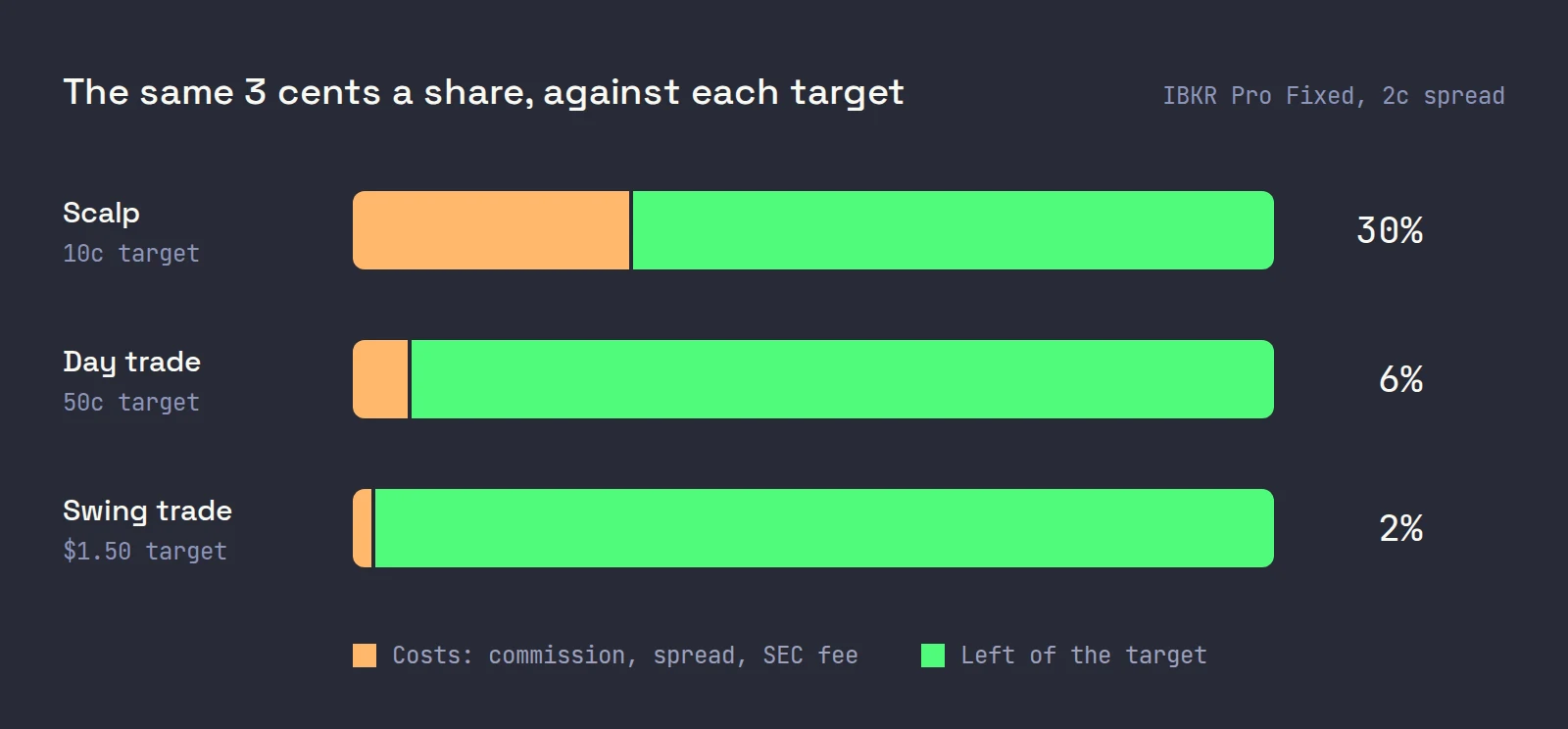
Slippage is not in these numbers, and it hits scalpers hardest: a fast small cap can fill a marketable buy several cents above the ask. Commissions also fall on IBKR Pro Tiered once monthly volume grows, and Tiered can be cheaper on small orders; IBKR's commission page lists every tier. The full list of costs is in our post on the cost of day trading.
The pattern holds whatever the exact numbers: the shorter the hold, the bigger the share of every win the market and your broker take. Trading more often does not make that better. In Brad Barber and Terrance Odean's study of 66,465 households, the households that traded the most earned 11.4% a year while the market returned 17.9% (Journal of Finance, 2000).
Time, tools and temperament
Scalping asks for the most. You need live Level 2 and a time and sales tape, hotkeys that fire without a confirmation dialog, and full attention for the whole window you trade. Most small-cap scalpers trade the pre-market and the first hour after 09:30 ET, when volume is highest. Chart timeframes are short, often 1-minute or shorter. It suits people who decide fast and can take a loss without dwelling on it.
Day trading on longer holds leaves room to think. Five-minute charts, a few alerts and a plan per stock are enough for many setups. You still need to be at the screen for most of the session.
Swing trading fits around a job. You can plan in the evening, place resting orders with a stop at the broker and check once or twice a day. The price is overnight risk: a stock can gap through your stop on news before the market opens.
Rules and accounts
The style you pick also decides which account rules you meet in the US:
- Margin accounts, intraday. On June 4, 2026, FINRA replaced the pattern day trader rule, with its $25,000 minimum and day trade count, with an intraday margin standard (FINRA Regulatory Notice 26-10). Brokers may phase the change in until October 20, 2027. Our post on the PDT rule on Interactive Brokers explains what applies to your account.
- Margin accounts, overnight. Swing trades held overnight meet the normal end-of-day margin requirements, not just the intraday ones.
- Cash accounts. You trade only with settled cash. FINRA's page on frequent intraday trading notes that most equity trades settle the next business day (T+1), so a scalper who recycles the same cash several times a day runs out of settled funds fast. A swing trader in a cash account rarely notices.
In this FINRA episode, two of its policy and credit regulation staff explain the intraday margin standard that replaced the pattern day trader rule. It runs about 28 minutes and comes from the regulator that wrote the rule.
Which one fits you
- You have one or two hours a day, at fixed times, and a full-time job: swing trading, or no trading at all until you have more time.
- You can be at the screen for the first hours of the session, every day: day trading on longer holds, or scalping if you also have fast execution and Level 2.
- You have a small account: costs matter even more, because the fixed minimums per order are a larger share of a small trade. See day trading a small account.
- You are new: start in a simulator with whichever style you choose, and give it a few hundred trades before you judge it. Our post on how long it takes to learn day trading explains why, and the wider plan is in how to start day trading.
Whatever you pick, the odds are poor. The SEC's investor page Day Trading: Your Dollars at Risk warns that "Day traders typically suffer severe financial losses in their first months of trading." The research on who makes money is in our post on day trading statistics.
Where Scalpel fits
Scalpel is built for one of these styles: long-only scalping of US small caps, pre-market first (what Scalpel is for). Each desk has a Level 2 montage, a time and sales tape, a chart and an order panel, with one-key entries and scale-outs sized by your risk. It is a poor fit for swing trading, and we would not recommend it for that:
- Its stops and take-profits are watched by the app, not resting at Interactive Brokers. That is what lets them work in the pre-market, where exchanges accept limit orders only, but it means they only work while Scalpel is running with a live feed (how stops work). An overnight swing trade needs a resting stop at the broker, which TWS does well.
- It is long only and trades US stocks only.
If you scalp, the costs above are why Scalpel's SIM books IBKR's own commission plans, so your practice results include them (commissions in SIM and LIVE). The momentum method guide covers the style the app is built around, and this video collects practical habits for it:
Scalpel is independent and not affiliated with or endorsed by Interactive Brokers. Fees and rules checked on October 22, 2026.
Trading carries a significant risk of loss. Nothing here is financial advice.
Questions
- What is the difference between scalping and day trading?
- Scalping is the shortest form of day trading: holds of seconds to minutes for small per-share gains, many times a day. Day trading more broadly means any position opened and closed within the same session, which can last minutes or hours.
- Is scalping more profitable than day trading?
- Not inherently. Scalping takes more trades for smaller gains, so costs such as the spread and commissions take a much larger share of each win. Most retail traders in either style lose money.
- What is the difference between scalping and swing trading?
- Scalpers hold for seconds to minutes and are flat at the end of the day. Swing traders hold for days to weeks, use resting stop orders at the broker and accept the risk of overnight price gaps.
- Is scalping good for beginners?
- It is the hardest style to learn because it needs fast execution, Level 2 reading and strict discipline, and costs punish every mistake. Beginners who try it should practice in a simulator for several hundred trades first.
- How long do scalpers hold trades?
- Usually from a few seconds to a few minutes. A scalper aims to be out as soon as the small move they targeted has happened or failed.
Related guides
Guide 1.9What Scalpel is for, and what it is notScalpel is opinionated: long-only scalping of US stocks, pre-market first, by keyboard and sound. What it does, what it never will, and who it is for.Guide 14.6The momentum method Scalpel is built aroundThe small-cap momentum style Ross Cameron teaches, from stock selection to gap and go and micro pullbacks, mapped to Scalpel's scanner, intel and stops.Guide 6.3Commissions: pick your IBKR planMatch Scalpel's SIM fees to your Interactive Brokers plan: Pro Tiered, Pro Fixed, Lite or custom, plus exchange and clearing fees, and the FEE column.
Keep reading
- How to start day trading in 2026: a realistic planHow to start day trading in 2026: the honest odds, the money and rules after the PDT change, one setup, simulator practice, a journal and going live small.
- Day trading statistics: what the research says about who makes moneyDay trading statistics from primary research: 97% of persistent Brazilian day traders lost money, under 1% in Taiwan profit reliably. Samples and limits.
- Paper trading: does it work, and how to make it countDoes paper trading work? Where simulated fills lie, IBKR's paper account limits, how to make practice realistic, and when to switch to live trading.
Practice in SIM, against the live book.A lifetime license, every update included, with a 7-day refund guarantee.Ask in DiscordGet Scalpel