Day trading rules in 2026: every rule a US stock trader should know
By Scalpel Team. , updated . 12 min read.
In short
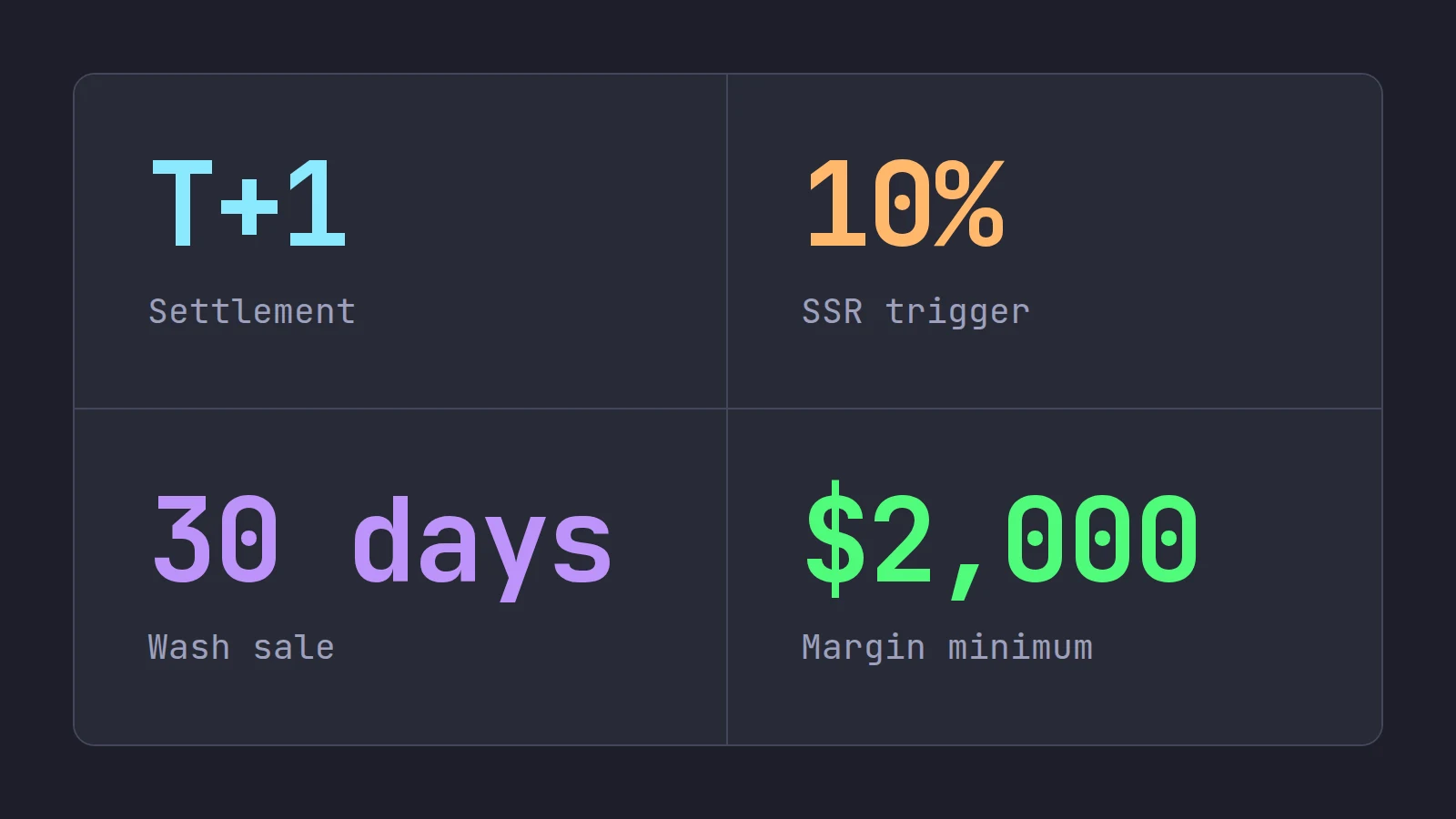
The day trading rules that matter for a US stock trader in 2026 fall into four groups. Account rules: the pattern day trader rule and its $25,000 minimum were replaced on June 4, 2026 by FINRA's intraday margin standards (phased in until October 20, 2027), margin trading still needs $2,000, and cash accounts trade only settled cash, which settles T+1. Market rules: LULD bands pause a stock that moves too far too fast, and the short sale restriction kicks in after a 10% drop but does not touch long sales. Cost rules: the SEC fee and other charges on every sale. Tax rules: profits are short-term gains taxed as ordinary income, and the wash sale rule defers losses you buy back within 30 days.
Most "day trading rules" articles still lead with the pattern day trader rule, which is no longer the rule. The ground moved in 2026, and the rules that now shape a small account are less famous: how much you borrow during the day, when your cash settles, what a halt does to your order, and what the IRS does with a year of round trips. This guide is the map. Each section gives the rule, the number, the source, and a link to the post in this cluster that covers it in depth.
All sources were checked on October 22, 2026. Rules change, so each section links the regulator's or Interactive Brokers' own page. We trade US small caps through Interactive Brokers, so IBKR is the broker in our examples; the FINRA, SEC and IRS rules apply at any US broker. Scalpel is independent and not affiliated with or endorsed by Interactive Brokers, FINRA, the SEC or the IRS.
Day trading rules at a glance
| Rule | Set by | What it does | The number | In depth |
|---|---|---|---|---|
| Intraday margin (replaced PDT) | FINRA Rule 4210 | Limits borrowing during the day, not the trade count | Effective June 4, 2026 | PDT rule change |
| Margin requirements | Fed Reg T, FINRA, IBKR | How much stock your equity can carry | 25% maintenance, 50% overnight | Intraday margin on IBKR |
| Liquidation | IBKR policy | Sells your positions when you fall below maintenance | No margin calls | Margin calls and auto-liquidation |
| Settlement | SEC | When sale proceeds become settled cash | T+1 | Cash account day trading |
| Free riding | Fed Reg T | Selling stock you have not paid for | 90-day freeze | Cash account day trading |
| Limit up-limit down | LULD Plan | Pauses a stock that leaves its price band | 5-minute pause | LULD trading halts |
| Short sale restriction | SEC Rule 201 | Limits short sales after a big drop | 10% below the prior close | Short sale restriction |
| Section 31 fee | SEC | A fee on the value of every sale | $20.60 per million | SEC fee and FINRA TAF |
| Short-term gains | IRS | How trading profits are taxed | Ordinary income rates | Day trading taxes |
| Wash sales | IRS, IRC 1091 | Defers a loss if you buy back within 30 days | 61-day window | Wash sale rule |
Every post in this cluster is also listed on the rules, costs and taxes hub.
Account rules: who can day trade, and with how much
The pattern day trader rule is gone
For decades a margin account that made four or more day trades in five business days was a "pattern day trader" and had to keep $25,000 of equity. The SEC approved FINRA's replacement on April 14, 2026, and FINRA's Regulatory Notice 26-10 set the effective date: June 4, 2026. Firms may "phase in their implementation over a period of 18 months, until October 20, 2027."
The day trade count and the $25,000 minimum are gone. What replaced them watches how far below your maintenance margin you go during the day. Interactive Brokers' stock margin page says the $25,000 requirement "is being removed," that clients "will still be subject to the standard Reg T $2,000 minimum for trades using margin or short sales," and that "your account may still be subject to existing PDT rules during FINRA's transition period, which ends in October 2027."
Start with the PDT rule change on Interactive Brokers, which explains the old rule, the new one and the transition with a worked example.
FINRA's own podcast episode on the change has two of the staff behind it explaining why the pattern day trader rule existed, why it was replaced, and what the intraday margin standard means for investors and their brokers.
Intraday margin: the new limit on a margin account
Under the new standard, any trade that leaves your account below its maintenance requirement creates an intraday margin deficit, even if you are flat by the close. FINRA requires the deficit to be met "as promptly as possible." If a customer makes a practice of not meeting deficits and one is still unmet at the close of the fifth business day, the firm must restrict the account for 90 calendar days. Deficits no larger than "the lesser of 5 percent of the equity in the margin account or $1,000" do not count toward that practice.
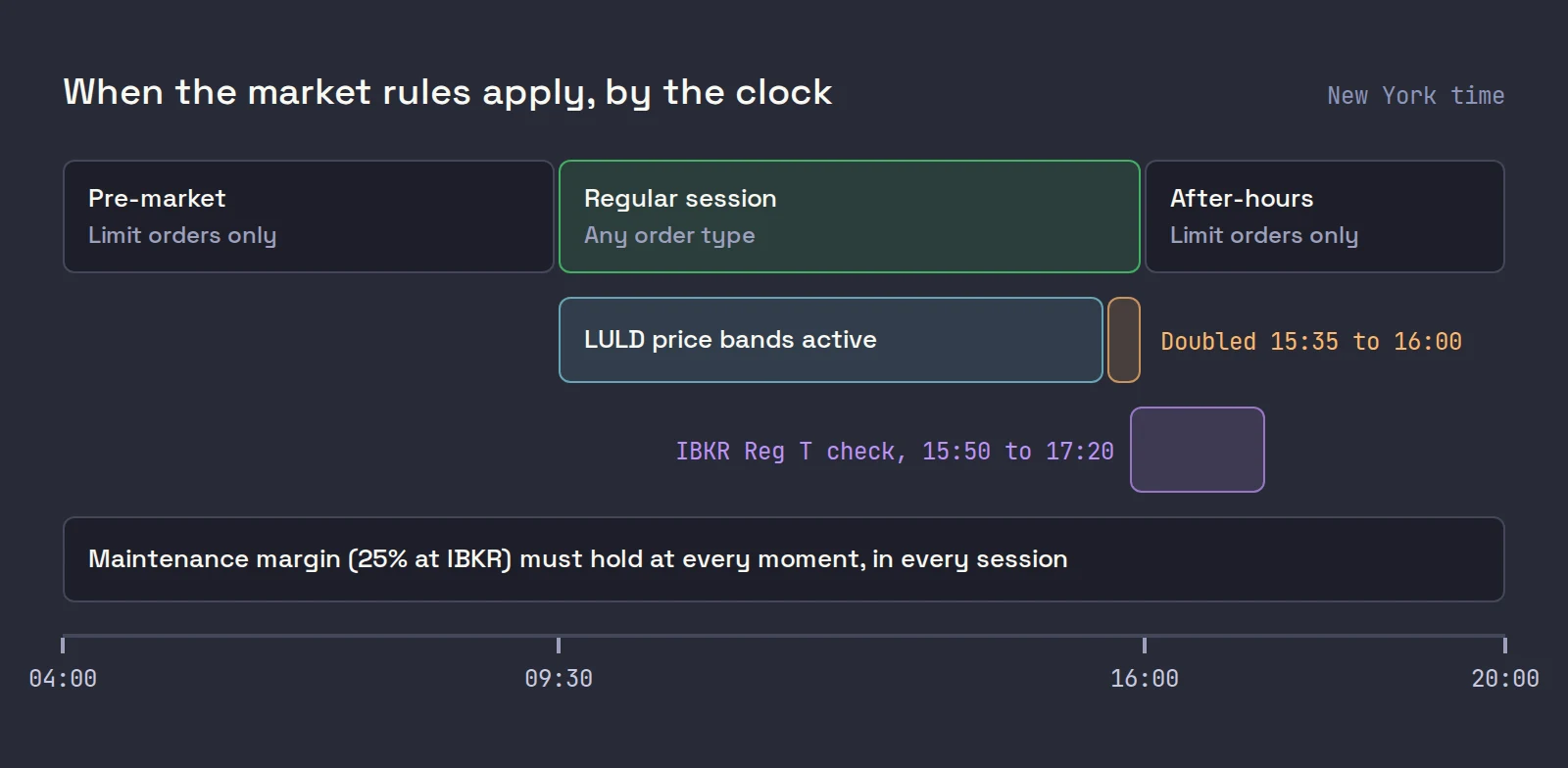
At IBKR the working numbers for a marginable US stock are 26.25% initial margin when you place the order, 25% maintenance at all times and 50% Reg T from 15:50 ET for what you hold overnight. A $5,000 margin account can open about $19,000 of stock, and at that size a fall of under 4% can trigger liquidation. IBKR issues a deficit call the next business day, expects it met within three business days, and treats the fourth miss in a rolling 12 months as a practice. All of that, with the arithmetic, is in intraday margin on IBKR for small accounts.
Margin calls and forced liquidation
The rule that actually closes positions at IBKR is not FINRA's. It is IBKR's own policy. Its margin warning glossary entry says: "Interactive Brokers does not make margin calls. Real-time liquidations occur when your account has a margin deficiency." It adds that "generally, accounts will not have time to deposit funds." How the liquidation engine works, what it sells first and how to watch for it is covered in IBKR margin calls and auto-liquidation.
The practical rule for a small account is to keep enough room between you and maintenance that a normal adverse move cannot trigger it, or to never borrow at all.
Cash accounts and T+1 settlement
Cash accounts were never under the PDT rule and are not under the intraday margin rule. Their limit is settlement. The SEC moved most US securities trades from two business days to one: adopted February 15, 2023, compliance date May 28, 2024 (SEC press release 2023-29). Cash from a sale today is settled cash tomorrow, so each settled dollar can buy once per day.
Two violations come with it. A good faith violation is buying with unsettled sale proceeds and selling before those proceeds settle. Free riding is buying and selling without paying in full, and under Regulation T it brings a 90-day freeze on delayed payment. IBKR checks for free riding at the end of each day and puts violators on a 90-day "Cash Up Front" restriction. Worked days, IBKR's exact behavior and when a margin account kept under your cash works better are in day trading in a cash account.
Market rules: what can happen to your order
Trading hours and extended-hours orders
The regular session runs 09:30 to 16:00 ET. Before and after it, from 04:00 and until 20:00 ET, is extended-hours trading, where only limit orders are accepted, books are thinner and spreads are wider. For a pre-market trader this is the rule that matters most day to day: a broker stop order cannot protect a position before 09:30 because it would become a market order. It is the reason Scalpel's stops are watched by the app, not left at the broker.
Limit up-limit down halts
The LULD Plan stops trades in a stock from happening outside a price band around its average price over the previous five minutes. The band width depends on the stock's tier and the previous day's closing price:
| Stock | Previous close | Band |
|---|---|---|
| Tier 1 (S&P 500, Russell 1000 and some ETPs) | Above $3.00 | 5% |
| Tier 2 (most small caps) | Above $3.00 | 10% |
| Tier 1 or Tier 2 | $0.75 to $3.00 | 20% |
| Tier 1 or Tier 2 | Under $0.75 | The lesser of $0.15 or 75% |
The bands double in the last 25 minutes of the regular session for Tier 1 stocks and Tier 2 stocks under $3.00. If the price sits at the band and does not come back within 15 seconds, the listing exchange declares a five-minute trading pause, which can be extended.
An example: ABCD, a Tier 2 stock that closed yesterday at $2.50, has a 20% band. With a five-minute average price of $4.00, the band runs from $3.20 to $4.80. A run to $4.80 can stop it cold, with your order and your stop stuck until it reopens. The full mechanics, and what happens to resting orders, are in LULD trading halts and the LULD halt glossary entry.
The short sale restriction (SSR)
SEC Rule 201, adopted on February 24, 2010, is triggered when a stock's price "declines by 10 percent or more from the prior day's closing price." The restriction applies "for the remainder of the day as well as the following day," and during it short selling is permitted only "if the price of the security is above the current national best bid" (SEC press release 2010-26).
It restricts short sales only. Selling shares you own is never affected. Why a long trader should still care, and how SSR changes the tape on a stock that has already faded, is in the short sale restriction: what it means when you are long. Scalpel is long only and never sells short (long only).
The Reg SHO threshold list
A stock goes on the threshold list when it has had an aggregate fail-to-deliver position for five consecutive settlement days "totaling 10,000 shares or more" and "equal to at least 0.5% of the issuer's total shares outstanding," per the SEC's key points about Regulation SHO. If failures persist for 13 consecutive settlement days, the clearing firm must buy shares to close them out. For a long trader, a stock on the threshold list is a sign of tight borrow and a crowded short side, which is part of how squeezes start (borrow and short squeezes).
Penny stocks and OTC
Stocks under a few dollars, and especially those that trade over the counter rather than on Nasdaq or NYSE, come with their own limits at the broker: which ones you can trade at all, how orders are priced and what they cost. IBKR's version of those rules is covered in trading penny stocks on Interactive Brokers.
Cost rules: what every trade pays
The SEC fee and FINRA's trading activity fee
Every stock sale pays a Section 31 fee, set by the SEC and passed through by your broker. The SEC's fee rate advisory for fiscal year 2026 set it at $20.60 per million dollars of sales from April 4, 2026; through April 3, 2026 it had been $0.00. On a $5,000 sale that is about 10 cents. FINRA charges a separate trading activity fee per share sold. How both are calculated and where they show on your statement is in SEC fee and FINRA TAF.
Commissions and the full cost of trading
Commissions are a broker's price, not a rule, but at scalping frequency they decide whether a small edge survives. Interactive Brokers' Fixed and Tiered plans work out differently by order size, frequency and whether your orders take or add liquidity; the math on real trades is in IBKR Tiered vs Fixed. Add market data, exchange fees, slippage and software, and you have the real cost of day trading.
Tax rules: what the IRS does with a year of round trips
Short-term gains are ordinary income
Anything held a year or less is short term, and IRS Topic 409 says net short-term gains are "subject to taxation as ordinary income at graduated tax rates." A day trader has no special rate. Net losses offset only $3,000 of other income a year ($1,500 if married filing separately), with the rest carried forward. Worked examples with the 2026 brackets are in day trading taxes in the US.
The wash sale rule
If you sell a stock at a loss and buy substantially identical stock within 30 days before or after, the loss is disallowed and added to the cost of the new shares (IRS Publication 550). For a scalper who trades the same tickers daily, this mostly defers losses from trade to trade. It costs real money at year-end, when the replacement is bought in an IRA, and across accounts. The details are in the wash sale rule for day traders.
Trader tax status and 475(f)
The IRS treats you as a trader in the business of trading only if you seek to profit from daily price movements and your activity is substantial, continuous and regular (IRS Topic 429). A trader deducts business expenses on Schedule C. A trader who also makes a timely section 475(f) election reports gains and losses as ordinary, escapes the $3,000 loss limit, and is not subject to the wash sale rules. The election is due by the original due date of the previous year's return, so it has to be decided in advance.
This is general information, not tax or legal advice. Use a tax professional for your own situation.
The rules you set yourself
The PDT rule was a crude brake: three day trades a week capped how much a small account could lose to overtrading. That brake is gone. Under the new rules a $3,000 margin account can make thirty trades on a Tuesday at close to four times its equity. Nothing in the 2026 rulebook will stop a bad morning from becoming a blown account, so you need your own:
- A daily loss limit. A fixed dollar amount, usually a few full losers, after which you stop for the day (daily loss limit).
- Fixed risk per trade. Size each trade from its stop so every loser costs the same (trade a fixed dollar risk).
- Position caps under your cash. No single position, and no combination of them, larger than the cash in the account. You give up leverage and in return you cannot create an intraday margin deficit or be force-liquidated by a normal move (small account setup).
None of these is a legal requirement. All of them matter more than the ones that are. If you are starting with a few thousand dollars, day trading a small account in 2026 puts them into a full plan.
Where Scalpel fits
Scalpel does not enforce FINRA's, the SEC's or the IRS's rules; Interactive Brokers applies the account and market rules to your orders, and when it refuses one, Scalpel shows a red toast with IBKR's own reason and code (why an order was rejected). What Scalpel does is enforce your own rules before an order ever reaches IBKR:
- Daily loss ($) in Settings > Risk trips a RISK LOCK when the day's realized plus open P&L reaches minus that amount. New buys are refused until you click Resume trading, and with Auto-flatten on daily loss ticked it also sells every open position.
- Fat-finger ($) and Max position ($) refuse any single order, or any position in one symbol, above the value you set. Set them under your cash and a single trade cannot borrow.
- Risk (Cents) buy presets size each entry from your stop, so a $20 button risks $20 whatever the stock's price.
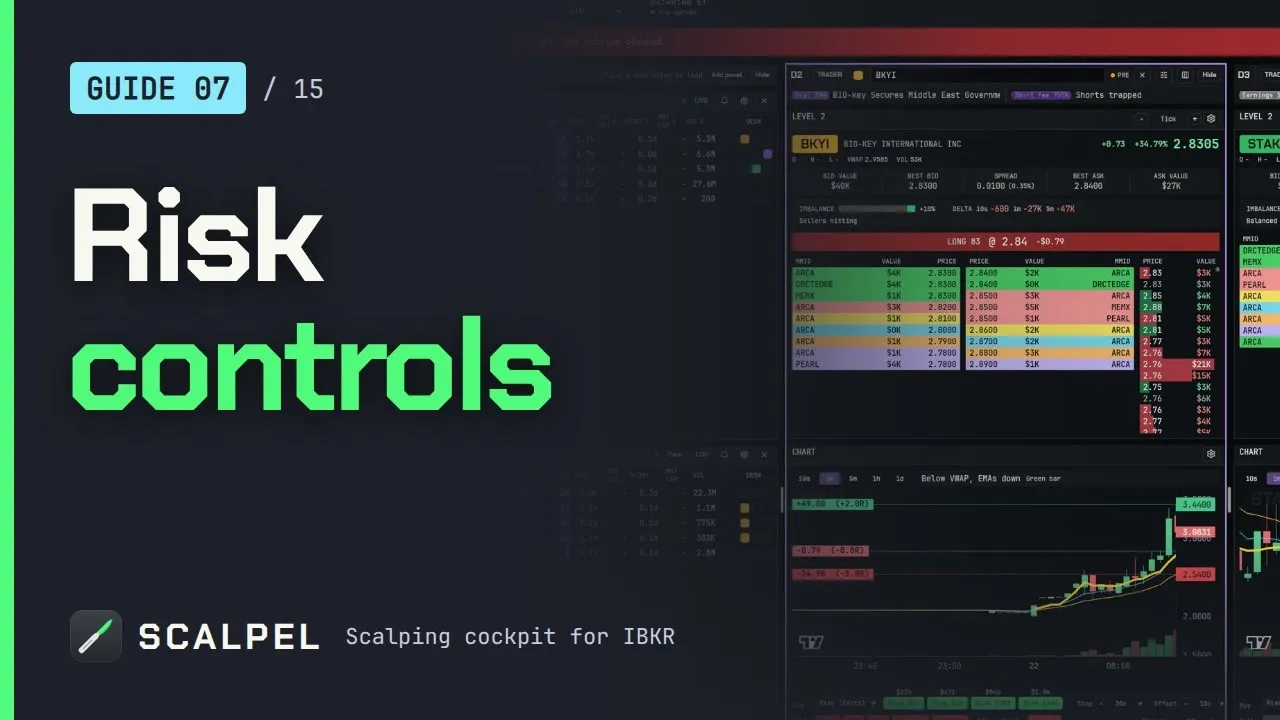
The two-minute risk controls video shows the limits, the lock and the caps in the app:
Scalpel is long only, so the short sale rules never apply to an order it sends. Its stops are app-monitored rather than resting at IBKR, because outside regular hours a broker stop cannot protect a pre-market trade; they only work while Scalpel runs with a live feed, and no fill is guaranteed. Where TWS alone is enough, it is enough: IBKR's own margin checks and Account Window already tell you where you stand.
FINRA, SEC, LULD Plan, IRS and IBKR sources checked on October 22, 2026.
Trading carries a significant risk of loss. Nothing here is financial advice.
Questions
- What are the rules for day trading stocks in 2026?
- Margin accounts follow FINRA's intraday margin standards, which replaced the pattern day trader rule on June 4, 2026, and margin trading needs $2,000 of equity. Cash accounts trade only settled cash, which settles one business day after the trade. Market rules such as LULD halts and the short sale restriction, and tax rules such as the wash sale rule, apply to everyone.
- Is the pattern day trader rule still in effect?
- No. FINRA's intraday margin standards replaced it on June 4, 2026, removing the day trade count and the $25,000 minimum. Brokers may phase the change in until October 20, 2027, so some accounts may still be on the old rule until then.
- How many day trades can I make with under $25,000?
- Under the new rule there is no day trade count. A margin account is limited by its intraday margin and a cash account by its settled cash, but neither has a fixed number of day trades.
- What is the T+1 rule?
- It is the standard settlement cycle for most US stock trades since May 28, 2024: a trade settles one business day after the trade date. In a cash account, money from a sale can be spent again once it settles.
- Does the short sale restriction affect selling shares I own?
- No. SEC Rule 201 only restricts short sales, allowing them only above the national best bid for the rest of the day and the next day after a 10% drop. Selling a long position is not affected.
- How are day trading profits taxed?
- They are short-term capital gains, taxed as ordinary income at your regular rate. Net losses offset only $3,000 of other income a year unless you qualify as a trader and made a timely section 475(f) election.
Related guides
Guide 14.4Settings for a small accountSettings that suit a small account: risk-based presets, tight caps, a daily loss limit you will respect, the right commission plan, and what to watch for.Guide 13.5A LIVE order was rejectedA LIVE order came back rejected: read IBKR's reason in the toast, then check Read-Only API, trading permissions, buying power and Scalpel's own caps.Guide 7.3Why Scalpel is long-onlyScalpel is long-only by design: every sell is capped to the shares you hold, so a double press never puts you short. No shorts, futures, options or crypto.
Keep reading
- The PDT rule is gone: what changed for day trading on Interactive BrokersYes: IBKR began dropping the PDT rule on June 4, 2026. No $25,000 minimum, no day trade count. What replaced it, a worked example and who is still on it.
- IBKR Tiered vs Fixed for scalpers: the math on real tradesTiered vs Fixed pricing explained simply: Fixed is one flat rate a share, Tiered a lower rate plus exchange fees. Which is cheaper on IBKR, worked out.
- Intraday margin on IBKR for small accounts after the PDT changeIntraday margin on IBKR for a $5,000 account: 26.25% initial, 25% maintenance, the 15:50 ET Reg T check, and how IMD calls and the 90-day limit work.
Practice in SIM, against the live book.A lifetime license, every update included, with a 7-day refund guarantee.Ask in DiscordGet Scalpel