Day trading statistics: what the research says about who makes money
By Scalpel Team. , updated . 9 min read.
In short
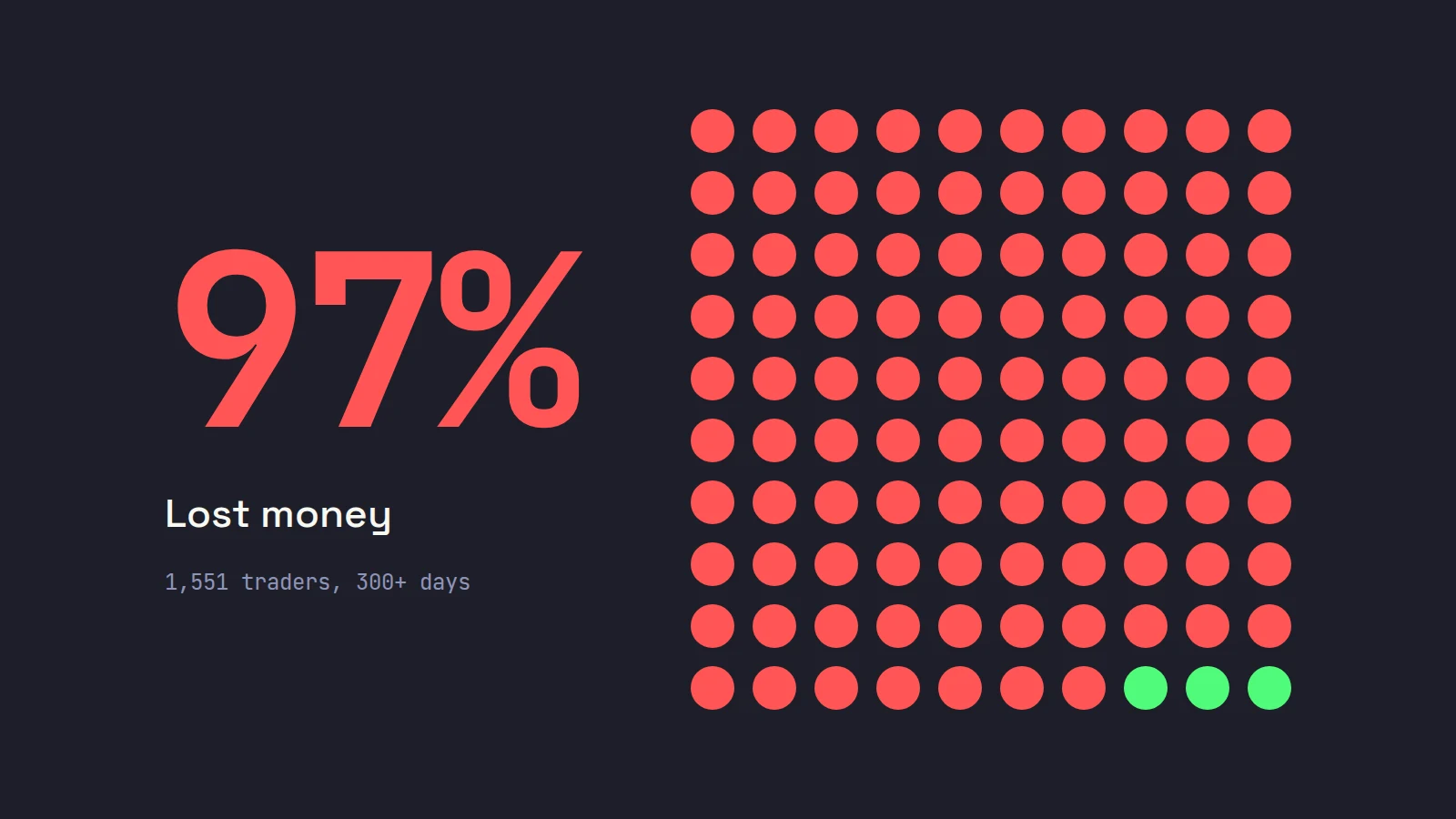
The research on day trading statistics says most day traders lose money, and very few make a living at it. In Brazil, 97% of people who day traded index futures for more than 300 days lost money and only 1.1% earned more than the minimum wage. In Taiwan, less than 1% of day traders were predictably profitable after fees over 15 years of complete exchange data. In the best-known US sample, from 1998 and 1999, 64.2% of day traders lost money after commissions.
Search for day trading statistics and you get a wall of round numbers with no source: "90% lose 90% in 90 days", "95% fail". Some may be close to the truth. None of them comes from a study you can read. This post collects the primary research instead: who was studied, what they found, the exact figures, and where each study is weaker than its headline.
We build a day trading tool, so it would suit us to tell you the odds are fine. They are not. Read this before you put money into the style we built Scalpel for, and read it again if you already have.
Day trading statistics at a glance
| Study | Market and years | Who was studied | Headline figure |
|---|---|---|---|
| Chague, De-Losso and Giovannetti (2019, revised 2020) | Brazil, mini-Ibovespa index futures, 2013 to 2015 | All 19,646 individuals who started day trading; 1,551 kept going for more than 300 days | 97% of the 1,551 lost money; 1.1% earned more than the minimum wage |
| Barber, Lee, Liu and Odean (2014) | Taiwan Stock Exchange, 1992 to 2006 | Every day trader in the market | Less than 1% predictably profitable net of fees |
| Barber, Lee, Liu, Odean and Zhang (2020) | Taiwan Stock Exchange, 1992 to 2006 | Every day trader in the market | 97% likely to lose money in future day trading; 74% of volume from traders with a history of losses |
| Jordan and Diltz (2003) | United States, stocks, February 1998 to October 1999 | 324 clients of one day trading firm | 64.2% lost money after commissions; 35.8% made a profit |
| Barber and Odean (2000) | United States, stocks, 1991 to 1996 | 66,465 households at a discount broker | The most active traders earned 11.4% a year while the market returned 17.9% |
Brazil: 97% of persistent day traders lost money
The study. Fernando Chague, Rodrigo De-Losso and Bruno Giovannetti, "Day Trading for a Living?", a working paper first circulated in 2019 (SSRN 3423101; the University of Sao Paulo working paper PDF has the full text).
The sample. Data from Brazil's securities regulator on every individual who day traded mini-Ibovespa futures for the first time from 2013 to 2015: 19,646 people. The authors followed each one's net profit after exchange and brokerage fees.
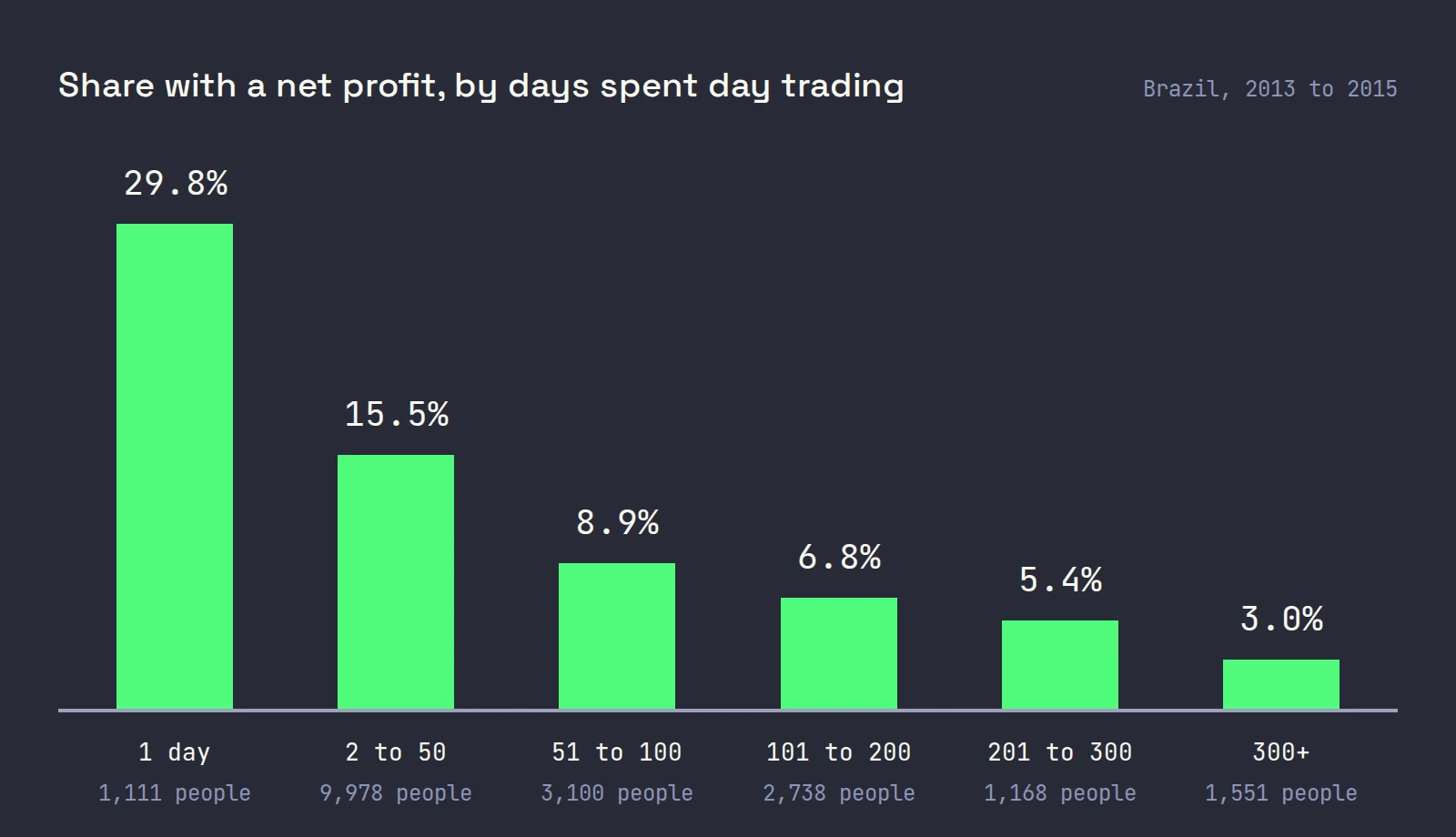
The findings. Of the 1,551 people who day traded for more than 300 days, 47 (3.0%) made a net profit. Only 17 (1.1%) earned more than the Brazilian minimum wage, US$16 a day. Only eight (0.5%) earned more than a bank teller's starting salary, US$54 a day. The best of them averaged US$310 a day, and the eight who beat the bank teller had daily profits that swung with a standard deviation of US$632 to US$3,308. The average daily net result was a loss of US$48.81.
The detail that matters most for anyone planning to "push through the learning curve": the share of people with a profit fell the longer they traded. It was 29.8% for those who traded a single day, 15.5% for 2 to 50 days, and 3.0% for more than 300 days. The authors also tested for learning, and found none: the expected profit stayed negative and did not improve with experience.
The limits. This is index futures, not small-cap stocks, in one country. High-frequency trading firms grew from 11.6% of deals in 2012 to 41.9% in 2017 over the period, which made the competition harder; the authors control for that and still find no learning. Profit here is before income tax and before the cost of courses and platforms, so real results are worse, not better. The abstract of one revision gives 0.4% for the bank teller figure where the body says 0.5%; we quote the body.
Taiwan: under 1% predictably profitable
The largest body of evidence comes from Taiwan, where researchers had every trade on the Taiwan Stock Exchange with the identity of each trader, from 1992 to 2006. Day trading there is common and almost entirely retail.
The cross-section of skill. Brad Barber, Yi-Tsung Lee, Yu-Jane Liu and Terrance Odean, "The cross-section of speculator skill: Evidence from day trading", Journal of Financial Markets 18 (2014), pages 1 to 24 (DOI 10.1016/j.finmar.2013.05.006). They ranked day traders by their returns in one year and tracked them the next. The 500 best went on to earn 61.3 basis points a day before fees and 37.9 after (a basis point is a hundredth of a percent). The worst-ranked lost 11.5 basis points a day before fees and 28.9 after. Their conclusion, in the abstract: "Less than 1% of the day trader population is able to predictably and reliably earn positive abnormal returns net of fees."
So skill exists. A small group is consistently good. The problem is how small.
Learning, or not. The same team plus Ke Zhang asked why people keep day trading if most lose: "Learning, Fast or Slow", Review of Asset Pricing Studies 10, no. 1 (2020), pages 61 to 93 (DOI 10.1093/rapstu/raz006). Losing traders were more likely to quit, as you would expect. But in aggregate day traders lost money, "74% of day trading volume is generated by traders with a history of losses", and "97% of day traders are likely to lose money in future day trading." An earlier 2017 working-paper version adds that more than 75% of day traders quit within two years, and that unprofitable traders with long experience kept going at almost the same rate as profitable ones.
The limits. Taiwan's costs were higher than a US scalper's: a 0.3% tax on every sale and commissions of about 0.1 to 0.14% of value. A strategy that loses there might do a little better on IBKR's per-share pricing. But costs do not explain the whole gap: the bottom-ranked traders lost money before fees too. The market, era and rules (daily price limits of 7%) also differ from US small caps today.
United States: two in three lost money
The study. Douglas Jordan and J. David Diltz, "The Profitability of Day Traders", Financial Analysts Journal 59, no. 6 (2003), pages 85 to 94 (DOI 10.2469/faj.v59.n6.2578).
The sample. Confirmed trades of 324 day traders at seven branch offices of one US day trading firm, February 1998 to October 1999.
The findings. 208 traders (64.2%) lost money after commissions and 116 (35.8%) made a profit. 19.4% made more than $5,000 over the period and 14.2% more than $10,000; on the other side, 25.0% lost at least $5,000 and 13.0% more than $10,000. The average trader made more than $8,000 gross and lost about $750 net: commissions turned a small gross profit into a loss. Profits also tracked the Nasdaq Composite, which tells you how much of the "skill" was the market going up.
The limits. This is the friendliest of the major studies, and the reasons are easy to see. It covers 21 months of the dot-com rally, one firm, and a few hundred people. It is also the only one of these that measures US stock day traders directly, which is why it gets quoted.
The wider evidence on active trading
Day traders are the extreme end of active retail trading, and the broader studies point the same way.
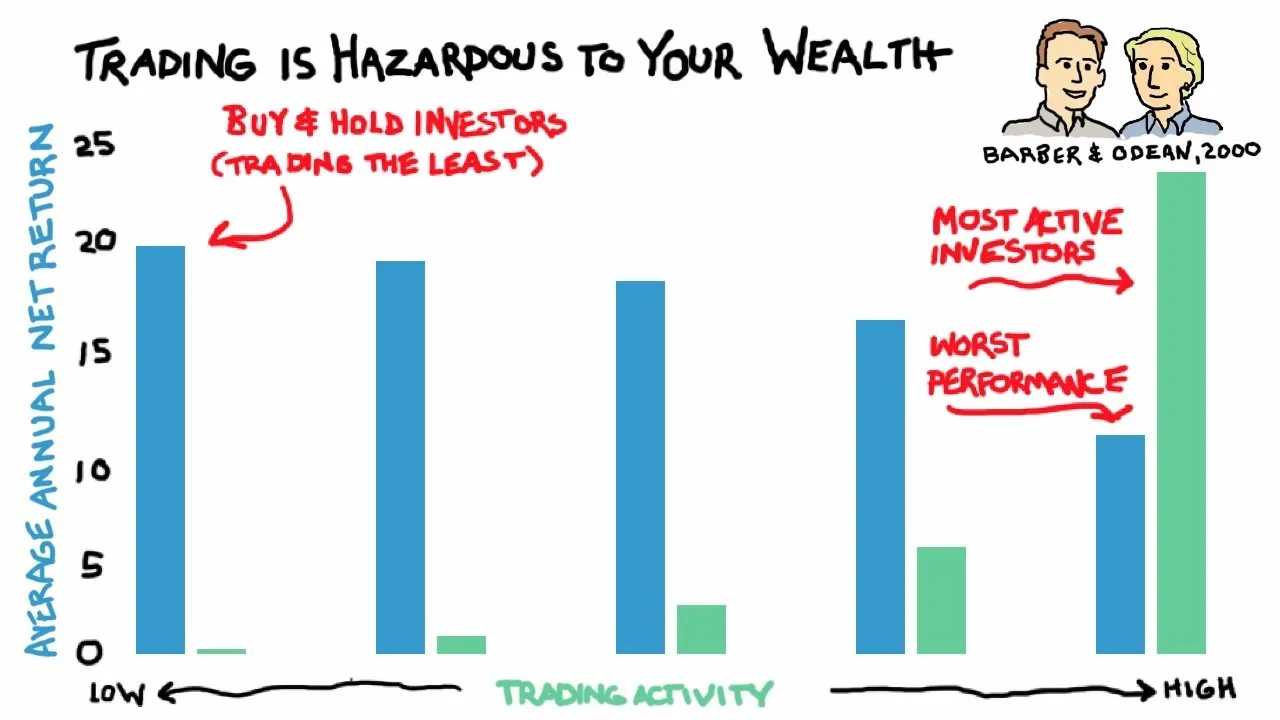
- Trading more earned less. Barber and Odean, "Trading Is Hazardous to Your Wealth", Journal of Finance 55, no. 2 (2000), pages 773 to 806 (DOI 10.1111/0022-1082.00226): of 66,465 households at a large discount broker from 1991 to 1996, those that traded most earned 11.4% a year while the market returned 17.9%.
- The losses add up. Barber, Lee, Liu and Odean, "Just How Much Do Individual Investors Lose by Trading?", Review of Financial Studies 22, no. 2 (2009), pages 609 to 632 (DOI 10.1093/rfs/hhn046): individual investors in Taiwan lost 3.8 percentage points a year in aggregate, equal to 2.2% of Taiwan's GDP, and virtually all of the losses trace to their aggressive orders, the ones that cross the spread.
- Buying what everyone is buying. Barber, Huang, Odean and Schwarz, "Attention-Induced Trading and Returns: Evidence from Robinhood Users", Journal of Finance 77, no. 6 (2022), pages 3141 to 3190 (DOI 10.1111/jofi.13183): the stocks Robinhood users bought most heavily each day went on to an average 20-day abnormal return of -4.7%. That is the statistical shape of chasing, which our post on FOMO trading takes apart.
Terrance Odean, co-author of the first two studies above, explains in this lecture on his own channel how overconfidence leads investors to trade too much, the behavior behind the gap between those households and the market.
What percentage of day traders make money?
It depends on what you count, and the honest answer is a range:
- Made any profit over a period: about one in three in the 1998 to 1999 US sample (35.8%), and 3.0% of the Brazilians who kept at it for more than 300 days.
- Predictably profitable, year after year: less than 1% in Taiwan.
- Earned a living wage: 1.1% of persistent Brazilian day traders beat the minimum wage; 0.5% beat a bank teller.
No study we found supports the idea that most people who stick with it become profitable. The Brazilian data show the opposite: the longer people traded, the smaller the share in profit.
What the research does not tell you
We want to be fair to the numbers as well as honest about them.
- Nobody has studied our niche. There is no published study of US small-cap momentum traders in the pre-market. It may be better or worse than index futures; nobody knows.
- Averages hide a tail. Every study finds a small group with real, persistent skill. The data say that group exists; they do not say you are in it, and they do not tell you in advance who will be.
- Costs differ by market. A tax of 0.3% per sale in Taiwan is a far higher hurdle than US fees. But the losing traders lost before costs as well.
- Self-selection cuts both ways. People who quit fast may have been the sensible ones. People who persist may be the most overconfident.
The US Securities and Exchange Commission's long-standing investor alert, Day Trading: Your Dollars at Risk, says the same thing in plainer words: day traders "typically suffer severe financial losses in their first months of trading", many never become profitable, and you should only risk money you can afford to lose.
If you still want to try
Plenty of people read these numbers and try anyway. If that is you, treat the statistics as the starting point of your plan:
- Assume you are the average until your own data says otherwise. Practice on paper first, with real fills and real costs; our post on paper trading covers how to make it honest.
- Measure yourself the way the researchers did: net of every fee, over hundreds of trades. A trading journal kept in R multiples is how.
- Cap the cost of being wrong: a small, fixed risk per trade and a hard daily loss limit. Our pillar on day trading risk management has the rules.
- Set a deadline and a test. Decide in advance how many trades, and what result, would tell you to stop. Our post on how long it takes to learn day trading shows how many trades it takes before a win rate means anything.
The full sequence, from the odds to a first live trade, is in how to start day trading.
Where Scalpel fits
Scalpel cannot change these numbers. What it can do is give you your own statistics, measured the way the studies measure: every closed trade is journaled net of fees, and Analytics shows your expectancy in R, your win rate, your profit factor and your P&L by hour (guide 6.4). It starts in SIM, which fills paper orders against the live Level 2 book with your IBKR commissions, so you can find out where you stand before you risk money (guide 6.1). The first week in SIM guide sets out a plan, and Scalpel's philosophy is plain about the risk.
This video from our guides shows SIM and LIVE, and how Scalpel keeps the two journals apart.
Sources checked on October 22, 2026. Scalpel is independent and not affiliated with or endorsed by Interactive Brokers.
Trading carries a significant risk of loss. Nothing here is financial advice.
Questions
- What percentage of day traders make money?
- It depends on the measure. In a US sample from 1998 to 1999, 35.8% made a profit after commissions. In Brazil, only 3.0% of people who day traded for more than 300 days made any profit, and in Taiwan less than 1% of day traders were predictably profitable after fees.
- Is it true that 90% of day traders lose money?
- No study we found measures exactly that figure, but the research points the same way. 97% of persistent Brazilian day traders lost money, 64.2% of a US sample lost money after commissions, and researchers estimate 97% of Taiwanese day traders are likely to lose money in future day trading.
- Can you day trade for a living?
- Very few people do. In the Brazilian study, 1.1% of people who day traded for more than 300 days earned more than the minimum wage and 0.5% earned more than a bank teller's starting salary.
- Do day traders get better with experience?
- The evidence says not for most. The Brazilian study found no learning, and the share of profitable traders fell the longer people traded. In Taiwan, a small group with a record of profits stayed profitable, but they were under 1% of day traders.
- Why do most day traders lose money?
- Costs turn small gross profits into net losses, and most traders also lose before costs. The research links heavy trading to overconfidence, and finds that losses come mainly from aggressive orders that pay the spread.
Related guides
Guide 1.9What Scalpel is for, and what it is notScalpel is opinionated: long-only scalping of US stocks, pre-market first, by keyboard and sound. What it does, what it never will, and who it is for.Guide 6.4Analytics: review your tradingScalpel's Analytics view: equity curve, win rate, expectancy, profit factor, R distribution, every trade, results by symbol and hour, and a trader grade.Guide 7.1Set a daily loss limit (the kill-switch)Set a max daily loss in Scalpel: when your P&L hits it, new entries stop, a RISK LOCK banner shows, and it can flatten everything. How to resume trading.
Keep reading
- How to start day trading in 2026: a realistic planHow to start day trading in 2026: the honest odds, the money and rules after the PDT change, one setup, simulator practice, a journal and going live small.
- Paper trading: does it work, and how to make it countDoes paper trading work? Where simulated fills lie, IBKR's paper account limits, how to make practice realistic, and when to switch to live trading.
- A day trading journal that actually improves your tradingA day trading journal that improves your trading: the fields that matter, a template with worked R math, a weekly review and the numbers to compute.
Practice in SIM, against the live book.A lifetime license, every update included, with a 7-day refund guarantee.Ask in DiscordGet Scalpel