Day trading routine: a momentum trader's morning, from 06:00 ET
By Scalpel Team. , updated . 7 min read.
In short
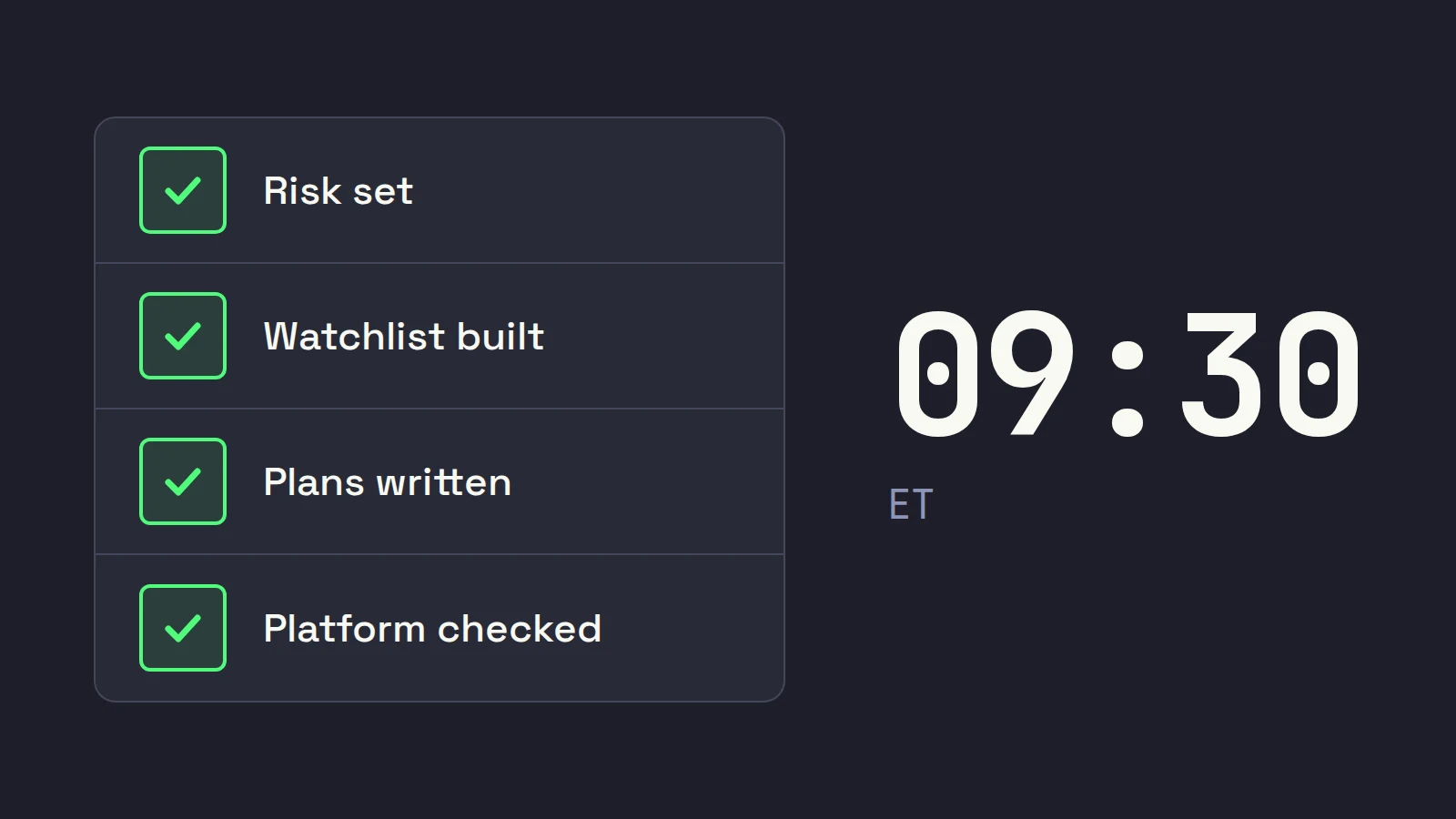
A day trading routine for momentum stocks runs on New York time: set your risk numbers by 06:00 ET before you look at a chart, check overnight news and filings, build a watchlist of two to four pre-market gappers by 08:30, write a one-line plan for each (trigger, stop, size), check your platform at 09:15, trade only those plans after the 09:30 open, and stop by a rule, a loss limit or about 11:30, then review the day in your journal.
A routine is not a ritual. It is a list of decisions you make while calm, so you do not have to make them at 09:31 with a stock up 40% and your heart rate up with it. The traders who last tend to have a boring morning and a short list. This is the day trading routine we would hand a new momentum trader, minute by minute from 06:00 ET to the late morning, with the reason for each step.
All times are New York time (ET). If you trade from another time zone, convert the clock, not the routine.
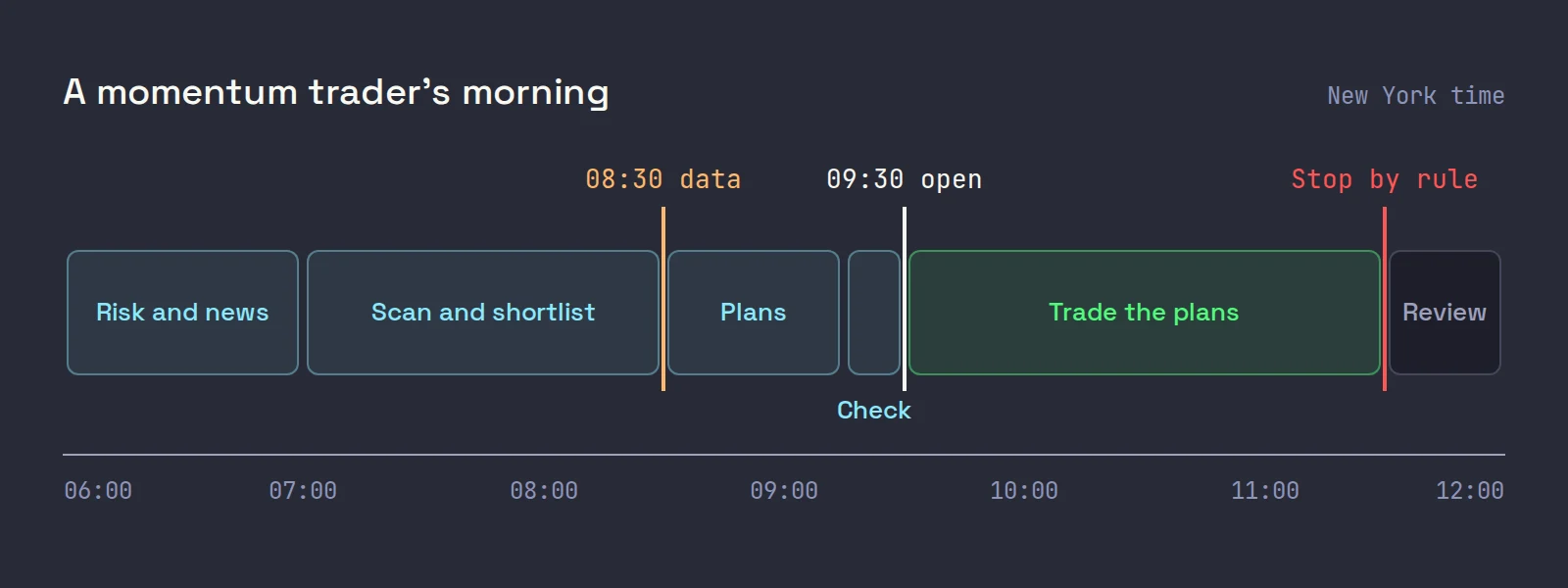
The day trading routine at a glance
| Time (ET) | What you do | What you have at the end |
|---|---|---|
| 06:00 | Set the day's risk numbers, check overnight news and filings | A daily loss limit and risk per trade, written down |
| 07:00 to 08:30 | Scan for pre-market gappers, shortlist | Two to four names with a reason to move |
| 08:30 | Watch the economic data release, if there is one | A sense of the market's mood |
| 08:30 to 09:15 | Write a plan for each name | Trigger, stop, size and invalidation per stock |
| 09:15 to 09:30 | Platform and order check | Data live, keys ready, limits on |
| 09:30 to 11:30 | Trade only the plans | Trades you can journal |
| By 11:30, or your rule | Stop | A flat account |
| After the session | Review | One thing to change tomorrow |
06:00: decide your risk before you see a chart
The first job of the morning is the one you will be least able to do later: decide how much you can lose today.
- Risk per trade. A fixed dollar amount, for example $40, and size every trade so a stop-out costs that much (trade a fixed dollar risk).
- Daily loss limit. Usually a few losing trades, for example $120 with $40 risk per trade. When it is hit, the day is over (daily loss limit).
- Maximum trades. A number that stops you grinding all morning.
Write them on paper or set them in your platform now. A limit you set at 06:00 is a rule. A limit you set at 10:15 after three losers is a negotiation.
Then check what happened overnight: your broker's news feed for the names you know, the SEC EDGAR latest filings for offerings priced after the close, and the economic calendar. Big US data such as the jobs report come out before the open: the Bureau of Labor Statistics schedules the Employment Situation release for 08:30 AM, for example on November 6, 2026 (BLS release schedule). On those mornings expect a jolt at 08:30 and decide whether you want a position open through it.
07:00 to 08:30: build the watchlist
Nasdaq's pre-market session runs from 04:00 to 09:30 ET and after hours from 16:00 to 20:00 (Nasdaq trading hours), so by 07:00 the stocks with overnight news have already shown themselves. Scan for them, then cut hard.
What small-cap momentum traders usually look for:
- A gap up of 10% or more on real volume, priced roughly $2 to $20.
- Relative volume of several times normal, which shows the stock is in play today.
- A catalyst you can name: earnings, an FDA decision, a contract. No news usually means no follow-through.
- No fresh dilution. An offering filed overnight can cap the move; check dilution before you fall in love.
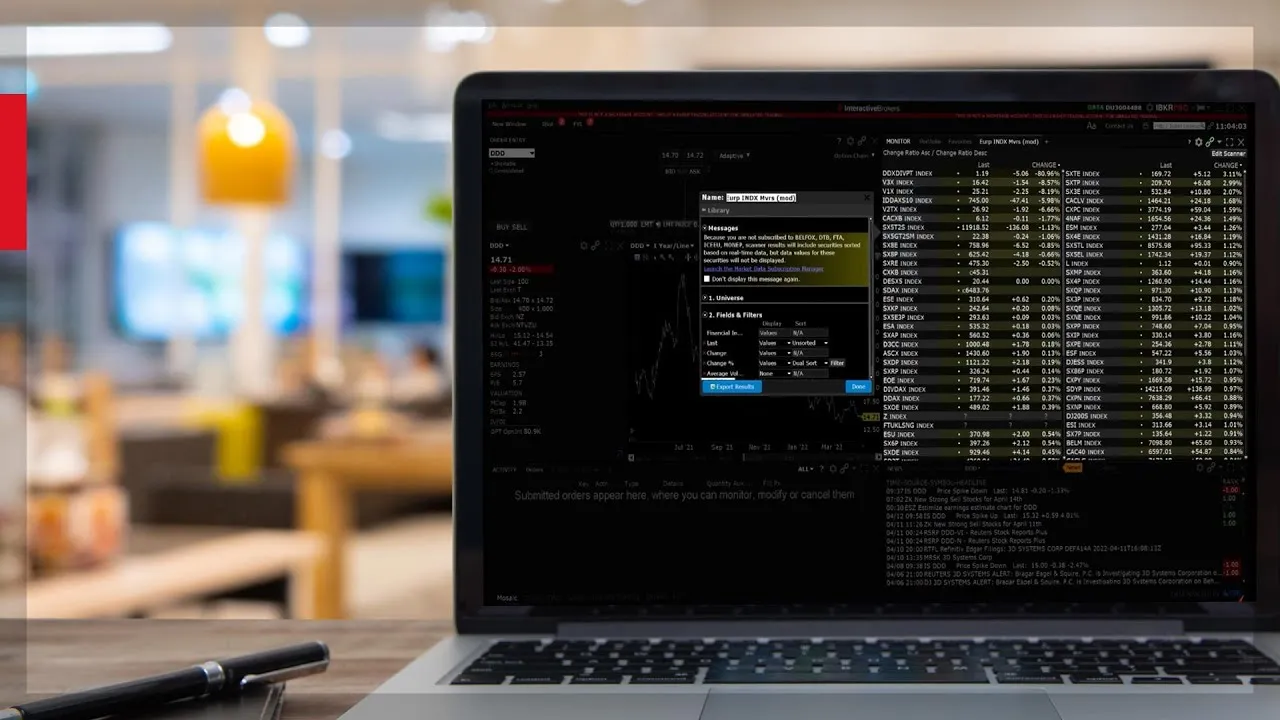
Our post on pre-market gappers goes through the scan in detail. If you build the scan in TWS, IBKR's own video on Mosaic market scanners shows how to set the filters and save the scan, which is the quickest way to get this step working without extra software.
Stop at two to four names. You can read the Level 2 and tape of two stocks properly; you cannot read ten. A long watchlist feels like opportunity and works like distraction.
08:30 to 09:15: write a plan for each stock
A plan is one line per stock, written before the open:
| Stock | Levels | Trigger | Stop | Size | Invalid if |
|---|---|---|---|---|---|
| ABCD | Pre-market high 6.40, VWAP 5.95, 6.00 | Break and hold above 6.40 | 6.24 | 250 shares | It loses VWAP before the open |
The arithmetic: a stop at 6.24 under a 6.40 entry is 16 cents of risk a share. With $40 of risk per trade, $40 / $0.16 = 250 shares. If the stock opens at 6.55, above your trigger, the plan does not say "buy higher": you wait for a new setup or you skip it. Buying anyway is chasing, and our post on FOMO trading puts a number on what it costs.
There is research behind the warning. Barber, Huang, Odean and Schwarz studied what happened after Robinhood users crowded into the same stocks: the stocks they bought most heavily each day had average 20-day abnormal returns of -4.7% ("Attention-Induced Trading and Returns: Evidence from Robinhood Users", Journal of Finance 77, no. 6, 2022, DOI 10.1111/jofi.13183). Buying because everyone is watching is not a plan.
09:15 to 09:30: the platform check
Fifteen minutes before the open, check the machine, not the market:
- Market data is live and streaming, with Level 2 on the stocks you plan to trade.
- Your hotkeys work: test them in a paper account if you changed anything.
- Orders can fill outside regular hours if you trade the pre-market. In TWS that is the outside-RTH setting; IBKR's lesson on trading outside regular trading hours shows where it is.
- Your daily loss limit and position caps are set.
- Phone notifications off.
Scalpel is independent and not affiliated with or endorsed by Interactive Brokers or Nasdaq.
09:30 to 11:30: trade the plan, then stop
The open is fast. Spreads are wide in the first minutes and the first move is often reversed. Trade only the triggers you wrote down, at the size you wrote down, with the stop where you wrote it.
Then stop by rule, whichever comes first:
- The daily loss limit is hit. No exceptions, no "one more to get it back"; that is the start of revenge trading.
- Your trade count is reached.
- The clock. Many momentum traders stop by about 11:30, when volume usually fades into midday. Your own journal is the real judge of which hours pay you.
- A daily goal, if you use one, so a good morning is not given back.
After the session: the review
Spend 15 minutes, not an hour. Fill in every trade in your day trading journal with its setup, R and mistake tag. Note one thing you did well and one to change tomorrow. Once a week, sort the journal by hour: it will show whether your routine's stop time is right for you.
If you are still learning, run this exact routine in paper trading first. A routine practiced on paper is one less thing to think about when the money is real.
A day trading schedule if you start at 04:00
Some momentum traders start when the pre-market opens at 04:00 ET, because the biggest gappers can make much of their move before most people are awake. The routine is the same, earlier: risk set at 03:45, scan from 04:00, plans written before you take a trade. Pre-market books are thin and spreads are wide, so trade smaller than you would after the open. Two things differ at the broker: exchanges accept only limit orders outside regular hours, and a stop order resting at the broker does not protect a pre-market trade; our post on why stops do not trigger in the pre-market explains it.
Whatever time you start, pick a stop time and keep it. A day trading schedule with no end is how a good morning becomes a bad day.
Where Scalpel fits
Scalpel was built around this routine, pre-market first. Our pre-market routine guide walks it in the app: set Daily loss ($), the caps and your four risk presets in Settings before the session, keep a desk on SCAN with IBKR's own scanner merged into one list from 04:00 (pre-market scanning), and read the dilution and catalyst chips on each row. The voice calls the session times ("Pre-market is open. Good luck!" at 04:00), and the daily loss limit raises a RISK LOCK that refuses new buys when the day goes wrong. Its stops are app-monitored, which is why they can protect a pre-market trade, and also why Scalpel must stay running and connected while you hold a position.
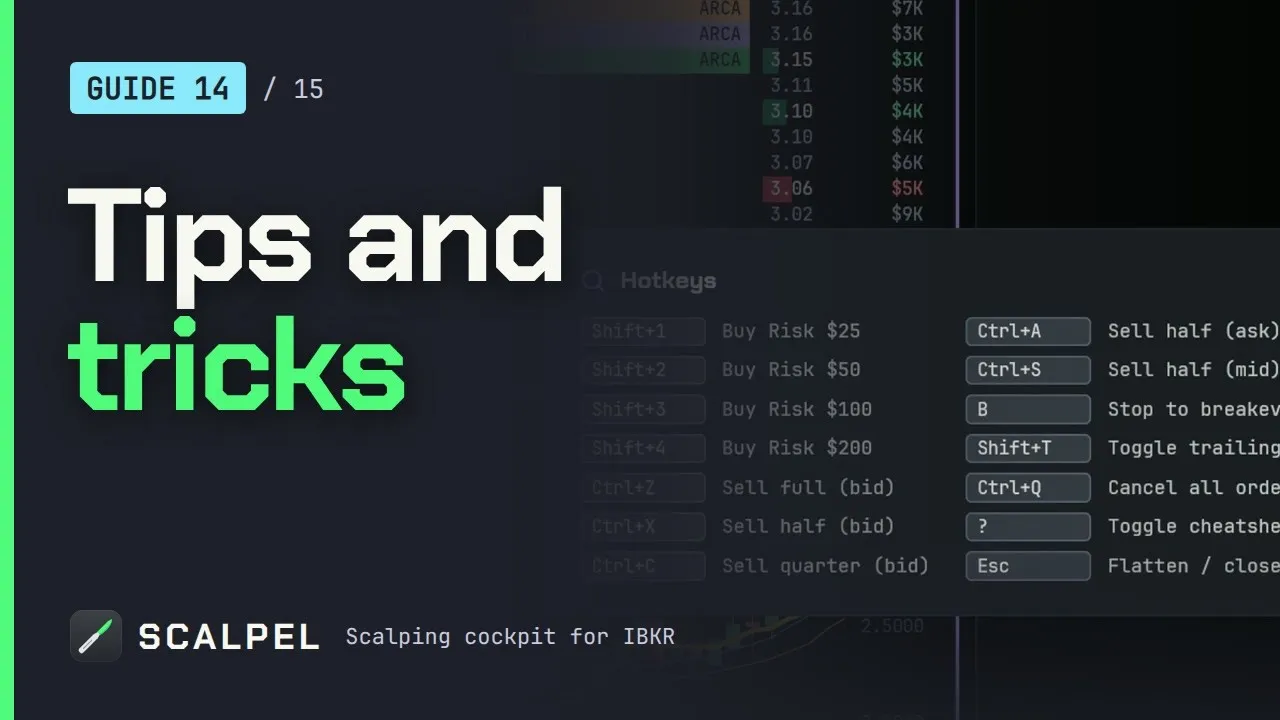
This short video from our guides collects the tips that make a morning faster in Scalpel.
For where the routine fits in the bigger plan, see how to start day trading. Facts on market hours and release times checked on October 22, 2026.
Trading carries a significant risk of loss. Nothing here is financial advice.
Questions
- What time should a day trader start in the morning?
- Most momentum traders are at the screen by 07:00 ET to scan pre-market gappers, and some start when the pre-market opens at 04:00 ET. Set your risk numbers before you look at any chart.
- What is a good day trading routine?
- Set your daily loss limit and risk per trade first, check overnight news and filings, shortlist two to four gappers, write a trigger, stop and size for each, check your platform at 09:15 ET, trade only those plans, stop by rule, and review the day in a journal.
- How many stocks should be on a day trading watchlist?
- Two to four. You can read the Level 2 and tape of a few stocks properly; a long list mostly creates reasons to chase.
- When should a day trader stop trading for the day?
- When the daily loss limit is hit, the trade count is reached or the stop time arrives, whichever comes first. Many momentum traders stop by about 11:30 ET as volume fades.
- What time does the pre-market start?
- Nasdaq's pre-market session runs from 04:00 to 09:30 ET, and after hours runs from 16:00 to 20:00 ET. Books are thinner and spreads wider than in regular hours.
Related guides
Guide 14.2A pre-market routine with ScalpelA step-by-step routine from 04:00 ET to the open: connect, scan for gappers, check dilution and borrow, load your desks and set your risk before the bell.Guide 8.3Scan the pre-marketScan pre-market movers from 04:00 ET in Scalpel: what the gainers, volume spike and gap scans show before the open, gap and go, and what changes at 09:30.Guide 7.1Set a daily loss limit (the kill-switch)Set a max daily loss in Scalpel: when your P&L hits it, new entries stop, a RISK LOCK banner shows, and it can flatten everything. How to resume trading.
Keep reading
- How to start day trading in 2026: a realistic planHow to start day trading in 2026: the honest odds, the money and rules after the PDT change, one setup, simulator practice, a journal and going live small.
- Day trading statistics: what the research says about who makes moneyDay trading statistics from primary research: 97% of persistent Brazilian day traders lost money, under 1% in Taiwan profit reliably. Samples and limits.
- Paper trading: does it work, and how to make it countDoes paper trading work? Where simulated fills lie, IBKR's paper account limits, how to make practice realistic, and when to switch to live trading.
Practice in SIM, against the live book.A lifetime license, every update included, with a 7-day refund guarantee.Ask in DiscordGet Scalpel