FOMO trading: why you chase stocks and the rules that stop it
By Scalpel Team. , updated . 8 min read.
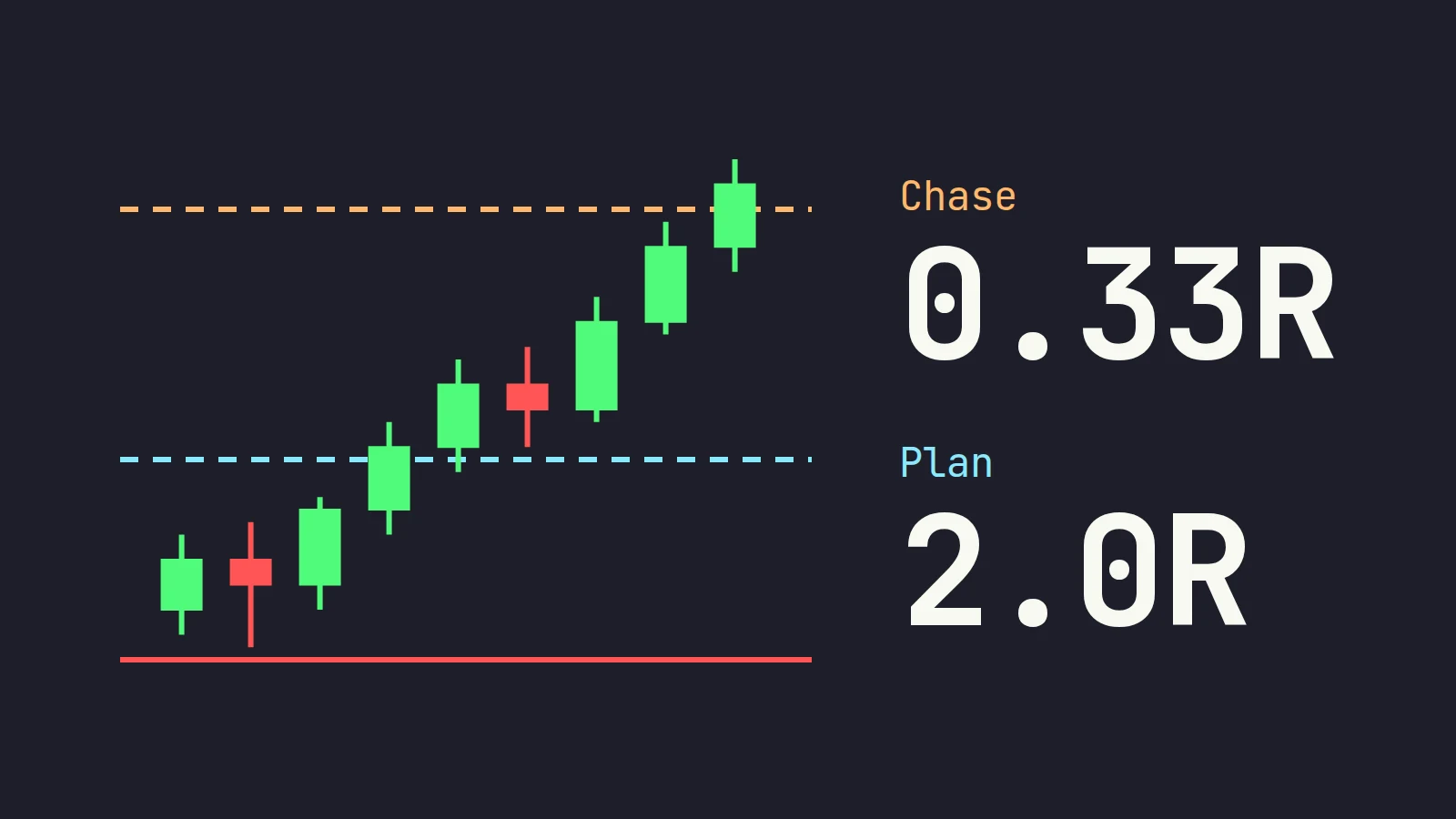
In short
FOMO trading is buying a stock because it is moving and you are afraid to miss the rest of the move, not because your setup triggered. In day trading it shows up as chasing: paying well above your planned entry, which either widens your stop and shrinks your reward-to-risk, or keeps the stop tight and puts it inside normal noise. Research backs the pull: individual investors are net buyers of attention-grabbing stocks, and the stocks Robinhood users herded into went on to underperform. The fix is a written entry rule with a maximum distance from your trigger, a minimum reward-to-risk at the price you would actually pay, size worked out from the stop, and the habit of treating a missed trade as a $0 trade.
A small cap gaps up on news, you watch it run from $4.20 to $5.10 in a few minutes, and your hand is on the buy key before you have decided where the stop goes. That is fear of missing out in trading, and on fast small caps it is one of the most expensive habits a day trader can have. This post explains why the pull is so strong, what chasing costs in R with a worked example, how to recognize it while it is happening, and the entry rules that stop it.
We build Scalpel, a day trading cockpit for Interactive Brokers, so we spend our days around exactly the kind of stocks that trigger FOMO. None of what follows makes trading easy: most day traders lose money, and the research behind that is in our post on day trading statistics.
What FOMO trading looks like on a small cap
Fear of missing out is the feeling that everyone else is making money on a move you are not part of. On a momentum stock it has a recognizable shape:
- The stock is up big on the day, often on a fresh catalyst, with heavy relative volume.
- You were not in it for the first leg, so you either missed the planned entry or never had a plan for it.
- It keeps printing green candles, with no pullback to buy.
- You buy near the high of day, with no stop decided, because waiting feels like losing.
The trade is not chosen. It is triggered by the move itself. That matters because the move is exactly what a scanner, a chat room or a news alert is built to show you.
Why traders chase: attention drives buying
Behavioral finance has a clean explanation for why chasing feels natural. Brad Barber and Terrance Odean studied the trades of individual and institutional investors in All That Glitters (Review of Financial Studies, 2008) and confirmed that individual investors are net buyers of attention-grabbing stocks: stocks in the news, stocks with unusually high trading volume and stocks with extreme one-day returns. Their reasoning is simple. When you buy, you have thousands of stocks to choose from, so you only consider the ones that caught your eye. When you sell, you choose from the few you own.
The effect was not small. In the working paper version, investors at a large discount broker made nearly twice as many purchases as sales of stocks in the top 5% of abnormal trading volume. Professional money managers showed the least attention-driven buying.
The same authors, with Xing Huang and Christopher Schwarz, later looked at Robinhood users in Attention-Induced Trading and Returns (Journal of Finance, 2022). Robinhood users herded into attention-grabbing stocks, and the stocks they bought most each day went on to have average 20-day abnormal returns of -4.7%.
Surveys say the same thing in plainer words. In the FINRA Investor Education Foundation and CFA Institute study of investors aged 18 to 25, half (50%) said they had made an investment driven by fear of missing out. The SEC's investor education office ran a column on it under the slogan Say NO GO to FOMO.
Two honest caveats. These studies are about investors holding for days, not scalpers holding for minutes, and a momentum day trader is deliberately trading attention-grabbing stocks. The point is not that hot stocks are untradeable. It is that the urge to buy them is a known, measurable bias, and it does not care whether your setup is there.
Odean explains attention-driven buying, and the habit of selling winners and holding losers, in this short lecture on his own channel. It is worth five minutes because it shows the bias is about how people choose, not about intelligence.
What chasing costs, in R
Chasing does not just mean a worse price. It changes the shape of the trade. Measure it in R, the amount you risk to your stop, and the damage is easy to see.
Take a fictional stock, ABCD, that gapped up in the pre-market. Your plan: buy a break of the $5.00 pre-market high at $5.02, stop under the pullback low at $4.86, target the earlier spike high at $5.34. You risk $80 a trade.
You hesitate, the break goes without you, and you buy at $5.22 instead. You now have two choices, and both are worse.
| Planned entry | Chase, same stop | Chase, tight stop | |
|---|---|---|---|
| Entry | $5.02 | $5.22 | $5.22 |
| Stop | $4.86 | $4.86 | $5.06 |
| Risk per share | 16c | 36c | 16c |
| Shares for $80 risk | 500 | 222 | 500 |
| Target | $5.34 | $5.34 | $5.34 |
| Reward per share | 32c | 12c | 12c |
| Reward-to-risk | 2.0R | 0.33R | 0.75R |
| Win rate needed to break even | 33% | 75% | 57% |
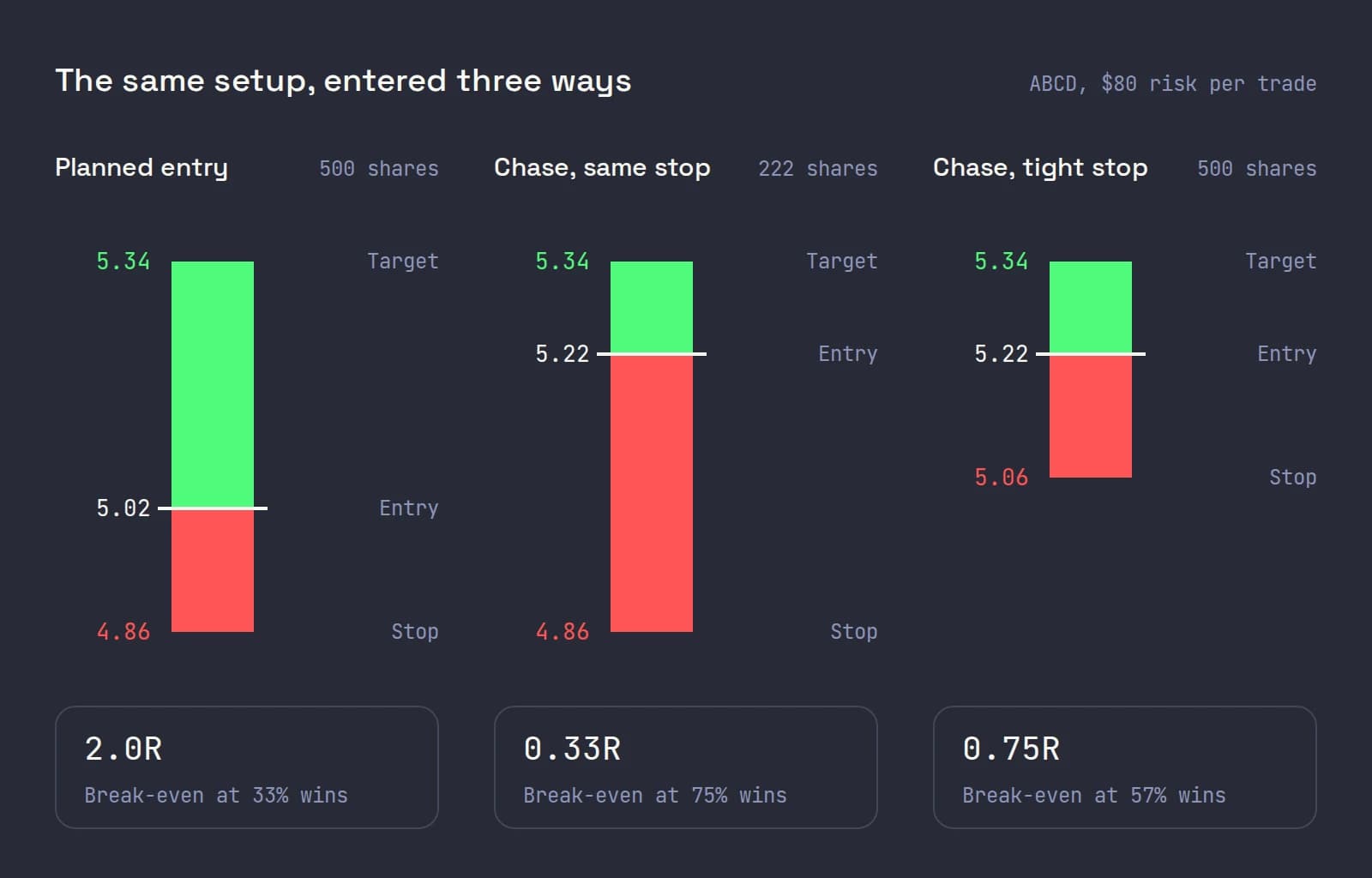
The break-even win rate is 1 divided by (1 plus the reward-to-risk), before costs. The planned trade can be wrong two times in three and still break even. The chased trade with the honest stop has to win three times in four. The chased trade with the tight stop keeps the share count but parks the stop at $5.06, in the middle of a move that only has to pull back to the breakout level to stop you out.
Costs make it worse. A chase usually means a marketable buy into a thin, fast book, so you also pay more slippage and a wider spread than on a planned entry.
The more general lesson is the one in our post on the risk reward ratio: the price you pay decides how much the trade can make, and a chase spends most of that before you start.
Signs you are chasing
You rarely notice FOMO in the moment, so name the signs in advance. If two or more of these are true, you are probably chasing:
- You cannot say where your stop goes before you press.
- The stock has printed three or more green candles in a row and you are buying the last one.
- Your entry is far above the level your setup was built on, such as the breakout level or VWAP.
- You had not looked at the stock five minutes ago.
- You bought because of an alert, a chat message or a scanner row, not because you saw your setup.
- You sized up because "it is a runner."
- You feel relief when the order fills, not calm.
Write the list on a card next to your screen. It works better than willpower.
Rules that stop chasing trades
These are the rules we would give a trader who keeps chasing. None of them needs special software.
- Write the trigger before price gets there. Entry level, stop and target, in a note or on the chart. If you did not write it, you do not trade it.
- Set a maximum distance from the trigger. If price is more than a quarter of your stop distance above your planned entry, the trade is gone. With a 16c stop, that is 4c: you buy up to $5.06, not $5.22.
- Check reward-to-risk at the price you would actually pay. Not at the price you planned. If the target is less than twice your risk from here, pass.
- Size from the stop, never from the share count. A wider stop then means fewer shares on its own, so a chase is visibly smaller. Our guide to trading a fixed dollar risk shows the method.
- Wait for the pullback. A stock that ran without you often gives a second entry. The first pullback strategy is the usual one in small-cap momentum.
- Count missed trades as $0, and log them. A missed trade costs nothing. Write it in your trading journal with what would have happened, so you can see over time how many chases would have worked. Usually fewer than it feels.
- Keep the daily loss limit as the backstop. If a chase loses and the next trade is a chase to win it back, the limit ends the day before that becomes revenge trading. Our daily loss limit guide shows how to set it.
FOMO is worse in the pre-market
Pre-market books on small caps are thin. Outside regular hours, exchanges take limit orders only, spreads are wider and a few thousand shares can move the price. A FOMO buy at 07:30 ET is usually a buy at the ask in a book that has little behind it. If the move fails, the exit is just as thin.
If you trade the pre-market, use smaller size there, keep a tight limit on how far your buy can reach past the ask, and accept that most pre-market moves you miss were never yours. The wider plan for a beginner is in our guide to how to start day trading.
Where Scalpel fits
No software can stop you wanting a trade. What it can do is make the cost of a chase visible before you press and put hard limits where your rules are soft. These are the Scalpel features we would use against FOMO:
- The size line. Above each buy button the order bar shows the dollar size that press would buy at the current ask (order bar guide).
- Risk (Low) sizing. This preset puts the stop under the lowest low of the last 20 one-minute candles and sizes the trade from the ask down to it. After a long run with no pullback that low is far away, so the size line shrinks as the stock runs. A chase looks small because it is (sizing presets).
- Buy offset (c). Every Scalpel buy is a marketable limit at the ask plus an offset, 10 cents by default, in Settings > Trading. That caps how far one press can walk up a thin book (marketable limit).
- Fat-finger ($) and Max position ($). These caps in Settings > Risk refuse any single buy, or any position in one stock, above the value you set, so a FOMO double-size never gets sent (fat-finger and position caps).
- Daily loss ($). The kill-switch blocks new buys once the day's realized plus open loss reaches your limit.
- Analytics by hour. The Breakdowns view shows net P&L by New York hour, so you can check whether your late, extended entries actually pay (analytics).
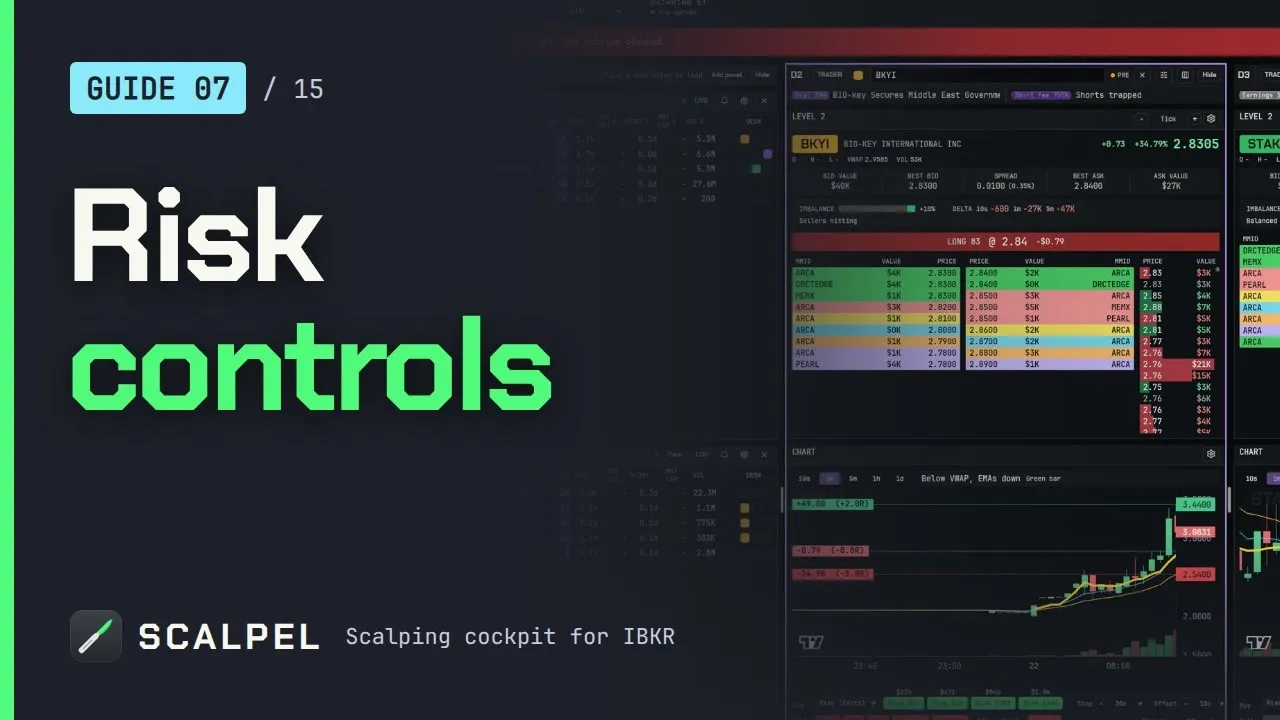
This video walks through the risk controls in the app:
The stock selection side of momentum trading, and where these entries come from, is in the momentum method guide. Scalpel is long only, has no auto trader, and its stops are watched by the app rather than resting at your broker, so they only work while Scalpel runs with a live feed.
Research sources checked on October 22, 2026.
Trading carries a significant risk of loss. Nothing here is financial advice.
Questions
- What is FOMO in trading?
- FOMO, fear of missing out, is the urge to buy a stock because it is moving and others seem to be profiting, rather than because your own setup triggered. In day trading it usually shows up as chasing: buying far above your planned entry with no stop decided.
- How do I stop chasing stocks?
- Decide your entry, stop and target before price gets there, set a maximum distance above the trigger you will pay, and check reward-to-risk at the price you would actually pay. If the trade is gone, log it as a missed trade and wait for a pullback.
- Why is chasing a stock bad?
- A higher entry either widens your stop, which cuts your reward-to-risk, or forces a stop inside normal price noise. In our example a 2R trade became a 0.33R trade that needed a 75% win rate to break even.
- Is FOMO trading a real bias or just impatience?
- It is well documented. Barber and Odean found individual investors are net buyers of attention-grabbing stocks, and a later study found the stocks Robinhood users bought most each day had average 20-day abnormal returns of -4.7%.
- Should I buy a stock that is already up 50% on the day?
- Only if your own setup gives an entry with a defined stop and enough reward-to-risk at that price. Being up a lot is not a setup. Many momentum traders wait for the first pullback instead of buying an extended move.
Related guides
Guide 7.1Set a daily loss limit (the kill-switch)Set a max daily loss in Scalpel: when your P&L hits it, new entries stop, a RISK LOCK banner shows, and it can flatten everything. How to resume trading.Guide 7.2Fat-finger and max-position capsWhat Scalpel's fat-finger cap and max-position cap block, how they interact with risk sizing, and sensible values for small, medium and larger accounts.Guide 14.6The momentum method Scalpel is built aroundThe small-cap momentum style Ross Cameron teaches, from stock selection to gap and go and micro pullbacks, mapped to Scalpel's scanner, intel and stops.
Keep reading
- How to start day trading in 2026: a realistic planHow to start day trading in 2026: the honest odds, the money and rules after the PDT change, one setup, simulator practice, a journal and going live small.
- Day trading statistics: what the research says about who makes moneyDay trading statistics from primary research: 97% of persistent Brazilian day traders lost money, under 1% in Taiwan profit reliably. Samples and limits.
- Paper trading: does it work, and how to make it countDoes paper trading work? Where simulated fills lie, IBKR's paper account limits, how to make practice realistic, and when to switch to live trading.
Practice in SIM, against the live book.A lifetime license, every update included, with a 7-day refund guarantee.Ask in DiscordGet Scalpel