Day trading taxes in the US: short-term gains, trader status, 475(f)
By Scalpel Team. , updated . 9 min read.
In short
Day trading taxes in the US start with one fact: profits are short-term capital gains, taxed as ordinary income at your regular rate (10% to 37% in 2026) and reported on Form 8949 and Schedule D. Net losses offset only $3,000 of other income a year, with the rest carried forward, and wash sales apply. If you qualify as a trader in the IRS's sense, you deduct trading expenses on Schedule C, and with a timely section 475(f) election your gains and losses become ordinary: no $3,000 cap and no wash sales. The election is due by the original due date of the previous year's return.
Most new day traders find out how their trading is taxed in April, from a 1099-B with hundreds of lines. This post explains day trading taxes before that point: how profits are taxed, a worked example with the 2026 brackets, what happens in a losing year, what trader tax status is and is not, and how the 475(f) mark-to-market election changes the picture.
This is general information, not tax or legal advice. Rules depend on your whole situation, and the trader status test in particular turns on facts. Use a tax professional who works with active traders. IRS sources checked on October 22, 2026. Scalpel is independent and not affiliated with or endorsed by Interactive Brokers.
How day trading profits are taxed
Day trades are held for minutes or hours, so every gain and loss is short term. IRS Topic 409 draws the line at one year: hold an asset "for more than one year" and the gain is long term; one year or less and it is short term. Then: "Net short-term capital gains are subject to taxation as ordinary income at graduated tax rates."
So there is no special day trading rate. Your net trading gain is stacked on top of your wages and other income and taxed at your marginal rates. For 2026 the IRS published these brackets for single filers (IR-2025-103, Revenue Procedure 2025-32):
| Rate | Single filer, taxable income over |
|---|---|
| 10% | $0 |
| 12% | $12,400 |
| 22% | $50,400 |
| 24% | $105,700 |
| 32% | $201,775 |
| 35% | $256,225 |
| 37% | $640,600 |
For married couples filing jointly, the 37% rate starts above $768,700. The 2026 standard deduction is $16,100 for single filers and $32,200 for married filing jointly.
A worked example
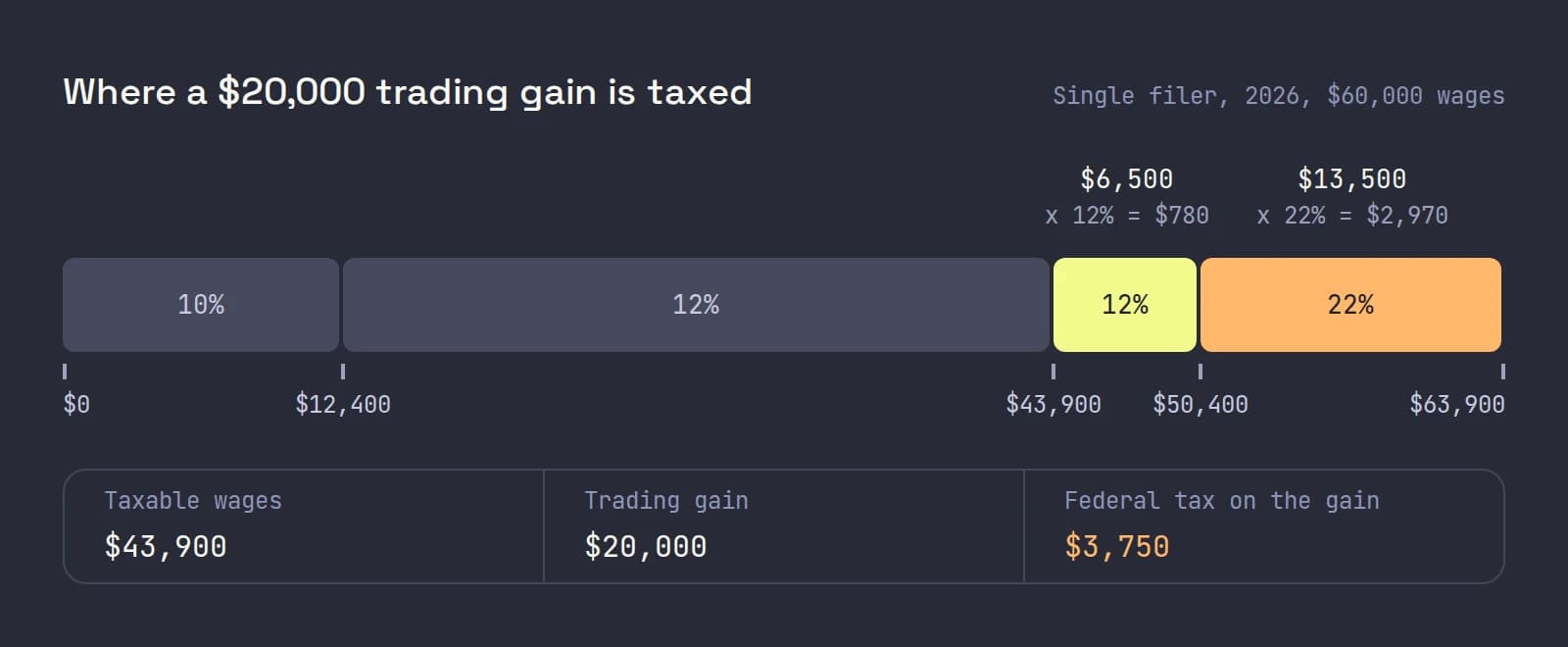
A single filer earns $60,000 in wages and has a net short-term trading gain of $20,000 for 2026, after commissions. Using the standard deduction and ignoring everything else:
| Without trading | With trading | |
|---|---|---|
| Income | $60,000 | $80,000 |
| Standard deduction | $16,100 | $16,100 |
| Taxable income | $43,900 | $63,900 |
The extra $20,000 lands in two brackets: $6,500 of it fills the rest of the 12% bracket (up to $50,400) and $13,500 falls in the 22% bracket. Federal income tax on the trading gain is $780 + $2,970 = $3,750, about 18.75% of the gain. State income tax, where your state has one, comes on top.
Two more federal items can apply:
- Net investment income tax. IRS Topic 559 adds 3.8% on the lesser of your net investment income or the amount your modified AGI exceeds $200,000 (single or head of household) or $250,000 (married filing jointly). Its definition of net investment income includes net gains from selling stocks and income from a trade or business of "trading in financial instruments."
- Estimated tax. Nobody withholds tax from trading gains. The IRS says individuals generally must pay estimated tax if they expect to owe $1,000 or more when they file. A good trading year without quarterly payments can mean an underpayment penalty.
How day trading losses are taxed
A losing year is where the default rules hurt. Under Topic 409 you can deduct net capital losses only up to "the lesser of $3,000 ($1,500 if married filing separately)" against other income, and carry the rest forward to later years.
A trader who ends 2026 down $18,000 net deducts $3,000 against wages this year and carries $15,000 forward. If 2027 is also flat, that carryforward is still sitting there, $3,000 at a time.
Wash sales make the timing worse. A loss in December in a stock you buy again in January moves into next year (the wash sale rule for day traders has the worked example).
Reporting: 1099-B, Form 8949 and Schedule D
Your broker sends Form 1099-B listing every sale. You carry it to Form 8949 and the totals to Schedule D. Wash sales the broker has identified appear on the 1099-B; you add any it could not see, such as a rebuy in a different account. Tax software imports a 1099-B directly, which with hundreds of trades is the only sane way to do it.
At Interactive Brokers, TWS has a Tax Optimizer that shows year-to-date short-term and long-term P&L by symbol and lets you choose how sales are matched to tax lots. That is useful for a running estimate; the 1099-B is what you file from. IBKR's Traders' Academy also has a course on US taxes for traders and investors, which the video below comes from.
Trader tax status: what the IRS requires
"Trader" is a tax status, not a job title. IRS Topic 429 lists three conditions, all of which must be met:
- "You must seek to profit from daily market movements in the prices of securities"
- "Your activity must be substantial"
- "You must carry on the activity with continuity and regularity"
and four factors the IRS weighs: your typical holding periods, the frequency and dollar amount of your trades during the year, the extent to which the activity produces income for a livelihood, and the time you devote to it. Publication 550 adds a blunt line: "It does not matter whether you call yourself a trader or a 'day trader.'"
The IRS gives no bright-line numbers: no minimum trade count, no hours per week. Our reading, and it is only that: someone with a full-time job who trades a few mornings a week, or takes a few dozen trades a year, will struggle to show substantial, continuous and regular activity. Someone who trades most sessions, every week, all year, as a main activity, is the profile the test describes. If your claim matters, document it and get a professional opinion.
This IBKR Traders' Academy lesson walks through the trader or investor question, the facts and circumstances, and the audit considerations. It is from 2019; the criteria it explains are the same ones on the IRS pages today:

What trader status changes, and what it does not
Without any election, a qualifying trader's gains and losses are still capital gains and losses on Form 8949 and Schedule D, still subject to the $3,000 loss limit and to wash sales. Topic 429 says so directly. What changes is expenses: "Traders report their business expenses on Schedule C." Publication 550 says interest and other expenses of the trading business go on Schedule C, and that the investment interest limit that applies to investors does not apply to a trading business. Those business expenses may include costs like market data and trading software, if they are genuinely expenses of the trading business.
What does not change: commissions are not a separate deduction for anyone; they are part of the cost or proceeds of each trade. And trading gains are not subject to self-employment tax, with or without the election.
The section 475(f) mark-to-market election
A qualifying trader can elect mark-to-market accounting under section 475(f). From Topic 429 and Publication 550, the effect is:
- Gains and losses from the trading business are "generally treated as ordinary gains and losses," reported in Part II of Form 4797 instead of on Form 8949 and Schedule D.
- Securities still held in the trading business at year-end are treated as sold at fair market value on the last business day of the year.
- "The wash sale rules, and certain other rules do not apply."
- The $3,000 capital loss limit no longer applies to trading losses, because they are no longer capital losses.
| Investor | Trader, no election | Trader with 475(f) | |
|---|---|---|---|
| Gains and losses | Capital (Form 8949, Schedule D) | Capital (Form 8949, Schedule D) | Ordinary (Form 4797, Part II) |
| Net loss against other income | $3,000 a year, rest carried forward | $3,000 a year, rest carried forward | Not capped at $3,000 |
| Wash sale rule | Applies | Applies | Does not apply |
| Trading business expenses | Not on Schedule C | Schedule C | Schedule C |
| Open positions at year-end | Taxed when sold | Taxed when sold | Marked to market |
| Self-employment tax on gains | No | No | No |
Back to the $18,000 losing year: with trader status and a valid 475(f) election, that is an ordinary loss rather than $3,000 now and $15,000 later.
The election deadline
This is where most people miss out. Publication 550: to make the election for 2026, "you must have filed an election statement no later than the due date for your 2025 return (without regard to extensions)." The statement goes with that return or with an extension request, and names section 475(f), the first tax year it covers, and the trading business. For 2027, the deadline is the original due date of your 2026 return, normally April 15, 2027.
So you elect before the year you want it for, not after you see the results. A new taxpayer not required to file the year before can instead place the statement in their books within 2 months and 15 days of the start of the year. A change of accounting method also needs Form 3115. And once made, the election stays in force for later years unless the IRS gives permission to revoke it.
The main trade-off: gains on securities in the trading business can never be long term, so investments you mean to hold must be identified separately on the day you acquire them, for example by holding them in a separate account. For a scalper who never holds overnight that costs little. For someone who also invests, it takes real record keeping.
A day trading taxes checklist for the year
- Track your net, after fees, as you go. Your broker's year-to-date P&L and your own journal should agree.
- Set aside tax on gains and pay estimated tax if you will owe $1,000 or more.
- Watch wash sales in December.
- Decide on 475(f) before the deadline, not after a losing year.
- Keep records that show how you trade: trade counts, hours, the setup. They matter if trader status is ever questioned, and a day trading journal does double duty here.
The other rules that shape a day trading account, from settlement to intraday margin, are in our guide to day trading rules. What trading costs before tax is in the real cost of day trading, and the commission side is worked out in IBKR Tiered vs Fixed.
Where Scalpel fits
Scalpel does not prepare taxes or produce tax forms; for filing, use your broker's 1099-B. What it does is keep an honest record of your trading as you go. Every LIVE trade goes into the LIVE journal with its entry, exit, size and the commission IBKR reported, and the Analytics view shows net P&L after fees, by symbol and by New York hour (analytics guide). That is the running number to set tax aside against, and the evidence of how often and how regularly you trade.
SIM trades are paper trades with no tax consequence, and SIM keeps its own journal apart from LIVE. Set SIM's commission plan to your IBKR plan (commissions guide) and size it like your real account (small account setup), and its numbers show whether a strategy survives its fees before any tax is due. This video shows how SIM and LIVE work side by side:
Scalpel is long only, and its stops are app-monitored rather than resting at IBKR, so they only work while Scalpel runs with a live feed.
This is general information, not tax or legal advice.
Trading carries a significant risk of loss. Nothing here is financial advice.
Questions
- How are day trading profits taxed?
- Day trading profits are short-term capital gains, taxed as ordinary income at your regular federal rate, which runs from 10% to 37% for 2026. They are reported on Form 8949 and Schedule D unless you have a valid section 475(f) election.
- Can I deduct day trading losses?
- Net capital losses offset other income up to $3,000 a year, or $1,500 if married filing separately, and the rest carries forward. A qualifying trader with a timely 475(f) election treats trading losses as ordinary instead.
- What is trader tax status?
- It is the IRS treatment for people in the business of trading. You must seek to profit from daily price movements, and your activity must be substantial and carried on with continuity and regularity. The IRS weighs holding periods, trade frequency and amounts, reliance on the income and time spent.
- When is the deadline for the 475(f) election?
- Individuals must file the election statement by the original due date, without extensions, of the tax return for the year before the year the election takes effect. For 2027 that is the due date of the 2026 return, normally April 15, 2027.
- Do day traders pay self-employment tax?
- No. The IRS says gains and losses from selling securities as a trader are not subject to self-employment tax, whether or not the mark-to-market election is made.
- Do I need to pay estimated taxes on trading gains?
- Often, yes. The IRS says individuals generally must make estimated tax payments if they expect to owe $1,000 or more when they file, and no tax is withheld from trading gains.
Related guides
Guide 6.4Analytics: review your tradingScalpel's Analytics view: equity curve, win rate, expectancy, profit factor, R distribution, every trade, results by symbol and hour, and a trader grade.Guide 6.3Commissions: pick your IBKR planMatch Scalpel's SIM fees to your Interactive Brokers plan: Pro Tiered, Pro Fixed, Lite or custom, plus exchange and clearing fees, and the FEE column.Guide 14.4Settings for a small accountSettings that suit a small account: risk-based presets, tight caps, a daily loss limit you will respect, the right commission plan, and what to watch for.
Keep reading
- Day trading rules in 2026: every rule a US stock trader should knowDay trading rules for 2026: the PDT rule replaced by intraday margin, T+1 settlement, LULD halts, SSR, wash sales and taxes, each with its source.
- The PDT rule is gone: what changed for day trading on Interactive BrokersYes: IBKR began dropping the PDT rule on June 4, 2026. No $25,000 minimum, no day trade count. What replaced it, a worked example and who is still on it.
- IBKR Tiered vs Fixed for scalpers: the math on real tradesTiered vs Fixed pricing explained simply: Fixed is one flat rate a share, Tiered a lower rate plus exchange fees. Which is cheaper on IBKR, worked out.
Practice in SIM, against the live book.A lifetime license, every update included, with a 7-day refund guarantee.Ask in DiscordGet Scalpel