IBKR penny stocks: trading OTC and microcaps on Interactive Brokers
By Scalpel Team. , updated . 8 min read.
In short
Yes, you can trade penny stocks on Interactive Brokers, with limits. Exchange-listed stocks under $5 trade like any other stock. OTC stocks on OTCQX, OTCQB and Pink Current can be bought too, but IBKR will not accept opening orders in stocks OTC Markets labels Caveat Emptor or Grey Market, or online and phone opening orders in "unsolicited quotes only" stocks. IBKR also restricts transfers of US microcaps and trading by company affiliates. Commissions are IBKR's normal rates with the 1% of trade value cap, and on IBKR Lite, OTC stocks are charged Fixed pricing.
"Penny stock" means different things to different people. To a trader it is anything cheap. To the SEC it is a specific legal category. To Interactive Brokers the category that matters is "U.S. Microcap Stock," and it is broader than most traders expect: it includes plenty of Nasdaq-listed names. This post sorts out the definitions, then covers IBKR penny stocks in practice: IBKR's own restrictions, fees and data costs, all checked against IBKR's pages on October 22, 2026.
Scalpel is independent and not affiliated with or endorsed by Interactive Brokers or OTC Markets Group.
Penny stock, microcap, OTC: three different things
Penny stock (the legal term). Under the SEC's Rule 3a51-1, a penny stock is broadly an equity security priced under $5 that is not an NMS stock on a qualifying national exchange. By that definition a $2 stock listed on Nasdaq is usually not a penny stock at all.
Microcap. The SEC's investor site says companies with a market capitalization under $250 or $300 million are often called microcap stocks, and those under $50 million are sometimes called nanocaps.
IBKR's definition. IBKR's article on U.S. Microcap Stock Restrictions defines a microcap as a stock that either trades over the counter, or is listed on Nasdaq or NYSE American with a market cap between $50 million and $300 million and a price at or below $5, plus companies at or below $50 million. Once a stock is classified, it stays a microcap until both its market cap and its price exceed $300 million and $5 for 30 consecutive calendar days.
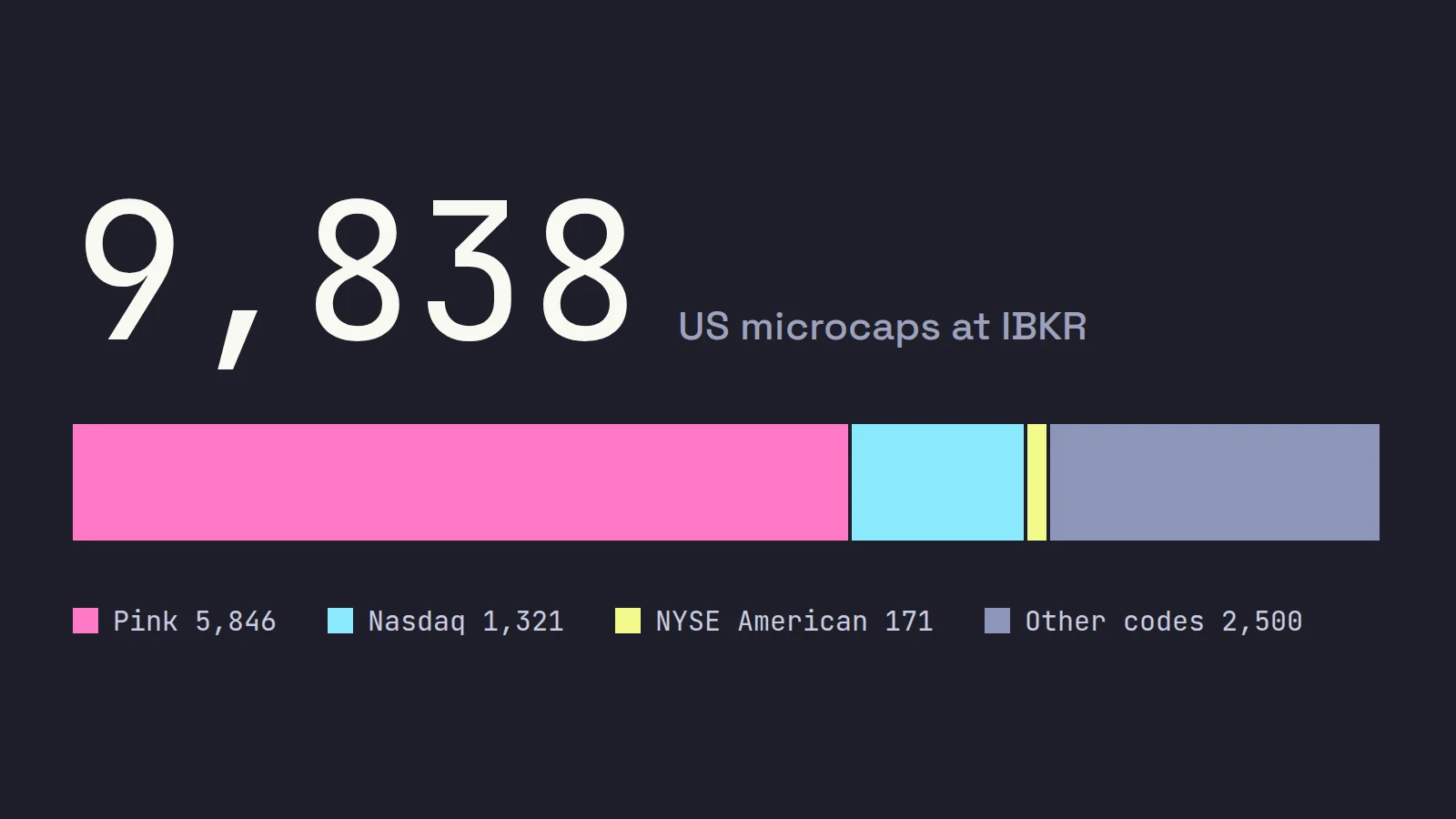
IBKR publishes the list daily as a CSV file. On October 22, 2026 it held 9,838 symbols: 5,846 with OTC Markets' Pink as their main exchange, 1,321 on Nasdaq and 171 on NYSE American, with the rest under other codes. In other words, a lot of the low-priced Nasdaq small caps that momentum traders watch are on IBKR's microcap list.
IBKR penny stocks: the restrictions
From IBKR's microcap article and its article on the OTC market and SEC Rule 15c2-11:
| Restriction | What IBKR says |
|---|---|
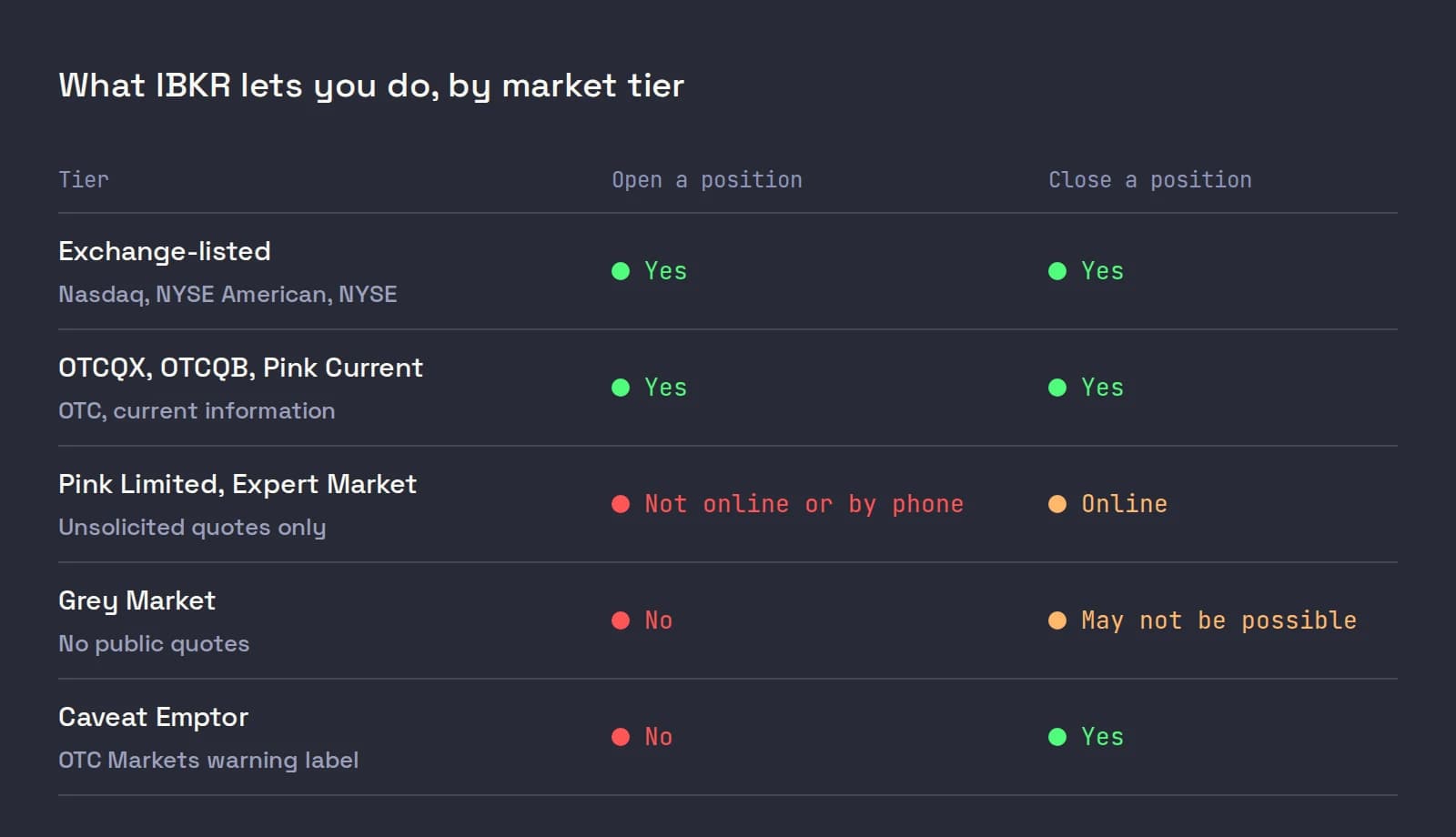
| Caveat Emptor and Grey Market stocks | No transfers in and no opening orders "from any client." Existing positions can be closed |
| Stocks reclassified to Caveat Emptor or Grey Market after you buy | You can keep, close or transfer the position, but not increase it |
| "Unsolicited quotes only" stocks (Pink Limited and Expert Market) | "Opening orders in these positions cannot be accepted online or by phone." Closing orders can be placed online |
| Transfers of blocks of US microcaps | Accepted only from Eligible Clients: at least $5 million of equity (or advisor clients with $20 million under management) and less than half of equity in US microcaps, with proof of open-market purchase or SEC registration |
| Company affiliates | Blocked from trading the issuer's microcap without written approval from an IBKR executive |
| Trading near Rule 144 volume limits | IBKR may restrict the stock in your account until a compliance review is done |
| Execution-only clients | Cannot trade US microcaps at IBKR |
For a day trader buying and selling in the open market, most of this never applies. The transfer and affiliate rules are aimed at people moving large blocks of thinly traded stock into IBKR to sell them, which is how many microcap frauds work. The rows that do bite a trader are the first three: if OTC Markets puts a stock in Caveat Emptor, the Grey Market or the unsolicited-only tiers, you cannot open a position in it at IBKR online.
Why some OTC stocks lost their quotes
Amendments to SEC Rule 15c2-11 took effect on September 28, 2021. IBKR's summary: brokers may no longer display or submit quotes for issuers that have not kept current public information available. Many such stocks moved to Pink Limited or the Expert Market as "unsolicited quotes only," and Grey Market stocks have no public quotes at all. IBKR warns that unsolicited-only orders "will not be displayed to the public," and that there will be "limited liquidity" because it participates in fewer market centers for them. A stock you can see on a website is not necessarily one you can trade.
Can you trade penny stocks on IBKR? A practical checklist
- Know which market it trades on. Exchange-listed (Nasdaq, NYSE American, NYSE) or OTC. The SEC's penny stock rules, IBKR's OTC rules and the short sale restriction all depend on it.
- Check the OTC tier on OTC Markets' own site for any OTC stock. OTCQX, OTCQB and Pink Current are normal. Pink Limited, Expert Market, Grey Market and Caveat Emptor are where the restrictions above start.
- Check IBKR's microcap list if you are transferring shares in or trade large size in one name.
- Check your trading permissions in Client Portal under Settings > Trading > Trading Permissions, per IBKR's trading permissions guide. An order for a stock or market you are not set up for is refused with a permissions reason.
- Use limit orders. On a stock that trades a few thousand shares a day, a market order can fill anywhere.
IBKR penny stock fees: commissions and the 1% cap
IBKR's US stock commissions page applies the same IBKR Pro rates to OTC and listed stocks: Fixed at $0.005 a share with a $1.00 minimum, Tiered from $0.0035 with a $0.35 minimum. Three details matter on low-priced stocks:
- The 1% cap. On both plans the commission cannot exceed 1% of the trade's value, even below the minimum. IBKR's own examples: 1,000 shares at $0.25 costs $2.50 on Fixed, and 10 shares at $0.20 costs $0.02.
- Venue fees on top. The cap is on the commission only. IBKR's footnote adds "the applicable exchange, ECN and/or specialist fees." On Nasdaq, removing liquidity on a sub-dollar stock costs 0.30% of the trade's value. IBKR's OTC Link ECN fee table lists $0.0029 a share to remove liquidity at $1.00 and up, and $0.0038 to $0.0040 a share when an order at that price is routed on to another venue. IBKR also says it "does not pass to customers all of the rebates" it receives on Pink and other OTC stocks.
- IBKR Lite is not free for OTC. IBKR Lite's $0 commissions cover US exchange-listed stocks. For "non-exchange-listed US stocks (e.g. Pink sheet and other OTC stocks)," Lite accounts are charged Fixed pricing.
A worked example. Buying 10,000 ABCD at $0.40 is a $4,000 trade. On Fixed, $0.005 x 10,000 is $50, but the 1% cap brings it to $40. If the order takes liquidity on Nasdaq, add 0.30% of $4,000, or $12. The round trip costs about $104 before regulatory fees on the sale: 2.6% of the position. The stock has to move more than 1 cent in your favor just to pay for the trip. The same math applied to a whole month of trading is in the real cost of day trading, and the plan comparison is in IBKR Tiered vs Fixed.
Market data for OTC stocks
Live OTC quotes are a separate subscription. On IBKR's market data pricing page, OTC Markets Level 1 is $8.00 a month and OTC Markets Level 2 is $20.00 for non-professionals. Without it, IBKR's delayed data for OTC Markets runs 15 minutes behind. The listed-stock bundles and Level 2 feeds most scalpers already pay for do not include OTC depth.
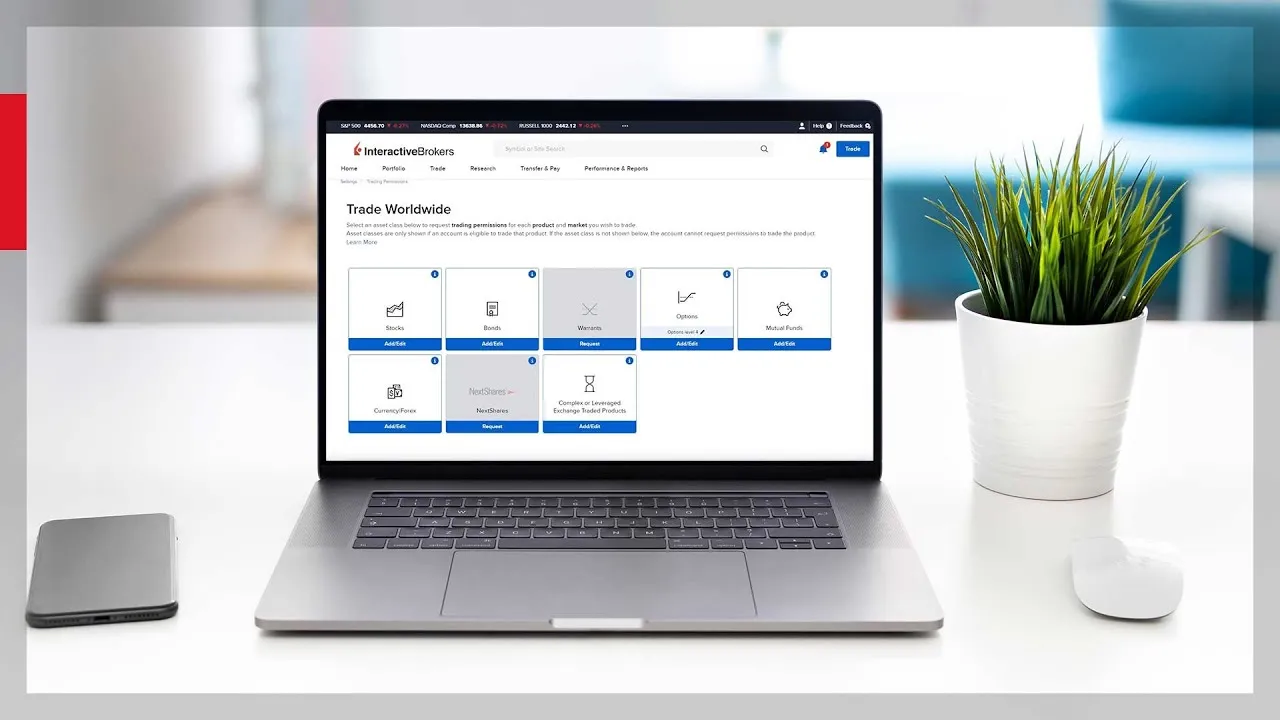
IBKR's Client Portal lesson covers both setup steps from this post: requesting a trading permission under Settings, and adding a market data subscription so delayed quotes turn live.
Margin, halts and SSR on low-priced stocks
- Margin. IBKR's stock margin page says it may reduce the collateral value of a stock for "small market capitalization or small issue size" or "low liquidity." Non-marginable positions need 100%. Assume a penny stock is bought with cash, and read IBKR margin calls and auto-liquidation before you assume otherwise.
- Short sale restriction. SEC Rule 201 covers exchange-listed stocks only. IBKR notes it does not apply to stocks traded only on OTC markets, so an OTC stock can fall 50% with no SSR. See the short sale restriction.
- Dilution. Low-priced listed small caps are frequent issuers of new shares. A filing check takes minutes: how to check a stock for dilution on SEC EDGAR.
Why scalpers stick to listed small caps
Our opinion, with reasons: for intraday trading, a $2 Nasdaq stock with news and volume is a better instrument than a $0.02 OTC stock, even though both get called penny stocks.
- The book is real. Listed stocks have Level 2 from the exchanges you already pay for, a consolidated quote and the national best bid and offer.
- The rules are clearer. Volatility halts, the short sale restriction and exchange listing standards apply. On the OTC side, a tier change can take away your ability to open a position.
- The costs are proportionate. At $0.02, a 1-cent spread is 50% of the price; at $2, a 2-cent spread is 1%.
- The information is there. Listed companies file with the SEC on a schedule. Many OTC issuers do not, which is the problem Rule 15c2-11 was amended to address.
None of that makes listed small caps safe. They are among the most volatile stocks in the market, and the risk of loss is high on either side of the line.
Where Scalpel fits
Scalpel is built for listed US small caps. Its momentum scanner runs on IBKR's own market scanner over the API and covers major US exchanges only, with no OTC stocks (set up the IBKR scanner). Its Price min and Price max default to $0.10 and $100, so sub-dollar listed runners count; set them to 2 and 20 if you only trade $2 to $20 stocks.
Scalpel is long only, sends every LIVE order as a limit order, and never sends a market order (long only). When IBKR refuses an order, for example for trading permissions or a restricted stock, Scalpel shows IBKR's own reason in a red toast (why an order was rejected). Fees on low-priced fills, including the 1% cap, are in the commissions guide. The troubleshooting video covers rejected orders and the other common problems:
For the full set of rules around day trading US stocks, see day trading rules.
IBKR restrictions, fees and data prices checked on October 22, 2026. They change, so check IBKR's pages before you trade.
Trading carries a significant risk of loss. Nothing here is financial advice.
Questions
- Can you trade penny stocks on Interactive Brokers?
- Yes. Exchange-listed stocks under $5 trade normally, and OTC stocks on OTCQX, OTCQB and Pink Current can be bought. IBKR does not accept opening orders in Caveat Emptor or Grey Market stocks, or online and phone opening orders in unsolicited-quotes-only stocks.
- Does IBKR allow OTC stocks?
- Yes, with restrictions. IBKR trades OTC stocks at its normal commission rates, but limits opening orders in the restricted OTC tiers, restricts transfers of US microcap blocks to eligible clients, and charges IBKR Lite accounts Fixed pricing on OTC trades.
- What does IBKR consider a microcap stock?
- Any stock that trades over the counter, any Nasdaq or NYSE American stock with a market cap between $50 million and $300 million priced at or below $5, and companies at or below $50 million. IBKR publishes the list daily.
- Is IBKR Lite free for penny stocks?
- Only for exchange-listed ones. IBKR Lite charges Fixed pricing on non-exchange-listed US stocks such as Pink sheet and other OTC stocks.
- Why can't I buy an OTC stock on IBKR?
- Most often the stock is in a restricted OTC Markets tier: Caveat Emptor, Grey Market, or unsolicited quotes only such as the Expert Market. IBKR will not accept opening orders in those online. A missing trading permission is the other common cause.
- What is the commission on penny stocks at IBKR?
- The normal IBKR Pro rates, capped at 1% of the trade's value, plus exchange or ECN fees. On sub-dollar stocks the venue fee can be 0.30% of the trade's value or more, so the all-in cost is a larger share of the trade than on higher-priced stocks.
Related guides
Guide 13.5A LIVE order was rejectedA LIVE order came back rejected: read IBKR's reason in the toast, then check Read-Only API, trading permissions, buying power and Scalpel's own caps.Guide 7.3Why Scalpel is long-onlyScalpel is long-only by design: every sell is capped to the shares you hold, so a double press never puts you short. No shorts, futures, options or crypto.Guide 8.1Set up the IBKR scannerTurn on Scalpel's IBKR scanner: switch a desk to SCAN, set price, change, volume and share filters, and know how many market data lines the list uses.
Keep reading
- Day trading rules in 2026: every rule a US stock trader should knowDay trading rules for 2026: the PDT rule replaced by intraday margin, T+1 settlement, LULD halts, SSR, wash sales and taxes, each with its source.
- The PDT rule is gone: what changed for day trading on Interactive BrokersYes: IBKR began dropping the PDT rule on June 4, 2026. No $25,000 minimum, no day trade count. What replaced it, a worked example and who is still on it.
- IBKR Tiered vs Fixed for scalpers: the math on real tradesTiered vs Fixed pricing explained simply: Fixed is one flat rate a share, Tiered a lower rate plus exchange fees. Which is cheaper on IBKR, worked out.
Practice in SIM, against the live book.A lifetime license, every update included, with a 7-day refund guarantee.Ask in DiscordGet Scalpel