Intraday margin on IBKR for small accounts after the PDT change
By Scalpel Team. , updated . 9 min read.
In short
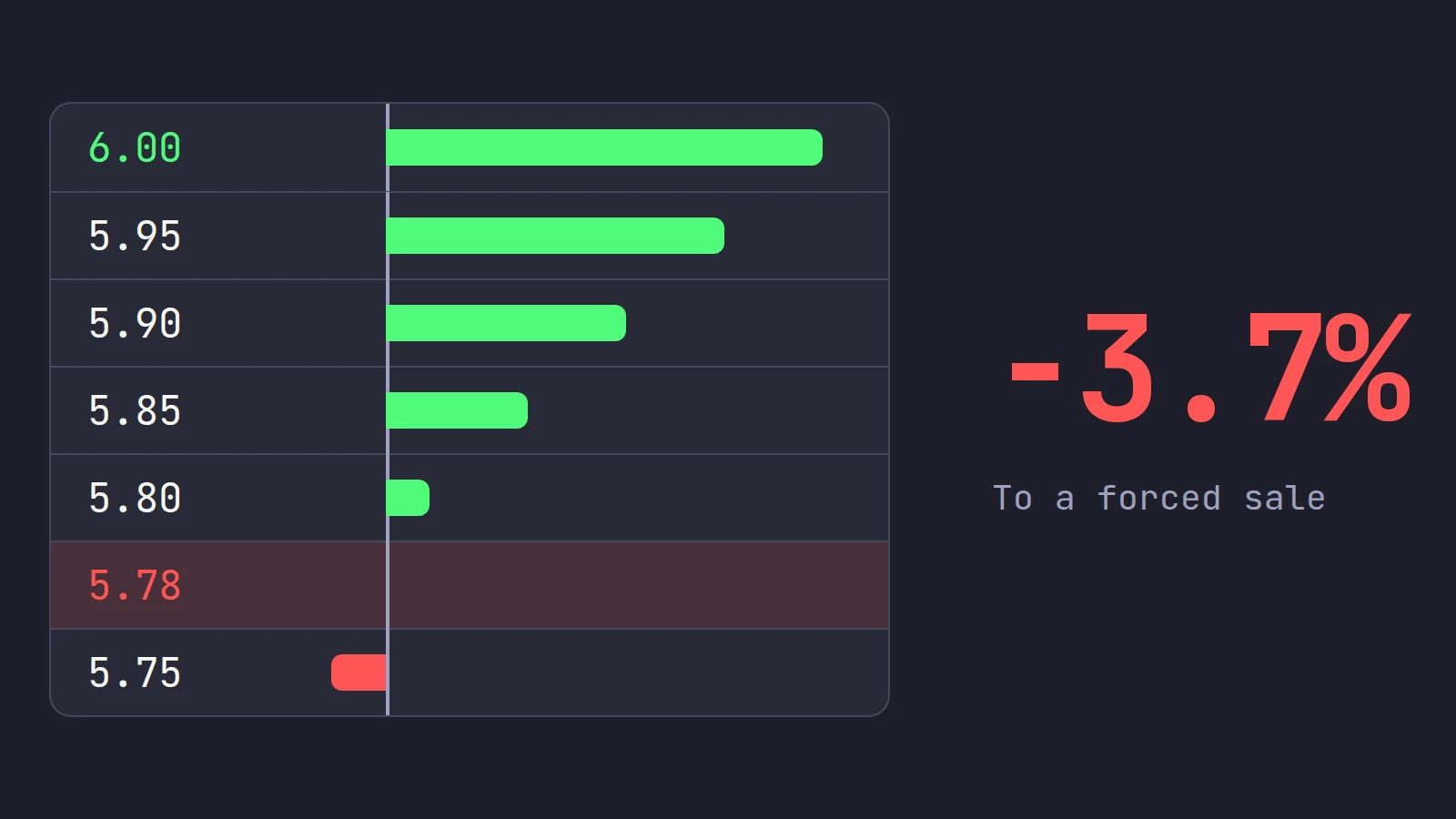
Intraday margin on IBKR comes down to three numbers for a marginable US stock: 26.25% initial margin checked when you place the order, 25% maintenance margin that must hold every second (your Excess Liquidity must stay positive), and Reg T's 50% for what you still hold from 15:50 ET. A $5,000 margin account can open about $19,000 of stock at once, but at that size a drop of under 4% triggers IBKR's real-time liquidation. If a trade leaves you below maintenance, that is an intraday margin deficit: IBKR issues a call the next business day and expects it met within three business days.
When FINRA's new intraday margin rule replaced the pattern day trader rule on June 4, 2026, the question for a small account stopped being "how many day trades do I have left?" and became "how much can I borrow, and for how long?" Our post on the PDT rule change covers the regulation itself. This one is the follow-up: how Interactive Brokers actually computes your intraday margin, a worked example for a $5,000 account, and what turns a bad trade into a forced sale or a 90-day restriction.
Everything below comes from IBKR's own stock margin requirements and its FAQ on the FINRA rule change, checked on October 22, 2026. IBKR says your account may stay on the old PDT rules until FINRA's transition ends in October 2027, so check which regime you are on first. Scalpel is independent and not affiliated with or endorsed by Interactive Brokers.
The numbers behind intraday margin on IBKR
IBKR publishes one table for a long US stock position. These are the rows a day trader lives with:
| Requirement | When IBKR checks it | Margin account | Cash account |
|---|---|---|---|
| Initial margin | When you place the order | 26.25% of the stock's value | 100% |
| Maintenance margin | Continuously, while you hold | 25% of the stock's value | 100% |
| Reg T end-of-day initial margin | From 15:50 ET | 50% of the stock's value | 100% |
| Minimum equity | On margin trades | $2,000 | None for the rule |
Two account values tie them together, both in the TWS Account Window:
- Available Funds = Equity with Loan Value minus initial margin. A new order that would push it below zero is refused before it reaches the exchange.
- Excess Liquidity = Equity with Loan Value minus maintenance margin. IBKR's FAQ says that if it goes negative, "your account becomes subject to immediate liquidation by IBKR, potentially without prior notice."
Equity with Loan Value is, for a plain stock account, your cash plus the market value of your stock. IBKR's margin FAQs put the leverage plainly: $10,000 of cash can hold $20,000 of stock overnight (50%) and $40,000 intraday at the 25% maintenance rate.
Those are the standard rates. IBKR also says it "may reduce the collateral value" of a stock for small market capitalization, small issue size or low liquidity, and that its house margin can exceed the rule. For small caps that is not a footnote: a thin $2 stock can carry a much higher requirement, up to full payment, and your buying power on it shrinks to match.
IBKR day trading buying power on a $5,000 account
Here is a $5,000 margin account that starts the day all cash, buying a marginable stock, ABCD, at $6.00. We use IBKR's standard rates, no house surcharge, and ignore commissions.
| Position | Value | Initial (26.25%) | Available Funds left | Maintenance (25%) | Excess Liquidity | Price that zeroes Excess Liquidity |
|---|---|---|---|---|---|---|
| 800 shares | $4,800 | $1,260 | $3,740 | $1,200 | $3,800 | None: no money borrowed |
| 1,500 shares | $9,000 | $2,362.50 | $2,637.50 | $2,250 | $2,750 | About $3.56, a 41% fall |
| 3,000 shares | $18,000 | $4,725 | $275 | $4,500 | $500 | About $5.78, a 3.7% fall |
The largest order the initial check allows is $5,000 / 0.2625, about $19,047 of stock. That is where the "4x intraday" idea comes from, and it is the line people trip over.
Work the 3,000-share row through. Every cent ABCD falls costs $30 of equity, while the maintenance requirement only drops by $7.50, so Excess Liquidity shrinks by $22.50 a cent. The $500 cushion is gone after about 22 cents. On a small-cap momentum stock that is one red candle, and IBKR does not wait: its margin warning entry says "Interactive Brokers does not make margin calls" and that "generally, accounts will not have time to deposit funds." Liquidations are automated and, per IBKR's FAQ, "accomplished with market orders."
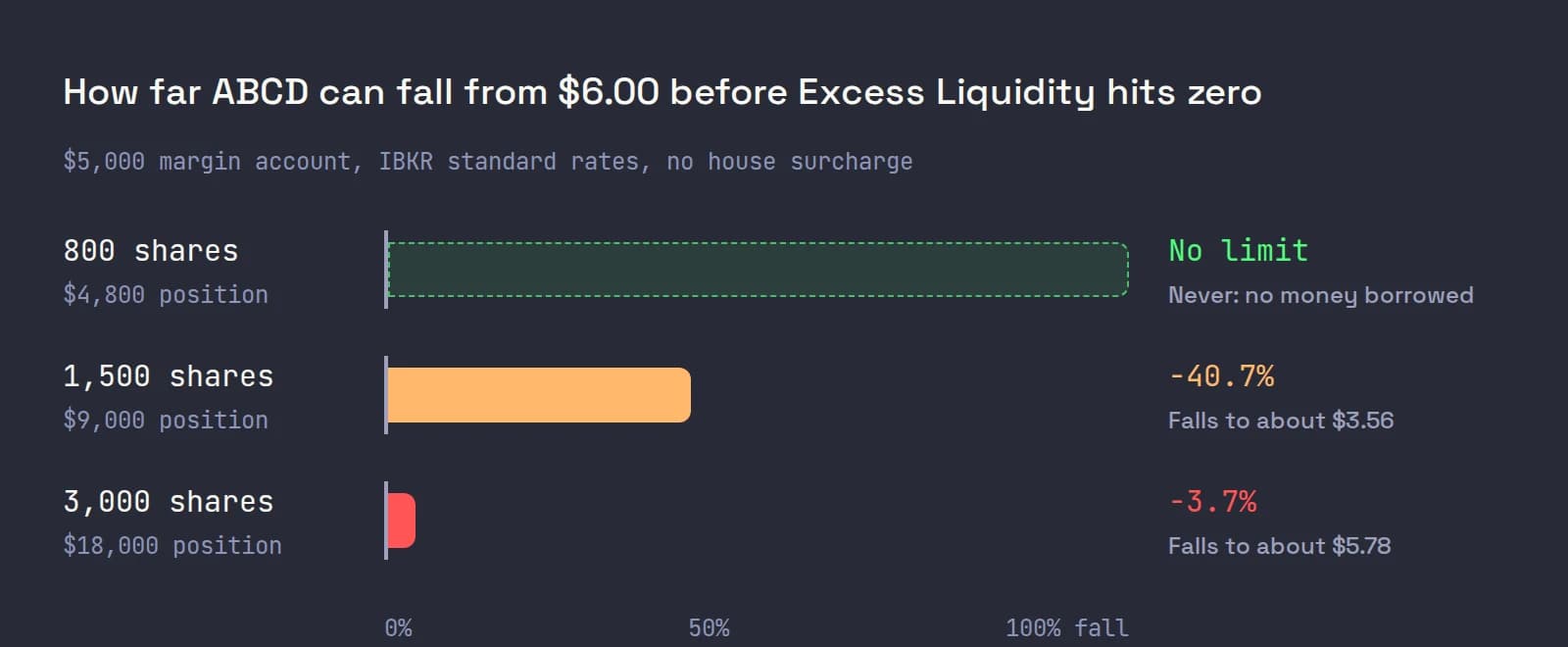
The 800-share row is the other extreme. The position is worth less than your cash, so you are not borrowing at all, Excess Liquidity can never go negative from that trade, and no intraday margin deficit can form. You give up leverage you probably should not be using on a $5,000 account anyway.
What changes at 15:50 ET
Intraday leverage is intraday only. IBKR's liquidation FAQ says a Reg T account needs "positive Excess Liquidity at all times and Positive SMA starting at 15:50 EST," and lists "non-compliance with Regulation T (enforced between 15:50-17:20 ET)" as a reason for automatic liquidation. In plain terms, what you still hold into the close has to fit the 50% Reg T requirement: roughly $10,000 of stock on a $5,000 account that started the day in cash. The 3,000-share position above would have to be cut by about $8,000 before then, by you or by IBKR.
The SMA (special memorandum account) has its own arithmetic and can carry credit from earlier days, so treat "twice your equity" as a rule of thumb, and read the SMA line in your Account Window if you plan to hold.
Intraday margin deficits at IBKR
The intraday margin rule adds a second layer on top of real-time liquidation. IBKR defines an intraday margin deficit (IMD) as "the largest maintenance margin deficiency with respect to any excess liquidity reducing transaction in a margin account during a given trading day."
What can create one, per IBKR:
- Any purchase or sale that reduces the account's Excess Liquidity.
- The expiration of a long option that reduces it.
- Any withdrawal of cash or securities.
Margin interest, fees and substitute dividend payments do not count. A price drop on its own is not a transaction either: a falling stock gets you liquidated in real time, not an IMD. The IMD is about the moment right after you trade.
Because IBKR checks initial margin before the order goes out, most small accounts will meet liquidation long before they meet an IMD. IBKR's own FAQ adds that an account with minimal Excess Liquidity "may be more prone" to IMDs, which is the 3,000-share row: a fast fill a few cents away from the price you saw is all it takes.
The IMD timeline
| When | What happens |
|---|---|
| Day 0 | A trade leaves the account below maintenance: an IMD |
| Day 0, after the deficit | A deposit can reduce or preempt the call |
| Next business day | IBKR issues the IMD call |
| Within 3 business days of the call | Met "as promptly as possible", per IBKR's reading of FINRA guidance |
| Close of the 5th business day | If still unmet and you are "making a practice" of it, the 90-day restriction starts |
| 15th business day | The IMD stops being outstanding, but is not treated as satisfied for the restriction |
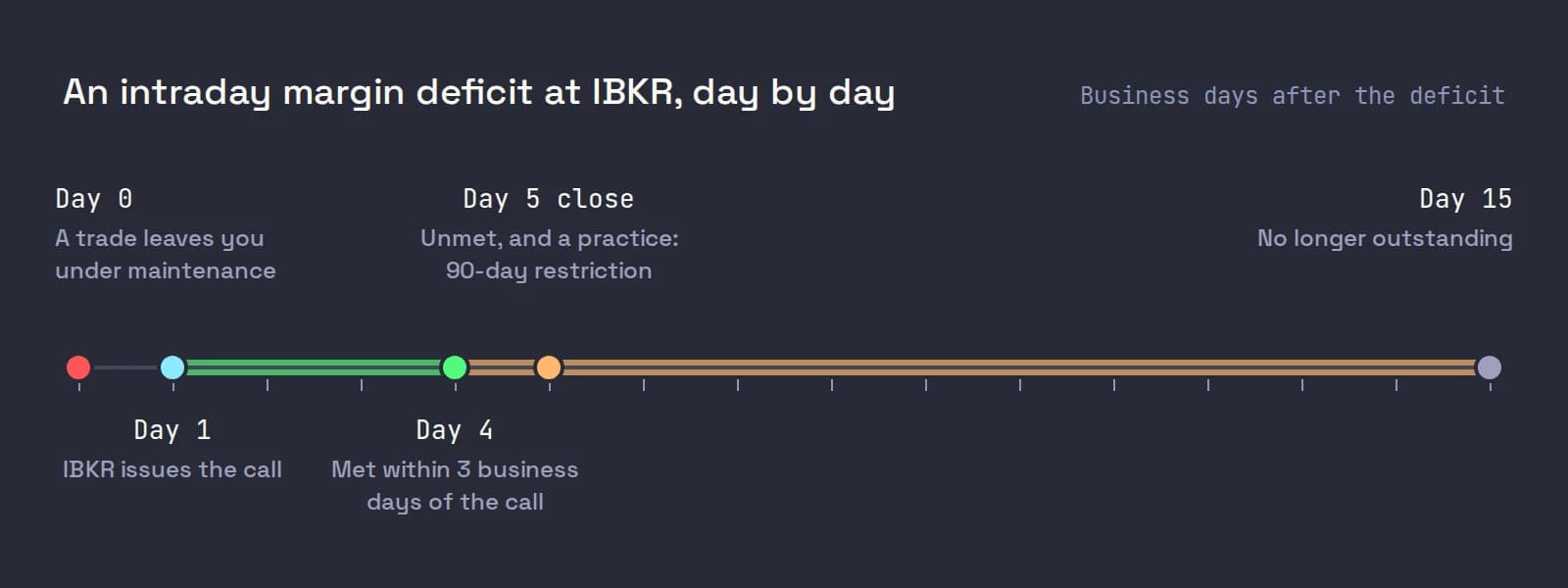
"Making a practice" has a number at IBKR: "on the fourth instance of not satisfying an IMD within three business days over a 12-month rolling period." The restriction then lasts 90 calendar days after that fifth business day, or until the deficit is met. During it you cannot make a purchase that increases a debit balance or sell short, though you can still withdraw cash and transfer securities out.
Small deficits do not count toward the practice. The de minimis level is "the lesser of 5% of the equity in the margin account or $1,000." On a $5,000 account that is $250, so the $600 deficit in our PDT post's example would count. On a $50,000 account the cap is $1,000.
Weekends shift the dates. A deficit incurred between 20:00 ET Friday and the end of Sunday is called on Tuesday morning, and a deposit made over a weekend or a US trading holiday is credited with the next business day's deposits.
How to satisfy an intraday margin deficit
IBKR follows FINRA's test: from the end of the deficit day to the end of a later day, your net deposits, or the rise in your Excess Liquidity, must add up to the deficit. Closing trades help only if they raise Excess Liquidity. Two details from the FINRA examples IBKR reproduces catch people out:
- Deposits and withdrawals net out. A $3,000 deficit is not met by depositing $1,500 on Wednesday and Friday if you withdrew $1,500 on Tuesday and Thursday.
- Deposited shares are haircut. $3,000 of fully paid marginable stock counts as $2,250, because the 25% maintenance requirement comes off first.
The plain fix on a flat account is a cash deposit at least the size of the deficit, made before the third business day after the call.
How to keep a small account out of margin trouble
The rules allow 4x. Nothing makes you take it. On a small account we would keep total position value at or below cash for the first months, then allow modest leverage once your stops are reliably honored. Three habits do most of the work:
- Cap position size below your cash. If no single position, and no combination of open positions, exceeds your cash, you cannot create an IMD and a 20% gap down costs you 20% of the position, not your account.
- Watch Excess Liquidity, not Buying Power. Buying Power tells you what IBKR will let you open. Excess Liquidity tells you how far you are from a forced sale. In TWS both sit in Account > Account Window, under Available for Trading.
- Flatten or shrink before 15:50 ET. If a trade is still open late in the day, make sure what you hold fits the 50% Reg T requirement before IBKR's check starts.
IBKR's Monitoring Margin in TWS lesson walks through the Account Window, the margin values on the Portfolio tab and how to check an order's margin impact before you send it. It is the fastest way to find these numbers on your own screen:

A daily loss limit matters as much as the margin numbers. A $5,000 account that loses $1,500 by 11:00 has also lost $6,000 of 4x buying power. Day trading a small account puts these limits into a full plan. Our small account setup guide has a full example, and why IBKR rejected an order covers the margin and buying power messages you will see in TWS. For every other rule that applies to a US day trader, from settlement to wash sales, see our pillar on day trading rules; if you would rather avoid margin entirely, read day trading in a cash account. How IBKR's liquidation engine picks what to sell is in IBKR margin calls and auto-liquidation.
Where Scalpel fits
Scalpel does not compute margin. In LIVE, Interactive Brokers decides what your account can carry, and when it refuses an order Scalpel shows a red toast with IBKR's own reason. What Scalpel adds is a set of limits you choose, checked before an order leaves your computer:
- Max position ($) in Settings > Risk refuses any buy that would take one symbol's position past the value you set, adds included. Set it under your cash and that symbol never borrows.
- Fat-finger ($) caps any single order the same way.
- Daily loss ($) trips a RISK LOCK when the day's realized plus open P&L reaches minus that amount; with Auto-flatten on daily loss ticked it also sells every open position (daily loss limit guide).
The caps are per symbol and per order, so with two desks trading at once, size them so the total still fits your cash.
Our two-minute risk controls video shows those settings and the lock in action:
The caps work the same in SIM, which is a cash account, so practicing there with SIM start ($) set to your real balance teaches you sizes that never need margin. Details are in the fat-finger and position caps guide. Scalpel is long only, and its stops are app-monitored, not resting orders at IBKR, so they only work while Scalpel runs with a live feed.
IBKR margin pages and FAQs checked on October 22, 2026.
Trading carries a significant risk of loss. Nothing here is financial advice.
Questions
- How does intraday margin work on IBKR?
- For a marginable US stock, IBKR checks 26.25% initial margin when you place the order and requires 25% maintenance margin at all times, so Excess Liquidity must stay positive. From 15:50 ET it also enforces Reg T's 50% on what you hold overnight.
- How much can I day trade with $5,000 on IBKR?
- At IBKR's standard rates a $5,000 margin account can open about $19,000 of a marginable stock at once. At that size a fall of under 4% can wipe out Excess Liquidity and trigger automatic liquidation, and small caps often carry higher house margin.
- What is an intraday margin deficit at IBKR?
- IBKR defines it as the largest maintenance margin deficiency after any trade or withdrawal that reduces Excess Liquidity during the day. IBKR issues a call the next business day and expects it met within three business days.
- What happens if I do not meet an IMD call?
- On the fourth time in a rolling 12 months that you miss the three-day window, IBKR treats it as a practice. If a deficit is then still unmet at the close of the fifth business day, the account is restricted from increasing a debit or short position for 90 calendar days or until the deficit is met.
- Does IBKR give you time to deposit before liquidating?
- No. IBKR says it does not make margin calls for maintenance deficiencies and that accounts generally will not have time to deposit funds. If Excess Liquidity goes negative, positions can be sold automatically with market orders.
- Is there still a $25,000 minimum to day trade on IBKR?
- IBKR says the $25,000 pattern day trader minimum is being removed and that margin trading needs $2,000 of equity. Some accounts may stay on the old PDT rules until FINRA's transition ends in October 2027.
Related guides
Guide 14.4Settings for a small accountSettings that suit a small account: risk-based presets, tight caps, a daily loss limit you will respect, the right commission plan, and what to watch for.Guide 13.5A LIVE order was rejectedA LIVE order came back rejected: read IBKR's reason in the toast, then check Read-Only API, trading permissions, buying power and Scalpel's own caps.Guide 7.1Set a daily loss limit (the kill-switch)Set a max daily loss in Scalpel: when your P&L hits it, new entries stop, a RISK LOCK banner shows, and it can flatten everything. How to resume trading.
Keep reading
- Day trading rules in 2026: every rule a US stock trader should knowDay trading rules for 2026: the PDT rule replaced by intraday margin, T+1 settlement, LULD halts, SSR, wash sales and taxes, each with its source.
- The PDT rule is gone: what changed for day trading on Interactive BrokersYes: IBKR began dropping the PDT rule on June 4, 2026. No $25,000 minimum, no day trade count. What replaced it, a worked example and who is still on it.
- IBKR Tiered vs Fixed for scalpers: the math on real tradesTiered vs Fixed pricing explained simply: Fixed is one flat rate a share, Tiered a lower rate plus exchange fees. Which is cheaper on IBKR, worked out.
Practice in SIM, against the live book.A lifetime license, every update included, with a 7-day refund guarantee.Ask in DiscordGet Scalpel