The wash sale rule for day traders, with worked examples
By Scalpel Team. , updated . 8 min read.
In short
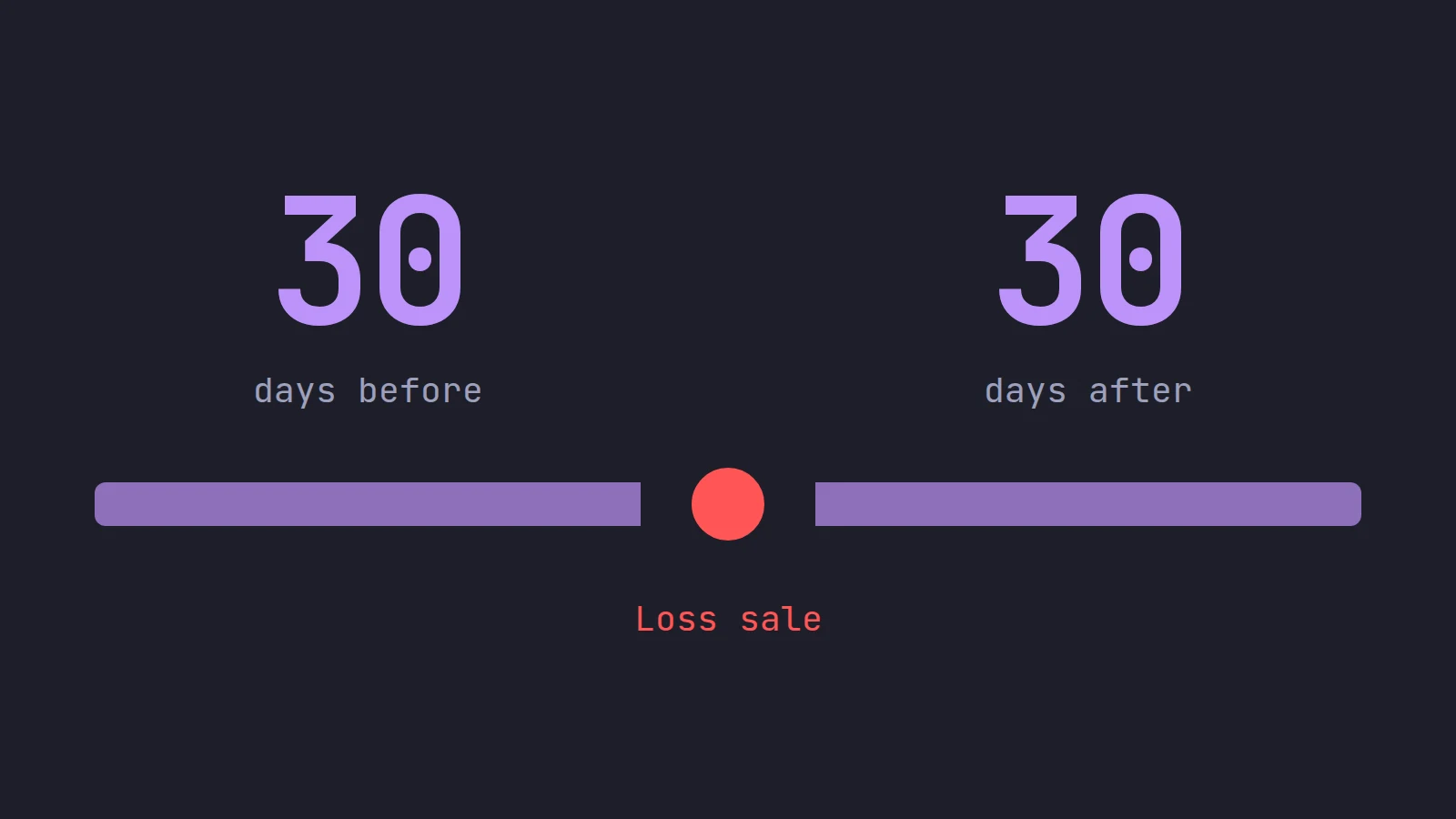
The wash sale rule disallows a loss on a stock you sold if you buy substantially identical stock within 30 days before or after the sale. The loss is not gone: it is added to the cost basis of the shares you bought, and comes back when you sell them. For a day trader who trades the same tickers again and again, most losses are deferred trade to trade and the year's total comes out the same. The rule bites at year-end, when you buy in an IRA, and when you trade one stock across several accounts. Traders with a section 475(f) mark-to-market election are exempt.
Day traders meet the wash sale rule on their first Form 1099-B: a column of "wash sale loss disallowed" figures that can be larger than the account. It looks alarming and is usually less so. This post explains the rule from IRS Publication 550, works through what it does to a scalper's same-day round trips, and shows the three situations where it costs real money.
This is general information, not tax or legal advice. Tax situations differ; for your own return, use a tax professional who works with traders. IRS sources checked on October 22, 2026. Scalpel is independent and not affiliated with or endorsed by Interactive Brokers.
What the wash sale rule says
The rule is section 1091 of the Internal Revenue Code (26 U.S.C. 1091). The IRS explains it in Publication 550, under Wash Sales. A wash sale happens when you sell stock at a loss and, within 30 days before or after the sale, you:
- Buy substantially identical stock,
- Acquire substantially identical stock in a fully taxable trade,
- Acquire a contract or option to buy substantially identical stock, or
- Acquire substantially identical stock for your IRA or Roth IRA.
It also applies if your spouse or a corporation you control buys the substantially identical stock. The window runs from 30 days before the sale to 30 days after it: 61 days with the sale day in the middle.
The consequence, in Publication 550's words: "add the disallowed loss to the cost of the new stock or securities (except in (4) above)." The holding period of the new shares also includes the holding period of the ones you sold. The IRS's own example: you buy 100 shares for $1,000, sell them for $750, and buy 100 again for $800 within 30 days. The $250 loss is disallowed, and your basis in the new shares is $1,050.
"Substantially identical" is a facts-and-circumstances test. Publication 550 says stock of one company is ordinarily not substantially identical to stock of another company. Two traps matter for small-cap traders. A company's convertible preferred stock can count. And if you sell common stock at a loss and at the same time buy warrants on the same company's common, the wash sale rules apply.
This IBKR Traders' Academy lesson covers wash sales together with the other special capital gains cases. It is from 2019, but the wash sale rule it describes has not changed:

The wash sale rule for day traders, worked through
Most of a scalper's wash sales look like this. ABCD is fictional, and fees are ignored to keep the numbers clean.
| Time (ET) | Trade | Cash result | What the rule does | Reported gain or loss |
|---|---|---|---|---|
| 09:40 | Buy 1,000 ABCD at $4.00 | |||
| 09:45 | Sell 1,000 at $3.80 | -$200 | Loss, but shares are bought again within 30 days | $0, $200 disallowed |
| 09:52 | Buy 1,000 ABCD at $3.90 | Basis becomes $3,900 + $200 = $4,100 | ||
| 10:05 | Sell 1,000 at $4.05 | +$150 | Proceeds $4,050 against a $4,100 basis | -$50 |
| Total | -$50 | -$50 |
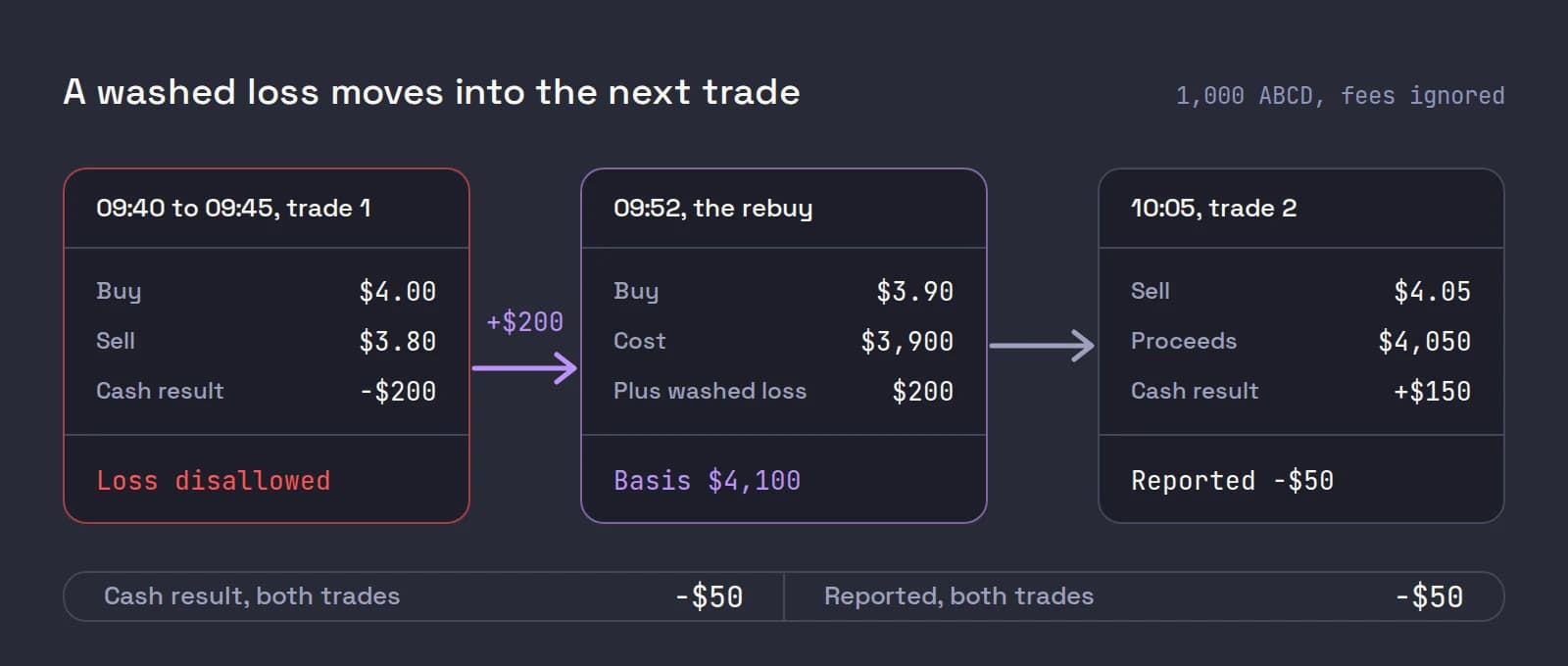
You lost $50 in cash and you report a $50 loss. The $200 was not lost for tax purposes; it moved into the next trade. If you buy ABCD again within 30 days of the 10:05 sale, that $50 moves again. Run this across a busy year in the same handful of tickers and your 1099-B can show tens of thousands of dollars of disallowed losses while your net result is unchanged, as long as everything is closed out cleanly at the end.
When you rebuy fewer shares
The rule matches share for share. Publication 550 says to match the shares bought with an equal number of the shares sold, in the order you bought them. If you sell 1,000 ABCD at a $200 loss and buy back only 500 within 30 days, the loss on 500 shares ($100) is disallowed and added to those 500 shares' basis. The loss on the other 500 ($100) is deductible.
Scaling in and out complicates this quickly: three entries and four exits in one stock produce a lot of partial matches. That is what your broker's 1099-B and tax software are for, but it helps to know why the numbers look strange.
Where wash sales cost real money
1. The year-end trap
The rule ignores the calendar year. A loss taken on December 30 and a repurchase on January 5 is a wash sale, and the loss moves into the new year's basis.
| Date | Trade | Effect |
|---|---|---|
| December 30 | Buy 2,000 WXYZ at $5.00, sell at $4.70 | $600 loss, disallowed this year |
| January 5 | Buy 2,000 WXYZ at $4.80 | Basis $9,600 + $600 = $10,200 |
| January 5 | Sell 2,000 WXYZ at $4.90 | Reported: -$400 next year (cash: +$200) |
If you had $10,000 of short-term gains earlier in the year, you are taxed on $10,000 instead of $9,400, and the $600 shows up a year later. The same thing happens if you sell at a loss late in December, buy back, and are still holding on December 31: the loss sits inside an open position. Publication 550 has an example of exactly this, with a December 27 sale and a January 10 purchase.
The fix is simple: in the last days of December, a loss in a stock you are likely to trade again in early January deserves a moment's thought.
2. Buying in an IRA
Rule 4 above is the expensive one. If you take a loss in your taxable account and buy the same stock in your IRA or Roth IRA within 30 days, the loss is disallowed and, because of the "except in (4)" wording, it is not added to the basis of anything. It is gone. If you trade small caps in a taxable account, keep them out of your retirement accounts.
3. Several accounts or several brokers
Your broker can only see its own accounts. Publication 550 says Form 1099-B box 1g shows the disallowed wash sale loss only when the shares were covered securities and the replacement shares "had the same CUSIP numbers as the stock or securities you sold and were bought in the same account." It then adds: "you cannot deduct a loss from a wash sale even if it is not reported on Form 1099-B." A loss at one broker and a rebuy at another within 30 days is your job to find and report.
IBKR wash sales and reporting
Like every US broker, Interactive Brokers reports your sales on Form 1099-B, and the wash sale amounts a broker must report follow that same-account, same-CUSIP rule. Two practical notes:
- Report from the 1099-B, then add what it cannot see. Wash sales go on Form 8949 with code W in column (f) and the disallowed amount as a positive number in column (g), per Publication 550.
- Lot matching is separate. TWS has a Tax Optimizer that changes which tax lots a sale is matched against and shows your year-to-date short-term and long-term P&L by symbol. It changes lot matching, not the wash sale rule.
If net losses survive the wash sale rule, they are still capital losses: per IRS Topic 409, you can deduct up to $3,000 a year ($1,500 if married filing separately) against other income and carry the rest forward.
The mark-to-market exemption
IRS Topic 429, on traders in securities, says "the wash sale rules, and certain other rules do not apply to traders using the mark-to-market method." That method needs two things: you qualify as a trader in the business of trading (a demanding facts-and-circumstances test), and you made the section 475(f) election on time, which for most individuals means by the original due date of the previous year's return. Gains and losses then become ordinary and the $3,000 capital loss limit no longer applies. It is a large decision with trade-offs, covered in our post on day trading taxes and trader tax status.
What we would do about wash sales
- Do not trade around the rule mid-year. For same-day round trips that you close out, the rule defers rather than denies. Skipping a good setup to avoid a wash sale is letting the tax tail wag the trade.
- Watch December. From about December 1, a loss in a ticker you might trade again in January is a deferred deduction. Decide on purpose.
- Keep trading stocks out of your IRA.
- Trade a given stock in one account. Then the 1099-B catches your wash sales and your own tracking stays short.
- Keep your own journal. You need to know your real net result anyway, and it is how you check the 1099-B.
All the account-level rules that sit next to this one are collected in our pillar on day trading rules, and a full cost picture, taxes aside, is in the real cost of day trading. For keeping records that help at tax time, see a day trading journal that improves your trading.
Where Scalpel fits
Scalpel is not tax software and does not compute wash sales. What it gives you is a clean record of your own trading. Every trade closed by a key, a stop, a take-profit or a flatten goes into the current mode's journal with its entry, exit, size, fees and R, and the Analytics view shows them net of fees (analytics guide). It measures results in R as well as dollars (R multiples), which is the number that tells you whether a strategy works before taxes ever enter into it.
SIM and LIVE keep separate journals, and SIM trades are paper trades with no tax consequence at all. LIVE fees are the commissions IBKR reports for each fill, so the journal's net matches what you actually paid (commissions). The journal is a plain text file per mode in Scalpel's data folder, one trade per line; for tax filing, use IBKR's 1099-B. This video shows how the two modes work:
Scalpel is long only, and its stops are app-monitored rather than resting at IBKR, so they only work while Scalpel runs with a live feed.
This is general information, not tax or legal advice.
Trading carries a significant risk of loss. Nothing here is financial advice.
Questions
- Does the wash sale rule apply to day trading?
- Yes. If you sell a stock at a loss and buy the same stock within 30 days before or after, the loss is disallowed and added to the cost basis of the new shares. For same-day round trips that you close out, this mostly defers losses rather than eliminating them.
- How long is the wash sale window?
- It runs from 30 days before the losing sale to 30 days after it, 61 days in all counting the day of the sale.
- Do wash sales carry over to the next year?
- Yes. A loss in December followed by a repurchase in January moves into the basis of the January shares, so the deduction shifts into the next tax year.
- Does IBKR report wash sales on the 1099-B?
- Brokers report wash sale disallowed losses in box 1g of Form 1099-B when the replacement shares have the same CUSIP and were bought in the same account. Wash sales across different accounts or brokers are still yours to apply.
- Do wash sales apply to buys in an IRA?
- Yes. Buying the same stock in an IRA or Roth IRA within 30 days of a taxable loss disallows the loss, and it is not added to any basis, so it is lost for good.
- How do traders avoid the wash sale rule?
- Traders who qualify for trader tax status and make a timely section 475(f) mark-to-market election are not subject to the wash sale rules. Everyone else can only manage the timing, especially around year-end and IRA purchases.
Related guides
Guide 6.4Analytics: review your tradingScalpel's Analytics view: equity curve, win rate, expectancy, profit factor, R distribution, every trade, results by symbol and hour, and a trader grade.Guide 6.3Commissions: pick your IBKR planMatch Scalpel's SIM fees to your Interactive Brokers plan: Pro Tiered, Pro Fixed, Lite or custom, plus exchange and clearing fees, and the FEE column.Guide 5.4R multiples: how Scalpel measures a tradeWhat R is, how Scalpel shows P&L in R on the chart and in the orders panel, how take-profit at N x R works, and why R makes trades on any stock comparable.
Keep reading
- Day trading rules in 2026: every rule a US stock trader should knowDay trading rules for 2026: the PDT rule replaced by intraday margin, T+1 settlement, LULD halts, SSR, wash sales and taxes, each with its source.
- The PDT rule is gone: what changed for day trading on Interactive BrokersYes: IBKR began dropping the PDT rule on June 4, 2026. No $25,000 minimum, no day trade count. What replaced it, a worked example and who is still on it.
- IBKR Tiered vs Fixed for scalpers: the math on real tradesTiered vs Fixed pricing explained simply: Fixed is one flat rate a share, Tiered a lower rate plus exchange fees. Which is cheaper on IBKR, worked out.
Practice in SIM, against the live book.A lifetime license, every update included, with a 7-day refund guarantee.Ask in DiscordGet Scalpel