LULD trading halts: what happens to your orders and your stop
By Scalpel Team. , updated . 8 min read.
In short
A LULD halt is a five-minute trading pause that starts when a stock cannot trade inside its limit up limit down price band for 15 seconds. The band is a percentage (5%, 10%, 20% or more, by tier and price) around the average price of the last five minutes, and it applies only from 09:30 to 16:00 ET. During the halt nothing trades: your resting orders stay on the book and you can cancel them, but a stop cannot trigger. The stock reopens with an auction, often far from the last price, and a stop that is through the reopening price fills there, not at your stop.
On a fast small cap, a halt is not a rare event. It is part of the trade. The stock you are in can stop dead mid-move, sit for five minutes with no prints, and reopen 15% higher or 15% lower. What you do in those five minutes matters more than anything you did before them.
This post explains how the LULD halt works under the Limit Up-Limit Down Plan, how often it happens, what happens to orders during a trading halt, and what to do when the stock you hold freezes. It is part of our order types for day trading series. Rules checked on October 22, 2026. Scalpel is independent and not affiliated with or endorsed by Interactive Brokers, Nasdaq or any exchange.
What is a LULD halt?
The Limit Up-Limit Down Plan sets a lower and an upper price band around every US-listed stock during regular hours. Trades outside the band are not allowed. If the stock gets pinned at the edge, trading pauses. The plan's own summary of the mechanics (LULD Plan):
- The reference price is the average price of eligible trades over the prior five minutes. It updates only when the new average is at least 1% away from the current one.
- A limit state begins when the best bid equals the upper band, or the best offer equals the lower band. If that quote is not executed or cancelled within 15 seconds, the listing exchange declares a five-minute trading pause, which may be extended.
- The hours are 09:30 to 16:00 ET. There are no LULD bands in the pre-market or after hours.
The band width depends on the stock's tier and its previous closing price. Tier 1 is the S&P 500, the Russell 1000 and selected ETPs; Tier 2 is every other listed stock except rights and warrants. Most momentum small caps are Tier 2.
| Previous close | Tier 1 band | Tier 2 band |
|---|---|---|
| Above $3.00 | 5% | 10% |
| $0.75 to $3.00 | 20% | 20% |
| Under $0.75 | Lesser of $0.15 or 75% | Lesser of $0.15 or 75% |
The bands double in the last 25 minutes of the day (15:35 to 16:00 ET) for all Tier 1 stocks and for Tier 2 stocks under $3.00 (LULD Plan 2025 annual report). A Tier 2 stock above $3.00 keeps its 10% band all day.
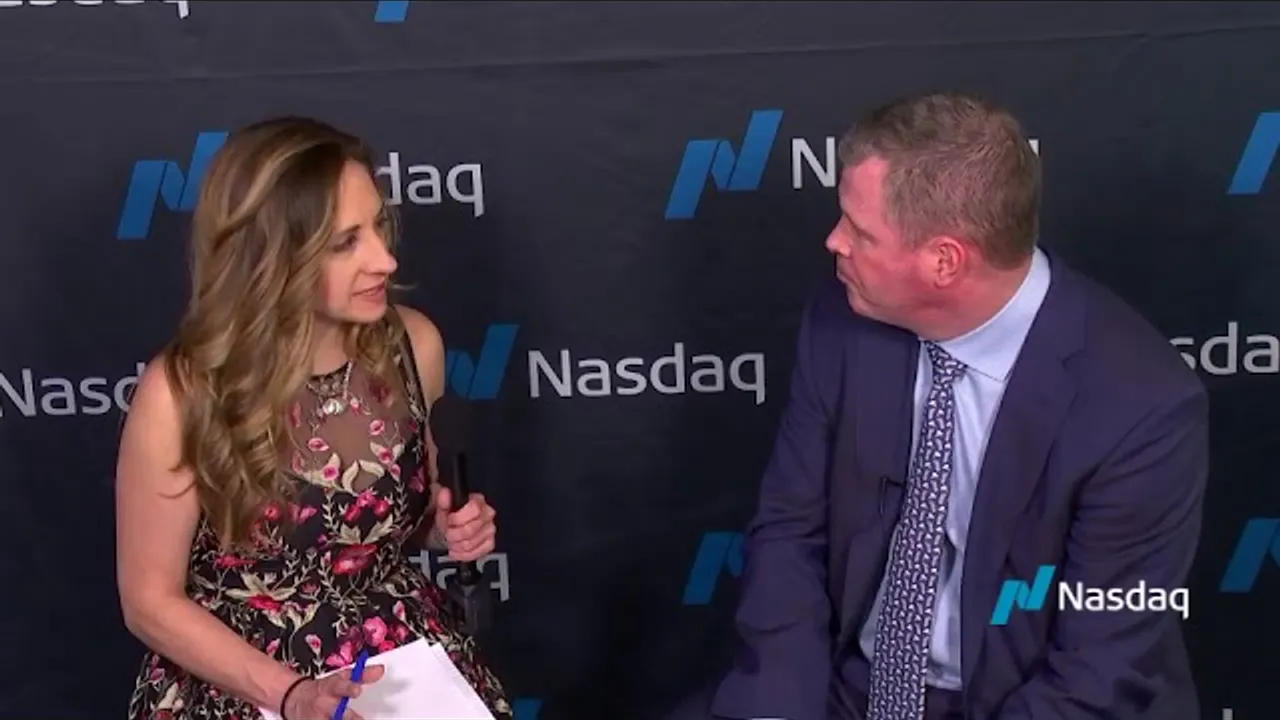
In this two-minute Nasdaq TradeTalks clip, Nasdaq's director of trading services explains the LULD bands for Tier 1 and Tier 2 stocks and why a pause gives liquidity time to return. He calls them circuit breakers, but the bands he describes are the LULD bands in the table above.
A worked example
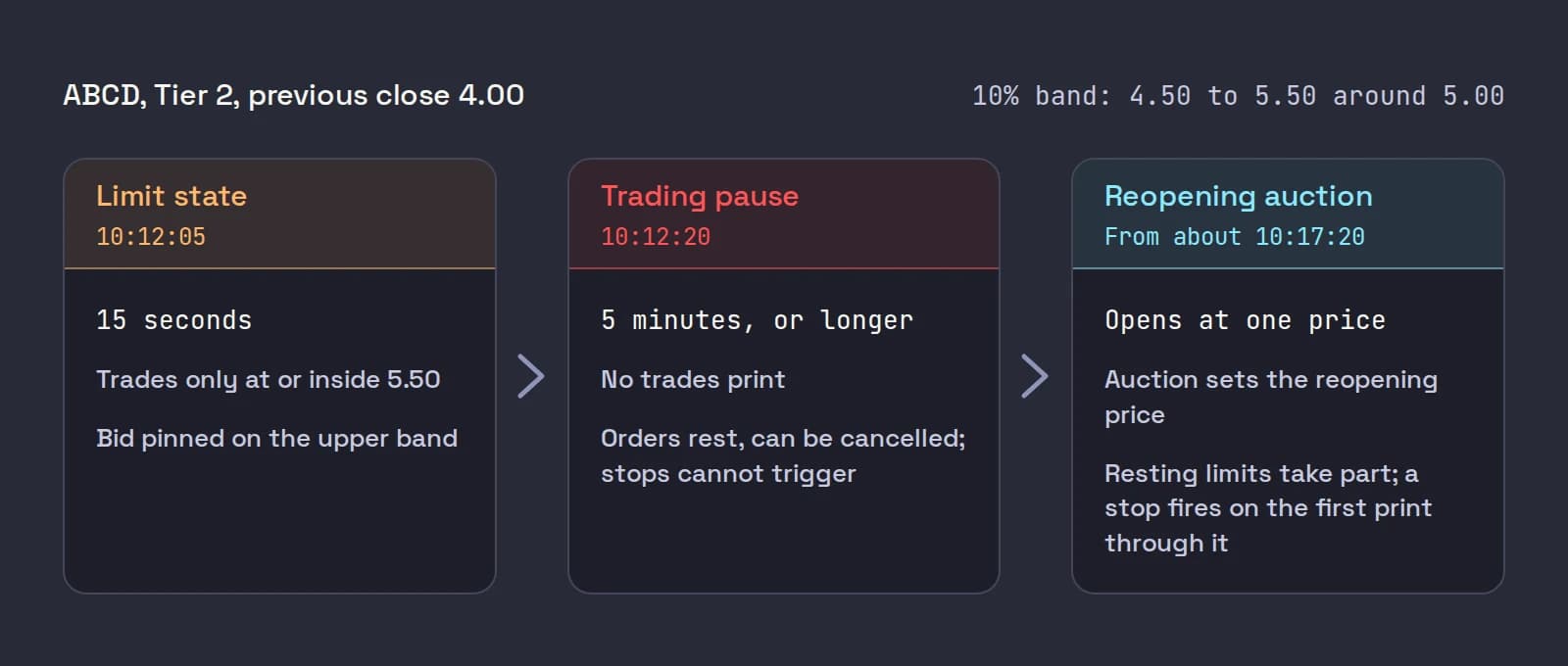
ABCD is a Tier 2 stock that closed yesterday at $4.00, so its band is 10%. It is running, and the five-minute average is 5.00. The bands are 5.00 plus or minus 0.50: 4.50 and 5.50.
At 10:12:05 ET buyers lift every offer up to 5.50 and the best bid sits at 5.50, the upper band. ABCD enters a limit state. Trades can still happen at or below 5.50, but nobody can pay 5.51. Fifteen seconds later the bid is still pinned, so at 10:12:20 the exchange halts the stock for five minutes. The earliest it can reopen is around 10:17:20, and only through an auction.
A lower-priced stock gets more room. WXYZ closed at $2.40, so it is in the 20% bracket. With a reference price of 2.50 its bands are 2.00 and 3.00, and after 15:35 ET they widen to 40%.
How often LULD halts happen
More often than most traders guess. The LULD Plan's operating committee reports on every year of trading. For 2025 it counted 10,763 trading pauses, a mean of 43.1 per trading day (median 37), up 22.5% from 2024 (LULD 2025 annual report). There were 97,195 limit states, and 11.1% of them turned into pauses: most stocks that touch the band trade back inside it within 15 seconds.
Two more numbers from the same report matter for small-cap traders:
- 1,823 of the pauses came between 09:30 and 09:45, the first 15 minutes. That is about 17% of the year's pauses in under 4% of the session.
- About 65% of all pauses happened in Tier 2 stocks (not ETPs) priced at $3 or more, a group that holds 41% of listed symbols.
So if you trade Tier 2 names at the open, you will see halts every week, and some of them will be in your stock.
Other trading halts
LULD pauses are the common ones, but not the only ones. Nasdaq's halt codes list (Nasdaq Trader: trade halt codes) includes:
| Code | Meaning | What to expect |
|---|---|---|
| LUDP | Volatility trading pause | Five minutes, reopening auction, possible extension |
| LUDS | Volatility trading pause, straddle condition | Same as LUDP |
| T1 | Halt, news pending | Until the news is out; can be much longer than five minutes |
| T12 | Additional information requested by Nasdaq | Open-ended |
| H10 | SEC trading suspension | The SEC can suspend trading for up to 10 trading days (SEC trading suspensions) |
Two things follow for the pre-market trader. First, because LULD bands only run from 09:30, a stock can move 40% before the open with no volatility pause at all. Second, a halt you see before 09:30 is a news or regulatory halt, not a LULD pause, and those have no five-minute clock. The plan's 2025 report says the committee is preparing a proposal for overnight price bands, ahead of exchange overnight trading scheduled for December 2026, but as of that report bands apply in regular hours only.
What happens to orders during a trading halt
Resting orders stay. Nasdaq's LULD FAQ says all open orders on its books "remain on the book during the limit state or pause, unless they are canceled by the customer," and that during the pause "only quoting may occur" (Nasdaq LULD FAQ). For Nasdaq-listed stocks it also accepts new orders during the pause. Your limit order is still there when the stock reopens, and it takes part in the reopening auction at your limit or better.
You can cancel. Cancelling during the pause is allowed, and it is often the right move for an entry you no longer want.
Orders through the band are repriced. Nasdaq's FAQ says orders "priced aggressively outside the bands will be re-priced upon entry to the limit price bands." A buy limit at 5.60 while the upper band is 5.50 rests at 5.50 instead.
Stops cannot trigger. A stop needs a trade at or through its price, and no trades print during a halt. On Interactive Brokers, stop orders on US stocks are usually simulated by IBKR's own systems, and IBKR's disclosure lists "market halts and interruptions" among the reasons a simulated order may not execute, or may execute badly (IBKR order types). When the stock reopens, the first print below your stop triggers it, and a plain stop becomes a market order at whatever the reopening price is. A stop-limit can be jumped entirely; see stop-limit vs stop-market.
The reopening price can be far away. The auction matches the buy and sell interest built up during the pause. A stock halted on the upper band can reopen higher, or open well below the band when the buyers who chased it change their minds.
What a halt does to a stop, in numbers
You hold 1,000 ABCD from 5.30 with a stop at 5.10: 20 cents, USD 200 of risk. ABCD spikes to the 5.50 upper band and halts. During the pause, the sell side builds. ABCD reopens at 4.95. The first print is 15 cents through your stop, the stop triggers there, and your exit fills around 4.90 to 4.95. At 4.90 you lose 40 cents a share, USD 400: 2R on a trade you sized for 1R, and you were up USD 200 a minute earlier.
This is why we treat a stock that is already near its upper band as a sizing problem, not just a chart pattern. The slippage post shows how to log outcomes like this so they stop being surprises.
Stock halted: what to do
- Read the code. LUDP is a five-minute pause; T1 is a news halt with no clock. Your plan for each is different.
- Cancel entries you no longer want. A buy left resting through the pause can fill at the reopening price in a market you did not see, sometimes only in part (partial fills).
- Decide your exit price before the reopen. If you hold the stock, choose a price you will accept on a gap against you. A sell limit at that price can sit in the auction; a plain stop does nothing until after the first print.
- Do not stack market orders. Outside regular hours IBKR does not accept them at all (IBKR Campus: trading outside RTH; more in why IBKR rejected your order), and in regular hours a market order into a reopening auction fills at the auction price, whatever it is.
- Size for the gap. If a stock is likely to halt (low float, a catalyst, already up 30% on the day), size so a reopen 15% against you is survivable. Our low float stocks post explains why these names halt so often.
Where Scalpel fits
Scalpel is a keyboard-first desktop cockpit for your own IBKR account, connected through TWS or IB Gateway. When the exchange halts a stock on one of your desks (desk status badges):
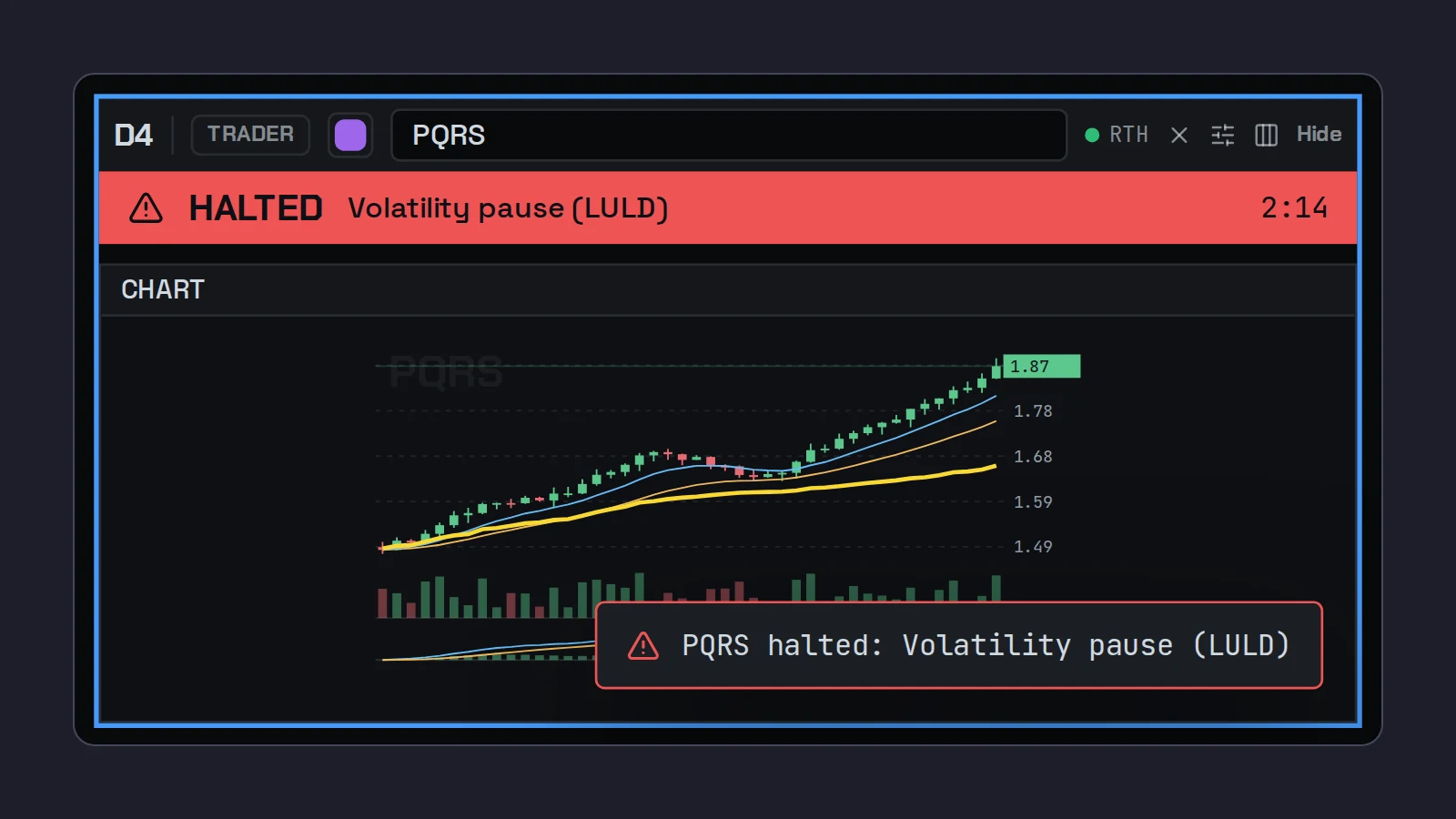
- A red HALTED strip opens under the desk header with the reason, such as Volatility pause (LULD) or Trading halted by the exchange, and a timer counting since Scalpel saw the halt. A red toast and a sound say the same, and a green ABCD resumed trading toast follows when it reopens.
- Buys are blocked from the moment Scalpel sees the halt until trading resumes: the buy buttons grey out and a buy key is refused with ABCD is halted: buys are blocked until it resumes. A halted stock reopens with an auction, so no entry can sit queued for that moment.
- Sells and Flatten All are not blocked, but nothing trades until the halt lifts.
Scalpel's stops are app-monitored, not resting orders at IBKR (how stops work). During a halt your stop stays armed but cannot fire, because no trades print. When the stock reopens, the first trade through your stop fires it and Scalpel sends a sell limit 5 cents under that trade, re-pricing it if the market keeps running, so on a gap the exit fills near the reopening price, not at your stop. The same applies before the open (pre-market stops). The built-in IBKR scanner includes IBKR's halts scan alongside top gainers and gappers. Our section video covers how the app-held stops work, dragging them on the chart, trailing and breakeven:
No software makes a halt safe. Scalpel only watches your stops while it is running with a live feed, and no stop guarantees a fill or a price.
Trading carries a significant risk of loss. Nothing here is financial advice.
Questions
- What is a LULD halt?
- A limit up limit down trading pause. When a stock's best bid sits on its upper price band, or its best offer on its lower band, for 15 seconds, the listing exchange pauses trading for five minutes and then reopens it with an auction.
- What happens to my orders during a trading halt?
- Resting limit orders stay on the book unless you cancel them, and they take part in the reopening auction at your limit or better. Stops cannot trigger, because no trades print during the halt.
- How long does a LULD halt last?
- Five minutes, and it can be extended if the stock cannot reopen in an orderly way. News halts and regulatory halts have no fixed length, and an SEC trading suspension can last up to 10 trading days.
- Does my stop loss work if a stock is halted?
- It stays in place but cannot trigger until trading resumes. If the stock reopens through your stop, the stop triggers on the first print and fills near the reopening price, which can be far below your stop.
- Do LULD halts happen in the pre-market?
- No. LULD price bands apply from 09:30 to 16:00 ET only. A halt before the open is a news or regulatory halt, which has no five-minute clock.
- How many LULD halts happen per day?
- The LULD Plan's 2025 annual report counted 10,763 trading pauses in 2025, a mean of 43.1 per trading day, with about 17% of them in the first 15 minutes of the session.
Related guides
Guide 2.5Desk badges: DELAYED, NO DATA, STALE and HALTEDWhat the session dot and the DELAYED, NO DATA and STALE badges mean on a Scalpel desk, what the HALTED banner shows, and what to do about each one.Guide 5.1How Scalpel's stops workWhy Scalpel holds your stops in the app, not on the book: pre-market rules, the working stop, catastrophe net and take-profit, and what if Scalpel closes.Guide 5.5Stops in the pre-market: why they cannot sit on the bookUS exchanges take only limit orders before 09:30, so a plain stop cannot guard a pre-market trade. How Scalpel's app stops fill the gap, and their limits.
Keep reading
- Day trading order types: what scalpers actually useDay trading order types: market, limit, marketable limit, stop, stop-limit and time in force, with a worked example and what scalpers really use on IBKR.
- Marketable limit order: the order type scalpers actually useA marketable limit order fills at once like a market order but caps your price. How it fills, how far through the ask to price it, and the TWS setup.
- Market order vs limit order in day trading: the small-cap costMarket order vs limit order in day trading small caps: what slippage costs in R on a thin book, why IBKR holds pre-market market orders, and what to use.
Practice in SIM, against the live book.A lifetime license, every update included, with a 7-day refund guarantee.Ask in DiscordGet Scalpel