IBKR liquidation: margin calls and auto-liquidation explained
By Scalpel Team. , updated . 9 min read.
In short
Interactive Brokers does not make margin calls. When a margin account's excess liquidity drops below zero, or its SMA is negative in IBKR's end-of-day Reg T window (15:50 to 20:20 ET), IBKR liquidation is automatic and real time: IBKR sells with market orders, it chooses which positions, and a deposit does not stop it because funds only count once they have cleared. The only warnings are a message when your equity falls to 110% of the maintenance requirement and color changes in the TWS Account window. The protection is to keep a cushion, not to plan on reacting.
Most brokers send a margin call and give you a few days to deposit. Interactive Brokers works differently, and traders who come from other brokers often learn this the hard way: the account dips under maintenance for a few minutes and positions are sold at market before they have opened their banking app. This post explains the two tests that trigger an IBKR liquidation, works through how far a leveraged small-cap position can fall before it happens, and lists what actually prevents it.
Everything here was checked against IBKR's own pages on October 22, 2026. Scalpel is independent and not affiliated with or endorsed by Interactive Brokers.
Does Interactive Brokers do margin calls?
No. IBKR says it plainly in its glossary entry on margin calls: "Interactive Brokers does not make margin calls. Instead, real-time liquidations occur when an account has a margin deficiency." The same entry adds that "accounts generally will not have time to deposit funds" and that deficit notifications go out "on a best-efforts basis."
That is legal. The SEC's investor site says of margin in general that a firm can sell your securities without informing you in advance, that it decides which ones to sell, and that it can change its thresholds at any time. Most brokers choose to send a call first. IBKR chooses not to, and it says so up front.
What triggers an IBKR liquidation: the two tests
IBKR's knowledge base article Why was I liquidated? names two margin violations for a margin account. They run on different clocks.
| Test | What must hold | When it is checked | Where to watch it in TWS |
|---|---|---|---|
| Maintenance margin | Equity with loan value (ELV) above the maintenance requirement, so Current Excess Liquidity stays positive | All the time, in real time | Account window, Available for Trading |
| Reg T (end of day) | SMA (Special Memorandum Account) at zero or above | During IBKR's enforcement window, "typically 15:50-20:20 ET" | Account window, Balances |
Maintenance is the one day traders hit. Excess liquidity is ELV minus the maintenance requirement. For a long US stock in a margin account, IBKR's stock margin page lists 25% maintenance and 26.25% initial margin at the time of trade. Equity can therefore carry positions worth up to four times itself, but only while prices hold.
Reg T is the overnight test. IBKR's page lists a 50% Reg T end-of-day requirement for a long stock. SMA is a running line of credit: a $10,000 purchase uses $5,000 of it, and a sale gives back 50% of the proceeds, per IBKR's explanation of SMA. If you are still holding at 15:50 ET and SMA is negative, the account is subject to liquidation. A position that was fine at four times equity during the day is not fine at four times equity overnight.
A worked example: how far a stock can fall before IBKR liquidates
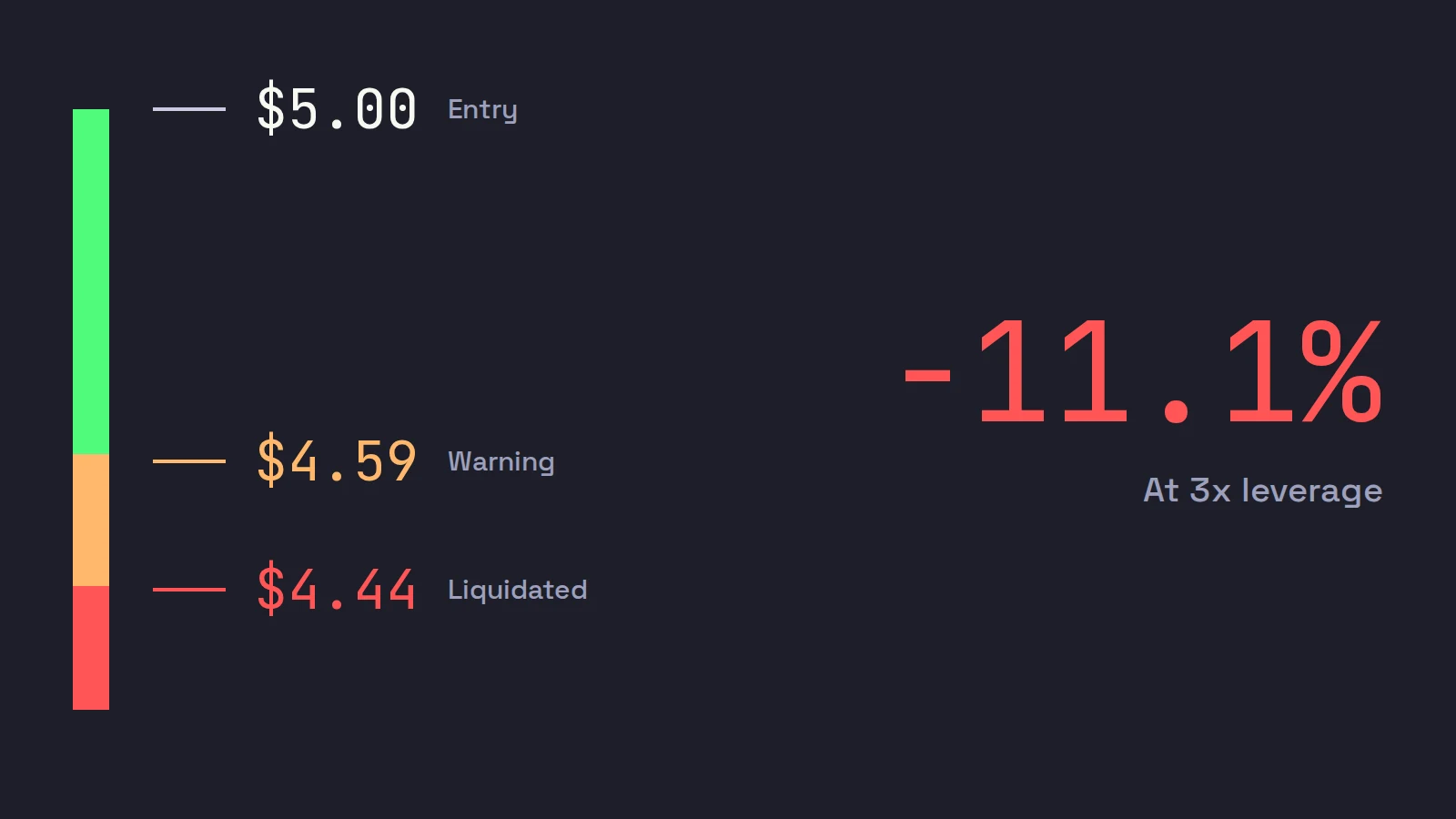
A margin account holds $10,000 cash and no positions. The trader buys 6,000 ABCD at $5.00, a $30,000 position. Initial margin at 26.25% is $7,875, under the $10,000 of equity, so IBKR accepts the order. The account now owes $20,000. Ignoring fees and any house requirement on the stock:
| ABCD price | Position value | Equity (ELV) | Maintenance (25%) | Excess liquidity | What happens |
|---|---|---|---|---|---|
| $5.00 | $30,000 | $10,000 | $7,500 | +$2,500 | Normal |
| $4.80 | $28,800 | $8,800 | $7,200 | +$1,600 | Normal |
| $4.59 | $27,540 | $7,540 | $6,885 | +$655 | Equity is under 110% of maintenance: the warning message |
| $4.45 | $26,700 | $6,700 | $6,675 | +$25 | One cent from a deficiency |
| $4.44 | $26,640 | $6,640 | $6,660 | -$20 | Margin deficiency: subject to liquidation |
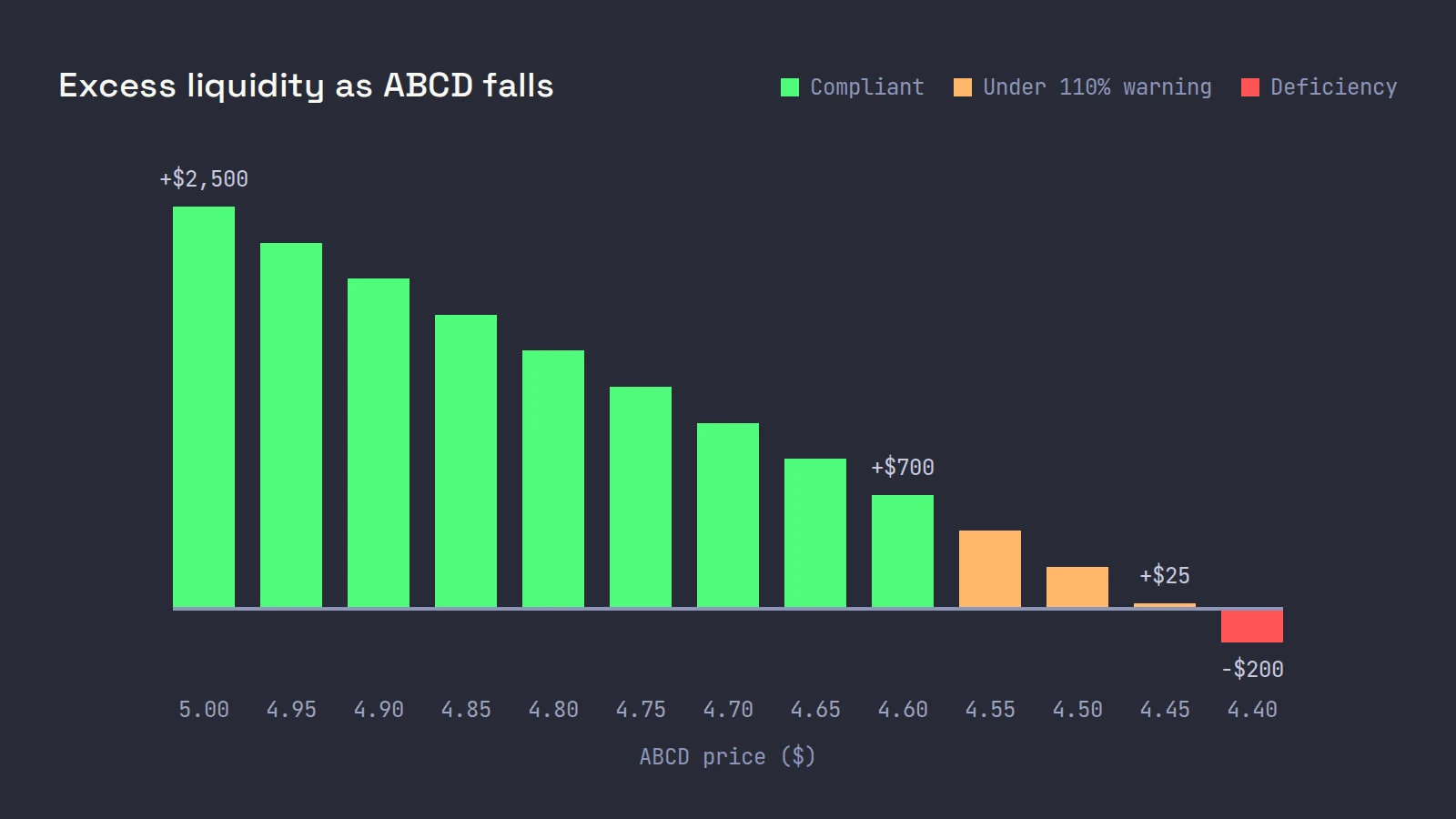
The break-even point is $4.444: equity of 6,000 x price minus $20,000 equals 25% of 6,000 x price. That is an 11.1% drop. A small cap moving 11% against you in a few minutes is an ordinary morning, not a crash. The warning arrives at $4.59, about 8% down, which on a fast stock can be seconds before the liquidation.
Now the overnight version of the same trade. The $30,000 purchase used $15,000 of Reg T requirement against $10,000 of equity, so SMA is -$5,000. If the trader is still holding at 15:50 ET, the account is in Reg T violation even if the price never moved. To hold overnight, the position has to come down to $20,000, twice the equity.
What else triggers a liquidation: margin increases, the close and fees
Price is not the only trigger. Three others catch small-cap traders:
- A margin increase on the stock you hold. IBKR says on its stock margin page that it "may reduce the collateral value of securities" for reasons including "small market capitalization or small issue size" and "low liquidity." If IBKR raised ABCD's maintenance requirement to 50% in the example, the requirement would jump from $7,500 to $15,000 against $10,000 of equity: a $5,000 deficiency with no price change at all. Non-marginable positions need 100%.
- Holding into the close. The 15:50 ET Reg T check described above.
- Fees, even in a cash account. IBKR's margin warning entry (below) notes that cash accounts sometimes require liquidation "to satisfy or avoid a loan," for example after a fee is charged. Keep enough cash to cover market data and other charges.
How IBKR auto liquidation works
From IBKR's article Will liquidation be delayed while I deposit funds?:
- "Automated liquidations are accomplished with market orders, and any/all positions in the account can be liquidated." IBKR picks what to sell, not you.
- "The liquidation system is automated and programmed to act immediately."
- Deposits are not taken into account "until those funds have cleared all the appropriate funds and banking channels." A wire sent after the deficiency does not stop the sale.
- IBKR does not allow transfers or other deposits while a margin violation exists. Occasionally it handles a deficit with a manual liquidation instead.
A market order on a thin small cap is the worst way to exit. The sale fills wherever the bids are, which can turn a $20 deficiency into a much larger realized loss.
Soft Edge Margin. IBKR's margin calculation page for Reg T accounts describes a grace band: from the start of the trading day until 15 minutes before the close, an account is not auto-liquidated until its deficit exceeds a set share of net liquidation value, "currently 10%." IBKR also says it is "not displayed in Trader Workstation," that IBKR may restrict it on any day, and that it "may eliminate SEM completely in times of heightened volatility." We would never size a position on the assumption that it applies.
It can count as a day trade. IBKR says that if a liquidation closes a position opened the same day, it counts as a day trade. That matters if your account is still on the old pattern day trader rules during FINRA's transition, which the PDT rule post covers.
The warnings you get before a margin deficiency
You get two, and neither gives you much time.
The 110% message. IBKR's margin warning entry says it is generated when ELV "is less than or equal to the Maintenance Margin Requirement * 110%." In the example, that is $4.59.
Color in the TWS Account window. The TWS guide to real-time margin monitoring highlights the row that is in distress:
| Color | What IBKR says it means |
|---|---|
| Yellow | "You have only a 10% cushion above the margin requirement" |
| Orange | The cushion is depleted. You have "a short time to enter into margin-reducing trades" and cannot enter trades that would increase margin |
| Red | "Your positions will shortly start to be liquidated" |
IBKR adds that if equity moves fast from above a 10% cushion straight into a violation, positions "may be liquidated without you receiving a yellow warning." One of IBKR's older website pages lists the yellow level at 5% rather than 10%, so treat the colors as a warning light rather than a measurement.
IBKR's own lesson walks through the Account window: Net Liquidation Value, Excess Liquidity and SMA on the Portfolio tab, then the Balances, Margin Requirements and Available for Trading sections. It is the clearest way to learn where those numbers live before you need them.

Margin deficiency vs intraday margin deficit
Since June 4, 2026, FINRA's intraday margin rule adds a second, separate idea: an intraday margin deficit, the most your account fell short of maintenance right after a purchase during the day. It is met by a deposit or by raising the account's margin level, and repeated unmet deficits can bring a 90-day restriction. A liquidation is what happens when the account is short of maintenance right now. You can have a deficit on your record without ever being liquidated, and you can be liquidated without the trade that created a deficit. The mechanics of the new rule are in intraday margin on IBKR, and the whole rule set is in day trading rules.
How to avoid an IBKR liquidation
- Size from the stop, not from buying power. Buying power tells you what IBKR will lend, not what you should risk. If a trade's worst case is an 11% drop, the example account is liquidated on an ordinary loss. See position sizing for day trading.
- Keep excess liquidity well above zero. On a small cap that can move 10% in a minute, a $655 cushion is not a cushion. Many small accounts are better off never borrowing at all: if positions never exceed cash, a maintenance deficiency cannot form (small account setup).
- Be at or under 2x equity by 15:50 ET if you hold anything overnight, or be flat.
- Expect margin increases on the stocks you trade. Low-priced, low-float names are exactly the ones IBKR may mark down. Check the margin on an order with TWS's Check Margin before you send it.
- Keep cash for fees in a cash account, so a data bill cannot force a sale. A cash account has its own settlement rules, too.
- Have a daily loss limit that stops you well before the margin math does (max daily loss).
Where Scalpel fits
Scalpel does not calculate IBKR's margin and cannot prevent an IBKR liquidation; IBKR decides that on its own servers. What Scalpel does is keep the numbers and the brakes in front of you while you trade.
The header shows NET LIQ and MARGIN USED: the dollars tied up in open positions and that as a percent of net liq, amber from 50% and red from 80% (cockpit tour). It is a simpler figure than IBKR's excess liquidity, but it makes "am I borrowing right now" visible at a glance.
The brakes are your own: Fat-finger ($) and Max position ($) caps refuse any buy above the value you set (fat-finger and position caps). Set Max position under your cash and Scalpel will not send a buy that borrows. A Daily loss ($) limit locks new entries when the day's P&L reaches it (daily loss limit). When IBKR refuses an order for margin or buying power, Scalpel shows IBKR's own reason in a red toast (why an order was rejected). This short video shows the risk controls in the app:
Scalpel's stops are app-monitored, not resting orders at IBKR, so they only work while Scalpel runs with a live feed, and no fill is guaranteed. Where TWS alone is enough, it is enough: its Account window and Check Margin are the authoritative view of your margin.
IBKR margin rules and pages checked on October 22, 2026.
Trading carries a significant risk of loss. Nothing here is financial advice.
Questions
- Does Interactive Brokers give margin calls?
- No. IBKR says it does not make margin calls. When an account has a margin deficiency, it is liquidated in real time, and IBKR says accounts generally will not have time to deposit funds first.
- What is excess liquidity on IBKR, and why did it drop?
- Excess liquidity is your equity with loan value minus the maintenance margin your positions need. It drops when your positions lose value, when you add to them, or when IBKR raises the margin requirement on a stock you hold, which can happen with no price change at all. Below zero, IBKR liquidates.
- When does IBKR auto liquidate?
- When Current Excess Liquidity goes below zero, meaning equity with loan value is under the maintenance requirement, or when SMA is negative during IBKR's end-of-day Reg T enforcement window, typically 15:50 to 20:20 ET.
- Can I deposit money to stop an IBKR liquidation?
- Usually not in time. IBKR does not count deposited funds until they have cleared banking channels, does not allow deposits while a margin violation exists, and its automated system acts immediately.
- How does IBKR liquidate positions?
- Automated liquidations use market orders, and IBKR can sell any or all positions in the account. You do not choose which positions are sold.
- What warning does IBKR give before liquidation?
- A message when equity with loan value falls to 110% of the maintenance requirement or below, and yellow, orange and red highlighting in the TWS Account window. A fast move can skip the warnings entirely.
- Does a forced liquidation count as a day trade?
- Yes. IBKR says a liquidation that closes a position opened the same day counts as a day trade, which matters if your account is still under the old pattern day trader rules during FINRA's transition.
Related guides
Guide 14.4Settings for a small accountSettings that suit a small account: risk-based presets, tight caps, a daily loss limit you will respect, the right commission plan, and what to watch for.Guide 7.1Set a daily loss limit (the kill-switch)Set a max daily loss in Scalpel: when your P&L hits it, new entries stop, a RISK LOCK banner shows, and it can flatten everything. How to resume trading.Guide 7.2Fat-finger and max-position capsWhat Scalpel's fat-finger cap and max-position cap block, how they interact with risk sizing, and sensible values for small, medium and larger accounts.
Keep reading
- Day trading rules in 2026: every rule a US stock trader should knowDay trading rules for 2026: the PDT rule replaced by intraday margin, T+1 settlement, LULD halts, SSR, wash sales and taxes, each with its source.
- The PDT rule is gone: what changed for day trading on Interactive BrokersYes: IBKR began dropping the PDT rule on June 4, 2026. No $25,000 minimum, no day trade count. What replaced it, a worked example and who is still on it.
- IBKR Tiered vs Fixed for scalpers: the math on real tradesTiered vs Fixed pricing explained simply: Fixed is one flat rate a share, Tiered a lower rate plus exchange fees. Which is cheaper on IBKR, worked out.
Practice in SIM, against the live book.A lifetime license, every update included, with a 7-day refund guarantee.Ask in DiscordGet Scalpel