The short sale restriction (SSR): what it means when you are long
By Scalpel Team. , updated . 7 min read.
In short
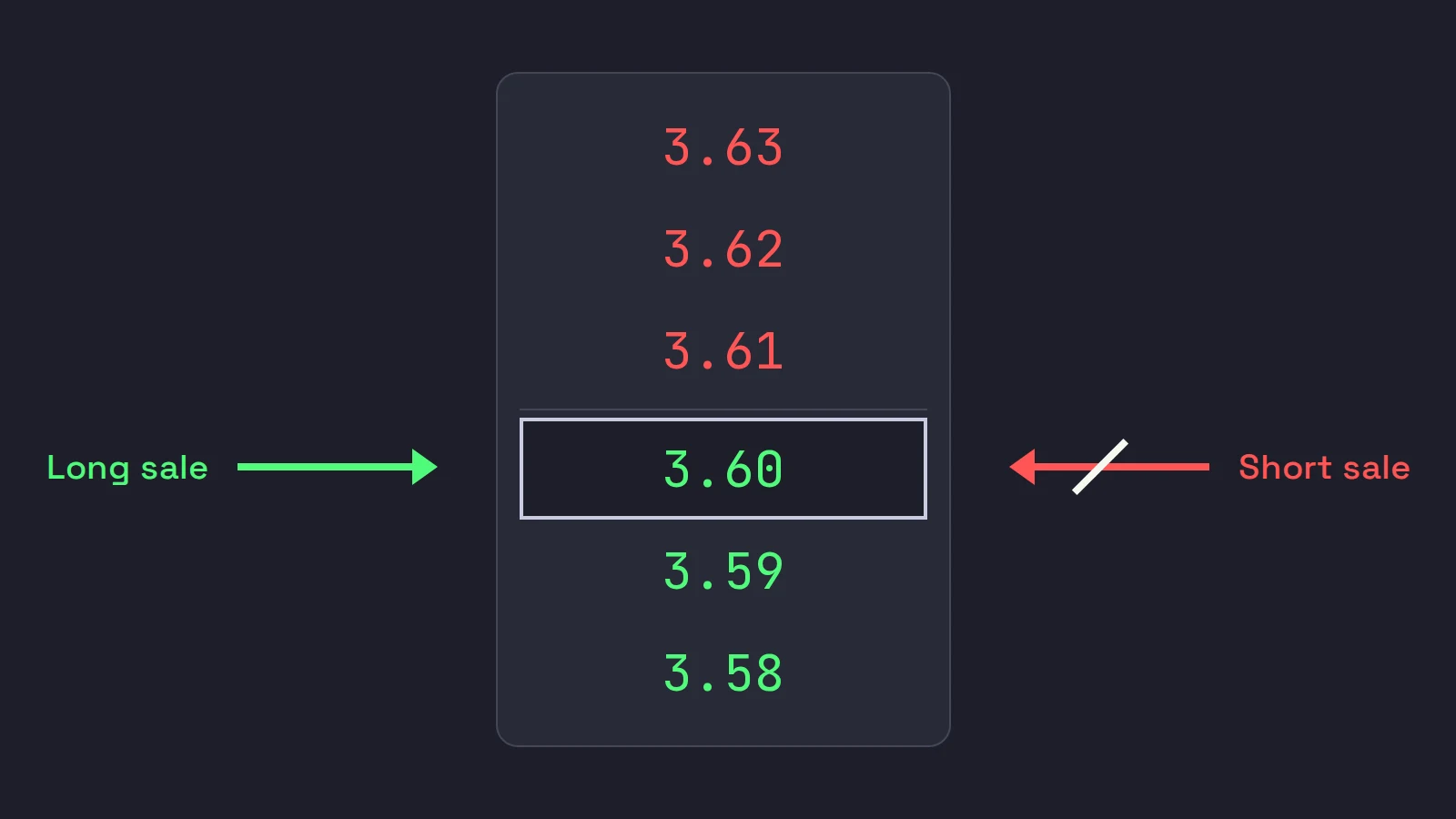
The short sale restriction (SSR) is SEC Rule 201. When a listed stock trades 10% or more below the prior day's close during regular hours, its listing market triggers a circuit breaker, and for the rest of that day and all of the next trading day, short sales can only execute above the national best bid. Long sellers are not restricted: they can still sell at the bid, so they get out ahead of shorts. SSR does not stop shorting, does not apply to OTC-only stocks, and says nothing about where the price goes next.
"SSR" shows up next to a ticker on many day trading screens, and in small-cap chat it is often treated as a bullish signal on its own. It is neither a halt nor a ban on shorting. It is a narrow price test that changes who can hit the bid. If you only ever buy and sell what you own, you are never restricted by it, but it still changes the order book you trade against. This post covers what Rule 201 says, exactly when it starts and stops, and what it means for a long trader.
Scalpel is independent and not affiliated with or endorsed by Interactive Brokers, Nasdaq or the SEC.
What does SSR mean?
SSR stands for short sale restriction, the trader's name for the "circuit breaker" in Rule 201 of Regulation SHO. The SEC adopted it on February 24, 2010, describing it in its press release as a rule "designed to restrict short selling from further driving down the price of a stock." It is also called the alternative uptick rule. IBKR's knowledge base gives November 10, 2010 as the date it went into effect.
The rule has three parts:
- The trigger. A covered stock's price falls "by 10% or more from the covered security's closing price as determined by the listing market" as of the prior day's close.
- The price test. Trading centers must prevent the execution or display of a short sale "at a price that is less than or equal to the current national best bid."
- The duration. The test applies "for the remainder of the day and the following day."
A covered security is an NMS stock: a stock listed on a US exchange such as Nasdaq or NYSE American, wherever it trades.
Rule 201: when SSR starts and when it ends
The SEC staff's Rule 201 FAQ fills in the details that matter to a pre-market trader:
- Only regular-hours trades trigger it. The determination is "limited to regular trading hours," 09:30 to 16:00 ET, and is based on last-sale trades in the consolidated tape. A stock down 15% at 08:00 ET is not on SSR yet. If it is still down 10% or more at the first regular-hours trades, it triggers then.
- Once on, it covers extended hours. The restriction applies outside regular hours on both days. If the circuit breaker triggers on a Friday, it applies for the rest of Friday and all of Monday.
- It can re-trigger. If the stock falls 10% from the next day's close, the clock restarts. There is no limit on consecutive days.
- The listing market decides. Not your broker's data, not a website. A trading center's own data showing a 10% drop does not put the stock on SSR until the listing market says so.
- After a halt, the reference is the last closing price, and the circuit breaker can trigger once trading resumes. A new listing is not covered until its second day.
A worked example
ABCD closes Monday at $4.00, so the trigger price is $3.60, exactly 10% lower.
| When (ET) | ABCD | SSR status |
|---|---|---|
| Tuesday 07:30 | $3.40 in the pre-market | Not on SSR: pre-market trades do not count |
| Tuesday 09:30 | Opens at $3.45 | Triggered by the listing market |
| Tuesday 09:30 to 20:00 | Bounces to $3.90, closes at $3.80 | On SSR for the rest of the day, after-hours included |
| Wednesday 04:00 to 20:00 | Trades between $3.55 and $4.10 | On SSR all day, pre-market included |
| Wednesday close | Closes at $3.70 | Ends, unless it fell 10% below Tuesday's $3.80 close ($3.42) during Wednesday's regular hours |
| Thursday | Off |
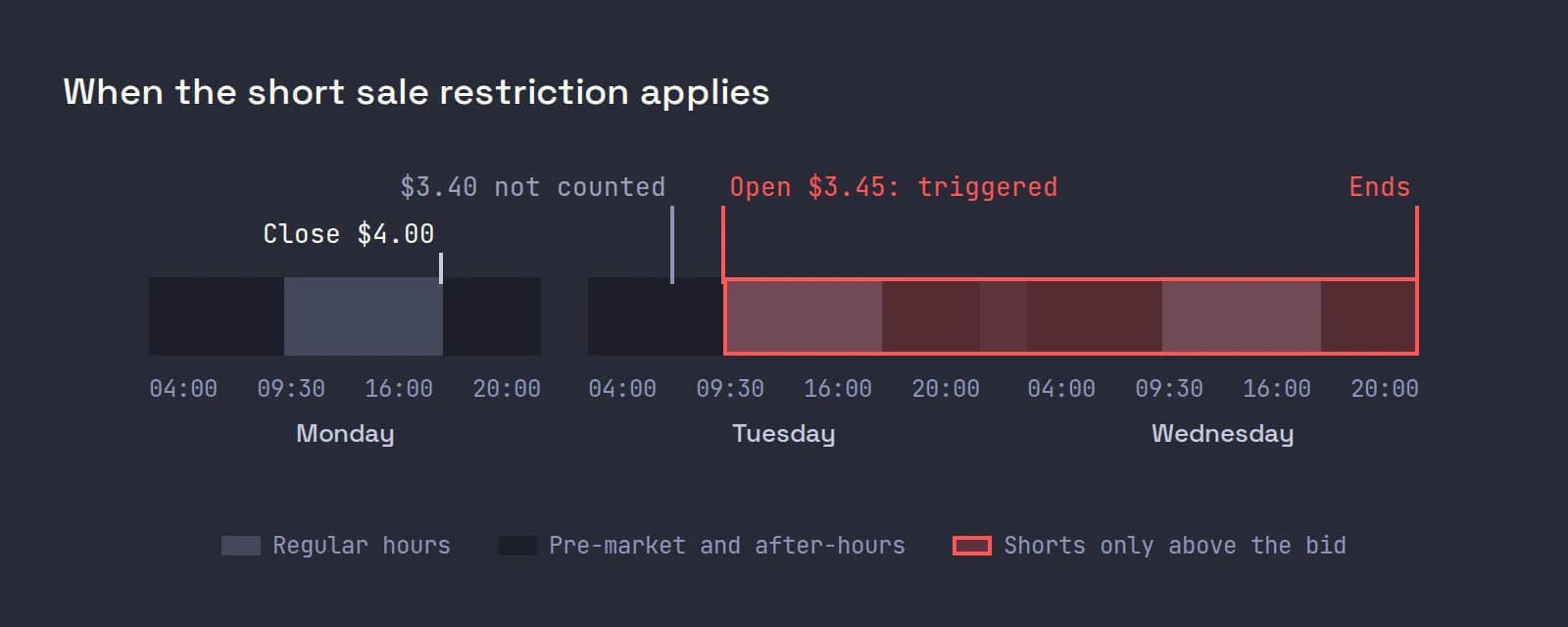
Notice that the bounce on Tuesday does not lift the restriction. Once triggered, it runs its course.
What SSR does to the order book
Under SSR, a short sale has to be priced above the national best bid. Shorts can still sell, but only by offering: they rest on the ask or between the bid and ask and wait for a buyer. They cannot hit the bid.
IBKR's knowledge base article on the Reg SHO short sale bid test puts it clearly: short sellers "can only participate as liquidity providers," while long sellers "may display or execute orders at the bid" and "are allowed to act as liquidity takers." The SEC's release said the same thing in plainer words: the rule lets "long sellers to stand in the front of the line and sell their shares before any short sellers" once the circuit breaker is triggered.
IBKR's example: a stock closed at $10.00, trades at $8.99 with a $8.98 by $9.00 quote. A short sale can only display or execute at $8.99 or higher. A long sale can execute at $8.98.
There is one exception worth knowing. A broker can mark an order "short exempt" if, for example, it is priced above the national best bid when submitted, or the seller is deemed to own the stock and will deliver it. Those are Rule 201's own exemptions; for a retail long trader the practical point is simpler: if you own the shares you are selling, your sale is a long sale and the test does not apply to you. Long or short, every sale still pays the regulatory fees on sales, covered in SEC fee and FINRA TAF.
Why long traders care about the short sale restriction
Your exit is protected, not your price. On an SSR day you can always hit the bid with a long sale. Shorts cannot. That is real priority, but it does not hold the bid up: other longs are selling into it too, and a stock that is already down 10% has plenty of them.
Shorts lose one tool. Without the ability to slam bids, short sellers who want to press a falling stock have to offer and wait. Some small-cap traders treat SSR as a reason a squeeze is more likely, because new shorts cannot pile in as aggressively. That is a theory about behavior, not something the rule guarantees. Borrow availability and the borrow fee usually tell you more about how much short pressure exists; our post on short squeezes covers them, along with the Reg SHO threshold list, and the borrow and short squeezes guide shows how to read them.
SSR tells you about yesterday. A stock on SSR is one that fell 10% or more from a close. On a small cap that can mean an offering, a failed run, a reverse split or nothing at all. Read the reason before you read the label. A dilution check on SEC EDGAR is the usual first stop.
A sell bigger than your position is a short sale. If you sell 1,000 shares while holding 600, the extra 400 are a short sale, and under SSR they cannot hit the bid. In TWS, a sell key with an absolute size that does not match your position can do exactly this. Close positions with an order sized to what you hold.
SSR does not apply to OTC stocks
Rule 201 covers NMS stocks only. IBKR's article states that it "does not apply to stocks which are traded only on the OTCBB and/or PINK." So an OTC penny stock can fall 50% with no SSR at all. The rules that do apply there are covered in trading penny stocks on Interactive Brokers.
SSR is also not a trading halt. A halt stops all trading; SSR only changes the price at which shorts may sell. Volatility halts work differently, and they are covered in LULD trading halts.
How to check whether a stock is on SSR
The listing markets publish the list. Nasdaq's short sale circuit breaker page posts a file for each trade date. Some trading platforms also flag SSR on the quote. We could not find an Interactive Brokers page that documents an SSR indicator in TWS, so we would not rely on one: if it matters to your trade, check the listing market's list, and remember the rule is about yesterday's close, which you can see on any chart.
Where Scalpel fits
Scalpel is long only: a sell can never exceed what you hold, so it cannot open a short position, and every sell it sends is a long sale (long only). That means the short sale restriction never blocks a Scalpel order. Scalpel does not show an SSR flag today.
What it does show is the short side's capacity to push, from free public sources: IBKR's live shortable data and borrow fee, the Reg SHO threshold list and FINRA short volume, scored into a borrow pressure reading with chips such as Can't short and Hard to short. That tells you more than SSR alone about whether shorts can add to a move.
The intel video shows where these reads appear on a desk:
To read who is hitting the bid on an SSR day, the Level 2 and tape are still the tools; the Level 2 guide covers both. The rest of the rules that shape a US stock trader's day are collected in day trading rules.
Rule 201, the SEC FAQ and IBKR's article checked on October 22, 2026.
Trading carries a significant risk of loss. Nothing here is financial advice.
Questions
- What does SSR mean on a stock?
- SSR means the short sale restriction under SEC Rule 201 is in effect. The stock traded 10% or more below the prior close during regular hours, so for the rest of that day and the next trading day, short sales can only execute above the national best bid.
- How long does the short sale restriction last?
- For the remainder of the day it triggers and all of the following trading day, including pre-market and after-hours. If the stock falls 10% from the next close again, it re-triggers for another day.
- Does SSR affect me if I am long?
- Not as a restriction. A sale of shares you own is a long sale and can execute at the bid. SSR only changes the book you trade against, because shorts cannot hit the bid while it applies.
- Can a stock go on SSR in the pre-market?
- No. Only regular-hours trades, 09:30 to 16:00 ET, can trigger the circuit breaker. Once triggered, though, the restriction applies outside regular hours on both days.
- Is SSR bullish?
- Not by itself. It removes one way for shorts to press a falling stock, but the stock is on SSR because it already fell 10% or more. Borrow availability, the reason for the drop and the tape tell you more.
- Does SSR apply to OTC penny stocks?
- No. Rule 201 covers NMS stocks, those listed on a US exchange. IBKR notes it does not apply to stocks traded only on OTC markets such as Pink.
Related guides
Guide 7.3Why Scalpel is long-onlyScalpel is long-only by design: every sell is capped to the shares you hold, so a double press never puts you short. No shorts, futures, options or crypto.Guide 9.3Borrow, short fees and squeeze setupsRead borrow like a squeeze trader: shares left to short, the borrow fee, the Reg SHO threshold list and short volume, combined into Scalpel's borrow chips.Guide 3.1How to read Level 2 in ScalpelRead Scalpel's DAS-style Level 2: bids left, asks right, optional colour bands per price, venues, spread, imbalance and delta, and reading players by behaviour.
Keep reading
- Day trading rules in 2026: every rule a US stock trader should knowDay trading rules for 2026: the PDT rule replaced by intraday margin, T+1 settlement, LULD halts, SSR, wash sales and taxes, each with its source.
- The PDT rule is gone: what changed for day trading on Interactive BrokersYes: IBKR began dropping the PDT rule on June 4, 2026. No $25,000 minimum, no day trade count. What replaced it, a worked example and who is still on it.
- IBKR Tiered vs Fixed for scalpers: the math on real tradesTiered vs Fixed pricing explained simply: Fixed is one flat rate a share, Tiered a lower rate plus exchange fees. Which is cheaper on IBKR, worked out.
Practice in SIM, against the live book.A lifetime license, every update included, with a 7-day refund guarantee.Ask in DiscordGet Scalpel