SEC fee on stock sales and FINRA TAF: the current rates
By Scalpel Team. , updated . 7 min read.
In short
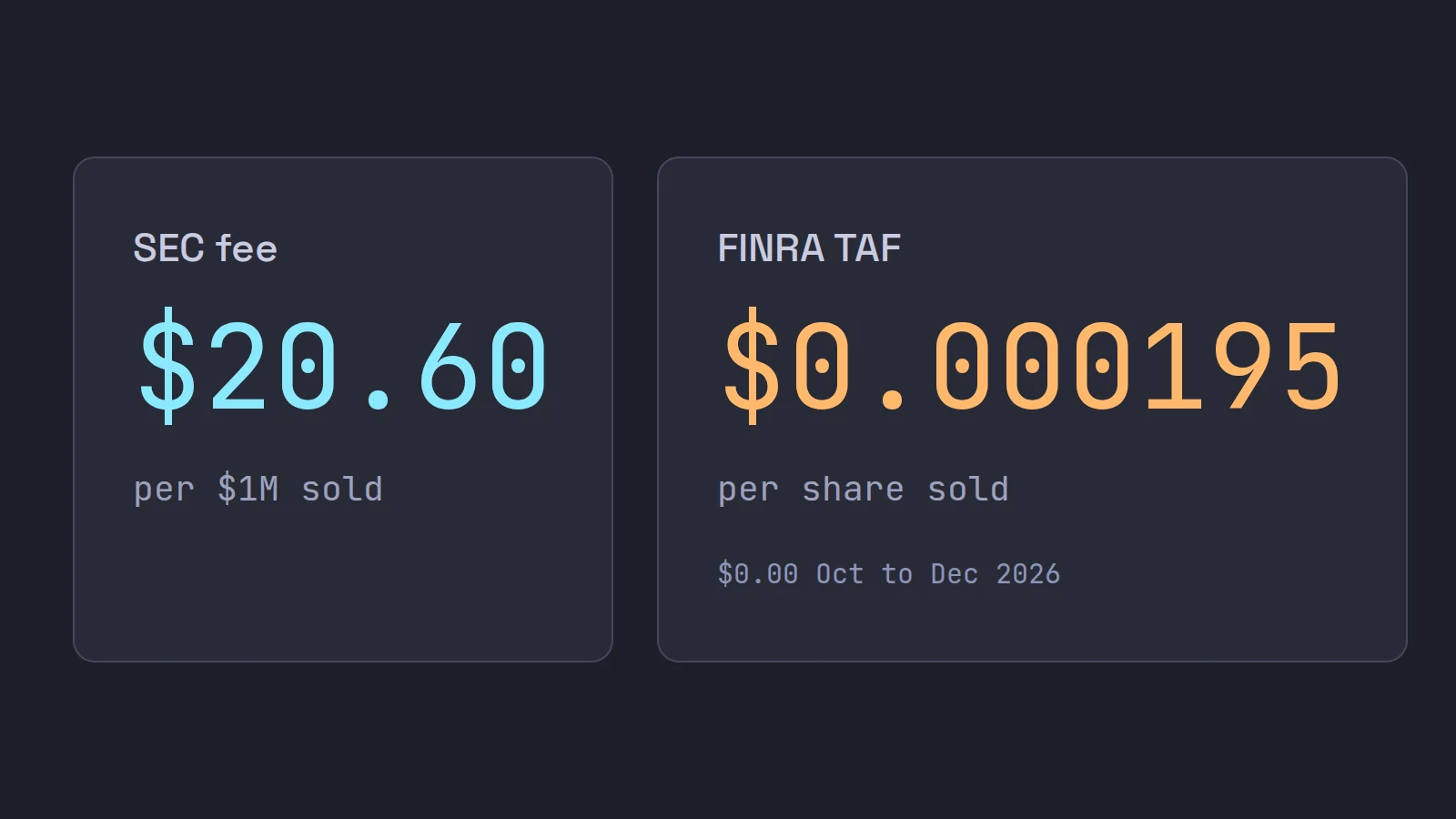
Two regulatory fees apply to every stock sale, and never to a purchase. The SEC fee on stock sales (the Section 31 fee) is $20.60 per million dollars sold, or $0.0000206 times the sale's value, since April 4, 2026: about 10 cents on a $5,000 sale. The FINRA trading activity fee (TAF) is $0.000195 a share, capped at $9.79 a trade, but FINRA has set it to $0.00 for trades from October 1 to December 31, 2026; it returns on January 1, 2027. On Interactive Brokers both are added on top of Fixed and Tiered commissions.
Look at an IBKR trade confirmation for a sell and you will find a few lines under the commission that do not appear on the buy. They are small, but they are on every sale you will ever make, short sales included, and their rates change more often than most traders realize: the SEC fee has been $27.80, $0.00 and $20.60 per million in the last two and a half years. This post gives the current rates from the regulators themselves, shows the math on real-size sells, and explains how they appear on an IBKR statement.
Scalpel is independent and not affiliated with or endorsed by Interactive Brokers, the SEC or FINRA.
The regulatory fees on a stock trade, in one table
| Fee | Who sets it | Charged on | Current rate | Cap |
|---|---|---|---|---|
| SEC fee (Section 31) | The SEC, under Section 31 of the Exchange Act | The dollar value of each sale | $20.60 per $1 million ($0.0000206 per dollar), since April 4, 2026 | None |
| FINRA TAF | FINRA, Schedule A to its By-Laws | The number of shares in each sale | $0.00 for trades October 1 to December 31, 2026; $0.000195 a share from January 1, 2027 | $9.79 a trade |
| CAT fee | FINRA CAT, passed on by IBKR | Shares on each trade | $0.000003 a share on IBKR's page | None |
Purchases pay none of the first two. IBKR's US stock commissions page lists the SEC fee as "USD 0.0000206 * Value of Aggregate Sales," the TAF as "USD 0.00 * Quantity Sold" with a note on the fee holiday, and the consolidated audit trail (CAT) fee as "USD 0.000003 * Quantity." All three are added on both IBKR Pro Fixed and Tiered.
The SEC fee on stock sales: how Section 31 works
Strictly, the SEC does not charge you anything. Its basic information page on Section 31 fees explains that Section 31 makes the exchanges and FINRA pay the SEC based on the dollar value of certain sales. They collect it from their member brokers through per-transaction charges, and brokers in turn charge their customers. The SEC even notes that calling these charges "SEC fees" is not accurate. The name stuck anyway.
The rate is reset to match the SEC's budget, so it moves. Here is the recent history, from the SEC's Fee Rate Advisory for fiscal year 2026, its fiscal year 2025 advisory and FINRA's May 1, 2024 information notice:
| Effective | Rate per $1 million sold | Fee on a $5,000 sale |
|---|---|---|
| Before May 22, 2024 | $8.00 | $0.04 |
| May 22, 2024 | $27.80 | $0.14 |
| May 14, 2025 | $0.00 | $0.00 |
| April 4, 2026 | $20.60 | $0.10 |
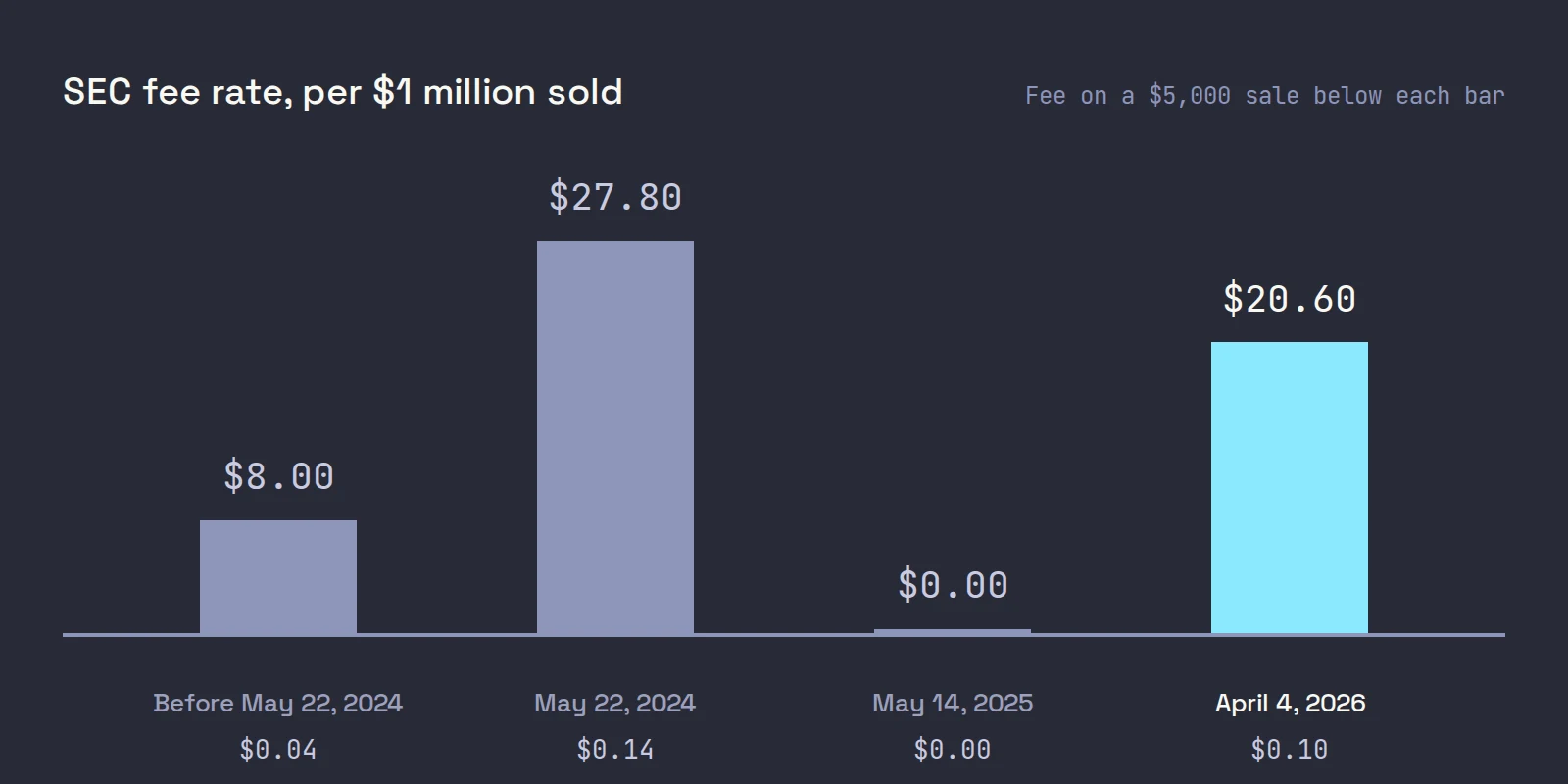
The current advisory, dated February 27, 2026, says the $20.60 rate stays in effect "until 60 calendar days after legislation is enacted" that sets the SEC's fiscal year 2027 appropriation. When we checked on October 22, 2026, the SEC's list of fee rate advisories showed no newer Section 31 advisory, so $20.60 is the rate today. The next change will be announced there first.
The formula is simple: SEC fee = sale value x 0.0000206. A sale of 1,000 shares at $5.00 is $5,000, so the fee is $0.103.
FINRA TAF: per share, with a cap
The trading activity fee is FINRA's, and it funds FINRA's own regulation. It is charged per share sold, not per dollar, which makes it relatively heavier on low-priced stocks. Two details matter:
- The cap. The maximum is $9.79 a trade, which you reach at about 50,206 shares.
- Sub-penny prices. If the execution price is below the TAF rate itself (under $0.000195 a share), no fee is charged. That only touches the very lowest-priced OTC stocks.
The fee holiday. FINRA's rule filing SR-FINRA-2026-021 pauses the TAF "for three months, for transactions from October 1, 2026 through December 31, 2026, with TAF assessment resuming on January 1, 2027." FINRA's reason is that trading volume in the first half of 2026 beat 2025, so TAF revenue was running ahead of its $438.6 million budget. During the pause the rate is $0.00 a share with a $0.00 cap. The same filing notes that a separate filing, SR-FINRA-2026-020, keeps the TAF at $0.000195 and $9.79 through December 31, 2028, postponing the increases FINRA had scheduled.
So the formula from January 1, 2027 is: TAF = shares sold x $0.000195, at most $9.79. On 1,000 shares that is $0.195.
Worked examples: SEC fee and FINRA TAF on real sells
IBKR calculates each fee at full precision, then rounds it to the nearest cent, per its article on handling fractional fees. Rounded the same way:
| Sell | Sale value | SEC fee | FINRA TAF, Oct to Dec 2026 | FINRA TAF from Jan 1, 2027 |
|---|---|---|---|---|
| 1,000 ABCD at $1.00 | $1,000 | $0.02 | $0.00 | $0.20 |
| 1,000 ABCD at $5.00 | $5,000 | $0.10 | $0.00 | $0.20 |
| 1,000 WXYZ at $20.00 | $20,000 | $0.41 | $0.00 | $0.20 |
| 300 WXYZ at $10.00 | $3,000 | $0.06 | $0.00 | $0.06 |
| 60,000 ABCD at $2.00 | $120,000 | $2.47 | $0.00 | $9.79 (the cap; uncapped it would be $11.70) |
The pattern: the SEC fee follows dollars and the TAF follows shares. On a $1 stock the TAF is about ten times the SEC fee. On a $20 stock the SEC fee is twice the TAF.
A short sale pays both. A short sale is a sale. The buy-to-cover pays neither.
A partial fill can pay twice. Each execution is its own sale, and IBKR rounds per line, so one order that fills in three pieces gets three roundings. On these sizes that is a cent here or there.
Regulatory fees vs commissions on IBKR
Put a typical scalping day next to its commissions. Twenty round trips of 1,000 shares at $5.00 on IBKR Pro Fixed:
| Item | Per round trip | 20 round trips |
|---|---|---|
| Commission, buy and sell at $0.005 a share | $10.00 | $200.00 |
| SEC fee on the sell | $0.10 | $2.00 |
| FINRA TAF on the sell, from 2027 | $0.20 | $4.00 |
| CAT fee, both sides | under $0.01 | under $0.20 |
Once the TAF returns, regulatory fees come to about 3% of the commission bill on this pattern; during the holiday, about 1%. They are not where a day trader's money goes; the commission and, much more, the bid-ask spread and slippage are. The full monthly picture, data included, is in the real cost of day trading, and the commission side is in IBKR Tiered vs Fixed.
Where the TAF does start to matter is large share counts at low prices. Sell 60,000 shares of a $0.50 stock and the TAF hits the $9.79 cap, about 0.03% of the $30,000 sale, while the SEC fee is $0.62.
Where to see them on an IBKR statement
On IBKR, regulatory fees are listed in the third-party fees, not folded into the commission rate:
- IBKR Pro Fixed includes exchange and clearing fees in its $0.005 a share, but IBKR's page lists regulatory fees as added on top.
- IBKR Pro Tiered adds exchange, clearing, pass-through and regulatory fees on top of its $0.0035.
- IBKR Lite charges no commission on US exchange-listed stocks, but the regulatory fees on sales still apply.
Your trade confirmations and the activity statement show the fees per execution. If your numbers differ from this post by a cent, the rounding is the reason; if they differ by more, check the date of the trade against the rate table above.
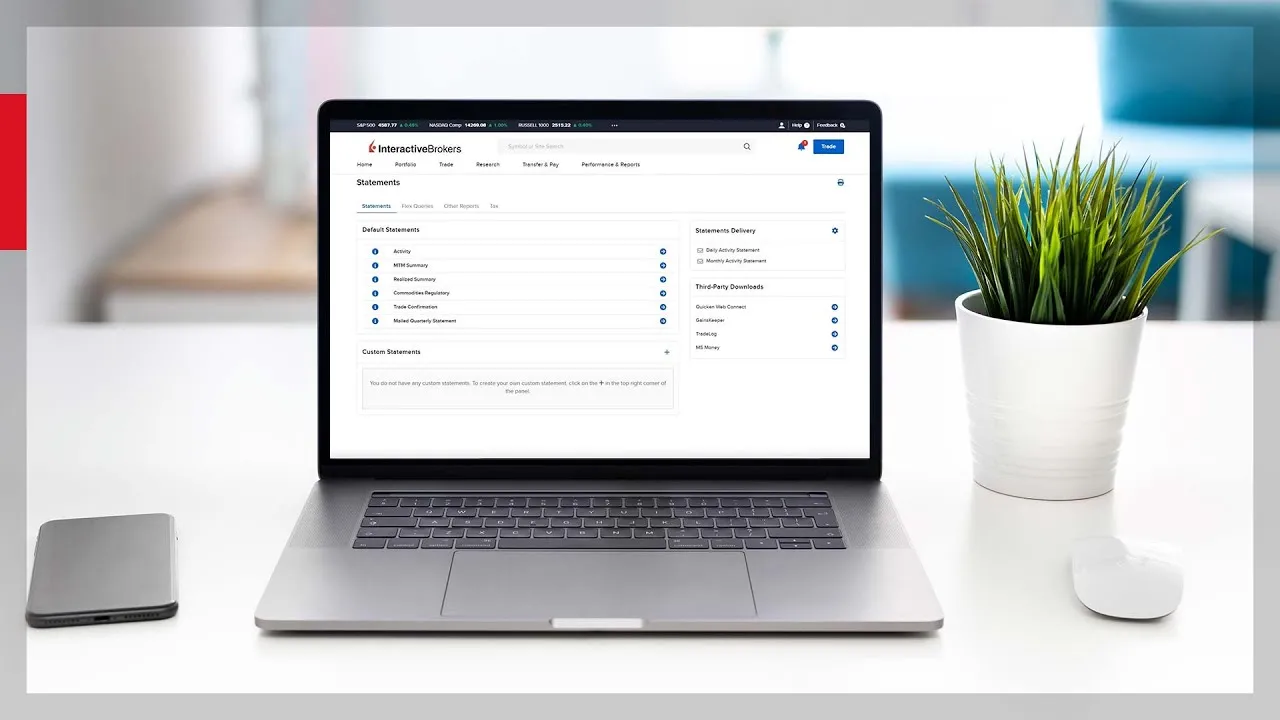
IBKR's lesson on its reporting tools shows where statements live in Client Portal and how to build a custom statement that includes the commission details and trades sections, which is where these fees appear.
Where Scalpel fits
Scalpel trades through your own IBKR account, so the regulatory fees are IBKR's charges, applied the same way as in TWS. In LIVE, Scalpel books the commission IBKR reports for each fill in the FEE column and nets it out of your P&L. For the separate regulatory lines, your IBKR statement is the source of truth.
In SIM, Scalpel estimates commissions from the plan you pick in Settings > Risk > Commission plan, adding exchange and clearing fees on Tiered. It leaves regulatory fees on sales out on every plan, because at these sizes they are cents (commissions guide). That makes SIM slightly optimistic: about 10 cents per $5,000 sold today, and about 30 cents per 1,000-share sale at $5.00 from January 2027. Over hundreds of trades it is worth knowing, and it is one more reason to read your SIM results in Analytics with a margin of safety before you practice in SIM and then go live.
This short video covers SIM and LIVE in Scalpel, including how fills and commissions are booked in each:
The rest of the regulations a day trader works under, from intraday margin to the short sale restriction, are collected in day trading rules.
Fees checked on October 22, 2026, against the SEC, FINRA and Interactive Brokers pages linked above.
Trading carries a significant risk of loss. Nothing here is financial advice.
Questions
- What is the SEC fee on stock sales?
- It is the Section 31 fee, $20.60 per million dollars of sale value since April 4, 2026, or $0.0000206 times the sale's value. It is charged on sales only, so a $5,000 sale pays about 10 cents and a purchase pays nothing.
- What is the FINRA TAF fee?
- The trading activity fee is $0.000195 per share sold with a maximum of $9.79 a trade. FINRA set it to $0.00 for trades from October 1 to December 31, 2026, and it resumes at the same rate on January 1, 2027.
- Are SEC and FINRA fees charged on buys?
- No. Both apply to sales only, including short sales. Buys and buys to cover pay neither, though IBKR lists a tiny consolidated audit trail fee on share quantity.
- Does IBKR Fixed pricing include regulatory fees?
- No. IBKR Pro Fixed includes exchange and clearing fees, but IBKR adds the SEC fee, the FINRA TAF and the CAT fee on top on both Fixed and Tiered.
- Why did the SEC fee change in 2026?
- The SEC resets the Section 31 rate to match its budget. It was $0.00 per million from May 14, 2025, and the SEC's fiscal year 2026 advisory set it to $20.60 per million from April 4, 2026, until 60 days after its fiscal year 2027 appropriation is enacted.
Related guides
Guide 6.3Commissions: pick your IBKR planMatch Scalpel's SIM fees to your Interactive Brokers plan: Pro Tiered, Pro Fixed, Lite or custom, plus exchange and clearing fees, and the FEE column.Guide 6.4Analytics: review your tradingScalpel's Analytics view: equity curve, win rate, expectancy, profit factor, R distribution, every trade, results by symbol and hour, and a trader grade.Guide 6.1Paper trading with SIMSIM fills your orders against the live Level 2 book, with partial fills, slippage and commissions. How it works, its paper ledger, and how to reset it.
Keep reading
- Day trading rules in 2026: every rule a US stock trader should knowDay trading rules for 2026: the PDT rule replaced by intraday margin, T+1 settlement, LULD halts, SSR, wash sales and taxes, each with its source.
- The PDT rule is gone: what changed for day trading on Interactive BrokersYes: IBKR began dropping the PDT rule on June 4, 2026. No $25,000 minimum, no day trade count. What replaced it, a worked example and who is still on it.
- IBKR Tiered vs Fixed for scalpers: the math on real tradesTiered vs Fixed pricing explained simply: Fixed is one flat rate a share, Tiered a lower rate plus exchange fees. Which is cheaper on IBKR, worked out.
Practice in SIM, against the live book.A lifetime license, every update included, with a 7-day refund guarantee.Ask in DiscordGet Scalpel