Low float stocks: what float means and why runners move
By Scalpel Team. , updated . 12 min read.
In short
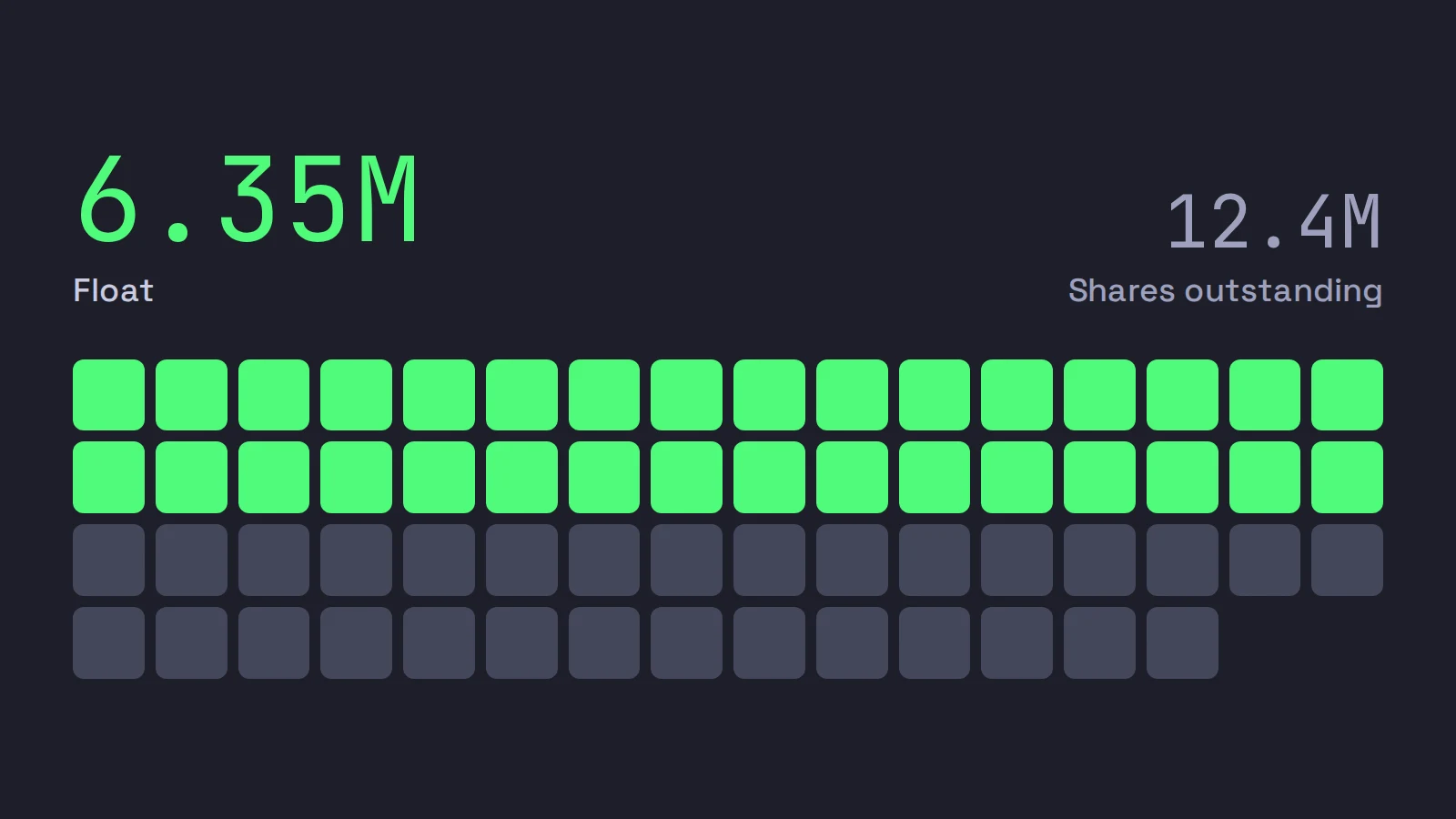
Low float stocks are stocks with only a few million shares that the public can actually trade. Traders usually mean a float under about 10 to 20 million shares, though no rule defines the term. The float is shares outstanding minus the shares held by insiders, large owners and holders who cannot sell yet. Low float runners move hard because a burst of buying meets a small supply, and they fall just as fast once the buying stops. The float is also never fixed: offerings, warrants and private sales add shares, so check the latest filings before you treat a low float as an edge.
Low float stocks are behind many of the small-cap runners that show up on pre-market gap lists. That is not a coincidence, and it is not magic either. It is supply and demand on a share count small enough that a burst of retail buying can move it a long way.
This pillar explains what float means, how it differs from shares outstanding, where the numbers come from and why they disagree, why low float runners move the way they do, and how dilution and short interest change the picture. Every other post in this cluster goes deeper on one part; they are linked at the end. Rules and figures were checked on October 22, 2026.
What is float in stocks?
The float is the number of shares available for the public to trade. It starts from shares outstanding, every share the company has issued, and takes out the shares that are not realistically for sale today:
- Shares held by officers and directors.
- Shares held by large owners, such as a founder, a venture fund or a parent company.
- Restricted shares: stock sold in a private placement or issued to employees that cannot be resold yet.
The SEC uses a close cousin of the idea. Its "public float" is a dollar figure: the market value of the common stock held by non-affiliates. Every Form 10-K cover page states it, "as of the last business day of the registrant's most recently completed second fiscal quarter", next to the number of shares outstanding "as of the latest practicable date". An affiliate, under Exchange Act Rule 12b-2, is anyone who controls the company or is under common control with it, which in practice means insiders and usually large holders.
Public float matters beyond trading. A company with a public float under $250 million is a smaller reporting company under the same rule, and the dilution limits covered below are set by public float too.
Float vs shares outstanding
The difference between the two numbers is where most float confusion comes from. A worked example makes it concrete.
ABCD's latest 10-Q cover shows 12,400,000 shares outstanding. Its filings show:
- Officers and directors own 3,100,000 shares.
- A venture fund owns 1,750,000 shares, 14% of the company.
- An investor bought 1,200,000 shares in a private placement four months ago. Those shares are not yet registered for resale.
| Measure | Shares | How it is worked out |
|---|---|---|
| Shares outstanding | 12,400,000 | From the 10-Q cover |
| Held by non-affiliates (the SEC's public float, in shares) | 7,550,000 | 12.4M minus 3.1M insiders minus the 1.75M fund, if the company treats the fund as an affiliate |
| Tradable float | 6,350,000 | 7.55M minus the 1.2M restricted shares |
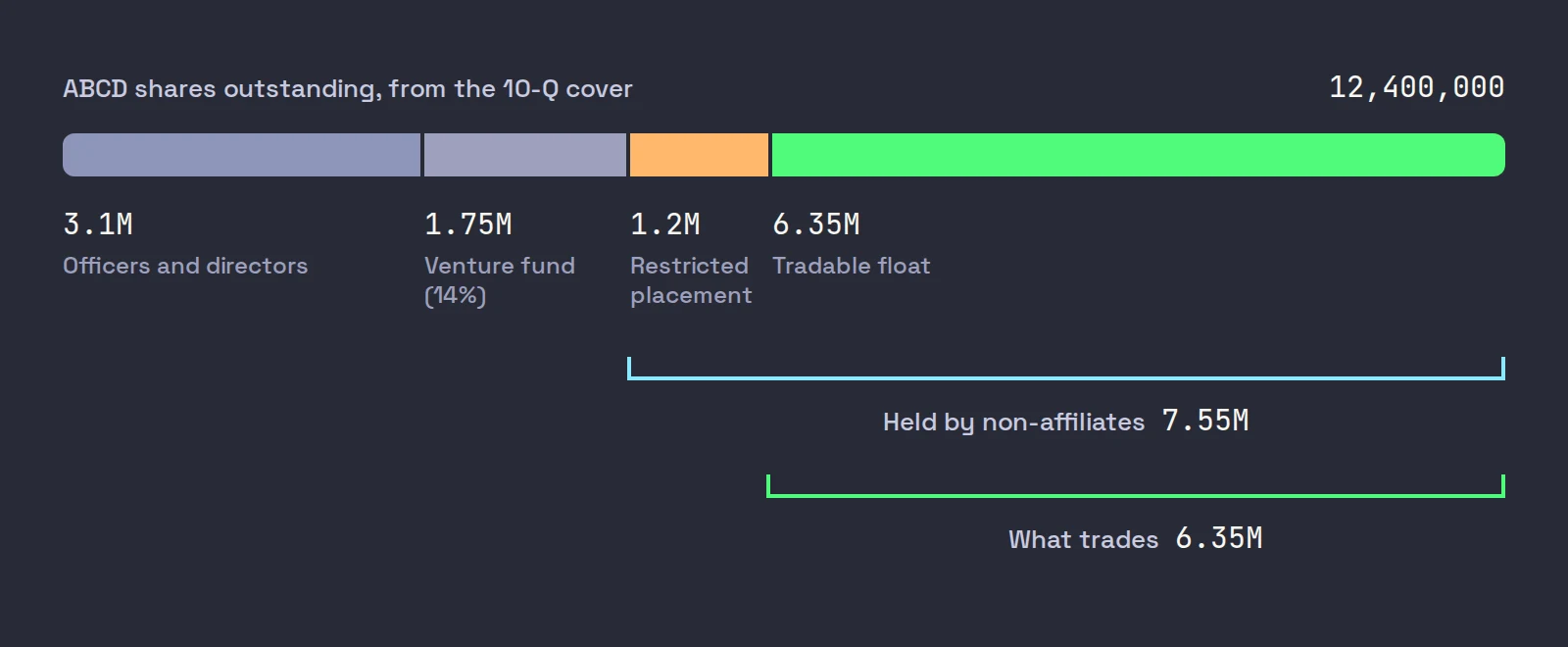
So the same company has three honest answers to "how many shares are there?": 12.4 million, 7.55 million or 6.35 million. Data vendors pick different rules for the middle steps, which is why two screeners can show two floats for the same ticker.
Exchanges draw the line in a similar place. Nasdaq's "Unrestricted Publicly Held Shares" are shares "not held by an officer, director, or 10% shareholder of the company and which are not subject to resale restrictions of any kind", as the SEC's December 18, 2025 order on Nasdaq's listing rules puts it. That is close to what traders mean by float.
Two practical rules follow:
- Shares outstanding is a ceiling. The float can never be larger, so a stock with 4 million shares outstanding is a sure low float.
- A large share count does not rule out a low float. If insiders hold 80% of 40 million shares, only 8 million trade.
Low float stocks: what counts as low?
There is no regulatory definition. These are the rough bands momentum traders use, and they shift with price:
| Float | How traders usually read it |
|---|---|
| Under 5M shares | Very low: can move several dollars on modest volume, and halt often |
| 5M to 20M shares | Low: the classic small-cap runner range |
| 20M to 50M shares | Middling: needs heavy volume or strong news to run |
| Over 50M shares | Not a low float play; moves are slower |
Share count alone misleads, so also think in dollars. A 5 million share float at $2 is $10 million of stock; at $20 it is $100 million, and it takes ten times the money to push it the same percentage.
The exchanges think in dollars too. In that December 2025 order, Nasdaq raised the minimum market value of unrestricted publicly held shares for Capital Market companies listing under its net income standard from $5 million to $15 million. Nasdaq said it had "observed problematic trading in companies with low public floats and liquidity", and that since March 2025 nearly three-quarters of companies listing on the Capital Market had used the net income standard, the one with the lowest bar. A new listing with a tiny float is exactly the kind of stock that can spike and collapse in a day.
Why low float runners move
A price moves when buyers want more shares than sellers will give them at the current price. With a low float, the pool of possible sellers is small, so a sudden wave of demand (a headline, a scanner alert, a halt that draws attention) lifts the price quickly until enough holders decide to sell.
Research backs the link between limited float and extreme prices. Hong, Scheinkman and Xiong, in Asset Float and Speculative Bubbles (Journal of Finance, 2006), model a stock whose float is limited by insider lockups, with investors who disagree and cannot easily short. They find that "the bubble, turnover, and volatility decrease with float", and that prices drop when lockups expire and the float grows, which matches the internet stocks of the late 1990s. The same forces work at small-cap scale every morning: limited supply, buyers who disagree with sellers, and short sellers who cannot easily add.
Float rotation
Traders measure how hard a low float stock is being traded by comparing its volume to its float. If ABCD's 6.35 million share float trades 19 million shares by 10:30 ET, the float has rotated 3.0 times: on average every tradable share has changed hands three times.
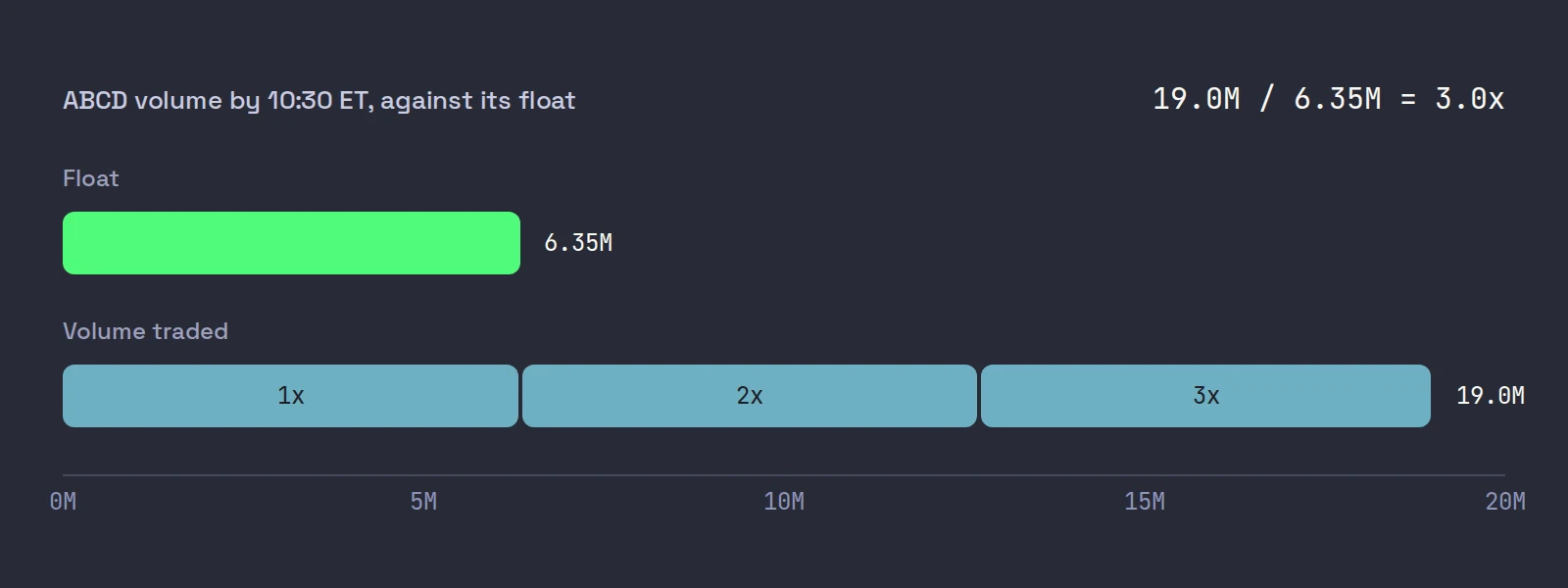
High rotation tells you two things. Interest is intense, which is what moves a stock. And many holders are now short-term traders with a cost basis near the current price, which is why low float runners pull back so violently: there are few long-term holders underneath to absorb selling. Rotation pairs naturally with relative volume, which compares today's volume to the stock's own normal.
The other side of thin supply
A thin float cuts both ways. The same small number of shares that lets a stock gap 60% also leaves little resting liquidity:
- Wide spreads. The gap between bid and ask can be 10 cents or more on a $3 stock, and you pay it on the way in and out.
- Air pockets. When buying stops, there may be no bids for several price levels, so a stop can fill far below its price.
- Halts. A fast move triggers LULD volatility pauses, and you cannot exit during a halt. See LULD halts for what happens to your orders.
Where float numbers come from, and why they disagree
You can get a reasonable float from public filings yourself, for free, and it is worth doing at least once so you know what the screeners are guessing at.
- Shares outstanding. The cover of the latest 10-Q or 10-K gives it as of a recent date. Use the newest filing.
- Insider holdings. The 10-K (often by reference to the proxy statement) has a beneficial ownership table listing officers, directors and holders of more than 5%. Those 5% holders also file Schedules 13D or 13G, listed under Beneficial ownership (Schedule 13D and 13G) on the company's EDGAR page.
- Restricted shares. Recent private placements show up in 8-Ks and in resale registration statements. Until a resale registration is effective, or until the holding period under Rule 144 passes (six months for a company that has been reporting for at least 90 days, one year otherwise), those shares are hard to sell.
Our step-by-step guide to checking a stock for dilution on SEC EDGAR walks through the company page and full-text search.
Why the float numbers you see disagree:
- Different dates. The 10-K's public float is measured at the end of the second fiscal quarter. For a company with a December year end, the 10-K filed in March states a float as of the previous June 30, about nine months old on the day it is filed.
- Different rules. Some vendors subtract every 5% holder, some only insiders, some ignore restricted stock.
- New shares not yet reported. A company that sold 3 million shares last week has a different float from the one its last 10-Q implies. Even the 8-K is not guaranteed: under Form 8-K Item 3.02, a smaller reporting company does not have to file one for unregistered sales that add up to less than 5% of its shares outstanding since its last report.
Interactive Brokers' API does not supply float at all, so any IBKR-based tool has to get share counts somewhere else.
Low float and dilution: the float is never fixed
The most expensive mistake with low float stocks is treating the float as a fixed number. Small caps with small floats are often companies that burn cash and need to raise it, and the cheapest moment to sell new stock is right after the price has run. Every new share sold adds to the float, and every seller of new stock is a seller into your long.
The main ways the float grows:
- Shelf offerings. A Form S-3 shelf registration lets a company sell stock over time without a new registration. A sale off the shelf is filed as a 424B prospectus supplement.
- At-the-market offerings. The company sells new shares straight into the market through a broker, a little at a time, often into strength. See ATM offerings.
- Warrants and convertible notes. Holders can buy or convert into new shares at a set price and sell them. See stock warrants and dilution.
- Private placements, which become tradable once a resale registration goes effective.
Small companies are limited in how fast they can sell off a shelf. Under General Instruction I.B.6 of Form S-3, the "baby shelf" rule, a listed company with a public float under $75 million can sell no more than one-third of its public float in any 12 months. The SEC estimates that 1,023 exchange-listed companies were held to that one-third limit in calendar 2024, out of 5,555 companies that filed an annual report. On May 19, 2026 it proposed removing the cap along with the $75 million test. As of October 22, 2026 that is still a proposal, not a rule.
The baby shelf has a twist that matters for runners: public float is computed at a price from any date within the 60 days before a sale, so a spike raises the amount a company may sell. The EDGAR dilution guide works through the arithmetic.
One event shrinks the float instead: a reverse split, which divides every share count by the ratio. A 1-for-10 reverse split turns a 20 million share float into 2 million. That is why some stocks run after one, and why many fall back once the company raises money on the smaller count. See reverse splits.
Low float and short squeezes
A small float makes short sellers vulnerable. If 2 million shares of a 6 million share float are sold short and the stock starts to run, the shorts are competing with new buyers for the same small pool of shares. That forced buying is a short squeeze, covered in full in short squeezes explained.
Three things to know about short data on low float stocks:
- Percent of float vs percent of shares outstanding. The same short position looks bigger against a smaller base. Know which one your source uses.
- Short interest can exceed 100% of the float. The SEC's staff report on the January 2021 meme stock episode found GameStop's short interest reached 122.97% of float, possible because the same shares can be lent, sold and lent again. The same report notes that small non-financial stocks usually have short interest under 13%.
- Live borrow beats old short interest. FINRA short interest is published twice a month and can be weeks old. The borrow fee and shares available to short change during the session. See IBKR borrow fees and shortable shares and the Reg SHO threshold list.
A pre-trade float checklist
Before you treat a low float as a reason to trade, run through these:
| Check | What you want to see | Red flag |
|---|---|---|
| Shares outstanding | Recent, from the latest 10-Q or later 8-K | Months old, with offerings since |
| Float | A source you understand, ideally checked against the filings | Vendors disagree by millions |
| Dollar float | Small enough to move on the day's volume | A large dollar float on weak news |
| Shelf and recent 424Bs | No recent sale, or a used-up baby shelf | A 424B5 in the last week |
| Warrants and converts | Exercise prices far above the price | Strikes at or just above the price |
| Cash runway | A year or more of cash | Under six months, or going concern language |
| Catalyst | Real news, today | A vague press release, or none |
| Volume | Rotation building through the morning | Price up on thin, fading volume |
A low float with a fresh offering is not the same trade as a low float with no shelf. The float tells you the stock can move; the filings tell you who is waiting to sell. For how float fits the rest of the momentum style, see momentum day trading.
Where Scalpel fits
Scalpel is a desktop trading cockpit for your own Interactive Brokers account, connected through TWS or IB Gateway. It does not supply float, for the reason above: IBKR's API has no float field, and reliable float data is a paid feed. Instead, its SHS OUT column shows shares outstanding from SEC EDGAR, which is free and is always a ceiling on the float (how SHS OUT, SHORT and SQZ work).
Each scan row also carries a dilution chip read from the company's filings (red Selling 21h after a financing filing, amber Dilution, grey Can dilute), violet borrow chips for the short side, and SQZ, a 0 to 100 score of how built a stock is to squeeze, cut when the company is selling stock. The intel chips guide lists every chip and the dilution guide explains the verdicts.
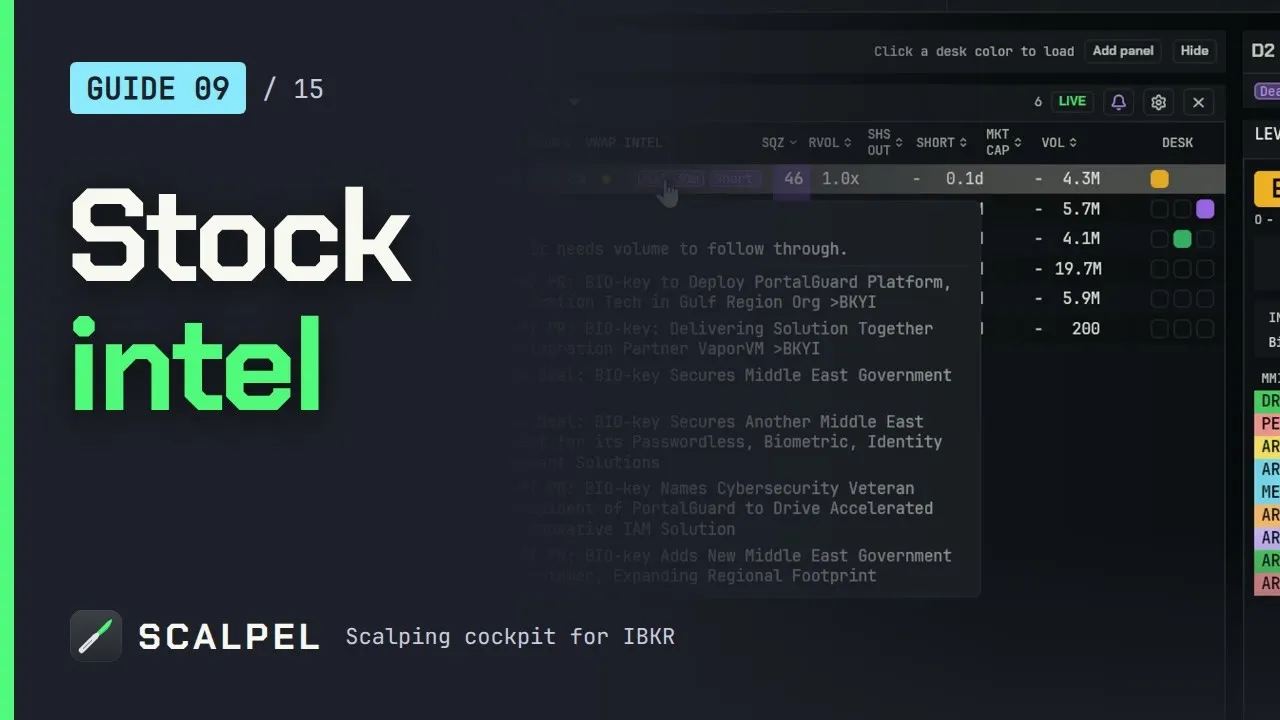
This short video walks through the intel reads, including shares outstanding, the dilution chips and the borrow chips:
Scalpel is long only: it reads short interest and borrow as information for a long trade and cannot short. Its stops are watched by the app, not resting at IBKR, so they only work while Scalpel runs with a live feed. Scalpel is independent and not affiliated with or endorsed by Interactive Brokers.
More on float, dilution and squeezes
Every post in this cluster, with what it covers (all of them are also on the float, dilution and squeezes topic page):
- Short squeezes explained: short interest, days to cover and borrow, the GameStop numbers from the SEC, and why squeezes are rarer than claimed.
- How to check a stock for dilution on SEC EDGAR: the forms to look for, full-text searches worth saving, the baby shelf math and cash runway.
- At-the-market offerings: how an ATM sells into the market, why it caps runners and how to tell one is active.
- Stock warrants and dilution: exercise prices as overhead supply, cashless exercise and where to find warrant terms.
- Reverse splits: the Nasdaq $1 rule, the ratio math, why some run and the offering that often follows.
- IBKR borrow fees and shortable shares: IBKR's stock-loan data and what a spiking fee means for a long.
- The Reg SHO threshold list: what puts a stock on it, where the lists are published and what it does not mean.
Trading carries a significant risk of loss. Nothing here is financial advice.
Questions
- What is considered a low float stock?
- There is no official definition. Day traders usually mean a float under about 10 to 20 million shares, and under 5 million is very low. Also think in dollars: a 5 million share float at $2 is only $10 million of stock.
- What is the difference between float and shares outstanding?
- Shares outstanding is every share the company has issued. The float is the part the public can trade: shares outstanding minus shares held by insiders, large owners and holders whose shares are still restricted. The float is always the smaller number.
- Why do low float stocks move so much?
- A small supply of tradable shares meets a sudden wave of demand, so the price has to rise a long way before enough holders sell. The same thin supply means few bids underneath, so they also fall fast.
- Where can I find a stock's float for free?
- Start with shares outstanding on the cover of the latest 10-Q or 10-K on SEC EDGAR, then subtract insider and large holder positions from the ownership table and Schedules 13D and 13G. The 10-K cover also states the public float in dollars as of the end of the second fiscal quarter.
- Can a stock's float change?
- Yes, often. Offerings, at-the-market sales, warrant exercises, note conversions and expiring resale restrictions add shares, and a reverse split cuts every share count by its ratio. Check recent filings before trusting any float number.
- What is float rotation?
- Volume divided by float. A 6 million share float that trades 18 million shares has rotated three times. High rotation shows intense interest, and also that many holders are short-term traders who may sell fast.
Related guides
Guide 8.4Shares out, short interest and the squeeze scoreWhy Scalpel shows shares outstanding instead of float, how FINRA short interest and days to cover are dated, and what goes into the 0 to 100 squeeze score.Guide 9.2Check a stock for dilution before you buySpot a company about to sell stock into your move: S-1, S-3 shelves, 424B prospectuses, ATMs, warrants and cash runway, read into one dilution verdict.Guide 9.5Every intel chip, explainedEach intel chip on Scalpel's scan rows and desk strips, from Selling and Warrants near to FDA, Can't short and Short fee: what it means for a long trade.
Keep reading
- Short squeeze explained: short interest, borrow and days to coverShort squeeze explained: how FINRA short interest, days to cover and borrow fees fit together, what the SEC found in GameStop, and why squeezes are rare.
- How to check dilution on SEC EDGAR, step by stepHow to check dilution on SEC EDGAR: the forms that mean a sale (S-3, 424B5, 8-K Item 3.02), full-text searches to save, baby shelf math and cash runway.
- ATM offerings: how at-the-market offerings cap small-cap runnersWhat is an ATM offering? How at-the-market sales work, why they cap small-cap runners, how to spot an active one, and what the SEC's 2026 proposal changes.
Practice in SIM, against the live book.A lifetime license, every update included, with a 7-day refund guarantee.Ask in DiscordGet Scalpel