ATM offerings: how at-the-market offerings cap small-cap runners
By Scalpel Team. , updated . 8 min read.
In short
An ATM offering (at-the-market offering) is a company selling newly issued shares straight into the open market at market prices, a little at a time, through a broker acting as its sales agent. It runs off an effective shelf registration and is announced with a sales agreement and a 424B5 prospectus supplement, but the individual sales are not announced: they show up weeks later in the company's quarterly report. For a small-cap long, an active ATM means a quiet seller behind every spike, which is why it so often caps runners.
Some small caps run on great news and then stall at a price that makes no sense on the chart. The bids keep getting hit, the high never breaks, and nothing on the news explains it. Very often the explanation is in a filing from weeks earlier: the company set up an at-the-market program, and its agent is selling new stock into the buying. This post covers how an ATM works, why it caps price, how to tell if one is active, and what the SEC's 2026 proposal would change. Rules and filing data were checked on October 22, 2026.
What is an ATM offering?
The SEC's Rule 415(a)(4) defines an "at the market offering" as "an offering of equity securities into an existing trading market for outstanding shares of the same class at other than a fixed price". In plain terms: the company sells new shares into the same market you trade in, at whatever the price is at the time, instead of selling a block at one fixed price to investors lined up by an underwriter.
The usual setup has three pieces:
- A shelf. A primary ATM has to come off a shelf registration on Form S-3 (or F-3 for foreign issuers), so the company must be shelf eligible first.
- A sales agreement with one or more brokers acting as sales agents. It sets the maximum amount and the agent's commission, often worded as up to 3.0% of the gross proceeds.
- A prospectus supplement, filed as a 424B5, that describes the program and the maximum it may sell. A prospectus for a shelf sale must be filed no later than the second business day after first use (Rule 424).
After that, the company tells the agent when to sell and how much, and the agent sells into the market over days, weeks or months.
ATMs are not a niche tool. In At-the-Market Offerings (Journal of Financial and Quantitative Analysis, 2019), Billett, Floros and Garfinkel found that by 2016 ATMs had reached 63% of the number of seasoned equity offerings and 26% of their proceeds, and that 65% of ATM proceeds went to building cash, against 84% for traditional offerings. A company with a weak balance sheet and an S-3 is exactly the kind that keeps one open.
On EDGAR full-text search, run on October 22, 2026, 424B5 prospectuses filed between October 1, 2025 and September 30, 2026 that contain "at the market offering" returned 1,293 results, and 814 of them also contain "sales agreement". These are search results (one per document, not per company), but they show how routine the structure is.
How an ATM offering works, step by step
| Step | What happens | What you can see |
|---|---|---|
| 1. Shelf filed | The company files an S-3 | The S-3 on EDGAR |
| 2. Shelf effective | The SEC declares it effective | An EFFECT notice |
| 3. Program opens | The company signs a sales agreement | An 8-K with the agreement as an exhibit, and a 424B5 for the program |
| 4. Sales | The agent sells shares into the market on the company's instructions | Nothing filed per sale |
| 5. Reporting | The company reports shares sold and proceeds | The next 10-Q or 10-K, sometimes a later prospectus supplement |
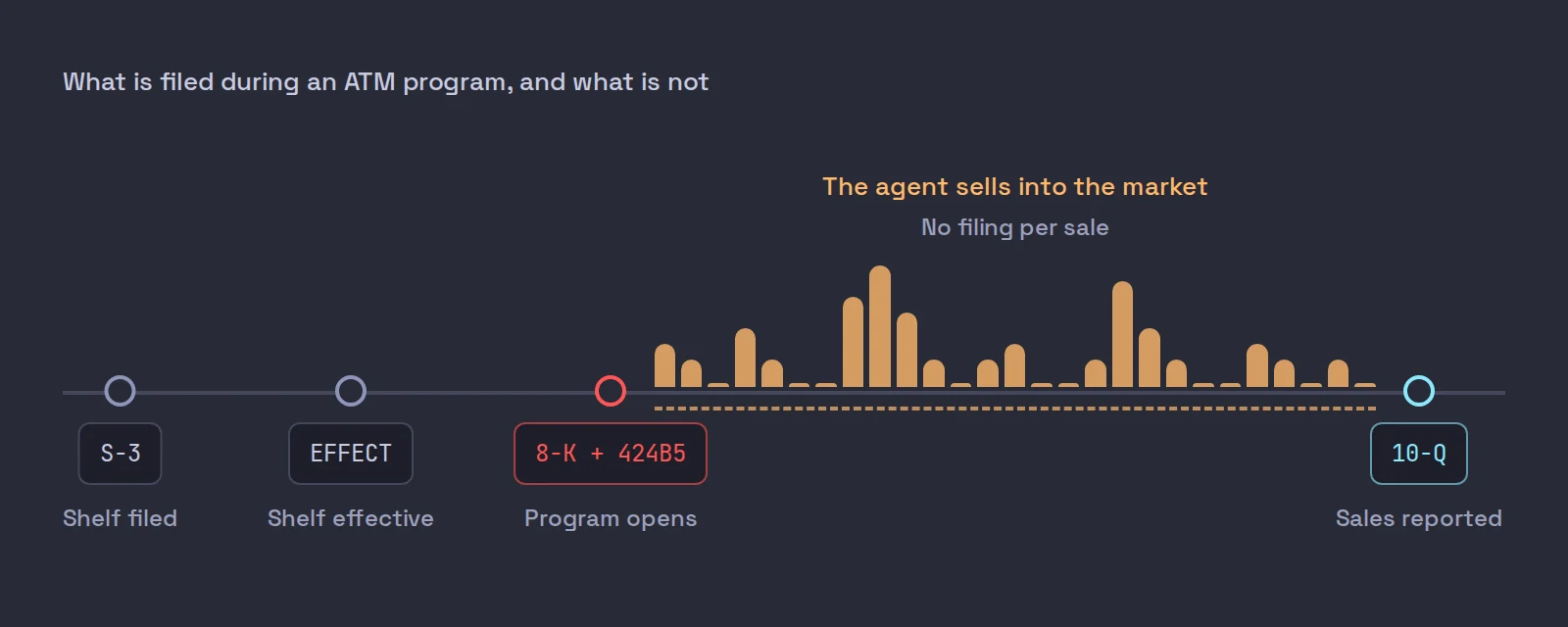
The gap between steps 3 and 5 is the problem for traders. The program can be open for months, and on any given day you cannot tell from the filings whether the agent is selling. You see the permission, not the trades.
An equity line works much the same way. The company sells shares to an investor, who resells them into the market. The SEC staff treats a primary equity line priced off the market as an at-the-market offering under Rule 415(a)(4) (Securities Act Forms interpretation 116.21).
Why an ATM caps small-cap runners
An ATM is a seller that does not care about your chart. Its job is to raise money at the best prices it can get, and the best prices come on the days the stock runs. A worked example shows the scale.
ABCD has an 8,000,000 share float, trades at $2.50 and has an ATM with $6.0 million of capacity left. At $2.50, $6.0 million is 2.4 million shares, 30% of the float.
Then ABCD gaps up on news and trades 30 million shares by noon. 2.4 million shares is 8% of that volume. The agent can sell the whole remaining program into one morning's buying without being obvious on the tape: no giant ask, no single print that gives it away, just a supply of shares that keeps refilling the offer every time buyers lift it.
That is what a cap looks like. Buyers push, the stock does not break, and when buying slows there are fresh sellers, the shares the ATM just sold to buyers who will sell them on the first dip. If the price runs further, the company raises more per share and, under the baby shelf rule below, may be allowed to sell more in total.
Not every stock with an ATM fades, and not every fade is an ATM. Some companies leave a program idle for months. But a run into an active program is fighting supply that the float number does not show. The low float stocks pillar explains why the float on your screener can already be out of date.
ATM offerings vs other offerings
| Offering | How it sells | Price | What you see first |
|---|---|---|---|
| ATM | An agent sells into the market over time | Market price, varies | A sales agreement 8-K and a 424B5, then nothing until the 10-Q |
| Underwritten or registered direct | One block, sold overnight or pre-market | Fixed, usually at a discount | A press release, then a 424B5 or 424B4 |
| Equity line | An investor buys from the company and resells | Off the market price, at a discount | An 8-K and a resale or primary registration |
| Private placement with warrants | Sold privately, registered for resale later | Fixed, plus warrant strikes | An 8-K with Item 3.02 or 1.01, then a resale S-1 or S-3 |
A fixed-price offering hits the stock once, hard, and you know the price. An ATM hits it gradually, and you do not. Warrants from a fixed-price deal add a second layer of supply at their exercise price; see stock warrants and dilution.
How to tell if an ATM is active
None of these proves the agent is selling today, but together they tell you whether you are trading against a program:
- Search for the program. On EDGAR full-text search, enter the company and search "at the market offering" with the filing type 424B5. A hit in the last few months, with no termination since, means a program exists. Our EDGAR dilution guide has the full set of searches.
- Read the 424B5 cover. It names the agent, the maximum amount and, for a small company, the baby shelf calculation with how much was sold in the last 12 months.
- Read the latest 10-Q. The notes and the liquidity section usually say how many shares were sold under the ATM, at what average price, and how much capacity is left. The subsequent events note often covers sales after the quarter closed.
- Compare share counts. Shares outstanding on the 10-Q cover rising faster than the announced deals explain is ATM selling.
- Watch for a new or upsized supplement after a run. A higher price can raise baby shelf capacity, and a company that wants to use it files a new 424B5.
The baby shelf limit, and the 2026 proposal
Most small caps that run ATMs are limited by General Instruction I.B.6 of Form S-3: with a public float under $75 million, a listed company may sell no more than one-third of its public float in any 12 months off the shelf. In the same full-text search as above, 324 of the 1,293 ATM results also cite "General Instruction I.B.6". The limit is real, but the float is priced at a date within 60 days of each sale, so a run raises it. The worked example in our EDGAR dilution guide shows one close nearly tripling a company's capacity.
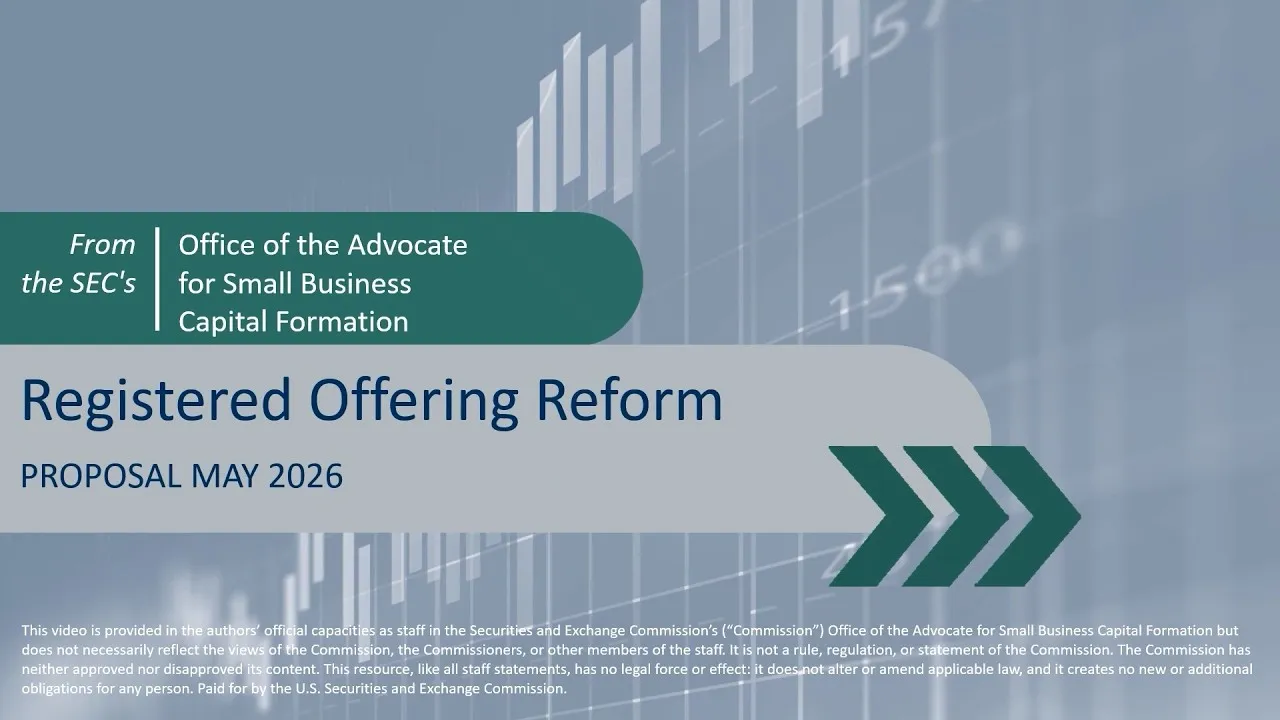
On May 19, 2026 the SEC proposed Registered Offering Reform. It would remove the $75 million test and every transaction requirement from Form S-3, including the one-third cap, and its fact sheet says the number of issuers able to offer an unlimited amount on Form S-3 could rise by over 60 percent. For ATMs specifically, it would define the "trading market" an ATM sells into as a national securities exchange or a market the SEC designates, which the SEC expects to include the OTCQX and OTCQB tiers. As of October 22, 2026 this is a proposal, not a rule.
This short SEC video summarizes the proposal. It is worth the three minutes because, if the proposal is adopted, small caps could run larger ATMs than the baby shelf allows today:
Trading a stock with an active ATM
Nothing here says never to trade one. It says to trade it as a stock with a seller you cannot see:
- Expect resistance into strength. Breakouts are more likely to stall; take profits into spikes rather than waiting for the next leg.
- Size down. The same news on a company with no shelf and a year of cash is a cleaner trade.
- Be careful holding overnight. A company that just watched its stock run can file an upsized supplement or price a block before the open.
- Respect the squeeze math. New shares relieve short sellers, so an ATM undercuts most short squeeze setups. See short squeezes explained.
Where Scalpel fits
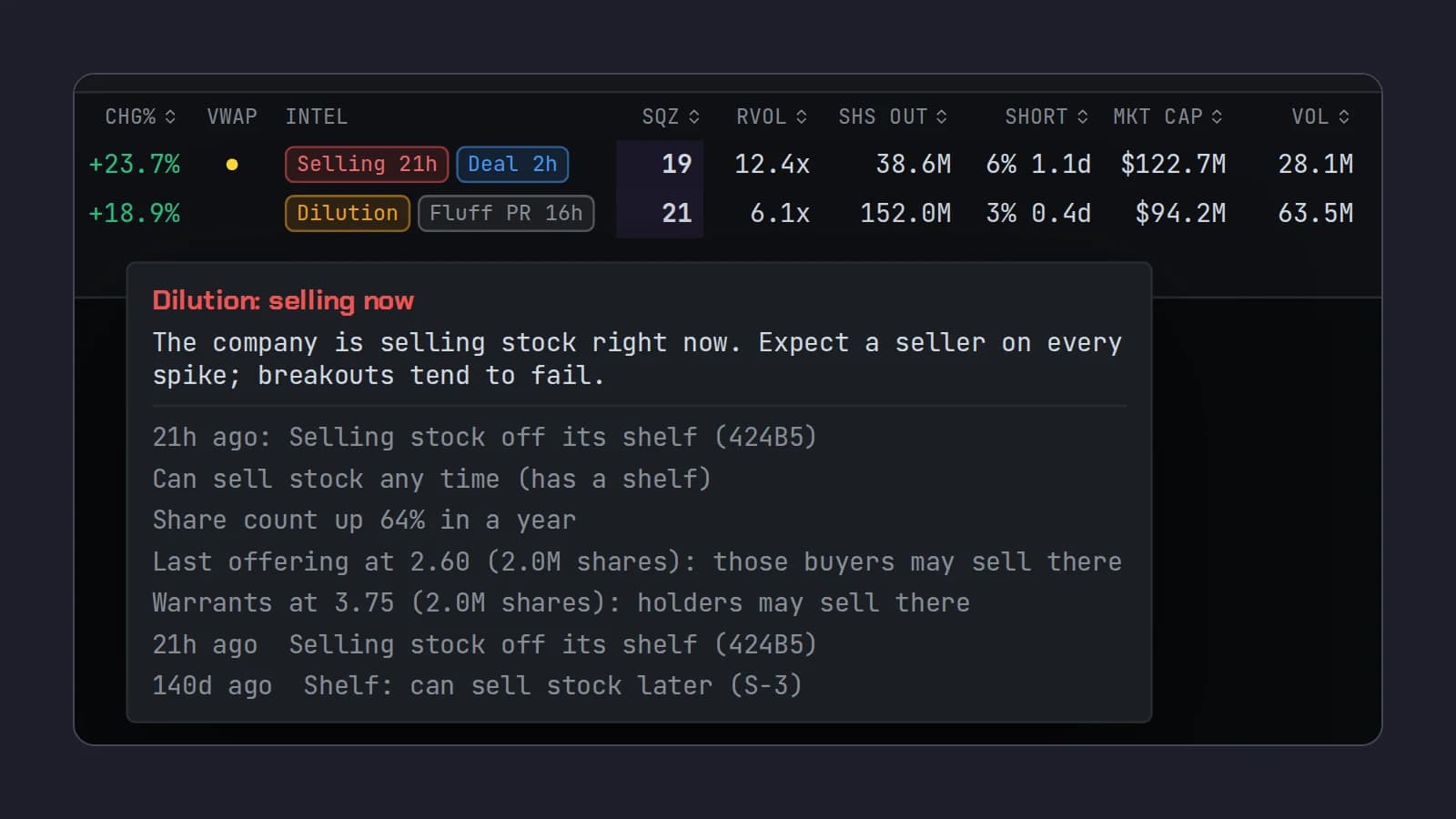
Scalpel, a desktop cockpit for your own Interactive Brokers account, reads each company's filings from SEC EDGAR for every stock it watches. A 424B5 is labeled Selling stock off its shelf, which covers ATM programs, and any financing filing in the last 7 days shows a red Selling chip with the filing's age; a shelf with little cash or repeated 424Bs reads as an amber Dilution (how Scalpel checks dilution, every intel chip).
When a financing filing lands on a stock you hold, you get a red toast and a spoken exit warning; on a stock you only watch, an amber toast. For 30 minutes after one, the dilution entry guard holds back your first buy press. With an optional OpenAI key, offering and warrant prices from the filings are drawn on the chart (warrant and offering lines).
The intel video shows the dilution chips and their hover cards on a scan panel:
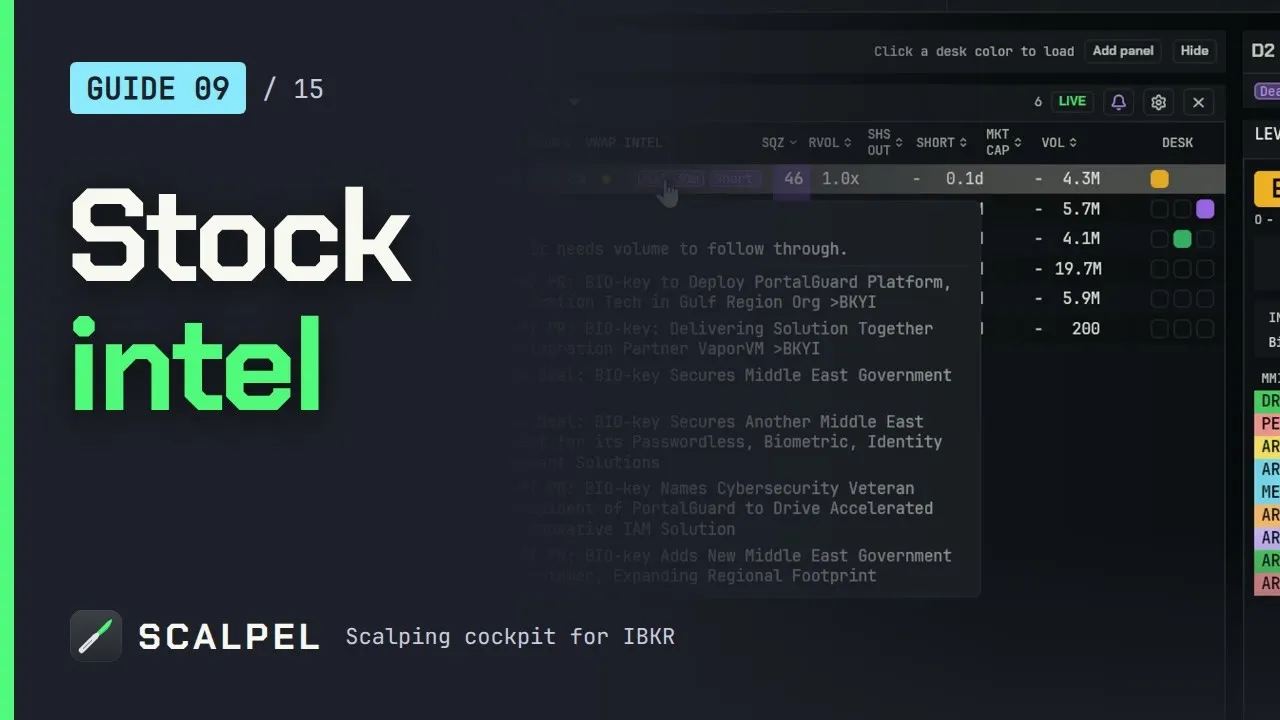
Scalpel cannot see individual ATM sales any more than you can: they are not filed. What it can do is make sure you never buy a run without knowing a program is in place. It is long only, and its stops are watched by the app rather than resting at IBKR, so they only work while it runs with a live feed. Scalpel is independent and not affiliated with or endorsed by Interactive Brokers or the SEC.
Trading carries a significant risk of loss. Nothing here is financial advice.
Questions
- What is an ATM offering in stocks?
- An at-the-market offering: the company sells newly issued shares into the open market at market prices, over time, through a broker acting as its sales agent. It runs off an effective shelf registration and is described in a 424B5 prospectus supplement.
- Is an ATM offering bad for a stock?
- It adds supply, so it tends to cap rallies and dilutes existing holders. Whether the stock falls depends on how much is sold and how strong demand is. For a short-term long, an active ATM means a seller behind every spike.
- How do I know if a company is using its ATM?
- Individual sales are not filed. Check the latest 10-Q for shares sold under the program, compare shares outstanding with the prior quarter, and watch for new or upsized 424B5 supplements after a run.
- What is the difference between an ATM and a direct offering?
- A direct or underwritten offering sells a block at one fixed price, usually overnight, and you see the price in the press release. An ATM sells gradually at market prices, and you only learn the amounts later.
- How much can a small company sell through an ATM?
- If its public float is under $75 million, the baby shelf rule limits it to one-third of its public float in any 12 months off a Form S-3. The SEC proposed removing that cap on May 19, 2026; it was still a proposal on October 22, 2026.
- Why do ATM filings say 424B5?
- Rule 424(b)(5) covers a prospectus supplement for a primary offering off a shelf that also changes the shelf prospectus. ATM programs are filed under it, as are other shelf takedowns.
Related guides
Guide 9.2Check a stock for dilution before you buySpot a company about to sell stock into your move: S-1, S-3 shelves, 424B prospectuses, ATMs, warrants and cash runway, read into one dilution verdict.Guide 9.6Warrant and offering lines on the chartScalpel draws the prices where new sellers can appear: warrant strikes, the last offering and note conversions, read from filings. What they need and mean.Guide 9.7The dilution entry guardAfter a financing filing or offering headline, Scalpel holds your first buy on it and asks for a second press within 4 seconds. How the guard works.
Keep reading
- Low float stocks: what float means and why runners moveLow float stocks explained: what float is, float vs shares outstanding, where to find it free on SEC EDGAR, and why low float runners move so fast.
- Short squeeze explained: short interest, borrow and days to coverShort squeeze explained: how FINRA short interest, days to cover and borrow fees fit together, what the SEC found in GameStop, and why squeezes are rare.
- How to check dilution on SEC EDGAR, step by stepHow to check dilution on SEC EDGAR: the forms that mean a sale (S-3, 424B5, 8-K Item 3.02), full-text searches to save, baby shelf math and cash runway.
Practice in SIM, against the live book.A lifetime license, every update included, with a 7-day refund guarantee.Ask in DiscordGet Scalpel