Stock warrants and dilution: how to read warrant exercise prices
By Scalpel Team. , updated . 8 min read.
In short
Stock warrants dilution starts with a simple contract: a warrant is a right, sold by the company, to buy new shares at a fixed exercise price until it expires. When the stock trades above that price, holders can exercise and sell at the market, so new shares appear and the exercise price behaves like overhead supply on the chart. A cash exercise adds every share and hands the company cash; a cashless exercise adds fewer shares, but under SEC Rule 144 those shares can often be sold sooner. The terms are in the deal's 8-K and prospectus on SEC EDGAR, and the full overhang is in the company's latest 10-Q.
Stock warrants dilution is the quiet kind. A small cap sells shares in a registered direct offering and throws in one warrant per share. Nothing else happens for weeks. Then the stock runs on news, crosses the warrant exercise price, and stalls there for no visible reason on the tape. The reason is in a filing: a few million warrant holders who can now buy at the strike and sell to you above it.
This post explains how warrants dilute shares, why the exercise price matters more to a momentum trader than the share count, the difference between cash and cashless exercise, and exactly where to find the terms. Rules were checked on October 22, 2026. Scalpel is independent and not affiliated with or endorsed by Interactive Brokers.
What a stock warrant is, and how it differs from an option
A warrant looks like a call option: the right to buy a stock at a set price before a date. The difference that matters to you is who sells the shares. An exchange-listed call is settled with shares that already exist. A warrant is issued by the company, and when it is exercised the company creates new shares. More shares, same company: that is dilution.
Small caps attach warrants to many kinds of financing: registered directs, private placements, underwritten public offerings and loans. The warrants are the sweetener that gets investors to fund a company the market has priced low. The terms you care about are four numbers:
| Term | What it tells you |
|---|---|
| Exercise price | Where new supply becomes profitable to sell |
| Number of warrant shares | How much supply sits there |
| Exercisable from | Whether holders can act now or only after a date or a shareholder vote |
| Expiry | How long the overhang lasts |
Two variants show up in filings all the time. Pre-funded warrants have an exercise price of a fraction of a cent: the buyer paid almost the whole price up front, so they behave like shares that have not been issued yet, not like a price level. Placement agent warrants go to the bank that ran the deal, usually at or above the offering price.
How stock warrants dilution works: the share math
Take a fictional company, ABCD, with 10,000,000 shares outstanding. It sells 2,000,000 shares at $2.00 in a registered direct and gives each buyer one warrant per share, exercisable at $2.50.
- After the deal: 12,000,000 shares outstanding.
- If every warrant is exercised for cash: 14,000,000 shares, and ABCD collects 2,000,000 x $2.50 = $5,000,000.
- The warrants alone add 2,000,000 / 12,000,000 = 16.7% to the share count.
That fully diluted number is what most dilution checklists stop at. For a trader it is the least useful part. What matters is the price at which those 2,000,000 shares become a seller.
Cash exercise vs cashless exercise
Most small-cap warrant agreements let the holder exercise in one of two ways:
- Cash exercise. The holder pays $2.50 per share and gets all 2,000,000 shares.
- Cashless (net) exercise. The holder pays nothing and receives only the shares worth the gain. The usual formula is warrant shares x (market price - exercise price) / market price.
At different stock prices, the cashless route gives:
| ABCD price | Cashless exercise | Cash exercise |
|---|---|---|
| $3.00 | 2,000,000 x 0.50 / 3.00 = 333,333 shares | 2,000,000 shares |
| $4.00 | 2,000,000 x 1.50 / 4.00 = 750,000 shares | 2,000,000 shares |
| $5.00 | 2,000,000 x 2.50 / 5.00 = 1,000,000 shares | 2,000,000 shares |
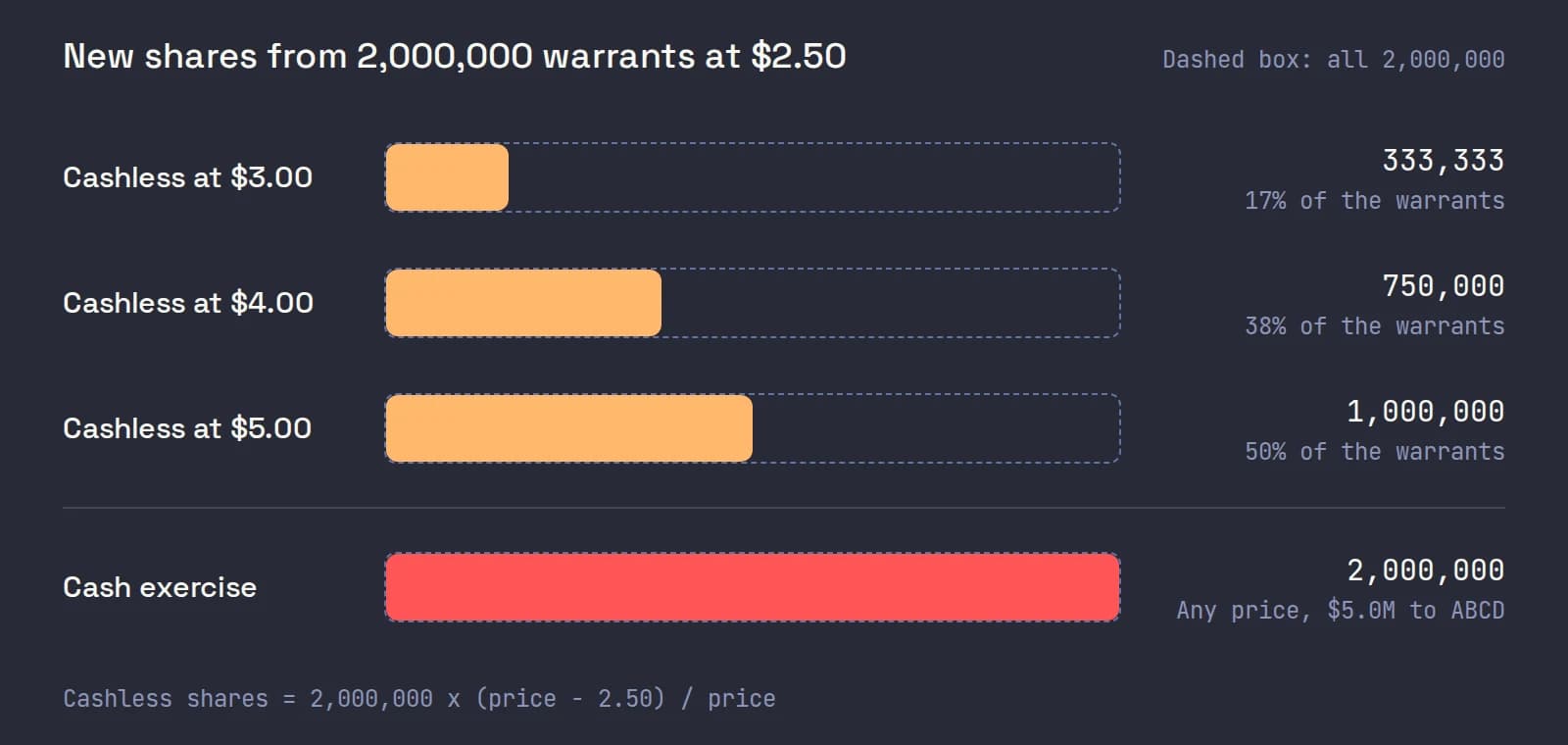
Cashless exercise dilutes less, but it brings the company no cash, and it has a timing effect that matters more. Under SEC Rule 144(d)(3)(x), shares received "solely upon cashless exercise" are treated as acquired when the warrant was acquired. Rule 144(d)(1) sets the holding period for restricted securities of a reporting company at six months. So a holder who has owned an unregistered warrant for six months can exercise cashless and, subject to Rule 144's other conditions, sell the shares straight away. A cash exercise starts a new clock instead, because the rule's holding period does not begin until the full purchase price is paid.
Many deals sidestep the question by registering the warrant shares for resale. Then holders can exercise for cash and sell the same day.
Why the exercise price acts as overhead supply
Think about it from the holder's side. They bought shares at $2.00 and got a warrant for free. ABCD now trades at $3.10 on contract news. Every warrant share can be bought at $2.50 and sold at $3.10, a 60 cent gain, with no market risk if they sell as they exercise. Many will. Some hedge before they exercise: a study of hedge funds that buy private placements, Brophy, Ouimet and Sialm (2009), Review of Financial Studies 22(2), found that these investors protect themselves by "requiring substantial discounts, negotiating repricing rights, and entering into short positions of the underlying stocks." That short selling shows up in the borrow data too, which is one reason IBKR borrow fees can climb on a stock with fresh warrants.
What you see on the chart:
- A run stalls just above the strike. Bids get hit by sellers who did not buy on the open market.
- The strike is a zone, not a wall. A strong catalyst with heavy volume can absorb the supply and go through. The first test is usually the hardest.
- Supply arrives in waves. Many agreements cap how much of the company a holder may own after exercise, so large holders exercise and sell in pieces.
These are not passive investors. A working paper on 3,001 private placements, Lim, Schwert and Weisbach (NBER w23967), estimates that the average PIPE investor holds for 384 days and earns an abnormal return of 21.2%, mostly because they buy at a discount with warrants attached and sell over time. Their profit is your supply. The same Brophy study found that companies funded by hedge funds "significantly underperform" companies funded by other investors over the following two years.
Where to find warrant terms on SEC EDGAR
You can find every number above for free. A full walkthrough of the filing types is in how to check a stock for dilution on SEC EDGAR; for warrants specifically:
Open the company's filing list
Search the ticker on SEC EDGAR and open the company's filings, newest first. Filter for 8-K, 424B and S-1 forms from the last 12 months.
Read the deal's 8-K and its exhibits
A financing usually comes with an 8-K: item 1.01 for the purchase agreement, and item 3.02 when the shares or warrants were sold privately. Form 8-K requires item 3.02 within four business days, but not when the sale adds up to less than 1% of the shares outstanding (less than 5% for a smaller reporting company), so small sales can go unreported until the next 10-Q. The exhibits list the "Form of Common Warrant" or "Form of Pre-Funded Warrant", with the exercise price and dates.
Check the prospectus for registered deals
For a public or registered direct offering, the 424B4 or 424B5 prospectus has a section describing the securities offered: exercise price, when the warrants become exercisable, expiry and share count. A later 424B3 or resale S-1 means holders' shares are being registered for sale.
Add up the overhang in the 10-Q
The latest 10-Q or 10-K has an equity note with a warrant table: all warrants outstanding across every past deal, often with a weighted average exercise price. Old deals with strikes far above the price are not supply today; recent ones close to it are.
Look for repricing
Search the filings for "inducement" or "amendment to warrants". Companies sometimes lower the exercise price to get holders to exercise now, often issuing new warrants in return. A repriced warrant moves the supply level, and the old strike in the original prospectus is no longer the one that counts.
Reading warrants before a momentum trade
Once you have the terms, five questions decide whether warrants matter to the trade in front of you:
- How far is the strike? ABCD at $2.30 with warrants at $2.50 is 8.7% below the supply. That is close enough to plan around.
- How big is it against the float? 2,000,000 warrant shares against a float of 3,000,000 is a different stock from the same warrants against 40,000,000.
- Are the shares registered, or past six months? If not, cash exercisers cannot sell at once.
- How fresh is the deal? Warrants from last week are held by the investors who just bought the shares at a discount. They want out.
- Was there a reverse split since? Warrant agreements adjust for splits. After a 1-for-10 reverse split, a $0.50 strike becomes $5.00 and the share count falls tenfold.
When an exercise price is a round number, it lines up with whole and half dollar levels that already attract sellers. A warrant strike at $2.50 is a reason to expect that level to hold the first time, not a reason to short it. For the wider picture on why supply matters so much on small caps, see our guide to low float stocks.
Where Scalpel fits
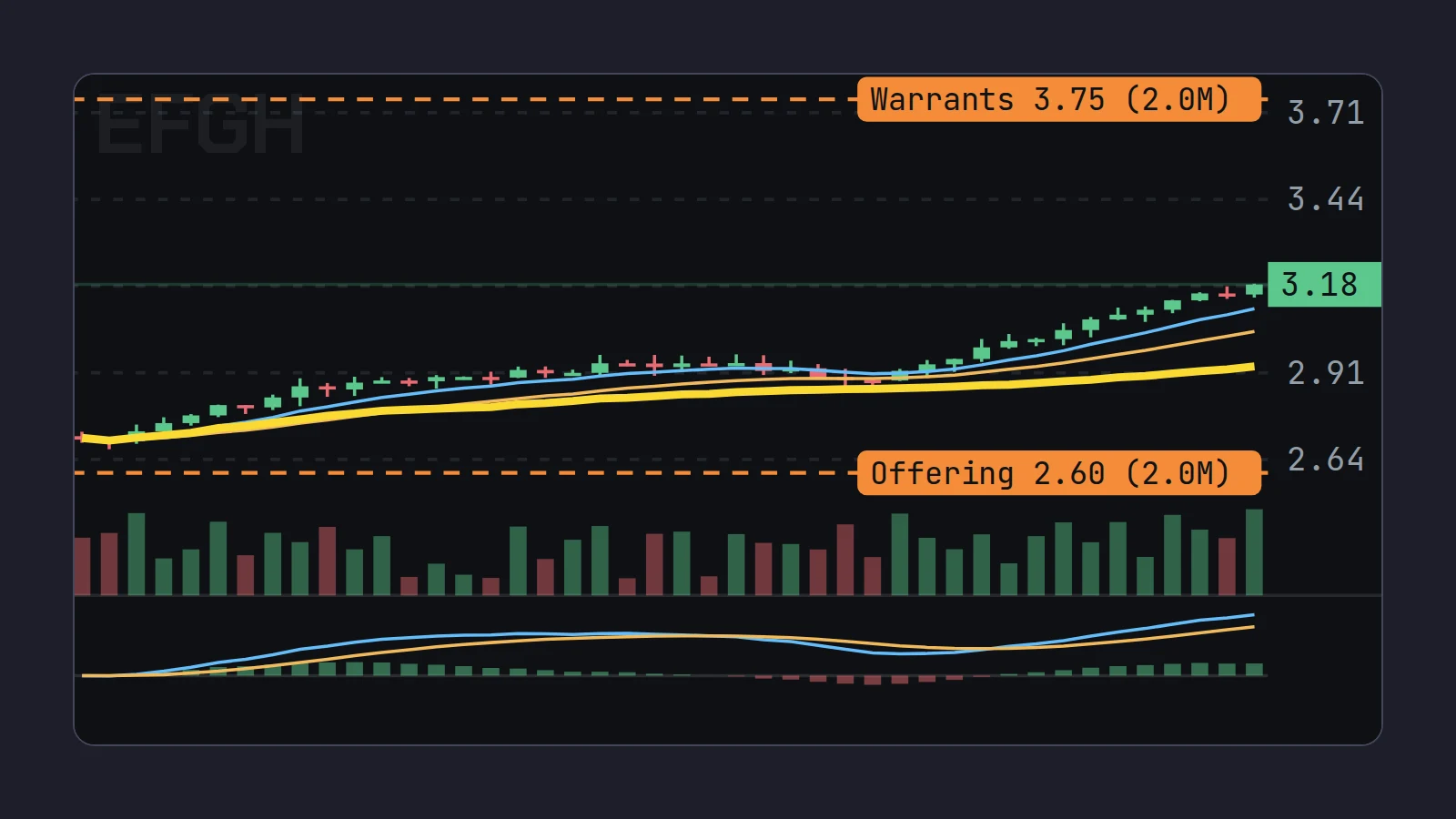
Scalpel is a keyboard-first desktop cockpit for your own IBKR account, and it does the EDGAR reading above for every stock it watches. With the SEC contact email and an OpenAI key set in Settings > Intel, and Extract filing terms ticked, it reads up to six financing filings from the last 12 months (424B prospectuses, S-1 registrations and 8-Ks that report a sale of stock) and draws the prices as orange dashed lines on the chart, for example Warrants 3.75 (2.0M) (warrant and offering lines).
A warrant or conversion price at, below, or within 10% above the current price makes the dilution verdict severe, shown as a red Warrants near chip. Hover it for each level in words.
Pre-funded warrants, with a token exercise price, are skipped, and any level more than 20 times away from the price is dropped as a misread. The extraction only reports prices the filing states, so a missing line does not prove there are no warrants. The chips and their reasons come from the filings themselves, without the OpenAI key (check dilution, intel chips). This short video shows the intel reads, including the dilution chips and supply lines:
Scalpel is long only and never trades for you. It puts the warrant price where you can see it; whether to buy below it, trade smaller, or pass is your decision. Scalpel is independent and not affiliated with or endorsed by OpenAI.
Trading carries a significant risk of loss. Nothing here is financial advice.
Questions
- How do warrants dilute shares?
- When a warrant is exercised, the company issues new shares to the holder at the exercise price. The share count rises, so each existing share owns a smaller part of the company, and the new shares can be sold into the market.
- What is a warrant exercise price?
- The fixed price at which the holder can buy a new share from the company. When the stock trades above it, holders can exercise and sell at a profit, which is why the exercise price often acts as overhead supply.
- What is the difference between cash and cashless warrant exercise?
- In a cash exercise the holder pays the exercise price and gets every warrant share. In a cashless exercise the holder pays nothing and receives only the shares worth the gain, so fewer new shares are issued but the company gets no cash.
- Are warrants bad for a stock?
- Not always, but they add supply at a known price. Warrants close to the current price, from a recent deal, with registered shares, are the ones most likely to meet a run with selling.
- What are pre-funded warrants?
- Warrants with an exercise price of a fraction of a cent, sold for almost the full share price up front. They let a buyer avoid holding too large a stake at once, and they behave like shares waiting to be issued rather than like a price level.
- Where can I find a company's warrants?
- On SEC EDGAR: the 8-K and its exhibits for the deal, the 424B prospectus for registered offerings, and the equity note in the latest 10-Q or 10-K for every warrant outstanding.
Related guides
Guide 9.6Warrant and offering lines on the chartScalpel draws the prices where new sellers can appear: warrant strikes, the last offering and note conversions, read from filings. What they need and mean.Guide 9.2Check a stock for dilution before you buySpot a company about to sell stock into your move: S-1, S-3 shelves, 424B prospectuses, ATMs, warrants and cash runway, read into one dilution verdict.Guide 9.5Every intel chip, explainedEach intel chip on Scalpel's scan rows and desk strips, from Selling and Warrants near to FDA, Can't short and Short fee: what it means for a long trade.
Keep reading
- Low float stocks: what float means and why runners moveLow float stocks explained: what float is, float vs shares outstanding, where to find it free on SEC EDGAR, and why low float runners move so fast.
- Short squeeze explained: short interest, borrow and days to coverShort squeeze explained: how FINRA short interest, days to cover and borrow fees fit together, what the SEC found in GameStop, and why squeezes are rare.
- How to check dilution on SEC EDGAR, step by stepHow to check dilution on SEC EDGAR: the forms that mean a sale (S-3, 424B5, 8-K Item 3.02), full-text searches to save, baby shelf math and cash runway.
Practice in SIM, against the live book.A lifetime license, every update included, with a 7-day refund guarantee.Ask in DiscordGet Scalpel