How to check dilution on SEC EDGAR, step by step
By Scalpel Team. , updated . 10 min read.
In short
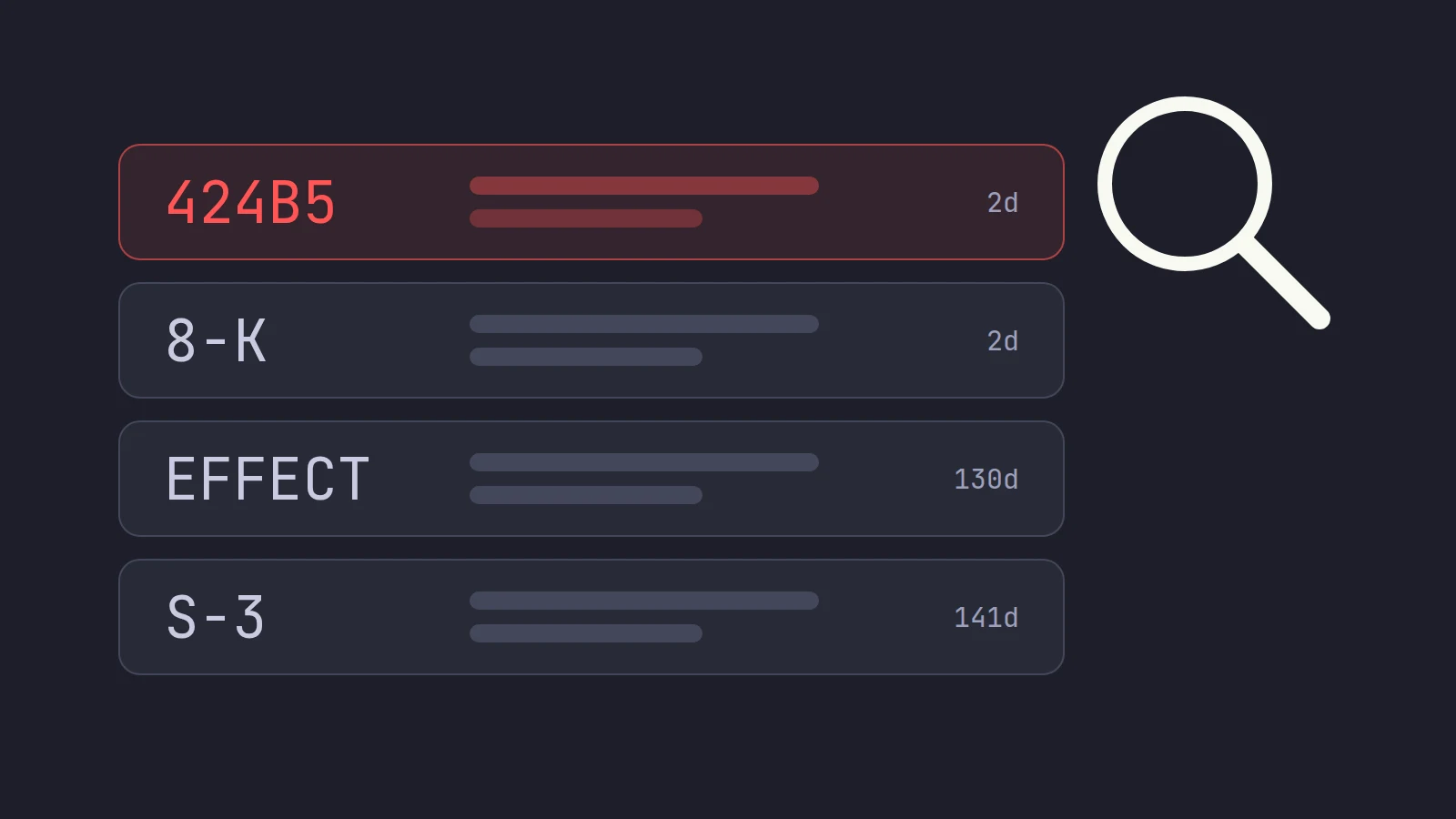
Here is how to check dilution on SEC EDGAR: open the company's page and look at three groups of filings: registration statements (an S-3 shelf or an S-1 means it can sell stock), prospectuses (a 424B5 or 424B4 means it just did), and 8-Ks (Item 1.01 for a financing agreement, Item 3.02 for a private sale). Then use EDGAR full-text search for phrases like "at the market offering" and "General Instruction I.B.6", and read the latest 10-Q for cash, cash burn and going concern language. A shelf plus little cash is a company that will probably sell into the next run.
Dilution is a company issuing new shares, and for a small-cap long it is the most common reason a good-looking run fails. The new shares have to be sold to someone, usually into strength, and the filings say so in advance more often than traders think. You do not need a paid dilution service to check. Everything below uses free SEC tools, and each screen, label and form type was checked on EDGAR on October 22, 2026.
What dilution looks like in SEC filings
Before the steps, the vocabulary. These are the form types that sell stock or set up to sell it:
| Form | What it is | What it means for a long |
|---|---|---|
| S-1 (and S-1/A) | A full registration statement for an offering or a resale | An offering is being prepared; amendments often come days before pricing |
| S-3 | A short-form shelf registration | Permission to sell stock over time, without a new registration each time |
| EFFECT | The SEC's notice that a registration is effective | The shelf or offering can now be used |
| 424B4 | The final prospectus for a priced offering | An offering just priced: the price, size and any warrants are in it |
| 424B5 | A prospectus supplement off a shelf | A shelf takedown or an at-the-market program |
| 424B3 | A prospectus for other changes, often resales | Existing holders, such as private placement buyers, can now sell |
| 8-K Item 1.01 | A material agreement | Often the purchase agreement, sales agreement or note behind a financing |
| 8-K Item 3.02 | An unregistered sale of stock | A private placement or similar |
| Form D | A notice of an exempt offering | A private raise, filed under Regulation D |
Timing matters as much as type:
- A shelf on Form S-3 can be used for up to three years from its first effective date (Rule 415).
- A 424B prospectus for a shelf offering must be filed "no later than the second business day" after pricing or first use (Rule 424).
- An 8-K is due within four business days of the event (Form 8-K). Under Item 3.02, a company need not file one at all if its unregistered sales since its last report add up to less than 1% of its shares outstanding, or less than 5% for a smaller reporting company.
So the filings tell you most of what you need, but not always the same morning. More on that gap below.
How to check dilution on SEC EDGAR, step by step
Open the company's EDGAR page
Go to EDGAR full-text search and type the ticker into the box labeled Company name, ticker, CIK number or individual's name, then pick the company from the suggestions. The results show its CIK, the SEC's number for the company, next to its name. The company's own filing page is
sec.gov/edgar/browse/?CIK=followed by that number. Bookmark it: you will come back to it.Read Selected Filings
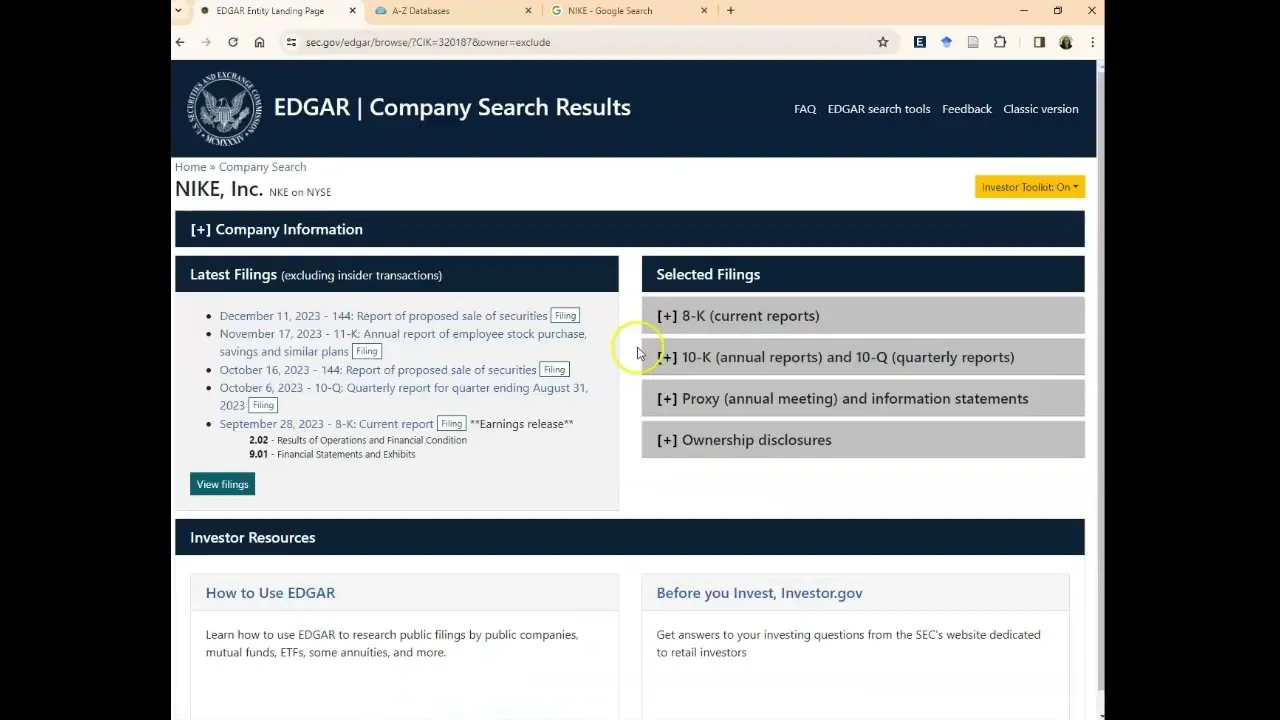
The company page groups recent filings under Selected Filings. Expand three groups: 8-K (current reports), Registrations statements (the SEC's spelling) and Prospectuses. Each shows the most recent filings of that kind, with links to view them all.
What you are looking for: any S-1, S-3 or amendment in the last three years, any 424B in the last 12 months, and any 8-K in the last few weeks.
Filter the full list by date
Click View filings to open the whole list. The filter buttons across the top include Registrations statements and Prospectuses, and From Date (yyyy-mm-dd) and To Date (yyyy-mm-dd) narrow it to a window. A year is a good first window.
Open the shelf and check it is effective
Open the latest S-3. Its prospectus cover usually states the total dollar amount the company may sell. Then look in the filing list for an EFFECT notice after it: until the SEC declares it effective, the shelf cannot be used. If the company is small, the prospectus usually says it is limited by "General Instruction I.B.6" of Form S-3, the baby shelf rule covered below.
Read every recent 424B cover
Open each 424B5 and 424B4 from the last 12 months. The cover page states how much is being sold, at what price or "at the market", through which agent or underwriter, and with what warrants. Under the baby shelf rule, the cover must also show the company's public float calculation and how much it has sold in the last 12 months, so you can work out how much it has left.
Check recent 8-Ks and their exhibits
Open each 8-K from the last month and read the item numbers in its first lines. Item 1.01 with a securities purchase agreement, a sales agreement or a note is a financing. Item 3.02 is a private sale of stock. The exhibits carry the details: exhibit 1.1 is usually the underwriting or sales agreement, 4.x the warrant forms, 10.x the purchase agreements.
Read the latest 10-Q for cash and runway
Open the most recent 10-Q. Note the shares outstanding on the cover, cash on the balance sheet, net cash used in operating activities in the cash flow statement, and the Liquidity and Capital Resources part of management's discussion. Search the document for "substantial doubt": that is the going concern warning, meaning management or the auditor doubts the company can fund itself for the next year. Then read the Subsequent events note, where sales made after the quarter closed often appear.
The Charles H. Trout Library's short tutorial walks through the current EDGAR company search and the Selected Filings groups used in the first two steps, if you have not used EDGAR before.
After the first full check, you only need what is new since you last looked.
EDGAR full-text search: the searches worth saving
EDGAR full-text search reads the text of every electronic filing since 2001, attachments and exhibits included, according to the SEC's full-text search FAQ. It accepts exact phrases in quotes, OR, NOT (or a leading minus), NEAR() for words within 10 words of each other, and a trailing * wildcard. The date choices are All (since 2001), Last 10 years, Last 5 years, Last year, Last 30 days and Custom, and the Filing category list includes Registration statements and prospectuses; for a single form, choose to enter the filing types yourself.
These searches, run on one company or across the market, answer the questions that matter for dilution:
| Question | Search for | Filing types |
|---|---|---|
| Is there an at-the-market program? | "at the market offering" "sales agreement" | 424B5 |
| Is it baby shelf limited, and how much has it sold? | "General Instruction I.B.6" | 424B5, S-3 |
| Were warrants sold with the deal? | "pre-funded warrants" OR "common warrants" | 424B4, 424B5, 8-K |
| Is there an equity line? | "equity line" OR "purchase agreement" | 8-K, S-1 |
| Was stock sold privately? | "Item 3.02" | 8-K |
| Is cash running out? | "substantial doubt" | 10-Q, 10-K |
Each document in a filing is a separate result, so one 8-K with three exhibits can show up three times. Filtering S-1 also returns S-1/A amendments, which is what you want. To give a sense of scale: on October 22, 2026, a search for "General Instruction I.B.6" in 424B5 prospectuses filed from October 1, 2025 to September 30, 2026 returned 498 results.
If you script any of this, the SEC asks automated tools to declare a user agent with a contact email and to stay at or under 10 requests per second.
The baby shelf rule: how much a small cap can sell
Most small caps that dilute do it off an S-3 shelf, and most of them are limited by General Instruction I.B.6 of Form S-3. If the company's public float (the market value of shares held by non-affiliates) is under $75 million, it can sell no more than one-third of that public float in any 12 calendar months. The SEC estimates 1,023 exchange-listed companies were held to that limit in calendar 2024.
The detail that matters for traders is the price. The public float can be computed using the price "as of a date within 60 days prior to the date of sale", so a company can use the highest close in that window, and the prospectus cover shows the date it chose. A spike therefore raises how much the company may sell.
A worked example. ABCD has 11,000,000 shares held by non-affiliates. It sold $4.5 million off its shelf in the last 12 months.
| Before the run | After a close at $6.00 | |
|---|---|---|
| Highest close in the last 60 days | $3.00 | $6.00 |
| Public float | 11.0M x $3.00 = $33.0M | 11.0M x $6.00 = $66.0M |
| One-third of public float | $11.0M | $22.0M |
| Minus sold in the last 12 months | $4.5M | $4.5M |
| Capacity left | $6.5M | $17.5M |
| In shares, at that price | About 2.2M | About 2.9M |
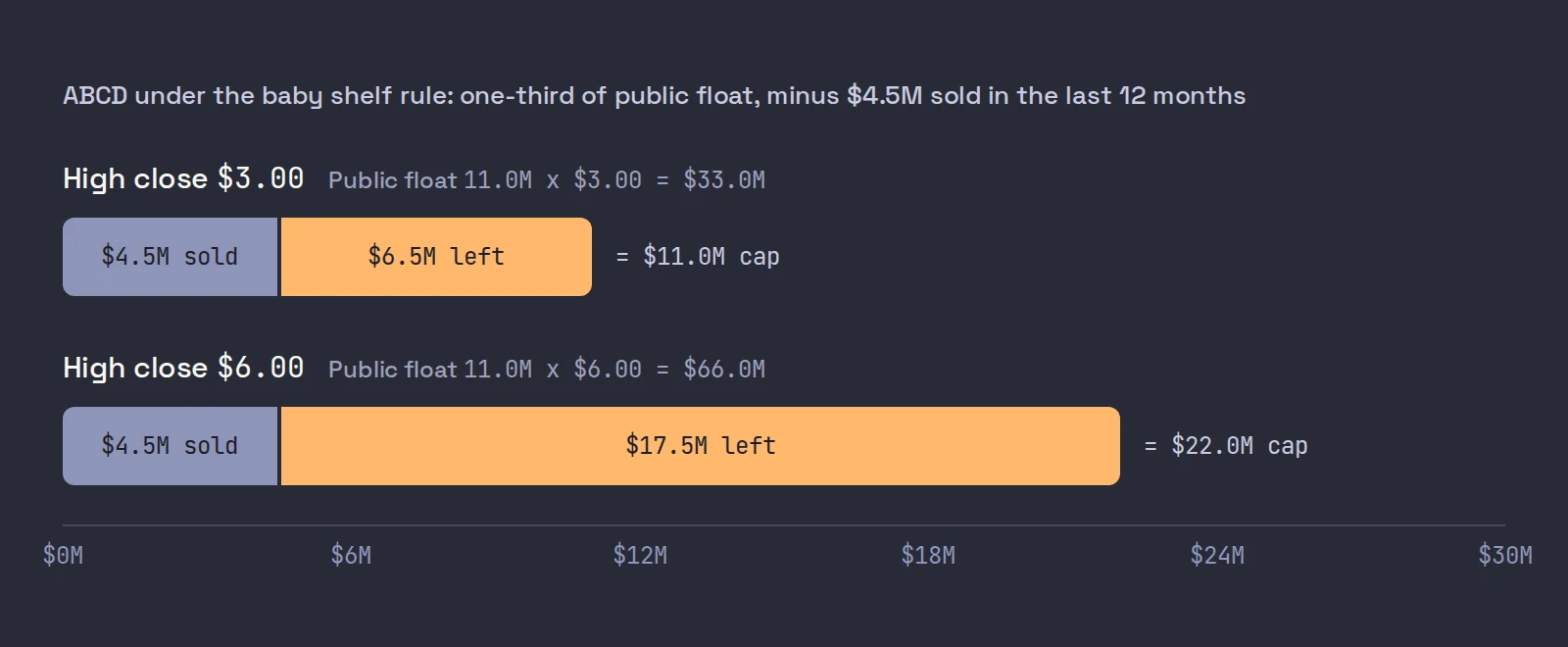
One close at $6 nearly triples what ABCD may raise. If its public float reaches $75 million (a close at about $6.82 here), the one-third limit stops applying to further sales off that registration statement. That is why a run in a cash-poor company with a shelf so often meets an offering within days.
On May 19, 2026 the SEC proposed removing the $75 million test and the one-third cap from Form S-3 entirely. As of October 22, 2026 it is a proposal. If it is adopted, the baby shelf cap disappears and this table stops mattering; check the status before you rely on it. Our post on ATM offerings covers what the proposal would change for at-the-market programs.
Cash runway from the 10-Q
Shelves give a company permission. Cash tells you whether it needs to use it. The simplest test:
Cash runway in months = cash / (quarterly cash burn / 3)
ABCD's latest 10-Q shows $6.2 million of cash and $7.8 million used in operating activities over six months, so $3.9 million a quarter, or $1.3 million a month. $6.2 million / $1.3 million = about 4.8 months of cash.
| Runway | How to read it |
|---|---|
| Under 6 months | Needs money soon. Expect it to sell into strength |
| 6 to 12 months | Will probably raise within the year. A run gives it the chance |
| Over 12 months | Less pressure, but not none: companies raise when they can, not only when they must |
Also compare the share count on the 10-Q cover with the one a year earlier. A count that grew 50% in a year belongs to a company that sells stock as a habit.
What EDGAR will not tell you in time
The filings are reliable but not instant:
- Evening deals. An offering priced after the close usually reaches you first as a press release headline. The 424B can follow the next business day or the one after.
- ATM sales. A company selling through an ATM does not file each sale. You usually learn the amounts at the next 10-Q or 10-K, or in a later prospectus supplement. See ATM offerings.
- Small private sales. Under the Item 3.02 thresholds above, a small private sale may never get its own 8-K.
- Warrant exercises and conversions. These add shares without a new offering. Their prices are in the deal filings; our post on stock warrants and dilution shows how to read them.
- Share counts after a reverse split need the next filing to update. See reverse splits.
EDGAR accepts filings on weekdays from 6:00 to 22:00 ET, and the SEC says its submissions data updates in real time with "typical processing delay of less than a second". The lag is the company's, not the SEC's. Pair filings with the news: a red offering headline is the same information, often hours earlier. Our guide to news catalysts covers how offering headlines read.
For why dilution and float decide so many small-cap runs, see the low float stocks pillar.
Where Scalpel fits
Scalpel, a desktop cockpit for your own Interactive Brokers account, does this check for every stock it watches. With an SEC contact email set, it reads each company's filings from SEC EDGAR directly: it checks EDGAR's live feed every 5 seconds on weekdays from 06:00 to 22:00 ET, and re-reads the full filing list of stocks you hold or have on a desk every 60 seconds. Shelves, 424B prospectuses, EFFECT notices, Item 3.02 8-Ks, cash runway and share growth become one verdict, shown as a chip: red Selling 21h after a financing filing, amber Dilution, grey Can dilute (how Scalpel checks dilution, setting up intel).
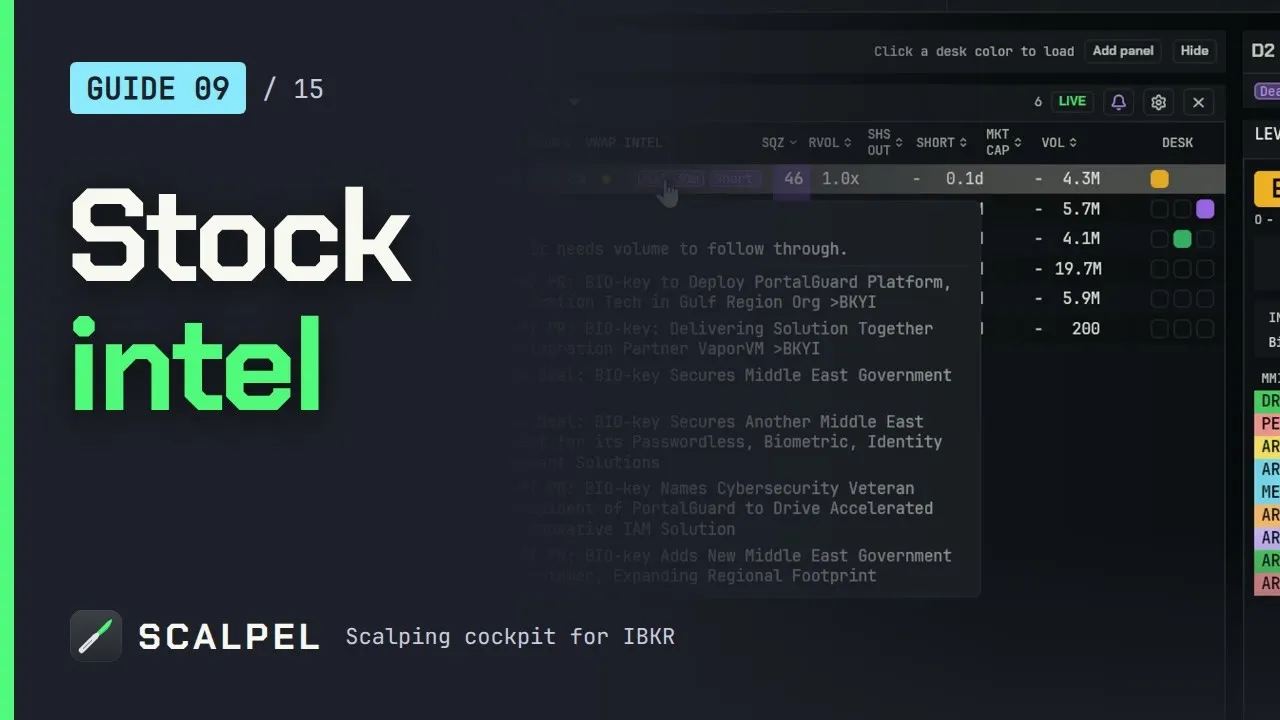
With an optional OpenAI key it also pulls warrant, offering and conversion prices out of the filings and draws them on the chart (warrant and offering lines). For 30 minutes after a financing filing, the dilution entry guard holds back your first buy press and asks you to press again. The intel video shows the dilution chips and the hover card:
A Low verdict is not a promise: a company can announce an offering at any moment. Scalpel is long only, and its stops are watched by the app rather than resting at IBKR, so they only work while it runs with a live feed. Scalpel is independent and not affiliated with or endorsed by Interactive Brokers or the SEC.
Trading carries a significant risk of loss. Nothing here is financial advice.
Questions
- How do I check if a company is diluting its shares?
- On SEC EDGAR, look for an S-1 or S-3 registration, recent 424B5 or 424B4 prospectuses, and 8-Ks with Item 1.01 or 3.02. Then compare shares outstanding on the latest 10-Q cover with a year earlier and check how many months of cash the company has.
- What is an S-3 shelf registration?
- A short-form registration that lets a company sell stock over time, in pieces, for up to three years after it becomes effective. Each sale is filed as a 424B prospectus supplement. A shelf is permission to sell, not a sale.
- What does a 424B5 filing mean?
- It is a prospectus supplement for a sale off a shelf: either a priced takedown or an at-the-market program. It is filed within two business days of pricing or first use, and it usually means the company is selling stock now.
- What is the baby shelf rule?
- General Instruction I.B.6 of Form S-3: a listed company with a public float under $75 million can sell no more than one-third of its public float in any 12 months off a shelf. The float is priced on a date within 60 days of the sale, so a spike raises the limit.
- How far back does EDGAR full-text search go?
- To 2001. It searches the full text of electronic filings, including exhibits, and can be filtered by form type, company, date range and location.
- Can a company sell stock without filing anything first?
- Sometimes. ATM sales off an effective shelf are reported later, often in the next 10-Q, and small private sales under the Item 3.02 thresholds may not get their own 8-K. Offerings priced in the evening often appear as a press release before the prospectus.
Related guides
Guide 9.2Check a stock for dilution before you buySpot a company about to sell stock into your move: S-1, S-3 shelves, 424B prospectuses, ATMs, warrants and cash runway, read into one dilution verdict.Guide 9.6Warrant and offering lines on the chartScalpel draws the prices where new sellers can appear: warrant strikes, the last offering and note conversions, read from filings. What they need and mean.Guide 9.7The dilution entry guardAfter a financing filing or offering headline, Scalpel holds your first buy on it and asks for a second press within 4 seconds. How the guard works.
Keep reading
- Low float stocks: what float means and why runners moveLow float stocks explained: what float is, float vs shares outstanding, where to find it free on SEC EDGAR, and why low float runners move so fast.
- Short squeeze explained: short interest, borrow and days to coverShort squeeze explained: how FINRA short interest, days to cover and borrow fees fit together, what the SEC found in GameStop, and why squeezes are rare.
- ATM offerings: how at-the-market offerings cap small-cap runnersWhat is an ATM offering? How at-the-market sales work, why they cap small-cap runners, how to spot an active one, and what the SEC's 2026 proposal changes.
Practice in SIM, against the live book.A lifetime license, every update included, with a 7-day refund guarantee.Ask in DiscordGet Scalpel