IBKR borrow fees and shortable shares as a squeeze signal
By Scalpel Team. , updated . 7 min read.
In short
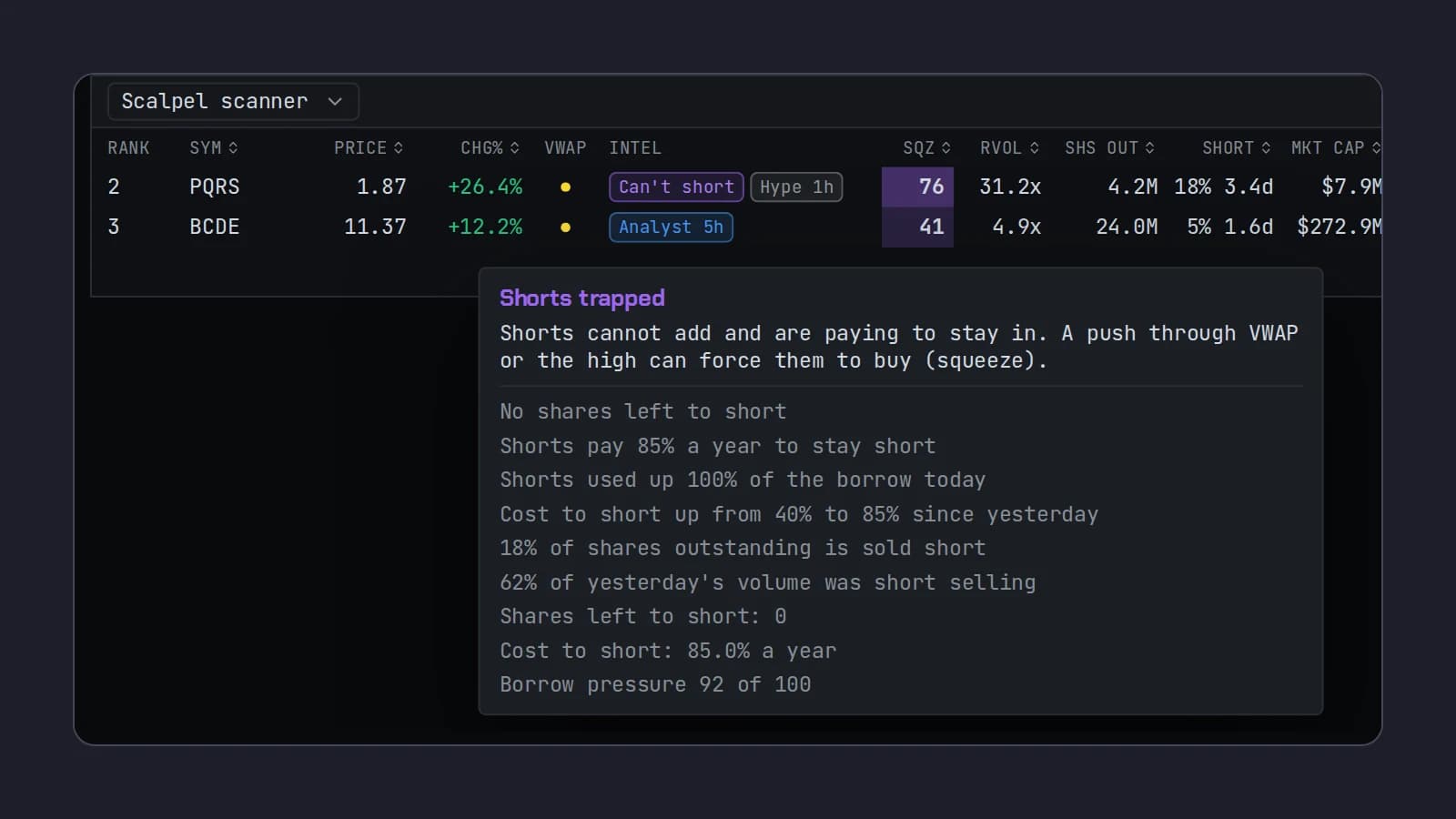
Interactive Brokers publishes the borrow fee and the shares it has available to lend for every US stock in a free text file, usa.txt, on its public FTP server (ftp2.interactivebrokers.com, user shortstock, no password), refreshed through the day. TWS shows the same data live in its Fee Rate and Shortable Shares columns. For a long trader, an IBKR borrow fee climbing past 20% a year while available shares drop toward zero means short sellers cannot add and are paying to stay in: squeeze fuel. It is not a buy signal on its own, and research shows that stocks expensive to short have, on average, gone on to underperform.
You never short, so why read the borrow side? Because every share sold short is a future buy order. When a stock runs, the people who must buy it back are part of the demand you are trading with, and IBKR's borrow data tells you how many of them are stuck. The IBKR borrow fee is the cheapest, most current read on that you can get without paying for data.
This post shows where IBKR publishes borrow fees and shortable shares, how to read its stock loan file field by field, what a fee costs a short seller, and what a spiking fee does and does not mean for a long trade. Every file number below comes from the copy we downloaded on October 22, 2026, stamped 07:34:48 ET. Scalpel is independent and not affiliated with or endorsed by Interactive Brokers.
Where to find the IBKR borrow fee and shortable shares
There are three places, and they serve different jobs:
| Where | What you get | Best for |
|---|---|---|
| TWS watchlist columns | Fee Rate, Shortable Shares, Utilization and more, live | The stocks on your screen right now |
| The public stock loan file (usa.txt) | Fee, rebate and shares available for every US symbol IBKR lends | Scanning the whole market, scripts, other tools |
| The TWS API | A shortable reading and a shortable share count on each quote | Trading apps built on the API |
In TWS, the columns are in the Short Selling group: click the wrench on a watchlist, choose Settings, and add the group from Available Columns. IBKR's own short video walks through it, and you do not need to short anything to use the columns:
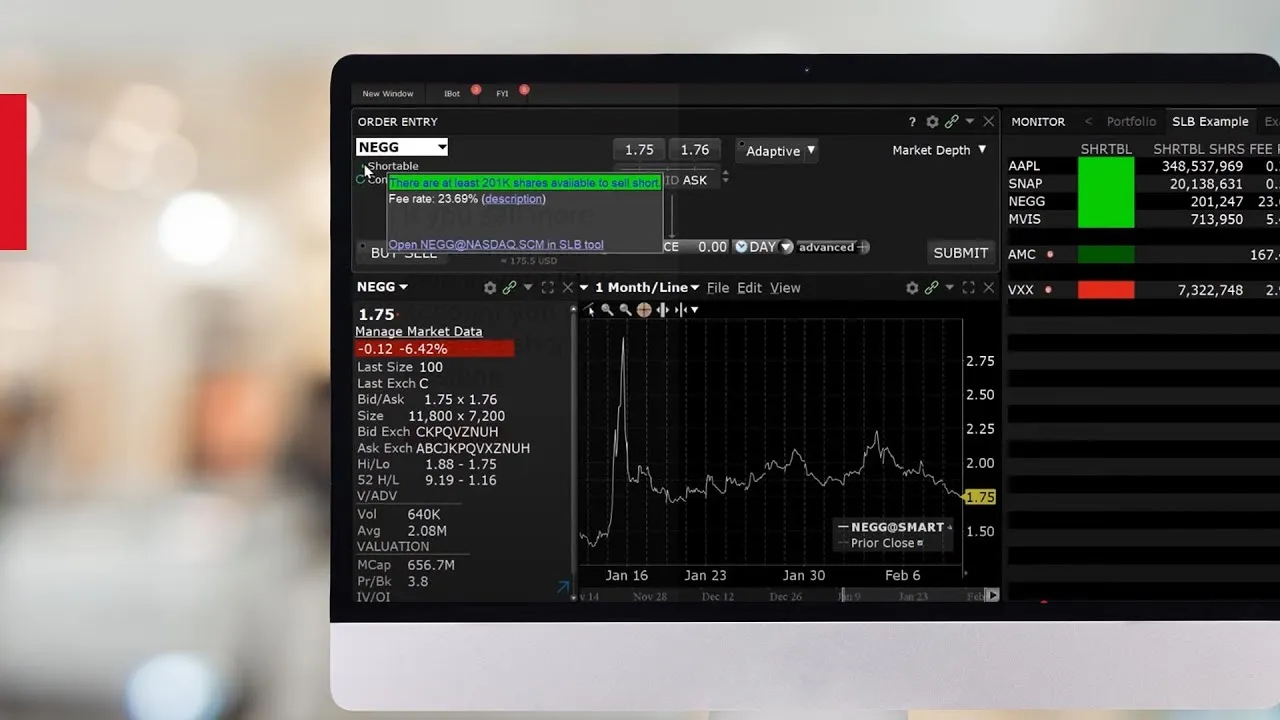
In the API, the shortable reading is a number with three bands, per IBKR's tick types reference: above 2.5 means at least 1,000 shares are available to short, above 1.5 means shares are available only if they can be located, and 1.5 or below means the stock is not available to short. A separate tick gives the number of shares available. The same page points to IBKR's FTP site for shortability data outside TWS.
How to read IBKR's stock loan file
The file is plain text, so any tool can read it. Browsers no longer open FTP links, so use curl from a terminal:
curl -u shortstock: ftp://ftp2.interactivebrokers.com/usa.txt -o usa.txt
The same folder holds files for other countries (canada.txt, british.txt, germany.txt and more), each with a .md5 checksum. The US file we downloaded was 1.8 MB and looked like this, with a fictional row for ABCD in place of a real one:
#BOF|2026.10.22|07:34:48
#SYM|CUR|NAME|CON|ISIN|REBATERATE|FEERATE|AVAILABLE|FIGI|
ABCD|USD|ABCD THERAPEUTICS INC|123456789|XXXXXXX12345|-81.1200|85.0000|4000|BBG000000000|
...
#EOF|19552
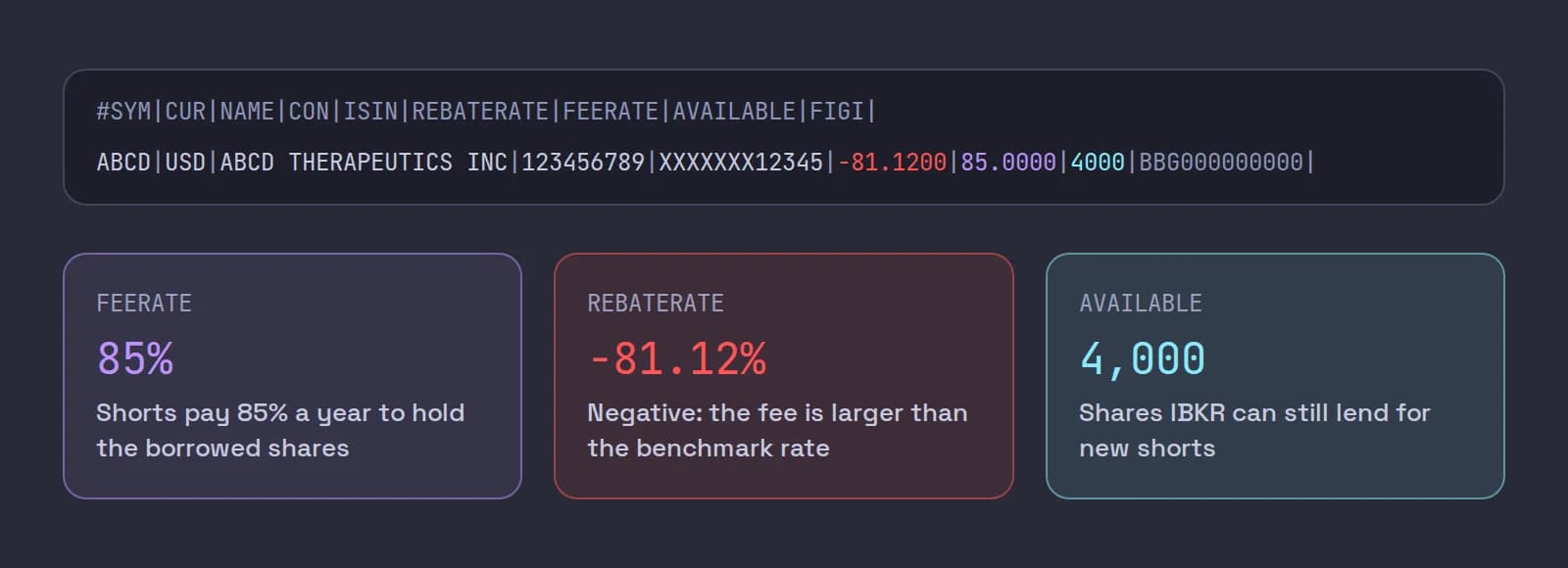
Field by field:
| Field | What it means |
|---|---|
| #BOF line | The date and time IBKR wrote the file. Check it: a stale file is a stale read |
| SYM | The ticker |
| CON | IBKR's contract id, the same conid the API uses |
| ISIN | Partly masked with X characters in the public file |
| FEERATE | The annual borrow fee a short seller pays, in percent |
| REBATERATE | The interest a short seller receives on the sale proceeds, in percent, after the fee. It goes negative when the fee is larger than the benchmark rate |
| AVAILABLE | Shares IBKR has available to lend. Large supply shows as the bucket >10000000 |
| #EOF line | The number of rows, so you can check the download is complete |
On the US dollar rows, rebate plus fee added up to 3.88 on October 22, 2026, which is the benchmark rate implied by IBKR's own interest table that day. IBKR's Short Sale Cost page confirms the logic: elevated borrow costs "may lead to negative rebate rates if the borrow fee rate exceeds the short proceeds interest earned." In our copy, 6,588 rows had a negative rebate.
What the file looked like on October 22, 2026
The file listed 19,552 rows. 155 of them showed NA for fee and rebate, leaving 19,397 with a fee:
| Annual borrow fee | Rows |
|---|---|
| Under 1% | 9,434 |
| 1% to under 5% | 4,514 |
| 5% to under 20% | 3,659 |
| 20% to under 100% | 1,387 |
| 100% or more | 403 |
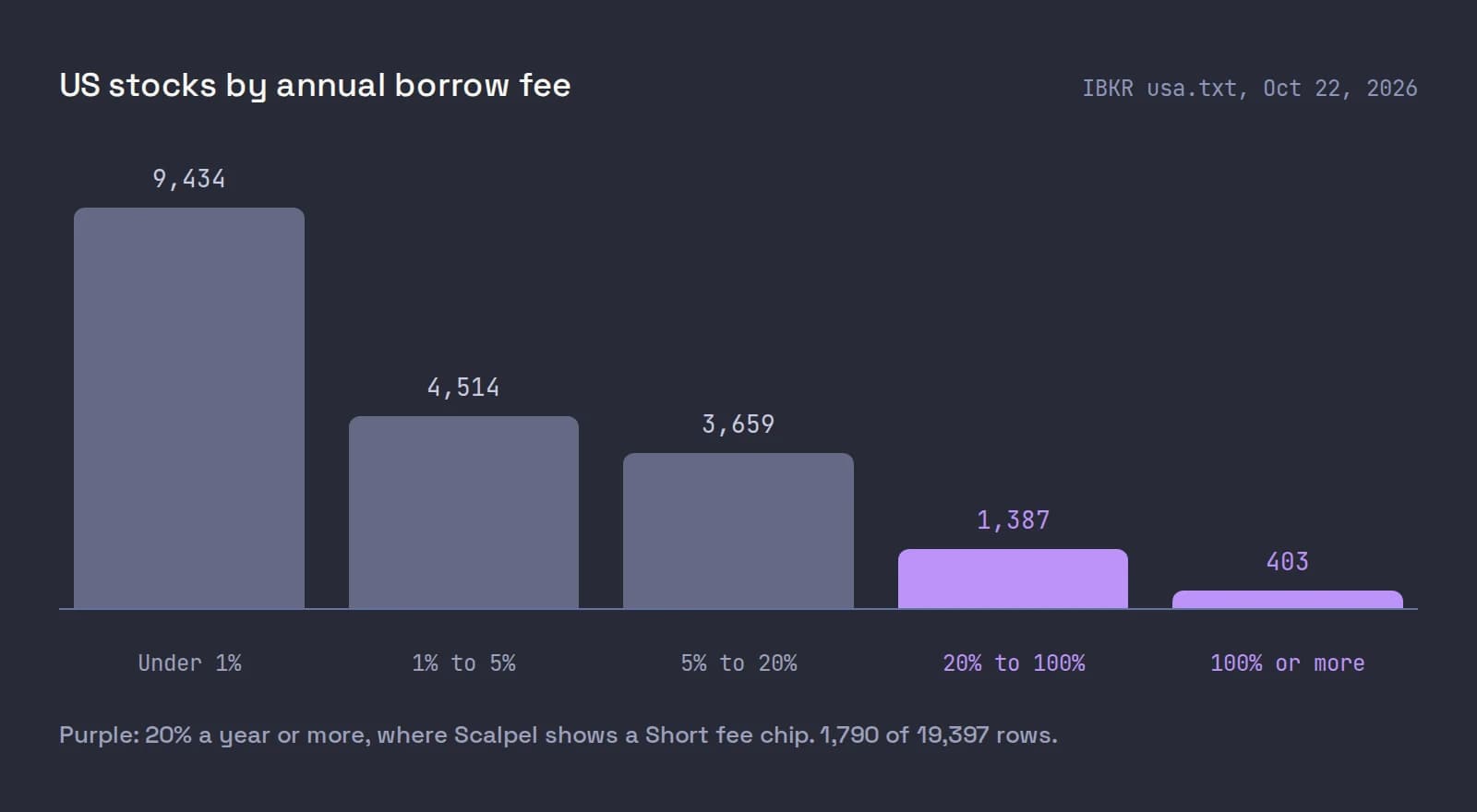
The median fee was 1.15%, and 4,813 rows sat at 0.25%, the lowest fee in the file. Only 25 rows were at 500% or more; the highest was 1,085.76% a year. On the supply side, 758 rows were in the over-10-million bucket, and no row showed zero shares available: the smallest figure was 1 share. A stock with nothing left to lend may simply be missing from the file, so treat a missing symbol as unknown, not as easy to borrow.
What an IBKR short borrow rate costs a short seller
The fee is an annual rate charged daily on the value of the borrowed shares. Say a short holds 10,000 ABCD at $3.00, a $30,000 position, and the fee is 85% a year. That is about $70 a day, roughly $490 a week, before any move in the stock. If ABCD rises to $4.00, the same fee is charged on $40,000, so the daily cost rises with the price. IBKR's Short Sale Cost page has a calculator with its exact day count and collateral marking.
That is why the fee matters to you. A short paying $70 a day in a stock that is going up has two reasons to buy it back, and both get stronger as the price rises.
What a spiking borrow fee means for a long trade
Read the fee and the availability together, and over time:
- Fee low, plenty available. Shorts can add freely. Any squeeze talk on social media is just talk.
- Fee rising, availability falling. Hard to borrow stocks in the making. Shorts are crowding in and the lenders are running out.
- Fee high, availability gone. No new shorts can open. Existing shorts are paying to stay in, and a push through a level they defended, usually VWAP or the high of day, can force them to buy at the same moment as momentum buyers. That is the setup our post on short squeezes in small caps describes.
Now the uncomfortable part. A high fee is the market saying many informed people think the stock is overpriced, and over months they have usually been right. Jones and Lamont (2002), Journal of Financial Economics 66 studied the stock borrowing market of 1926 to 1933 and found that stocks entering it, typically because shorting demand was high, had size-adjusted returns one to two percent lower per month. With modern data, Drechsler and Drechsler (2014), NBER w20282 found that a portfolio long cheap-to-short and short expensive-to-short stocks earned a monthly average gross return of 1.43%.
Our view: on a small cap, a spiking borrow fee is intraday fuel and a multi-week warning at the same time. Use it to pick which runners to watch and which levels matter. Never use it as a reason to hold a position overnight.
Why borrow fees spike on small caps
- Fresh dilution with warrants. Investors in a financing often short the stock against their discounted shares and warrants, which uses up borrow (warrants and dilution).
- A tiny float. Fewer shares exist to lend, and holders of a hot stock do not always lend them.
- Persistent delivery failures. A stock on the Reg SHO threshold list has had large fails to deliver for at least five settlement days, and shorts there face stricter borrowing rules.
Limits of IBKR's borrow data
- It is one broker. The file shows IBKR's lending inventory, not the whole market. Another broker may still have shares, or none.
- It is a snapshot. IBKR rewrites the file through the day. The live TWS columns and API ticks are fresher for symbols you are watching.
- It does not show who is short. For the size of the short position, use FINRA short interest, published twice a month and up to about three weeks old by the time you read it (shares out, short interest and squeeze).
- FTP can be blocked. Some office and public networks block FTP. The live columns still work.
Where Scalpel fits
Scalpel is a keyboard-first desktop cockpit for your own IBKR account. It reads the borrow side for you, from the same free sources, and turns it into one chip per stock (borrow and short squeezes):
| Chip | When |
|---|---|
| Can't short | IBKR's shortable reading shows no shares left |
| Short fee 85% | The borrow fee from IBKR's file is 20% a year or more; the number is the fee |
| Hard to short | A locate is needed: few shares to borrow |
Scalpel fetches IBKR's file every 15 minutes, and Settings > Intel shows its status line with the time IBKR stamped on it (set up intel). Behind the chip, a 0 to 100 borrow pressure score combines the fee, the shares left, how much of the session's first borrow reading is used up, whether the fee rose since yesterday, the Reg SHO list, short interest and FINRA short volume. When a stock you are watching runs out of borrow during the session, a toast such as PQRS: no shares left to short fires once per stock per day. If the file status never leaves loading, FTP is blocked on your network (fix intel off).
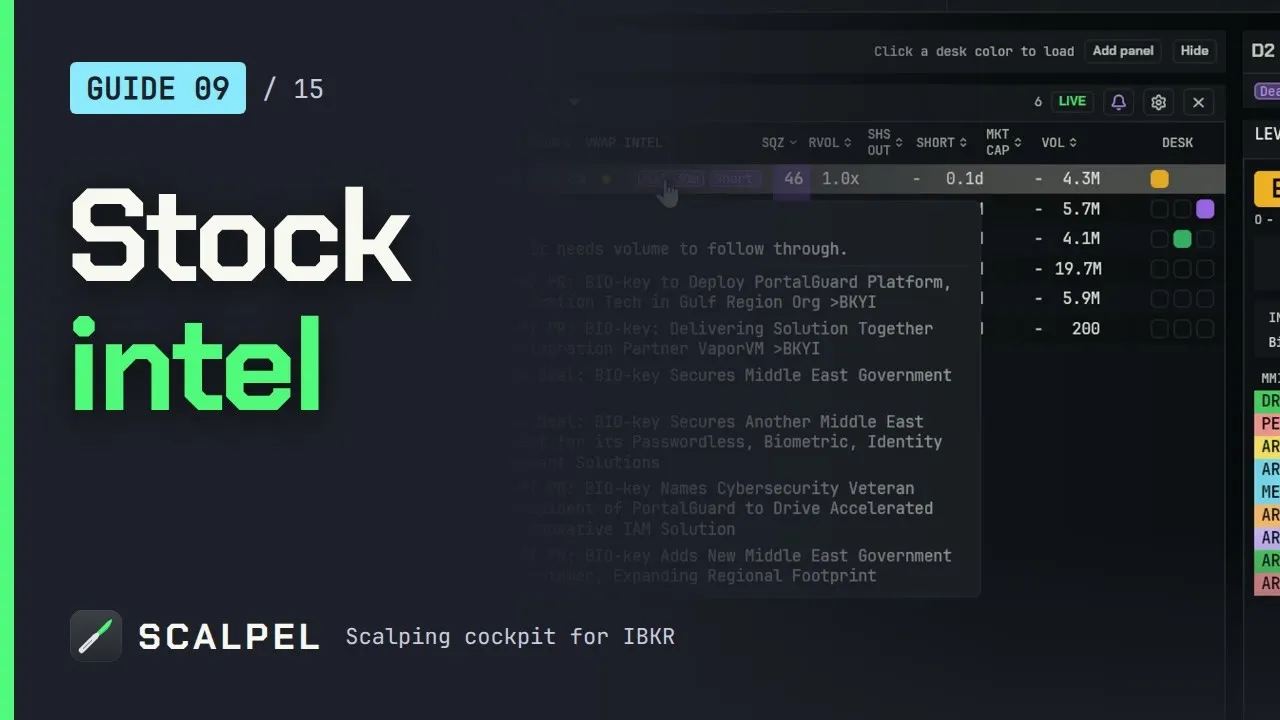
The guide video shows the borrow chips alongside the other intel reads:
Scalpel is long only: every sell is capped at the shares you hold, and it cannot short (long only). The borrow read exists to judge a long trade. For the whole picture of why supply matters, start with our guide to low float stocks. Fees and file contents checked on October 22, 2026.
Trading carries a significant risk of loss. Nothing here is financial advice.
Questions
- Where can I see the borrow fee on Interactive Brokers?
- In TWS, add the Short Selling column group to a watchlist for Fee Rate and Shortable Shares. IBKR also publishes every US stock's fee and availability in usa.txt on ftp2.interactivebrokers.com, user shortstock, with no password.
- What does a high borrow fee mean?
- Shares are scarce and demand to short is high, so short sellers pay a lot to hold their position. For a long, it can be squeeze fuel during a run, but on average stocks that are expensive to short have underperformed over the following months.
- How is the IBKR borrow fee charged?
- It is an annual rate charged daily on the value of the borrowed shares. An 85% fee on a $30,000 short costs about $70 a day, and the cost rises as the price rises.
- What does shortable shares mean on IBKR?
- The number of shares IBKR currently has available to lend for short selling. When it drops toward zero during a run, new short sellers cannot open positions.
- What is a negative rebate rate?
- The interest a short seller earns on the sale proceeds minus the borrow fee. When the fee is larger than the benchmark rate, the rebate goes negative and the short pays instead of earning.
- Is a hard to borrow stock going to squeeze?
- Not by itself. Hard to borrow means shorts cannot add easily, which is fuel. A squeeze still needs buyers to push the price through a level the shorts defended, with real volume.
Related guides
Guide 9.3Borrow, short fees and squeeze setupsRead borrow like a squeeze trader: shares left to short, the borrow fee, the Reg SHO threshold list and short volume, combined into Scalpel's borrow chips.Guide 9.1Turn on intelSet the SEC contact email and an optional OpenAI key so Scalpel reads filings, dilution, shares outstanding and news. What each source needs and costs.Guide 9.5Every intel chip, explainedEach intel chip on Scalpel's scan rows and desk strips, from Selling and Warrants near to FDA, Can't short and Short fee: what it means for a long trade.
Keep reading
- Low float stocks: what float means and why runners moveLow float stocks explained: what float is, float vs shares outstanding, where to find it free on SEC EDGAR, and why low float runners move so fast.
- Short squeeze explained: short interest, borrow and days to coverShort squeeze explained: how FINRA short interest, days to cover and borrow fees fit together, what the SEC found in GameStop, and why squeezes are rare.
- How to check dilution on SEC EDGAR, step by stepHow to check dilution on SEC EDGAR: the forms that mean a sale (S-3, 424B5, 8-K Item 3.02), full-text searches to save, baby shelf math and cash runway.
Practice in SIM, against the live book.A lifetime license, every update included, with a 7-day refund guarantee.Ask in DiscordGet Scalpel