The Reg SHO threshold list: what it means for a stock
By Scalpel Team. , updated . 7 min read.
In short
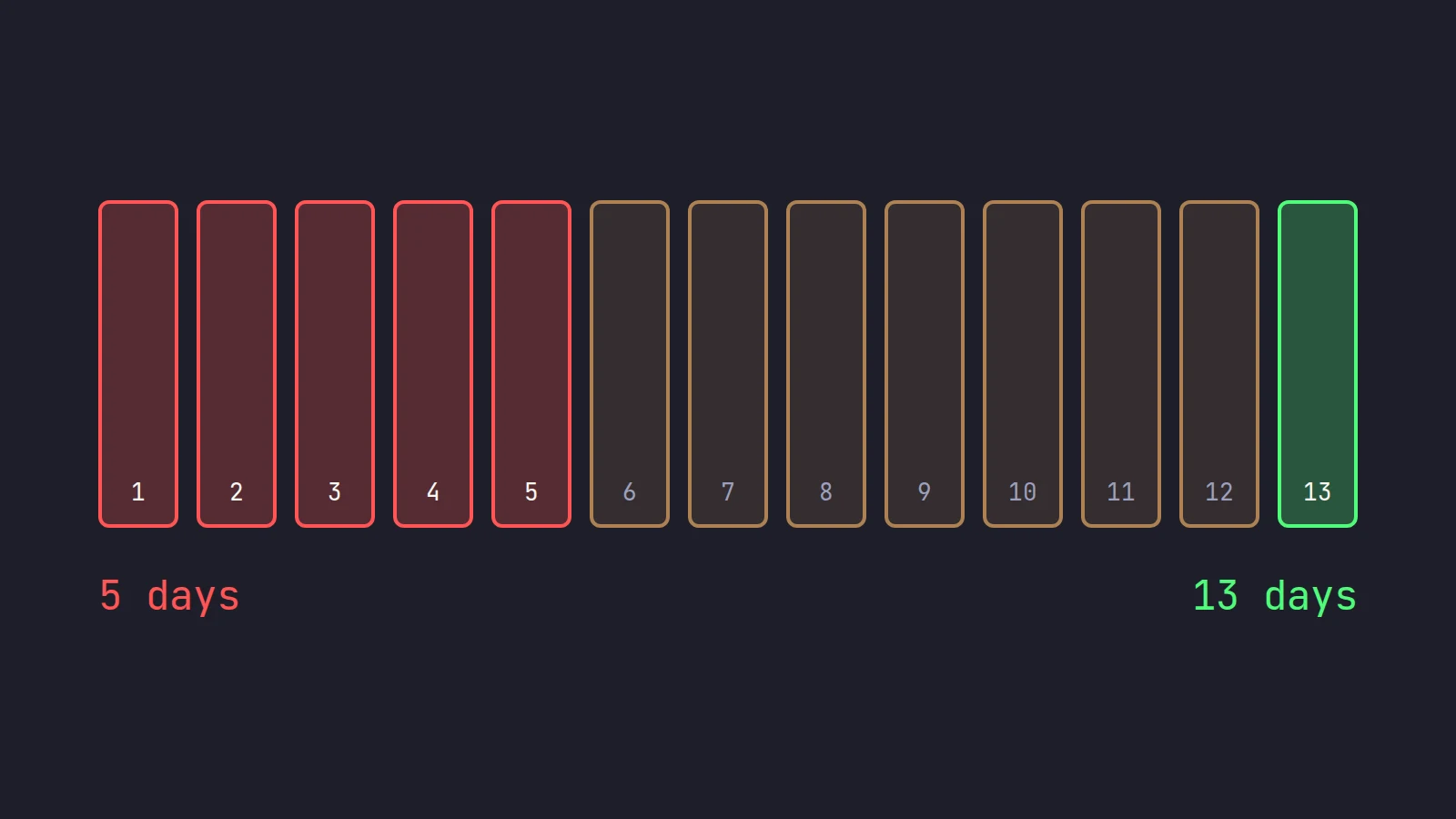
The Reg SHO threshold list is a daily list of stocks with persistent fails to deliver. Under SEC Rule 203(c)(6), a reporting company's stock goes on it after five consecutive settlement days of fails of at least 10,000 shares that also equal at least 0.5% of its shares outstanding, and each listing exchange publishes its own list: Nasdaq, NYSE and Cboe. Once a fail has lasted 13 consecutive settlement days, the clearing firm must buy shares to close it out and cannot accept short sales in that stock without borrowing first. For a long trader it is a sign the short side is under strain, not proof of naked shorting and not a buy signal.
The Reg SHO threshold list gets passed around like a squeeze alert. A ticker lands on it, and within the hour someone is sure a forced buy-in is days away. The real rule is narrower, slower and more interesting than that. It tells you something specific about delivery failures, and it says nothing about direction.
This post covers the regulation SHO threshold rule in its own words, what happens to a threshold security, what fails to deliver are, where the lists are published and how to read Nasdaq's file, and what the list means for a long trade. The rule text and lists were checked on October 22, 2026. Scalpel is independent and not affiliated with or endorsed by Interactive Brokers, Nasdaq, NYSE or Cboe.
What the Reg SHO threshold list is
The definition is in Rule 203(c)(6) of Regulation SHO. A threshold security is an equity security of a company registered under, or reporting under, the Exchange Act:
For which there is an aggregate fail to deliver position for five consecutive settlement days at a registered clearing agency of 10,000 shares or more, and that is equal to at least 0.5% of the issue's total shares outstanding; [and] is included on a list disseminated to its members by a self-regulatory organization.
Three conditions, all at once:
- Size: fails of 10,000 shares or more.
- Proportion: at least 0.5% of shares outstanding.
- Persistence: five consecutive settlement days.
A stock comes off the list once its fails stay below that level for five consecutive settlement days.
The 0.5% test is why small caps dominate. Take fictional ABCD with 6,000,000 shares outstanding: 0.5% is 30,000 shares. A fail of 25,000 shares clears the 10,000 floor but not the 0.5%, so ABCD stays off; a fail of 40,000 shares for five days puts it on. For a company with 500,000,000 shares, 0.5% is 2,500,000 shares, a fail that rarely happens. The same absolute problem is far more likely to qualify a small company.
What happens to a threshold security: the close-out rule
The list matters because of Rule 203(b)(3), which applies to the clearing firms that settle trades:
- The 13-day close-out. A clearing firm with a fail to deliver in a threshold security "for thirteen consecutive settlement days" must "immediately thereafter close out the fail to deliver position by purchasing securities of like kind and quantity." Fails from sales under Rule 144 get 35 consecutive settlement days instead.
- The pre-borrow penalty. Until it closes out, that firm, and any broker or dealer it clears for, may not accept a short sale order in the stock "without borrowing the security or entering into a bona-fide arrangement to borrow the security." The usual locate is not enough.
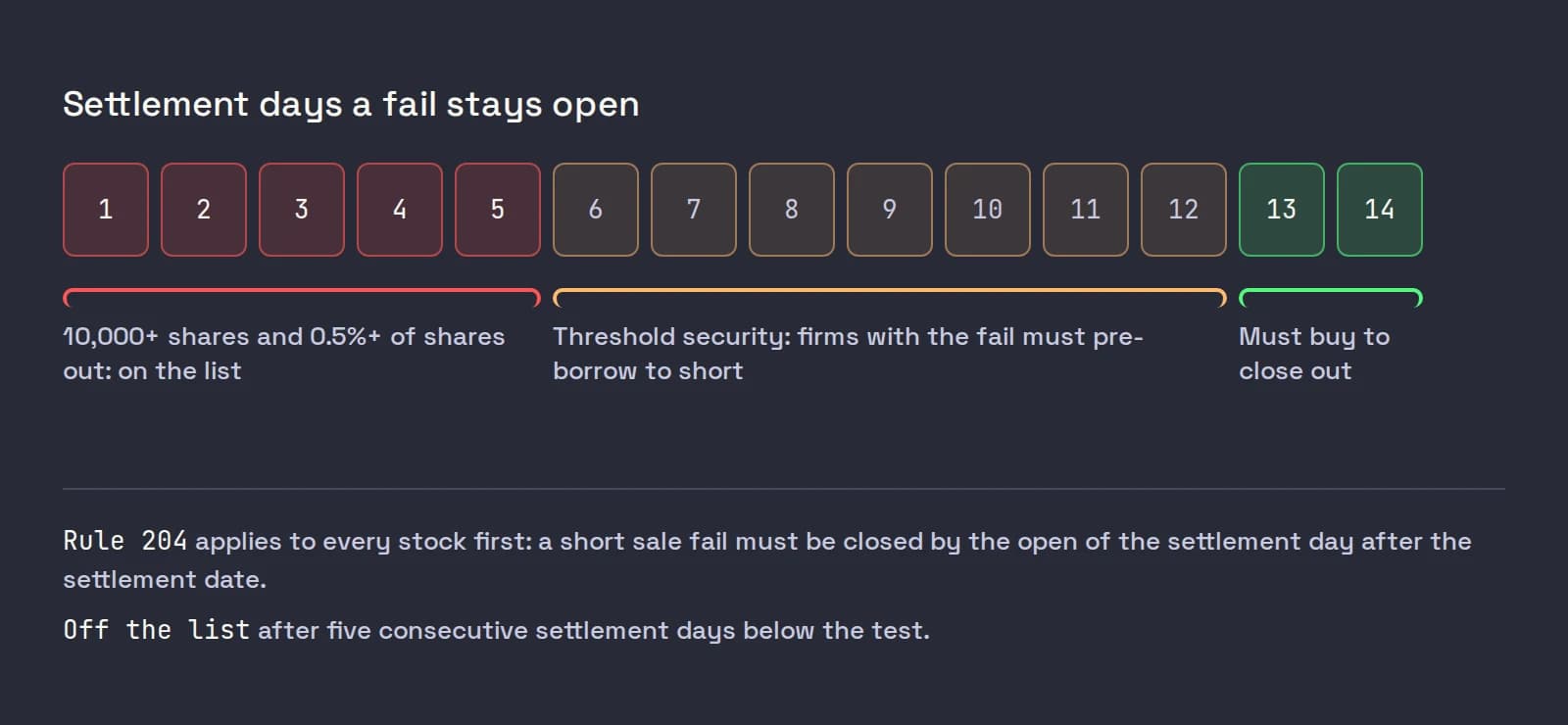
Since 2009, a stricter rule has applied to every stock, on the list or not. Rule 204 requires a fail from a short sale to be closed out "by no later than the beginning of regular trading hours on the settlement day following the settlement date", and a fail from a long sale or from bona fide market making by the third settlement day after it. So in practice the threshold list is a backstop: it catches the fails that Rule 204 should have closed out but did not, or that were rolled forward day after day.
Fails to deliver: what they are and what they are not
A fail to deliver is a sale whose shares did not arrive at the clearing agency by settlement. The SEC publishes the aggregate numbers on its fails-to-deliver data page, twice a month: the first half of a month is posted at the end of that month, and the second half around the 15th of the next. On October 22, 2026 the newest file covered the second half of September 2026. Each row gives the settlement date, CUSIP, ticker, name, the previous close and the total shares failed.
The SEC adds a caution worth repeating: fails "can occur for a number of reasons on both long and short sales", so they "are not necessarily the result of short selling, and are not evidence of abusive short selling or 'naked' short selling."
The research supports the caution. Fotak, Raman and Yadav (2014), Journal of Financial Economics 114(3) studied 1,492 NYSE stocks over 42 months from 2005 to 2008 and found that more fails to deliver came with higher liquidity and pricing efficiency, with an effect similar to that of delivered short sales. They found no evidence that fails caused price distortions or the failure of financial firms in the 2008 crisis.
Where the threshold lists are published
Each exchange publishes the list for the securities it lists, every settlement day:
| Listing market | Where |
|---|---|
| Nasdaq | NasdaqTrader Reg SHO threshold list, with a daily text file |
| NYSE markets | NYSE regulation public information, Threshold Securities, by date and market |
| Cboe | Cboe US equities Reg SHO threshold |
| Raw fails data | SEC fails-to-deliver data, twice a month |
So a stock listed on NYSE American will not be on Nasdaq's list even if it qualifies. Check the list of the exchange where it is listed.
Reading Nasdaq's file
Nasdaq posts each day's list as a pipe-separated file, named with the date, for example nasdaqth20261021.txt. The October 21, 2026 file was created at 11:00:07 PM ET and starts like this:
Symbol|Security Name|Market Category|Reg SHO Threshold Flag|Rule 3210|Filler
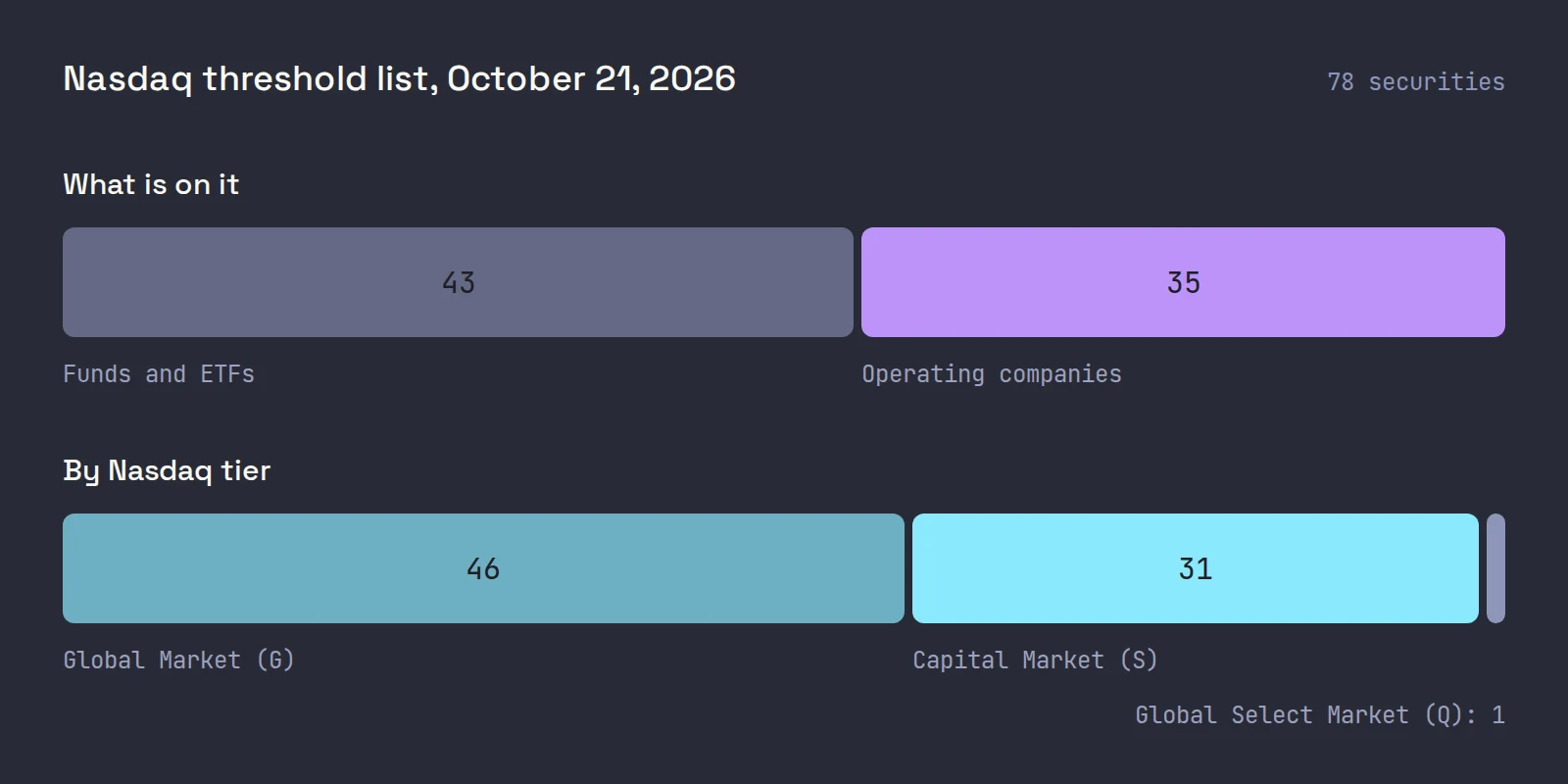
Each row is one security with the flag set to Y. Market Category is Nasdaq's tier code: Q for the Global Select Market, G for the Global Market, S for the Capital Market.
That day's list held 78 securities: 1 on the Global Select Market, 46 on the Global Market and 31 on the Capital Market. 43 of the 78 were exchange-traded funds and trusts, many of them leveraged single-stock funds, and 35 were operating companies. If you scan the list for squeeze candidates, the funds are mostly noise.
What the threshold list means for a long trade
It is information about the short side, and like all short-side data it is fuel, not a trigger.
What it can tell you:
- Delivery has been failing for at least a week. Five settlement days of large fails means someone has had trouble getting shares, often because borrow is tight. Check the live IBKR borrow fee and shortable shares: the threshold list is slow, the borrow data is current.
- New shorting is harder at some firms. Clearing firms with an aged fail must pre-borrow before accepting short sales, which removes some new sellers.
- Forced buying can exist. A 13-day close-out is a real purchase. Nobody outside the clearing firm knows its size or timing.
What it cannot tell you:
- It does not prove naked shorting. The SEC says so, and the research above finds fails tied to better, not worse, market quality.
- It does not predict direction. Plenty of threshold securities keep falling, especially when the company is selling stock into the market.
- It is not the short sale restriction. Rule 201's price test, triggered when a stock falls 10% or more from the prior close, is a separate rule with a separate list; see short sale restriction (SSR).
Use it as one input with short interest and days to cover, and with the dilution picture: a stock on the threshold list that just filed an offering has a seller who does not need to borrow at all. For why the share count makes small caps behave the way they do, see our guide to low float stocks.
Where Scalpel fits
Scalpel is a keyboard-first desktop cockpit for your own IBKR account. Its borrow read pulls Nasdaq's threshold list once a day, with IBKR's live shortable data, IBKR's stock loan file and FINRA's short volume, into a 0 to 100 borrow pressure score. Being on the list fills its Reg SHO ingredient, worth 10% of the score (borrow and short squeezes). The score shows as the verdict on the violet borrow chip's hover card, Shorts trapped from 60, and feeds the SQZ squeeze score (shares out, short interest and squeeze, intel chips).
One limit to know: Scalpel reads Nasdaq's file, so a threshold security listed on NYSE American or Cboe does not count toward its score. Check those exchanges' pages for stocks listed there.
The guide video shows where the borrow read appears:
Scalpel is long only and cannot short (long only). It reads the threshold list to judge a long trade. This is general information about a securities rule, not legal advice.
Trading carries a significant risk of loss. Nothing here is financial advice.
Questions
- What does it mean when a stock is on the Reg SHO threshold list?
- Its fails to deliver have been at least 10,000 shares and at least 0.5% of shares outstanding for five consecutive settlement days. Clearing firms with fails lasting 13 consecutive settlement days must buy shares to close them out.
- Does the threshold list mean a short squeeze is coming?
- No. It shows delivery has been failing and that new shorting is harder at some firms, which can add fuel, but plenty of threshold stocks keep falling. A squeeze still needs buyers to push the price through a level shorts defended.
- Where can I find the Reg SHO threshold list?
- Each listing exchange publishes its own daily: Nasdaq on NasdaqTrader, NYSE on its regulation public information page, and Cboe on its US equities market statistics page. The SEC posts raw fails to deliver data twice a month.
- What are fails to deliver?
- Sales whose shares did not reach the clearing agency by the settlement date. The SEC says they are not necessarily the result of short selling: late deliveries on long sales and processing problems also cause them.
- Is a stock on the threshold list being naked shorted?
- Not necessarily. The list measures fails to deliver, which happen on both long and short sales. The SEC says fails are not evidence of abusive or naked short selling.
- How long does a stock stay on the threshold list?
- Until its fails stay below 10,000 shares or 0.5% of shares outstanding for five consecutive settlement days, so a stock stays on for at least that long after its fails shrink. Nasdaq, NYSE and Cboe post the list every settlement day.
Related guides
Guide 9.3Borrow, short fees and squeeze setupsRead borrow like a squeeze trader: shares left to short, the borrow fee, the Reg SHO threshold list and short volume, combined into Scalpel's borrow chips.Guide 8.4Shares out, short interest and the squeeze scoreWhy Scalpel shows shares outstanding instead of float, how FINRA short interest and days to cover are dated, and what goes into the 0 to 100 squeeze score.Guide 9.5Every intel chip, explainedEach intel chip on Scalpel's scan rows and desk strips, from Selling and Warrants near to FDA, Can't short and Short fee: what it means for a long trade.
Keep reading
- Low float stocks: what float means and why runners moveLow float stocks explained: what float is, float vs shares outstanding, where to find it free on SEC EDGAR, and why low float runners move so fast.
- Short squeeze explained: short interest, borrow and days to coverShort squeeze explained: how FINRA short interest, days to cover and borrow fees fit together, what the SEC found in GameStop, and why squeezes are rare.
- How to check dilution on SEC EDGAR, step by stepHow to check dilution on SEC EDGAR: the forms that mean a sale (S-3, 424B5, 8-K Item 3.02), full-text searches to save, baby shelf math and cash runway.
Practice in SIM, against the live book.A lifetime license, every update included, with a 7-day refund guarantee.Ask in DiscordGet Scalpel