Reverse stock splits in small caps: what happens and why some run
By Scalpel Team. , updated . 8 min read.
In short
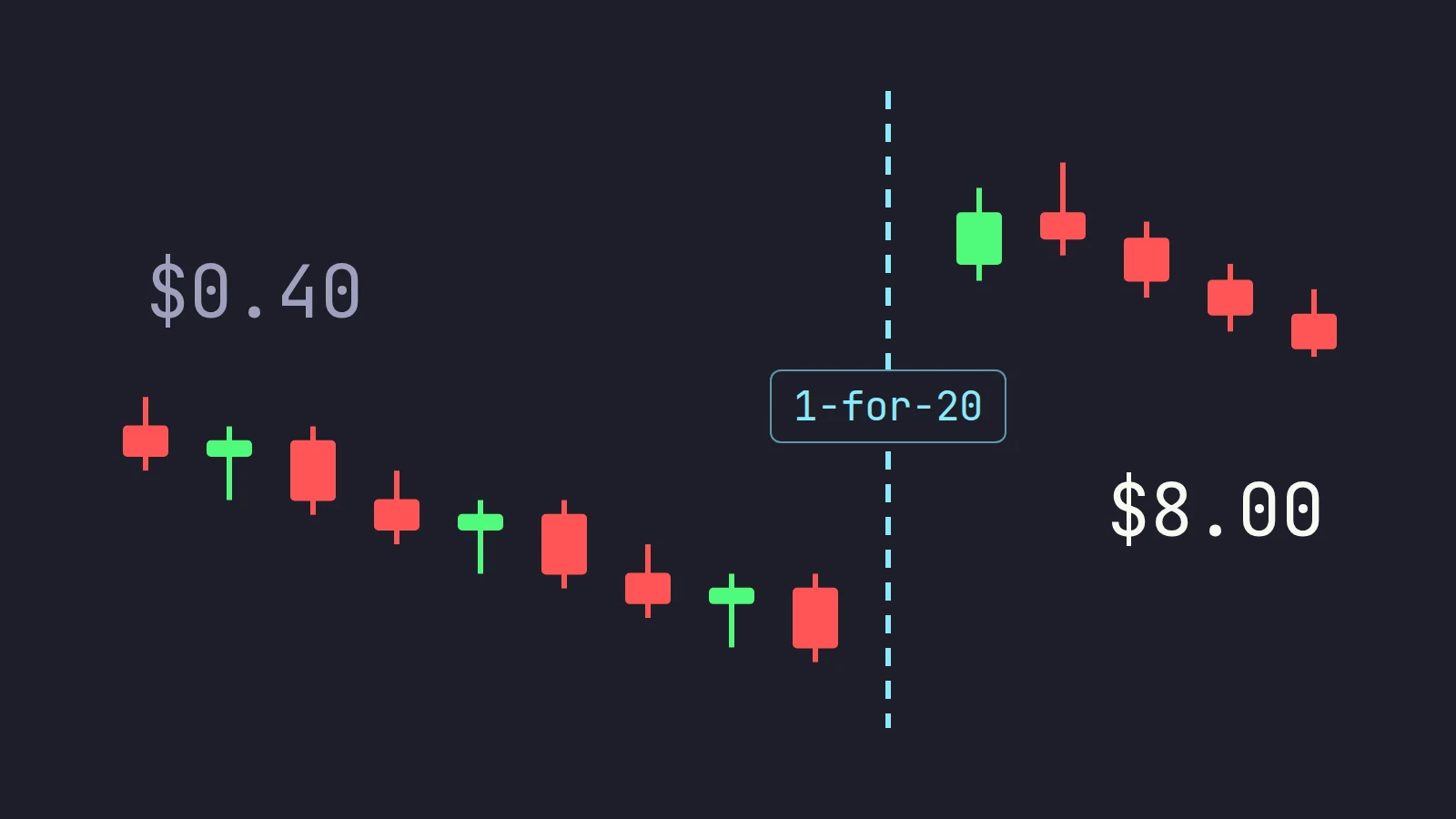
A reverse stock split merges shares: in a 1-for-20 split every 20 old shares become one, the price rises about twentyfold, and the company's market value does not change. Small caps do it mainly to get back above the $1 minimum price that Nasdaq and NYSE require for listing. Some reverse split stocks run hard in the days after, because the float is suddenly tiny, but the published research is clear that on average they underperform for years, and a new stock offering often follows the split. Trade one as a low float setup with a dilution risk attached, not as a turnaround.
A reverse split stock shows up on your scanner looking brand new: a $6 price where yesterday it was 30 cents, a float of a million and a half shares, and a chart that your platform may or may not have adjusted. Some of these move 50% in a morning. Many more bleed back toward where they came from within weeks.
This post covers what actually happens in a reverse stock split, the exchange rules that force most of them, why some run, what the research says about the aftermath, and a checklist for trading one. Listing rules were checked on October 22, 2026 against the SEC's approval orders. Scalpel is independent and not affiliated with or endorsed by Interactive Brokers.
What happens in a reverse stock split
The mechanics are simple. Take a fictional company, ABCD, trading at $0.40 with 40,000,000 shares outstanding, of which 30,000,000 are the public float. It does a 1-for-20 reverse split.
| Before | After 1-for-20 | |
|---|---|---|
| Shares outstanding | 40,000,000 | 2,000,000 |
| Float | 30,000,000 | 1,500,000 |
| Price | $0.40 | $8.00 |
| Market value | $16.0M | $16.0M |
| A holder of 150 shares | 150 shares | 7.5 shares |
| Warrants | 5,000,000 at $0.50 | 250,000 at $10.00 |
A few details traders miss:
- Fractions. Investor.gov notes that in some reverse splits small holders are "cashed out", receiving cash for partial shares. Our holder of 150 shares gets 7 shares plus cash for the half, unless the company rounds up.
- Warrants and options adjust. Warrant agreements normally divide the share count and multiply the exercise price by the ratio. A filing written before the split quotes pre-split prices, so a "$0.50 warrant" in an old prospectus is a $10.00 level now (warrants and dilution).
- Approval and notice. State law and the company's charter decide whether shareholders must vote. Investor.gov lists the places it shows up: a proxy (Schedule 14A) when a vote is needed, and the 8-K, 10-Q or 10-K that reports it.
The Options Industry Council's video works through a reverse split with numbers, including how the share count, price and listed options are adjusted, which is the same arithmetic as the table above.
Nasdaq halts the stock the night before
On Nasdaq, the first day of split-adjusted trading does not start at 04:00 ET. Under a rule the SEC approved on November 7, 2023 (Release 34-98878), Nasdaq halts a stock before the end of post-market trading on the day before the split's market effective date, and reopens it through its halt cross, which Nasdaq expected to run at 09:00 ET. So there is no pre-market tape on day one until the reopening. Nasdaq's filing gives the reason: errors in processing splits, including one broker that sold more shares than customers held. It also gives the scale. Nasdaq processed 196 reverse splits in 2022, against 35 in 2021 and 98 in 2020, and 78 in the first quarter of 2023 alone. For how halts reopen, see trading halts and LULD.
Why small caps reverse split: the $1 minimum bid rules
Most reverse splits on small caps are about staying listed. The rules, as described in the SEC's approval orders:
Nasdaq (SEC Release 34-102245, January 17, 2025):
- A deficiency exists when the closing bid is below $1.00 for 30 consecutive business days.
- The company gets 180 calendar days to regain compliance, which means a closing bid of at least $1.00 for a minimum of 10 consecutive business days.
- A Capital Market company can get a second 180-day period if it says it intends to cure, which in practice usually means a reverse split. If it uses that second period and still fails, a hearing request no longer stays the suspension: the stock trades over the counter while it appeals.
- A closing bid of $0.10 or less for 10 consecutive trading days means a delisting determination.
- A company that falls below $1.00 again within one year of a reverse split gets no compliance period at all, and neither does one whose reverse splits add up to 250 shares or more to one over two years.
- A split that pushes the company below another listing standard, such as the number of publicly held shares, does not count as a cure.
NYSE (SEC Release 34-102201, January 15, 2025, and Release 34-106133, August 14, 2026):
- A company is below standard when its average closing price is under $1.00 over 30 trading days, and it has six months to cure.
- No cure period after a reverse split in the prior year, or after splits totaling 200 or more to one over two years.
- From July 1, 2027, a close below $0.25 on any trading day means immediate suspension and delisting proceedings.
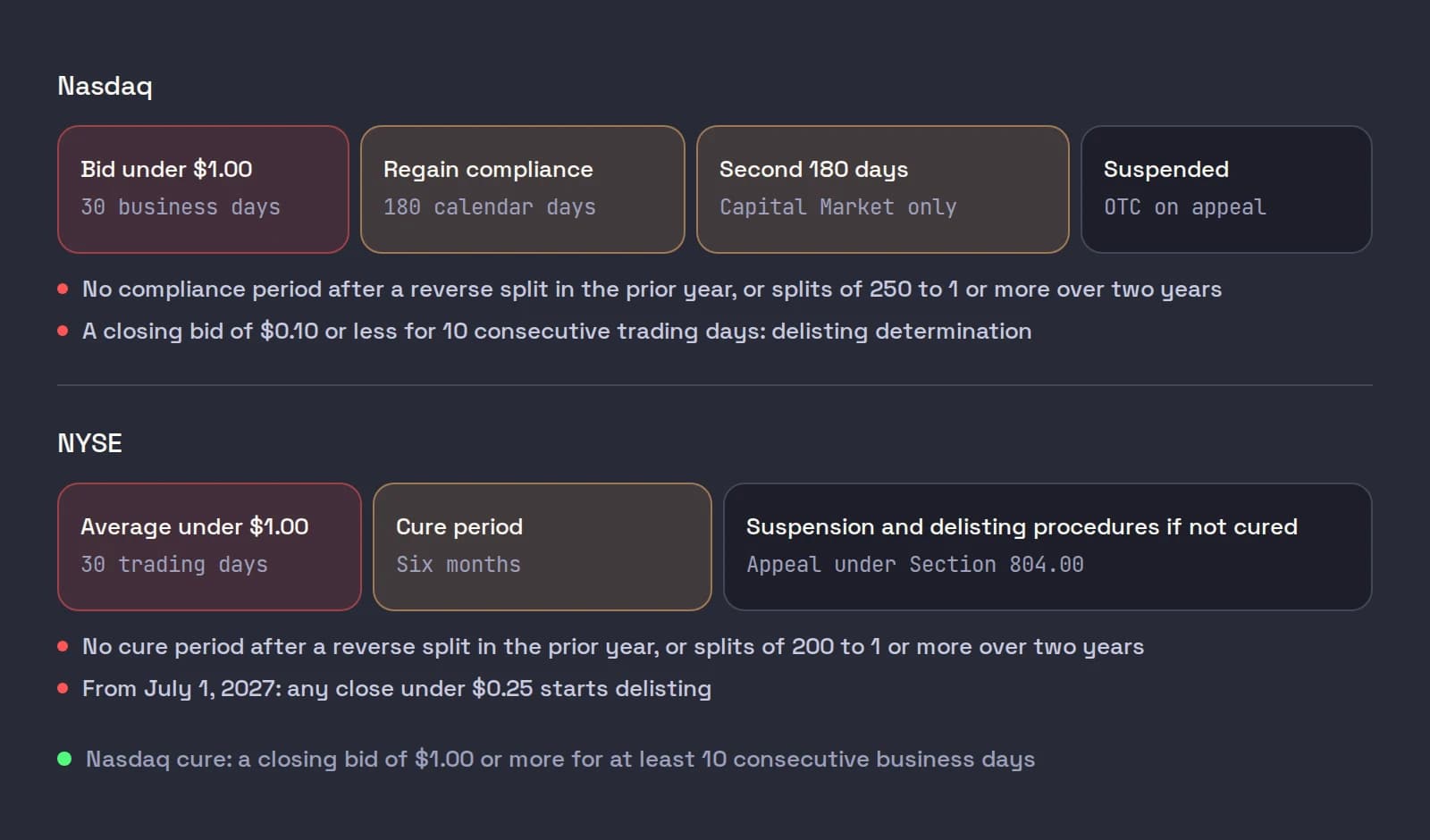
Read the one-year rule from the trader's side. A Nasdaq company that splits and then drifts back under $1.00 within a year is delisted without a second chance. So companies that expect to keep falling pick large ratios, and they need the price high enough to survive a year of selling. Nasdaq said as much when it proposed the rule: it "has observed that some companies, typically those in financial distress or experiencing a prolonged operational downturn, engage in a pattern of repeated reverse stock splits."
Why do reverse splits run
Some do, and the reasons are mechanical:
- The float collapses. ABCD's float went from 30,000,000 to 1,500,000. The value did not change, but the number of shares a buyer must take out to move the price did. Scanners filtering by float and price suddenly show it, and a reverse split low float stock with any news attracts the same crowd as any other low float stock.
- Borrow gets scarce. Lendable shares divide by the same ratio, and short sellers who built positions on the way down may find little left to borrow (IBKR borrow fees as a squeeze signal).
- Old supply levels move away. Sellers who sat at 40 and 50 cents are now at $8 and $10, and the order book is thin in between.
The same mechanics cut the other way. A small float is a float the company can refill, and a company that just did a reverse split to stay listed usually needs cash. A higher share price makes an offering possible again: the follow-on registered direct with warrants, or an at-the-market offering that sells into every bounce. If a run starts, check the filings before you assume the float is still 1.5 million shares.
What happens to stocks after a reverse split: the research
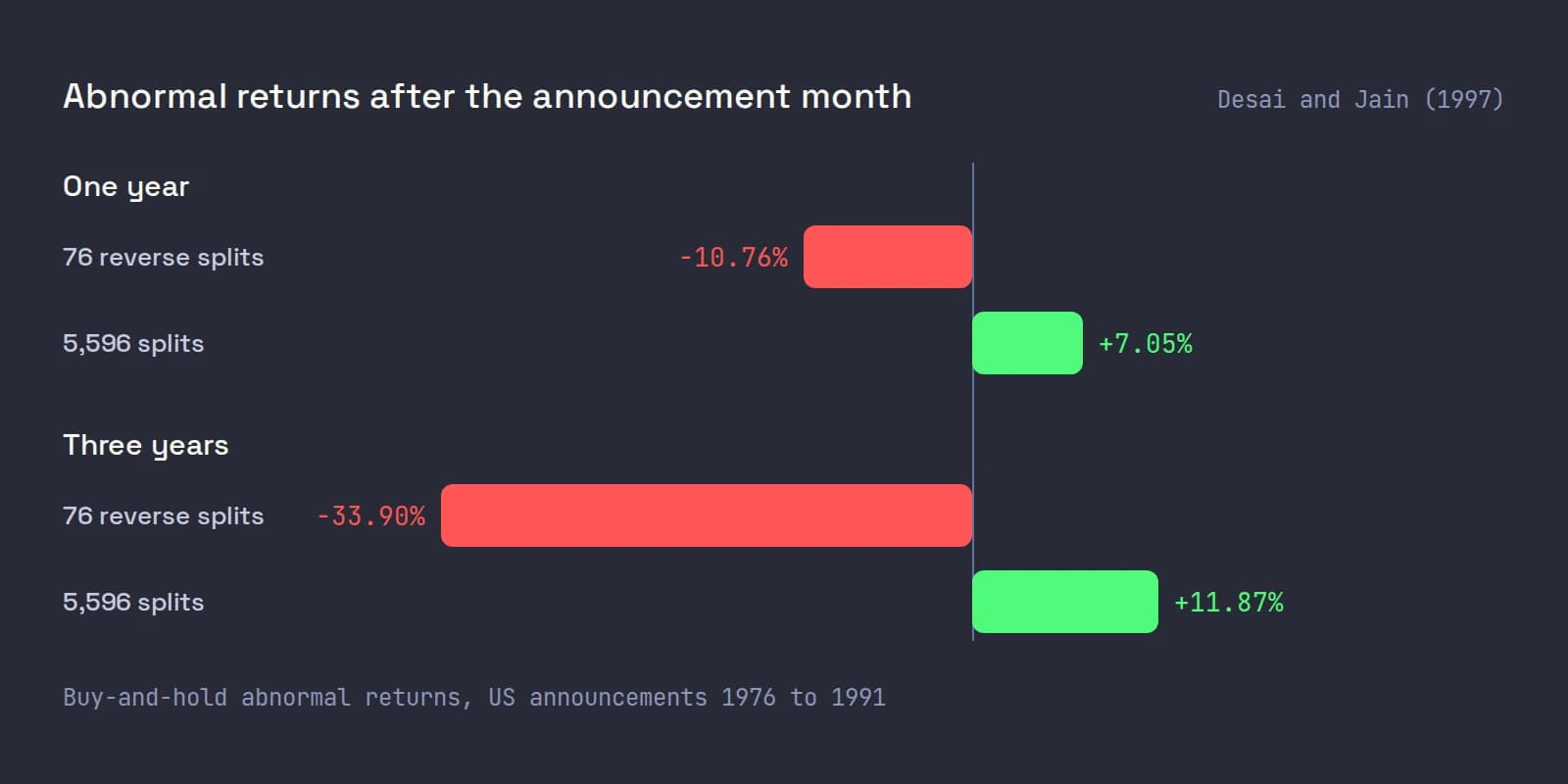
The best known study, Desai and Jain (1997), Journal of Business 70(3), followed 76 reverse split announcements from 1976 to 1991. The average one-year buy-and-hold abnormal return after the announcement month was -10.76%, and the three-year figure was -33.90%. Forward splits in the same study went the other way: +7.05% and +11.87%.
A larger sample came to the same answer. Kim, Klein and Rosenfeld (2008), Financial Management 37(2) studied over 1,600 firms with reverse splits and found statistically significant negative abnormal returns over the three years after the split month, along with poor operating performance over the four years that include and follow the split. They also found these stocks "very difficult to sell short", which is why the decline is not arbitraged away.
Two cautions on what this means for a day trader. These are averages over months and years, measured from the announcement; they say nothing about whether the first session after a split goes up or down. And both samples are old, from before today's $1 rules and the current wave of serial splits. What they do tell you is that holding a reverse split runner overnight as an investment has a poor track record. A momentum trade measured in minutes is a different bet, but it should be sized like one.
How to trade a reverse split stock
Know the dates
Find the 8-K or press release with the ratio and the market effective date. On Nasdaq, expect the halt the evening before and a reopening rather than an 04:00 ET start. A catalyst on the same day as the split is rarely a coincidence; read it with that in mind (stock catalysts).
Recompute the float yourself
Divide the last reported shares outstanding and float by the ratio. Data vendors and your own tools can take days, or until the next 10-Q, to catch up.
Adjust old supply prices
Multiply every warrant, offering and conversion price from pre-split filings by the ratio. A $0.25 offering from last spring is a $5.00 level after a 1-for-20.
Look for the shelf and the follow-on
Check for an S-3 shelf and any 424B5 or new S-1 after the split (how to check dilution on SEC EDGAR). A fresh filing in the days after a split is the pattern to fear.
Size for a thin book
The first minutes after a reopening often have a wide spread and few shares per level. Use limit orders and a size you can get out of.
Where Scalpel fits
Scalpel is a keyboard-first desktop cockpit for your own IBKR account, and its intel reads catch most of the checklist above, with two gaps you should know about.
What it catches: a reverse split headline from your IBKR news gets a Reverse split catalyst chip, and listing deficiency notices get Delisting (catalyst grading). A financing filing after the split turns the dilution chip into a red Selling chip with the filing's age, and for 30 minutes after it, the first press of a buy key on that stock asks you to press again (dilution entry guard, check dilution).
What it does not fix:
- SHS OUT lags a split. The column shows shares outstanding from the company's latest reported financials, so after a reverse split it can show the pre-split count until the next report (shares out, short interest and squeeze). The squeeze score's supply part then undercounts how tight the stock is. Divide by the ratio in your head.
- Old supply prices. Warrant and offering lines are read from the filings as written. Scalpel drops any level more than 20 times away from the price, which catches large splits, but a level from a smaller ratio can still show its pre-split price. Check the filing date against the split date (warrant and offering lines).
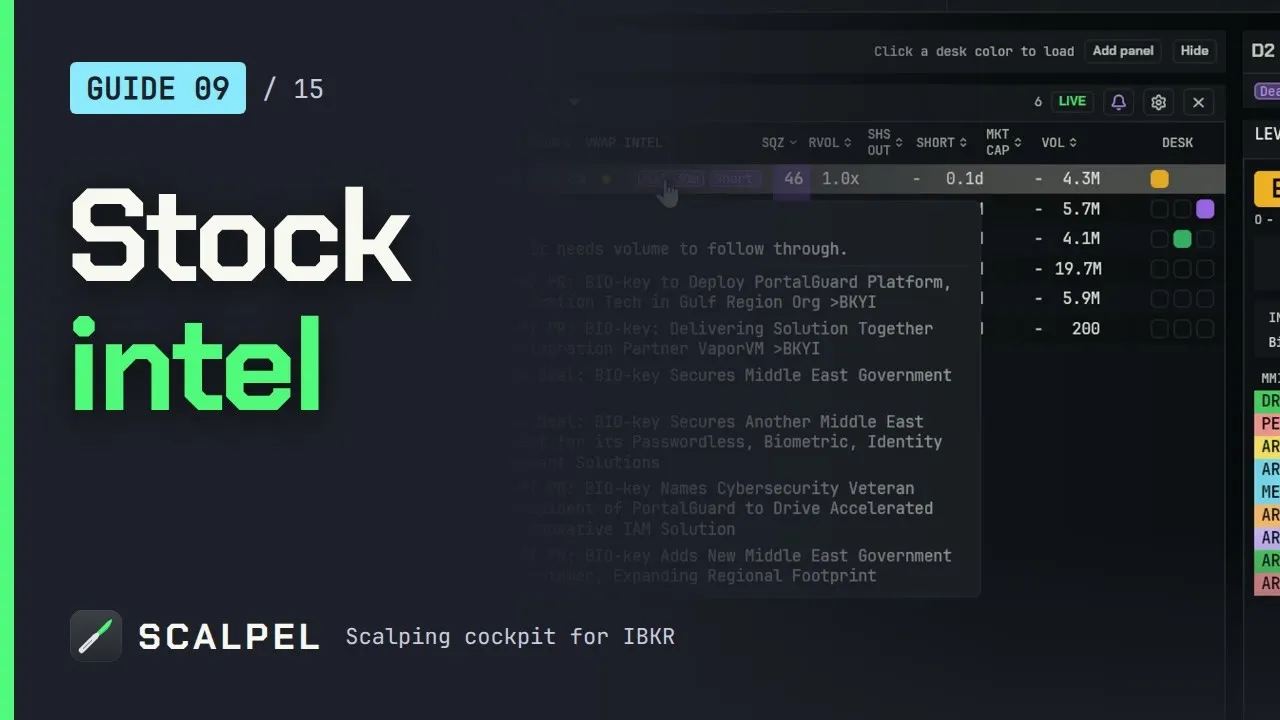
This short video walks through the intel reads, the catalyst and dilution chips included:
Scalpel is long only and never trades for you.
Trading carries a significant risk of loss. Nothing here is financial advice.
Questions
- What happens to my shares in a reverse split?
- You hold fewer shares at a proportionally higher price, so the value is unchanged. In a 1-for-20 split, 200 shares at $0.40 become 10 shares at $8.00. Fractional shares are usually paid in cash or rounded up, depending on the company.
- Why do companies do reverse splits?
- Mostly to lift the share price back above the $1.00 minimum that Nasdaq and NYSE require for continued listing. Some also do it before raising money, because a higher price makes an offering easier to sell.
- Is a reverse split good or bad for a stock?
- On average it has been bad. Desai and Jain (1997) found three-year abnormal returns of -33.90% after reverse split announcements, and later research on over 1,600 firms found the same pattern. Short-term runs still happen because the float shrinks.
- Why do reverse split stocks run?
- The float shrinks by the split ratio, so fewer shares stand between buyers and a higher price, and lendable shares for shorts shrink too. The run often ends when the company sells new stock into it.
- How long does a Nasdaq company have to fix a bid price below $1?
- After 30 business days under $1.00, it gets 180 calendar days, and a Capital Market company may get a second 180 days. It regains compliance with a closing bid of $1.00 or more for at least 10 consecutive business days.
- Can a company reverse split twice?
- Yes, but Nasdaq gives no compliance period to a company that falls below $1.00 within a year of a reverse split, or whose splits total 250 to 1 or more over two years. NYSE has the same rule at 200 to 1.
Related guides
Guide 8.4Shares out, short interest and the squeeze scoreWhy Scalpel shows shares outstanding instead of float, how FINRA short interest and days to cover are dated, and what goes into the 0 to 100 squeeze score.Guide 9.2Check a stock for dilution before you buySpot a company about to sell stock into your move: S-1, S-3 shelves, 424B prospectuses, ATMs, warrants and cash runway, read into one dilution verdict.Guide 9.4Why is it moving? Catalyst gradingHow Scalpel grades each headline by kind and strength, from fluff to explosive, why an offering is never good news, and how news timing compares to EDGAR.
Keep reading
- Low float stocks: what float means and why runners moveLow float stocks explained: what float is, float vs shares outstanding, where to find it free on SEC EDGAR, and why low float runners move so fast.
- Short squeeze explained: short interest, borrow and days to coverShort squeeze explained: how FINRA short interest, days to cover and borrow fees fit together, what the SEC found in GameStop, and why squeezes are rare.
- How to check dilution on SEC EDGAR, step by stepHow to check dilution on SEC EDGAR: the forms that mean a sale (S-3, 424B5, 8-K Item 3.02), full-text searches to save, baby shelf math and cash runway.
Practice in SIM, against the live book.A lifetime license, every update included, with a 7-day refund guarantee.Ask in DiscordGet Scalpel