Partial fills in day trading: why they happen and what to do
By Scalpel Team. , updated . 9 min read.
In short
A partial fill is an order that executes for only part of its size, because there were not enough shares at your limit price or better when it reached the market. The rest of the order keeps working at your limit until it fills, you cancel it, or it expires at the end of the day. For a scalper the right move is usually to decide at once: cancel the rest or let it work on purpose, then set your stop for the shares you actually hold, not the shares you asked for.
You press buy for 1,000 shares of a stock that is moving, and the platform says you own 400. A partial fill is not a broker error and it is not bad luck. It is what a limit order does when the book is thinner than your order, which on a small cap in the pre-market is most of the time.
This post explains why partial fills happen, what they cost on Interactive Brokers, and what to do with the shares that did not fill. It builds on our guide to order types for day trading. Rules and fees checked on October 22, 2026. Scalpel is independent and not affiliated with or endorsed by Interactive Brokers.
What is a partial fill?
A limit order is a promise about price, not about quantity. The SEC's Investor.gov puts it plainly: a buy limit order "can only be executed at the limit price or lower" (Investor.gov: types of orders). Nothing in that sentence says you will get every share. IBKR's own order type lessons carry the same warning: "In general, orders guarantee a fill or guarantee a price, but not both" (IBKR Campus: limit order type).
So when your order arrives, it takes every share offered at or below your limit, and stops. Whatever is left is the unfilled remainder, still live at your limit. That is a partial fill. In IBKR's API the order status reports it as two numbers, filled and remaining (TWS API order status); in TWS you see the order still working with the executed shares in your position.
Why partial fills happen: size at the price
The short answer is that your order was bigger than the size available at your price. Here is what that looks like on a real-shaped book.
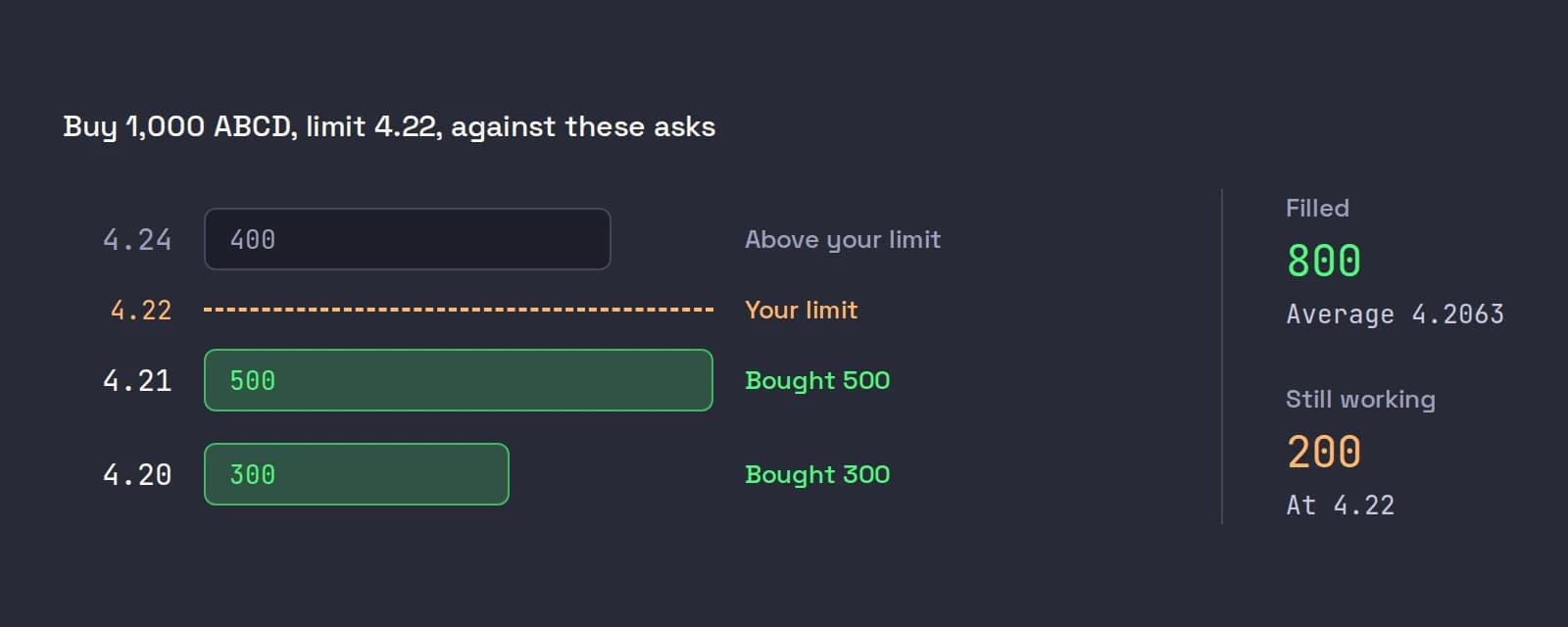
ABCD is moving and its asks read:
| Ask price | Shares offered |
|---|---|
| 4.20 | 300 |
| 4.21 | 500 |
| 4.24 | 400 |
You send a buy for 1,000 shares with a limit of 4.22. The order takes 300 at 4.20 and 500 at 4.21. The next offer is 4.24, above your limit, so it stops there. You own 800 shares at an average of (300 x 4.20 + 500 x 4.21) / 800 = 4.2063, and 200 shares keep working at 4.22.
That is the clean case. In practice, several things shrink the size you can reach:
- Someone got there first. Exchanges fill orders at the same price in time order. If another buyer's order lands a few milliseconds before yours, the 500 at 4.21 may be 200 by the time you arrive.
- The quote moves while your order travels. Sellers pull offers the moment a stock starts to run. The size you saw on Level 2 is a snapshot that can be gone before your order lands.
- Odd lots. For stocks priced at $250 or less a round lot is still 100 shares under the SEC's market data rules (SEC press release 2020-311). Orders smaller than that are odd lots, and you will often get fills like 37 or 63 shares from them. They are real shares; they just make your fills look ragged.
- Hidden and reserve size. Some of the liquidity that fills you was never displayed, and some displayed size refreshes from a hidden reserve. See hidden orders and dark pools for how that changes what the book shows.
- Thin hours. Before 09:30 ET there are far fewer resting orders, so the same 1,000-share order walks further and fills less. The IBKR extended hours post covers the sessions.
A marketable limit priced a few cents above the ask reduces partial fills because it reaches more levels. It cannot remove them: if the offers above the ask run out or vanish, you still get what was there.
What a partial fill costs on IBKR
IBKR Pro charges commission per share with a minimum and a cap per order. On the stock commissions page, Fixed is USD 0.005 a share with a USD 1.00 minimum per order and a maximum of 1% of trade value; Tiered starts at USD 0.0035 a share with a USD 0.35 minimum, plus exchange, clearing and regulatory fees (IBKR stock commissions).
A single order that fills in several pieces during the same day is still one order, so the minimum applies once. Two things turn one order into several for commission purposes, and both are things traders do with partial fills:
- Modifying the order. IBKR treats a modification as a cancel and a new order, and says that on certain exchanges the minimum can apply again. Its own example: a 200-share order fills 100, you modify it, and the other 100 fill. "A commission minimum would be applied to both 100 share orders." On Fixed that is 100 x 0.005 = USD 0.50, raised to the USD 1.00 minimum, twice: USD 2.00 instead of USD 1.00.
- Leaving it overnight. "Orders that persist overnight will be considered a new order for the purposes of determining order minimums," on the same page.
On normal scalping size this is cents, not dollars, and it should never decide a trade. It matters if you habitually chase a partial by nudging the limit up three times in a row on a small order. More on per-share costs in IBKR Tiered vs Fixed and the commissions guide.
Partial fills in day trading: what to do with the rest
You have four choices. Pick one deliberately within a second or two, because the default (doing nothing) is a choice too.
| Choice | When it makes sense | The catch |
|---|---|---|
| Cancel the rest | The move left without you; you will trade what you have | You hold less than planned, so the winner pays less |
| Let it work | You would happily own the full size at that price on a dip | It fills mostly when the stock comes back to you, which is often when the trade is failing |
| Chase it | The move is strong and you still want full size | You pay up, and each modification is a new order for IBKR's minimum |
| Cancel and sell | The partial filled into a spike that is already fading | Two commissions for a small position |
Our verdict for momentum scalps: cancel the rest by default. The unfilled shares only fill if price comes back down to your limit. On a breakout entry, a stock that falls back to your price is a breakout that is not working, so a resting remainder tends to complete your full size at exactly the wrong moment. If you want to add on a pullback, make that a separate, planned entry with its own stop, not a leftover from the first one.
Chasing is the worst habit of the four. Raising the limit three times on the same order buys the shares at the highest prices of the move and, on IBKR, can pay the minimum each time. If you must have size, price the first order further through the ask and accept the cap you set; the marketable limit order post explains how far through is reasonable.
Stops on a partial position
This is where partial fills cost real money. Two rules:
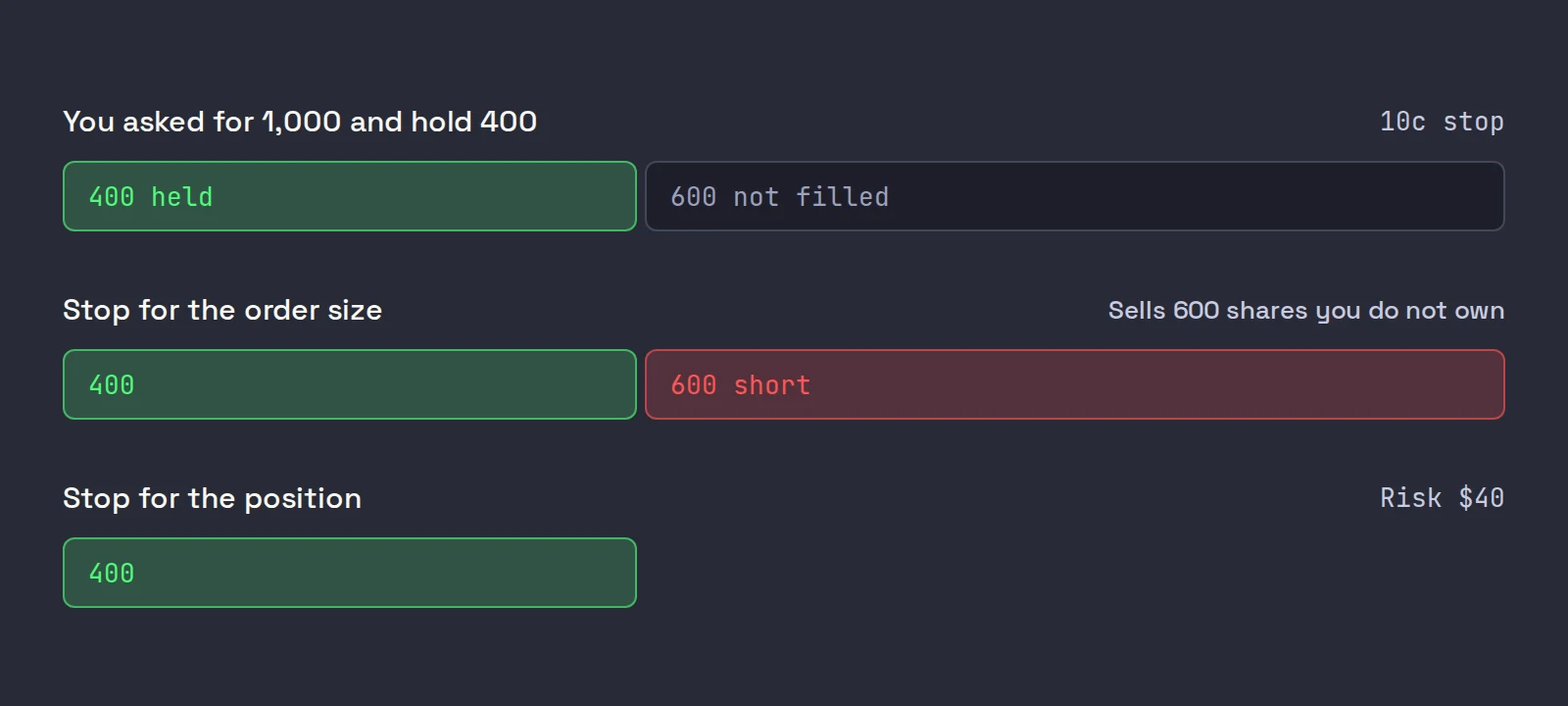
Size the stop to the shares you hold. Planned: 1,000 shares, stop 10 cents under entry, risk USD 100. Filled: 400 shares, so the stop risks USD 40. If the remaining 600 fill later at a lower price, your average falls and the dollar risk to the same stop changes again. Recheck the stop after every fill, not just the first one.
Never let a stop sell more than you own. If you place a sell stop for the order size (1,000) while holding 400, and it triggers, the extra 600 is a short sale in a margin account. At best IBKR holds or rejects it; at worst you are short a squeezing small cap. Match the stop quantity to the position, or use a tool that does it for you.
A related trap: if you cancel the remainder of a buy but forget a resting take-profit for the full planned size, the same overselling problem appears on the way up. Clean up every order tied to a trade when the size changes.
Why not use all or none?
All or none (AON) sounds like the fix: fill everything or nothing. On US stocks it rarely helps a scalper. When IBKR holds an AON order itself because the exchange does not support it natively, it waits until "the NBBO size must be equal to (or greater than) the order size + 1000 shares" (IBKR order types). A 1,500-share AON buy needs 2,500 shares offered at your price before IBKR sends it. On a thin small cap that moment often never comes, and an entry that never fills is worse than a partial one. Take the partial, and manage it.
Seeing partial fills in TWS
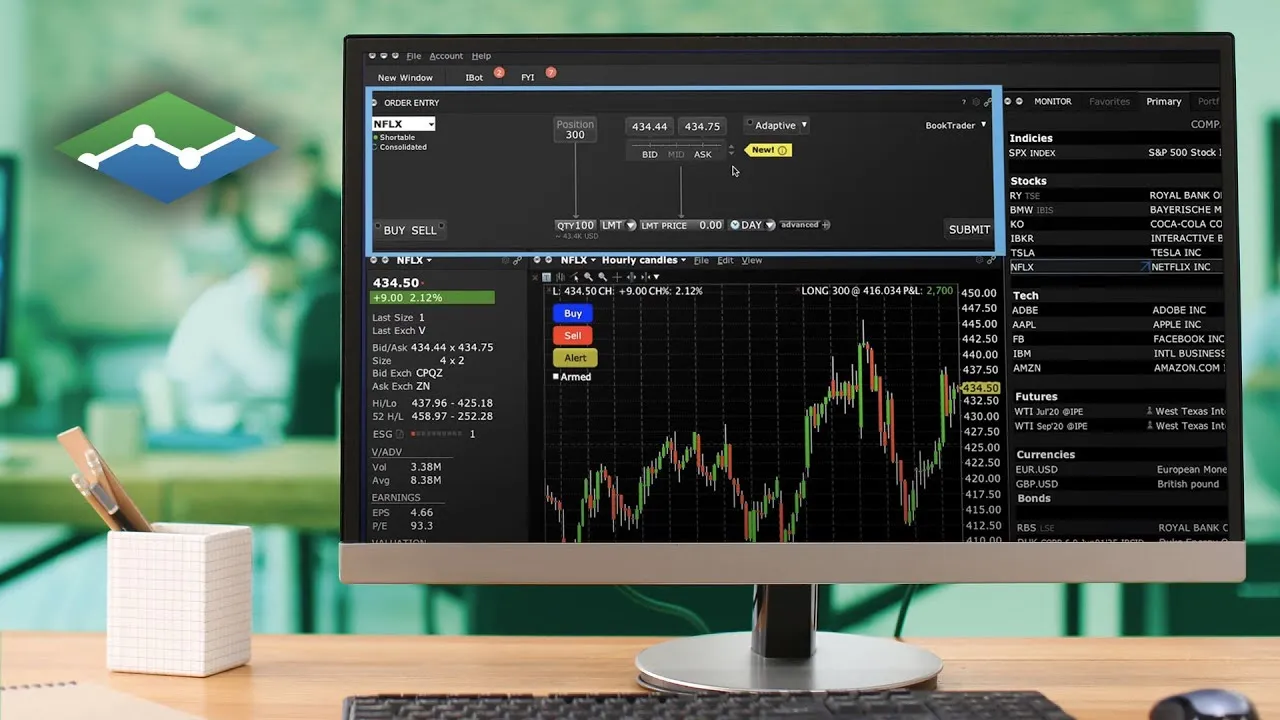
In TWS the working order stays in your orders panel with the executed shares already in your position, and the executions themselves appear in your trades. Before you touch anything, check the filled quantity against your position, then cancel or modify the order line. The limit order lesson below walks through where limit orders sit in Mosaic and how they behave when the market moves away, which is the root of every partial fill:
If an order sits completely unfilled instead, the causes are different (outside regular hours not set, a price that is not marketable); see fix an order that did not fill and, if it was refused outright, why IBKR rejected your order.
Where Scalpel fits
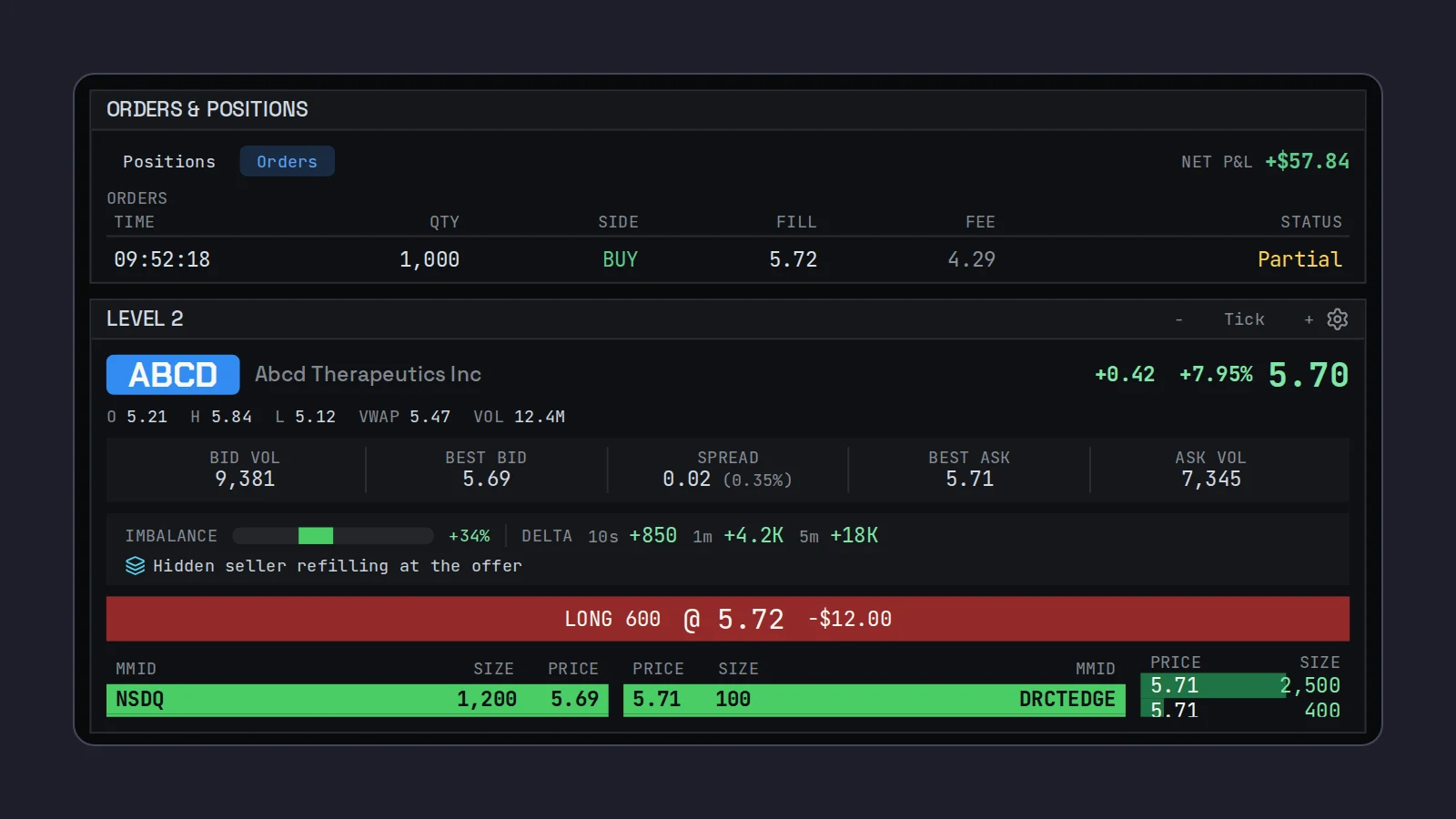
Scalpel is a keyboard-first desktop cockpit for your own IBKR account, connected through TWS or IB Gateway. Every buy is a marketable limit at the ask plus your Buy offset (10 cents by default), and partial fills are handled as part of the order flow (entries and fills):
- The desk's Orders tab shows a working buy as Partial, with the average fill so far.
- Your stop and take-profit arm on the first fill, for the shares you hold. When more shares fill, the levels stay where they are and only your average moves.
- Ctrl+Q (Shift+Q on a Mac) cancels the rest. Sell full, Flatten and Flatten All cancel a working buy on that stock before they sell, so a remainder cannot keep buying after you are out. A LIVE scale-out leaves a working buy alone, so cancel it yourself if you do not want it (scale out and flatten).
- Sells are capped to the shares you hold, so no exit can put you short.
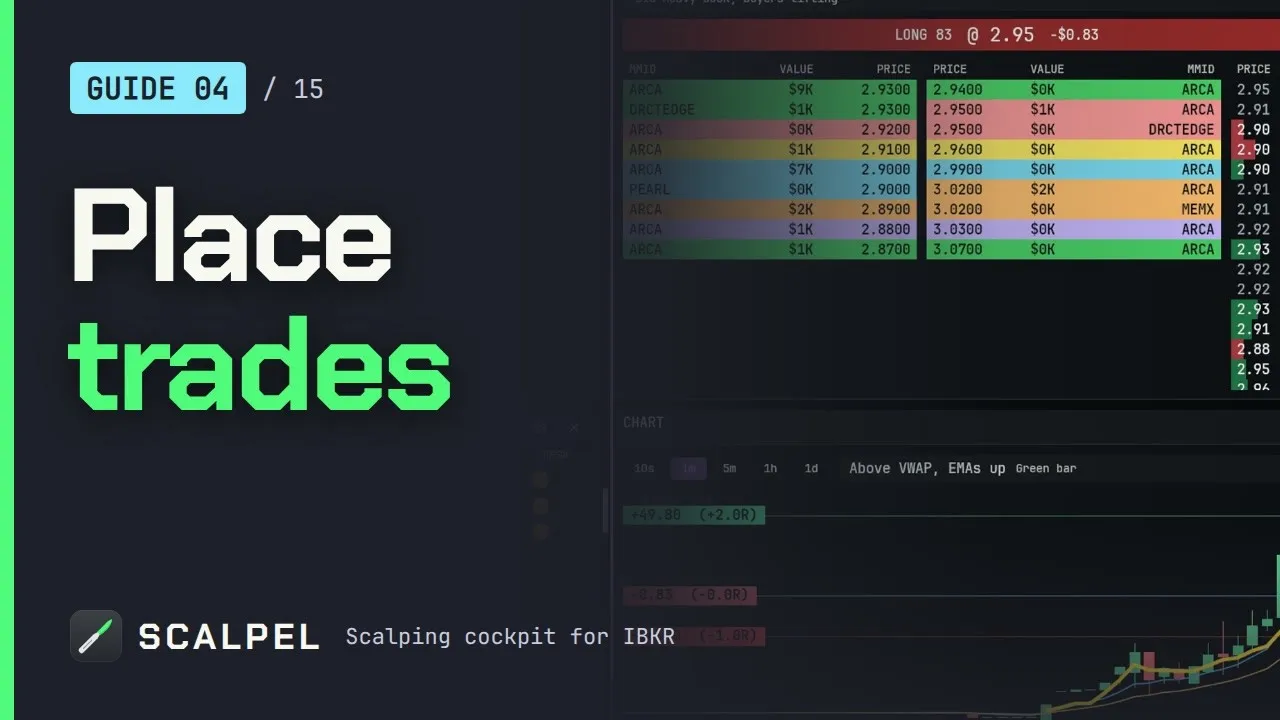
In SIM, a buy fills against the displayed Level 2 book up to your limit and the rest fills from later prints at or under it, so you practise the same decisions with paper money (paper trading SIM). Our section video covers the buy presets, marketable limit entries, scale-outs and flattening:
Where TWS is the better choice: if you want an order to keep working across sessions, or you trade size large enough to need IBKR's algos to work an order over time, TWS gives you those tools and Scalpel does not. Scalpel's stops are app-monitored, not resting orders at IBKR, so they only work while Scalpel runs with a live feed.
Trading carries a significant risk of loss. Nothing here is financial advice.
Questions
- What is a partial fill?
- An order that executes for only part of its size because there were not enough shares at your limit price or better. The rest stays working at your limit until it fills, you cancel it, or it expires.
- Why did my stock order only partially fill?
- Your order was bigger than the size offered at your price when it arrived. Other traders may have taken the offers first, sellers may have pulled them, or the book was simply thin, which is common on small caps before 09:30 ET.
- Do I pay commission twice on a partial fill at Interactive Brokers?
- Not for one order filled in pieces on the same day: IBKR applies the minimum per order. But IBKR treats a modified order as a new one, and an order that persists overnight as a new one, so the minimum can apply again in those cases.
- Should I cancel the rest of a partial fill?
- For a momentum scalp, usually yes. The remainder only fills if price comes back to your limit, which on a breakout is often the moment the trade is failing. Add on a pullback as a separate planned entry instead.
- How do I set a stop after a partial fill?
- Set the stop quantity to the shares you actually hold, not the order size, and recheck it after every new fill. A stop for more shares than you own can turn into a short sale if it triggers.
- Does an all or none order prevent partial fills?
- It prevents them by not filling at all until enough size is available. IBKR's simulated AON on US stocks waits for the NBBO size to reach the order size plus 1,000 shares, which on a thin small cap may never happen.
Related guides
Guide 4.4Entries: marketable limits, offsets and partial fillsHow a Scalpel buy is priced and filled: the marketable limit, the buy offset, partial fills, and why a buy is refused when the market is closed or halted.Guide 13.6An order did not fill, or only part filledWhy a marketable limit can miss or part-fill in a fast book, what happens to the rest in SIM and LIVE, and how to clear a stuck exit or a stop exit.Guide 4.5Scale out and flattenSell half, a quarter or the whole position at the bid, ask or mid, and flatten everything with Esc or Flatten All. What each exit does in SIM and in LIVE.
Keep reading
- Day trading order types: what scalpers actually useDay trading order types: market, limit, marketable limit, stop, stop-limit and time in force, with a worked example and what scalpers really use on IBKR.
- Marketable limit order: the order type scalpers actually useA marketable limit order fills at once like a market order but caps your price. How it fills, how far through the ask to price it, and the TWS setup.
- Market order vs limit order in day trading: the small-cap costMarket order vs limit order in day trading small caps: what slippage costs in R on a thin book, why IBKR holds pre-market market orders, and what to use.
Practice in SIM, against the live book.A lifetime license, every update included, with a 7-day refund guarantee.Ask in DiscordGet Scalpel