Market order vs limit order in day trading: the small-cap cost
By Scalpel Team. , updated . 8 min read.
In short
In day trading small caps, a market order buys certainty of a fill and pays for it in price: on a thin book it walks up through every offer until it is filled, so the slippage lands in your risk before the trade starts. In our worked example a 2,000 share market order on a $2.52 ask filled at 2.5645 and turned a $200 planned risk into $289. A limit order caps the price but can miss; the middle ground most scalpers use is a marketable limit, the ask plus a few cents. At IBKR a market order sent before 09:30 ET does not trade in the pre-market at all: it waits for the open.
Market order vs limit order is the first decision in day trading, and on small caps it is not a matter of taste. A market order on Apple costs you a cent. A market order on a $2.50 gapper with a few hundred shares on each price level can cost you 5 or 10 cents a share, and those cents come straight out of the distance to your stop.
This post puts numbers on that: the same trade sent as a market order, a marketable limit and a limit at the ask, and what each does to your fill, your size and your risk in R. It also covers the IBKR rules that decide whether a market order trades at all. Fees and rules checked on October 22, 2026. Scalpel is independent and not affiliated with or endorsed by Interactive Brokers.
Market order vs limit order in day trading: the definitions
The SEC's investor site puts the trade-off in one line each (Investor.gov: types of orders):
- A market order "guarantees that the order will be executed, but does not guarantee the execution price."
- A limit order "can only be executed at the limit price or lower" for a buy, and at the limit or higher for a sell. It guarantees the price, not the fill.
The middle ground is a marketable limit: a limit priced through the ask, so it fills at once when the shares are there and stops at your cap when they are not. Our overview of day trading order types covers the rest of the family; this post is about the cost of choosing the first one.
What a market order costs on a thin book: worked example
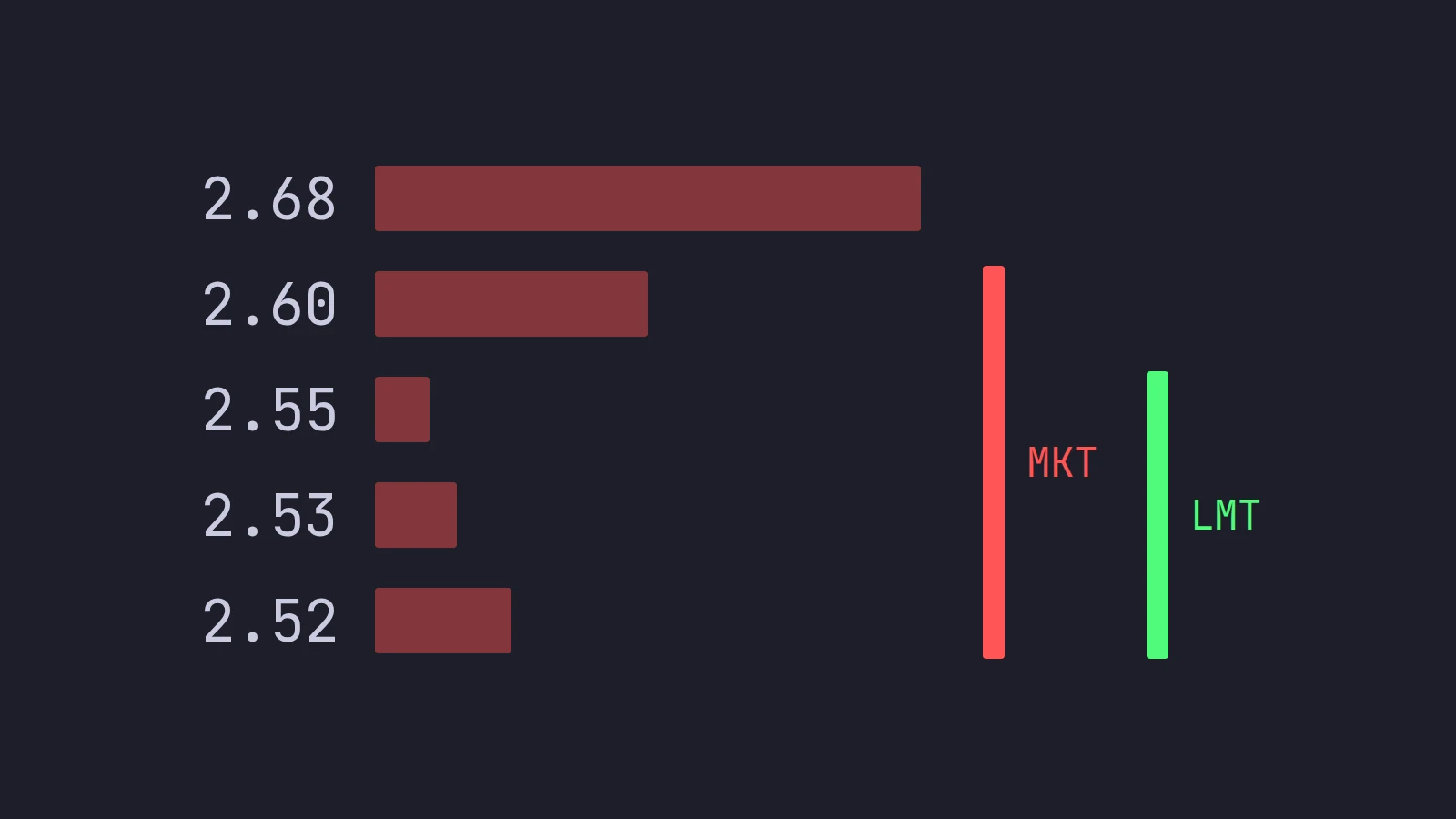
ABCD is a $2.50 small cap breaking out at 10:05 ET. The best bid is 2.50, and the offers are:
| Ask price | Shares offered |
|---|---|
| 2.52 | 500 |
| 2.53 | 300 |
| 2.55 | 200 |
| 2.60 | 1,000 |
| 2.68 | 2,000 |
Your plan: buy at the ask, stop at 2.42, 10 cents of risk. With $200 to risk, that is 2,000 shares. You send a market order for 2,000.
| Level | Shares | Cost |
|---|---|---|
| 2.52 | 500 | $1,260 |
| 2.53 | 300 | $759 |
| 2.55 | 200 | $510 |
| 2.60 | 1,000 | $2,600 |
| Total | 2,000 | $5,129, average 2.5645 |
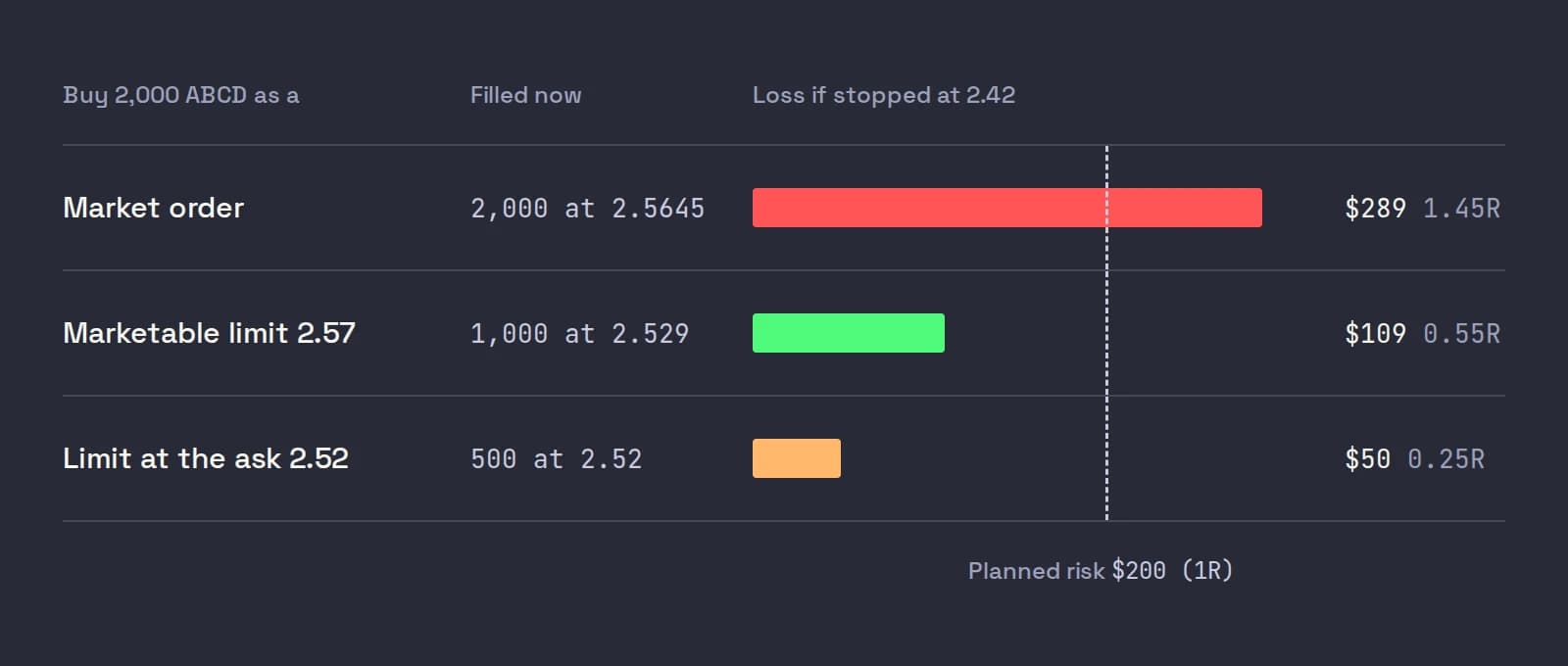
You paid 4.45 cents a share over the ask you saw, $89 on the position. Worse, your risk changed. From 2.5645 to the 2.42 stop is 14.45 cents, so a stop-out now costs about $289, not $200: 1.45R before the stock has moved a cent. That is the real cost of slippage for a scalper. It is not the $89; it is that every trade starts nearly half an R behind the plan.
And this is the polite version, where the book holds still. On a fast tape, the 2.52 to 2.55 offers are often gone by the time your order arrives. Then the market order fills 1,000 at 2.60 and 1,000 at 2.68, an average of 2.64, and the same stop costs $440: 2.2R.
Now the same press as a marketable limit at 2.57, the ask plus 5 cents:
- It takes 500 at 2.52, 300 at 2.53 and 200 at 2.55: 1,000 shares at an average of 2.529.
- The next offer, 2.60, is above the limit, so 1,000 shares rest as a bid at 2.57.
You hold half the size, with 10.9 cents of risk a share: $109 to the stop. If the stock pulls back and the resting 1,000 fill at 2.57, those add 15 cents of risk each, so cancel the rest if the stop math no longer works. Our post on partial fills covers that choice.
And a plain limit at 2.52: it takes the 500 at 2.52, then rests 1,500 at 2.52 while the stock trades 2.60.
Why the slippage is worse on small caps
Three things make the gap between a market order and a limit order wide on small caps and narrow on large ones:
- Thin depth. A few hundred shares a level means a modest order walks several levels. The bid-ask spread is the cost of one level; depth is the cost of the rest.
- Offers that move. On a breakout, sellers cancel and re-price their offers higher in the same instant buyers arrive. A market order fills against what is left after that, not what you saw.
- Speed of your own order. Every step between seeing the ask and the order reaching the exchange, from a confirmation popup to a slow click, gives the book more time to change.
The IBKR lesson on market orders makes the same point in its own words: "if markets are less liquid, this order type could move prices adversely, especially for larger orders." Its traders seem to agree. In IBKR's Rule 606 routing report, market orders were 0.35% of non-directed orders in non-S&P 500 stocks in June 2026; limit orders, marketable or resting, made up nearly all the rest.
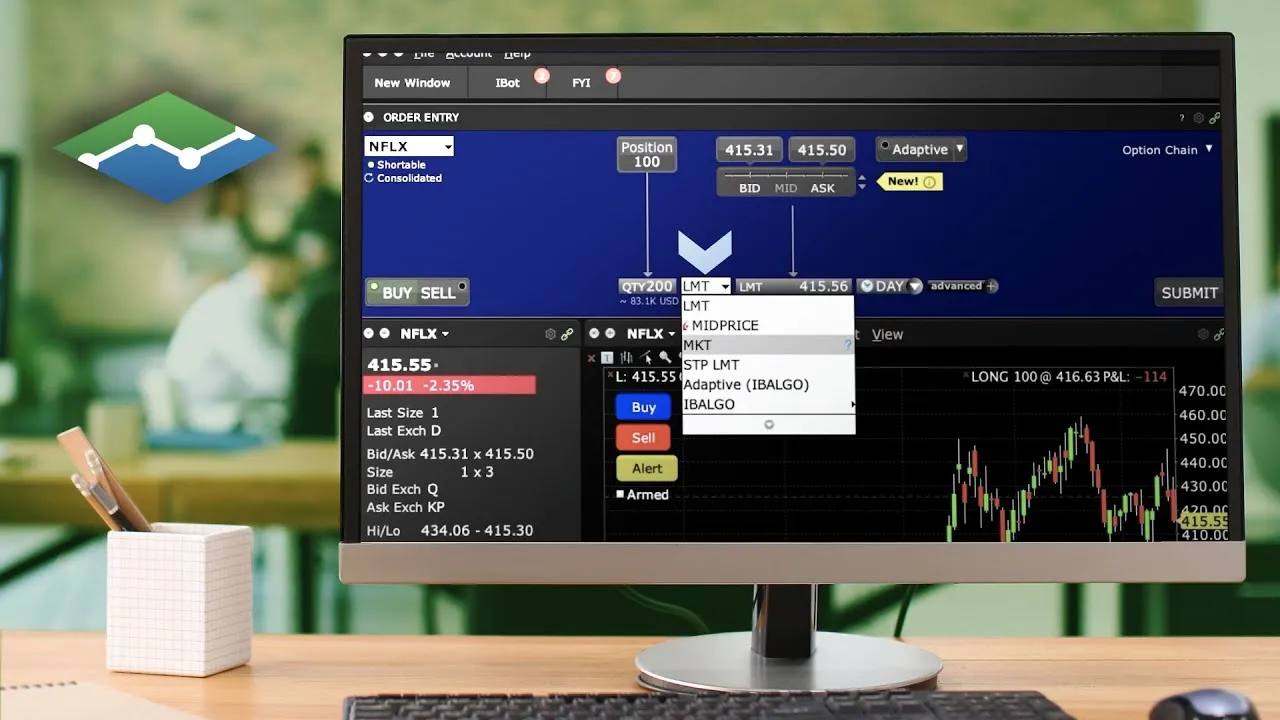
IBKR's own lesson is a short, plain demonstration of a market order in TWS, and it ends with the liquidity warning above:
Market orders before the open and after hours
On a small-cap gapper, much of the action is before 09:30 ET, and that settles the question at IBKR. The exchanges run limit-only sessions outside regular hours, and IBKR's commission page states that "Market orders placed prior to regular trading hours will be treated as Market OnOpen orders" (IBKR commissions).
So a market buy you send at 07:50 does not fill at 07:50. It waits for the 09:30 opening auction and fills at the opening price, whatever that turns out to be. If the stock traded 4.10 when you pressed and opens at 4.65, you bought 13% higher than you meant to, with a stop at 4.00 that is now 65 cents away instead of 10. In the pre-market, the only fast order is a marketable limit with outside RTH set.
Caps, bands and halts: what limits a market order
Market orders at IBKR are not unlimited even in regular hours. Two layers can stop them:
- IBKR's price caps. IBKR says that "the executing broker may set a price ceiling for a buy order or a price floor for a sell order", and that because of it "a trade will be delayed or may not take place" (IBKR: order handling using price capping). It does not publish the percentages, so do not count on a cap to protect you.
- LULD bands. The Limit Up-Limit Down plan stops trades printing outside a band around the average price of the last five minutes during 09:30 to 16:00 ET. For most small caps the band is 10% for a stock that closed above $3 and 20% for one that closed between $0.75 and $3. If the market stays at the band for 15 seconds, the listing exchange calls a five-minute trading pause.
The bands are a backstop against the absurd, not against paying 10 cents too much. Before they existed, the joint SEC and CFTC report on May 6, 2010 counted over 20,000 trades across more than 300 securities that executed 60% or more away from their prices minutes earlier, with market orders and limit orders alike filling against placeholder quotes. On a small cap that halts, a market order can also queue for the reopening auction; what happens then is in our post on LULD trading halts.
Should I use market orders for day trading?
Our answer for small caps is: almost never to enter, and only as an emergency tool to exit. When a market order is reasonable:
- the stock is liquid and in regular hours,
- your size is small next to the shares shown on the first two or three levels,
- getting the fill matters more than the last few cents, which is usually an exit, not an entry.
Even then, a marketable limit priced well through the bid, 1% or more on a sell, does the same job with a floor. It sweeps the bids that are there and stops at a price you chose. The one thing it cannot do is fill when there are no bids at all, and neither, usefully, can a market order.
The exit side has the same trade-off in stop form: a stop that becomes a market order versus one that becomes a limit. That is a separate post, stop-limit vs stop-market.
How to compare your own fills
You do not have to take our numbers on trust. For two weeks, write down for every entry the ask when you pressed, your average fill, and your stop distance. Divide the difference by the stop distance and you have your slippage in R. If your market orders average more than about a tenth of an R, they are costing you a meaningful slice of your edge. The full method, with a log template, is in slippage in day trading, and the commission side of the same trades is in our commissions guide.
If you switch to limits and orders start to sit unfilled, the usual causes, from no offset to no outside RTH flag, are in fix an order that did not fill.
Where Scalpel fits
Scalpel does not send market orders. Every LIVE order is a limit order through IBKR SmartRouting from your own account:
- Buys are marketable limits at the ask plus your Buy offset, 10 cents by default, and any remainder works as a partial (entries and fills).
- Sells go out at the bid minus your Sell offset; Flatten All (Esc) sends a limit 1% under the bid for every position, so one press clears the book down to that floor (scale out and flatten).
- Stop exits are limits 5 cents under the last trade, re-priced if the market runs away from them, so they work in the pre-market too.
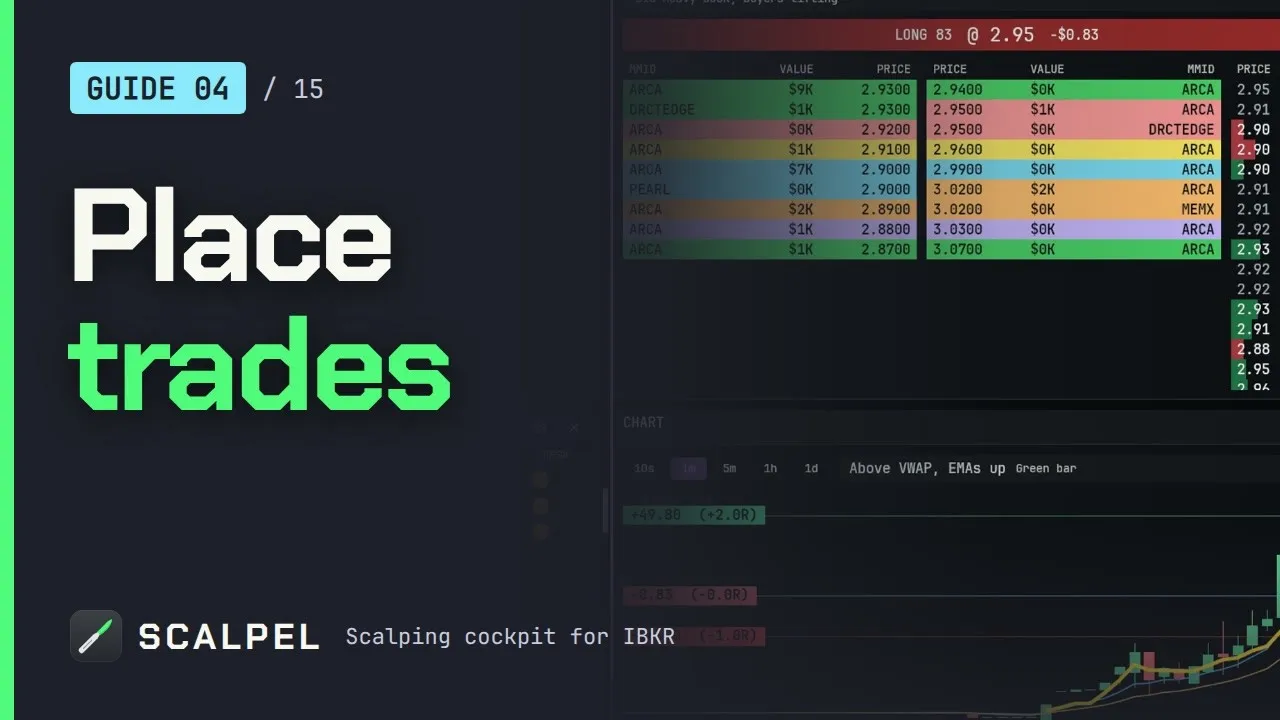
Our section video shows these orders on the keys:
The trade-off is the same one this post describes: a limit can leave you with fewer shares than you wanted, or with an exit still working in a collapsing book. Scalpel's stops are held by the app, not at the broker, so they only work while it runs with a live feed. In SIM, SIM slippage (c) in Settings > Risk lets you make paper fills a cent or two worse to keep practice honest.
Trading carries a significant risk of loss. Nothing here is financial advice.
Questions
- Should I use market orders for day trading small caps?
- Rarely. On a thin book a market order fills through several price levels, so the slippage widens your risk before the trade starts. A marketable limit, the ask plus a few cents, fills almost as fast with a cap on the price.
- How much slippage does a market order cost?
- It depends on the depth. In our example, 2,000 shares against a book with 500 at the ask filled 4.45 cents a share over the ask, which turned a 10 cent stop into a 14.45 cent one, about 1.45R of risk.
- Can I use market orders in the pre-market on IBKR?
- Not to trade in the pre-market. IBKR treats market orders placed before regular trading hours as market-on-open orders, so they wait for the 09:30 ET opening auction. Use a limit order with outside RTH set.
- Is a limit order or a market order better for day trading?
- For entries and most exits on small caps, a limit priced through the market, called a marketable limit. A plain limit at or under the ask often misses a moving stock, and a market order can fill far above the ask.
- Do market orders get price protection at IBKR?
- IBKR says it may cap the price of an order, which can delay or prevent a trade, and LULD bands stop trades far from the recent price in regular hours. Neither is designed to save you a few cents of slippage.
Related guides
Guide 4.4Entries: marketable limits, offsets and partial fillsHow a Scalpel buy is priced and filled: the marketable limit, the buy offset, partial fills, and why a buy is refused when the market is closed or halted.Guide 13.6An order did not fill, or only part filledWhy a marketable limit can miss or part-fill in a fast book, what happens to the rest in SIM and LIVE, and how to clear a stuck exit or a stop exit.Guide 6.3Commissions: pick your IBKR planMatch Scalpel's SIM fees to your Interactive Brokers plan: Pro Tiered, Pro Fixed, Lite or custom, plus exchange and clearing fees, and the FEE column.
Keep reading
- Day trading order types: what scalpers actually useDay trading order types: market, limit, marketable limit, stop, stop-limit and time in force, with a worked example and what scalpers really use on IBKR.
- Marketable limit order: the order type scalpers actually useA marketable limit order fills at once like a market order but caps your price. How it fills, how far through the ask to price it, and the TWS setup.
- IBKR SmartRouting vs direct routing for day tradersDoes IBKR give direct market access? How SmartRouting picks venues, why fills differ by venue, what direct routing costs and when day traders should use it.
Practice in SIM, against the live book.A lifetime license, every update included, with a 7-day refund guarantee.Ask in DiscordGet Scalpel