News catalysts for day trading: which headlines move small caps
By Scalpel Team. , updated . 8 min read.
In short
A catalyst is news that gives traders a reason to buy or sell a stock today. For small caps, the headlines that move them most are FDA decisions, clinical trial data, buyouts, contracts that are large next to the company's size, and surprise earnings. Conference appearances and recycled press releases rarely hold a move, and an offering is the company selling stock into it. For catalyst day trading, check three things fast: is the news new, is it material for a company this small, and does it raise money.
"Why is it moving?" is the first question on any runner, and the answer decides more than the chart does. A $25 million company announcing FDA approval can trade all day. The same company announcing that its CEO will present at a conference usually cannot hold a gap past 09:45 ET. This guide covers what a stock catalyst is, which news types move small caps, how to read the matching SEC filing, the red flags, and a 30-second way to grade a headline.
Scalpel is independent and not affiliated with or endorsed by Interactive Brokers.
What is a catalyst in stocks?
A catalyst is an event that changes what traders think a stock is worth, or at least gives them a reason to act today. For long-term investors, a catalyst might be a product cycle over two years. For a momentum day trader, it is a headline in the last few hours that brings in a crowd of buyers now.
That crowd is the point. Brad Barber and Terrance Odean showed that individual investors are net buyers of attention-grabbing stocks, and the first thing on their list is stocks in the news (Review of Financial Studies, 2008). The news is what puts a stock on the scanners, the chat rooms and the top gainers lists. Whether the move holds depends on whether the news is real.
The evidence on moves without news is not encouraging. Wesley Chan compared stocks with big price moves and public news against stocks with similar moves and no news, and found reversal after extreme moves that came without public news, mainly in smaller, more illiquid stocks (Journal of Financial Economics, 2003). His study measured returns over the following months, not minutes, so treat it as a tendency rather than a trading rule. It still matches what momentum traders see: a runner with no headline tends to give it all back.
News catalysts that move small caps
Not all news is equal, and the same headline means different things for a $20 million company and a $20 billion one. Judge every catalyst against the company's size.
| Strength | Catalyst types | Why |
|---|---|---|
| Strong | FDA approval, positive pivotal trial data, a buyout or merger at a premium, a contract bigger than the company's market value | Company-changing news. New buyers have a real reason to stay |
| Moderate | Solid earnings or guidance, a meaningful contract, a partnership with a known name, trial progress | Real but ordinary. Needs heavy volume to follow through |
| Weak | Conference presentations, letters to shareholders, a small purchase order, a rebranding | Little new information. The move is mostly momentum |
| Hype | A pivot into a hot theme: AI, crypto treasuries, drones, nuclear, quantum | Can move a stock violently, often without substance behind it |
| Red flag | An offering, a reverse split, a delisting notice | The company is raising money or in trouble. Usually bad for longs |
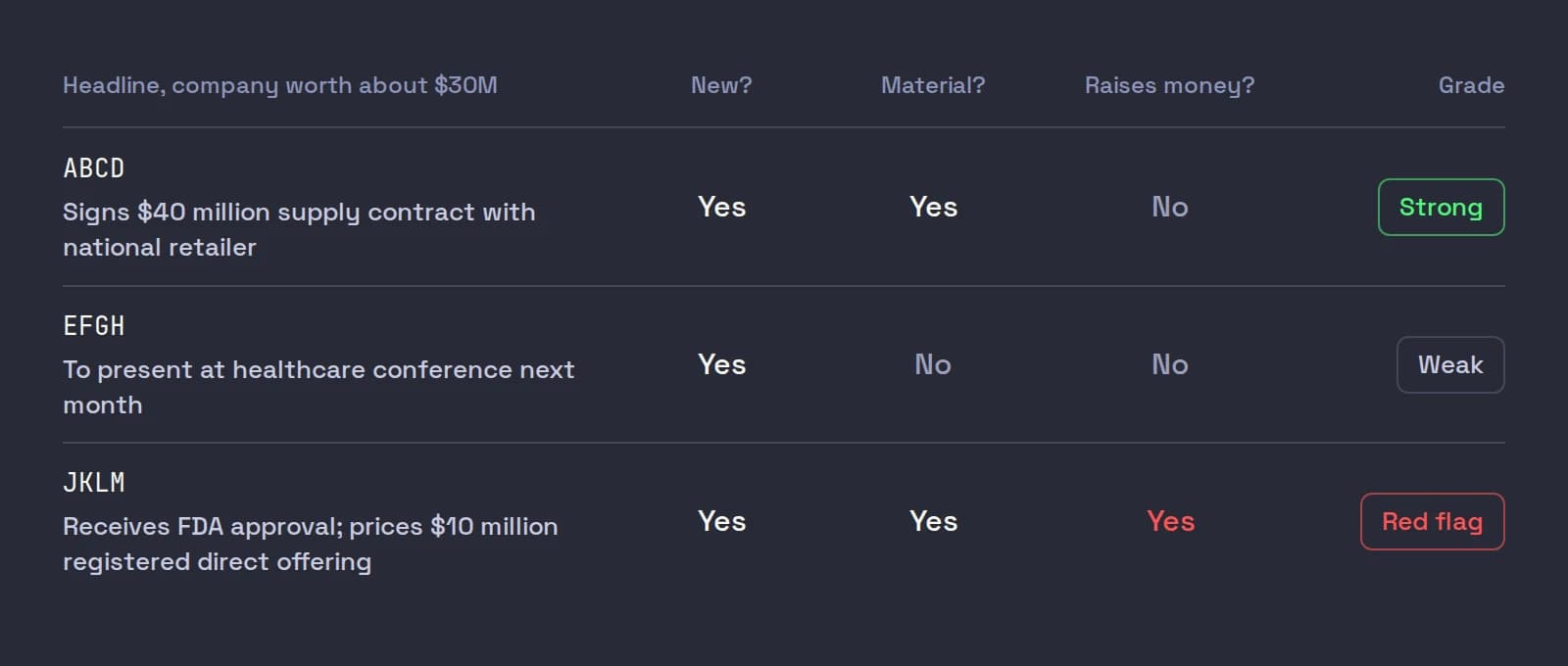
A worked example with fictional companies, each worth about $30 million:
- ABCD announces a $40 million supply contract with a national retailer. The contract is bigger than the company. Strong.
- EFGH announces that it will present at a healthcare conference next month. Nothing has changed. Weak.
- JKLM announces FDA approval, and in the same release prices a $10 million registered direct offering. It is offering news first. The buyers of the spike are buying stock the company is selling.
FDA catalysts: the scheduled ones
Biotech news is the classic small-cap catalyst, and some of it is on a calendar. The FDA's goal under the prescription drug user fee program is to act on a priority review application within 6 months, compared to 10 months under standard review. Companies usually announce the target date (often called the PDUFA date), so traders know roughly when a decision is due.
A known date cuts both ways. The run-up into it is often traded by many people, and an approval can be largely priced in by the time it arrives. A rejection, known as a complete response letter, can halve a stock in the pre-market. Treat scheduled binary events as a coin you cannot see, not a setup.
Reading the 8-K on SEC EDGAR
Material news from a US-listed company usually comes with a filing. Form 8-K is the "current report", and companies generally have four business days to file it after a triggering event. The press release usually hits the wires first; the 8-K follows minutes or days later. When it arrives, the item numbers tell you what kind of news it is. These are the SEC's own item titles:
| 8-K item | Title | What it usually means for a trader |
|---|---|---|
| 1.01 | Entry into a Material Definitive Agreement | A contract, licence or deal. Also used for financing agreements, so read it |
| 2.02 | Results of Operations and Financial Condition | Earnings |
| 3.01 | Notice of Delisting or Failure to Satisfy a Continued Listing Rule or Standard | A listing problem. Often followed by a reverse split |
| 3.02 | Unregistered Sales of Equity Securities | The company sold stock privately. Dilution |
| 5.03 | Amendments to Articles of Incorporation or Bylaws; Change in Fiscal Year | Often how a reverse split is filed |
| 7.01 | Regulation FD Disclosure | A press release or presentation furnished to the SEC |
| 8.01 | Other Events | Anything else the company chooses to report |
The quickest check of a hot headline is to open the company on SEC EDGAR and read the newest filings. An 8-K with Item 1.01 plus a securities purchase agreement as an exhibit is a financing, whatever the press release calls it. A 424B prospectus filed overnight is an offering priced into the morning's gap. How to check a stock for dilution on SEC EDGAR walks through the filings in order.
Catalyst red flags
An offering. Registered directs, at-the-market programs, warrants and convertible notes all mean new shares coming to market. A company that just ran 80% on news has every reason to sell stock into that price. At-the-market offerings explains how an ATM can cap a runner for days.
Stale news. Paul Tetlock found that individual investors trade more aggressively on stale news, stories that repeat earlier ones, and that the price move on such days reverses in the following week, more so in stocks with heavy individual trading (Review of Financial Studies, 2011). A "new" press release that restates last month's contract is stale news.
No news at all. A low-float stock up 150% with no headline and no filing is the pattern FINRA described in its notice on suspected ramp-and-dump schemes in small-cap listings: price increases that did not appear to be driven by news, followed by a quick decline to the offering price or below (Regulatory Notice 22-25, November 17, 2022). The IPOs in question typically raised less than $25 million and issued fewer than 20 million shares.
Promotion. The SEC describes pump and dump schemes as false or misleading information spread to create a buying frenzy, through social media, newsletters, chat rooms and ads, and notes that microcap companies are particularly vulnerable. If you heard about the stock in a group chat before you saw the headline, ask why.
How to grade a catalyst in 30 seconds
- Is it new? Check the timestamp. News from 07:02 ET is fresh at 07:30; news from yesterday at 16:05 has been traded overnight.
- Is it material for a company this size? Compare dollar figures with the market value. A $5 million order matters to a $15 million company and not to a $2 billion one.
- Does it raise money? Any mention of an offering, warrants, a purchase agreement or a shelf makes it a red flag, whatever else it says.
- Is there a filing? A real contract or approval usually has an 8-K or a regulator's notice behind it. A press release alone, with vague numbers, is weaker.
- Is the volume agreeing? Real news brings real volume. Check relative volume: a strong headline on 50,000 shares has not been noticed yet, or has not been believed.
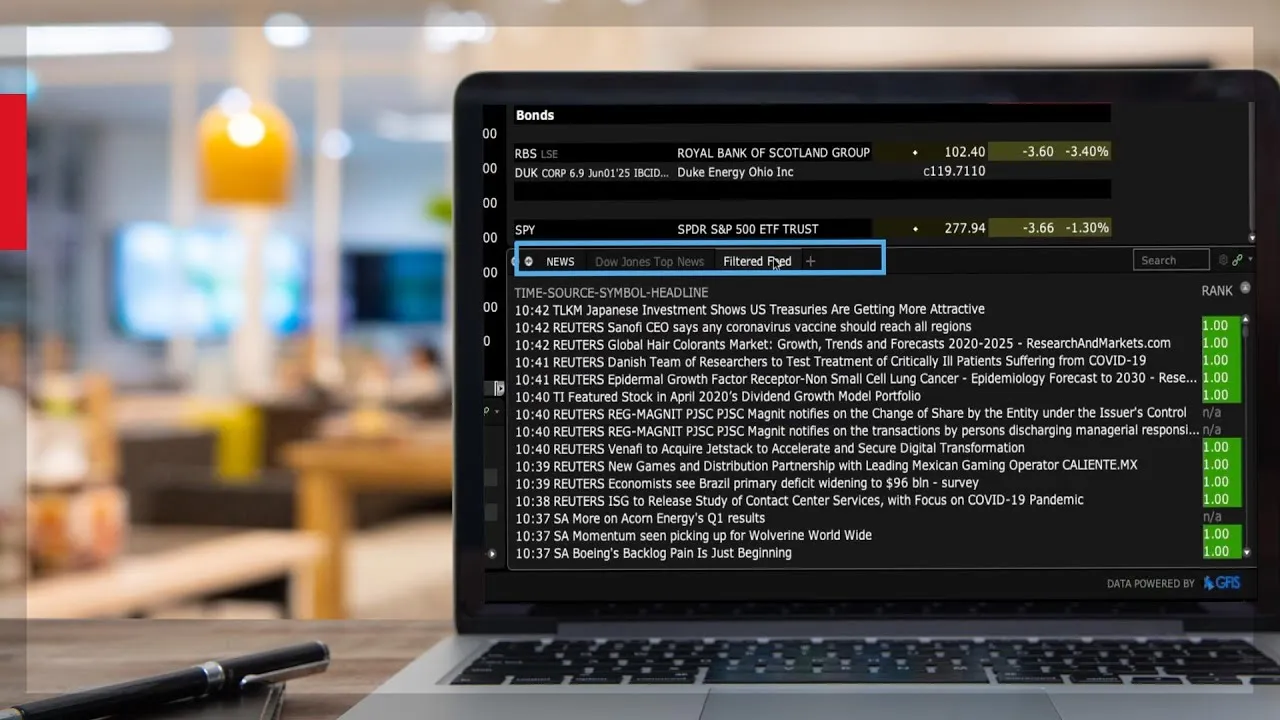
On IBKR, the headlines come through your account's news providers. IBKR's lesson on the TWS news panel shows where the providers are and how to set up the feeds, which is worth four minutes before you rely on it:
The catalyst check is one step of the morning routine in how to find pre-market gappers, and the news is the first of the five ingredients in momentum day trading. If you trade the open on news, gap and go covers the most common entry.
Where Scalpel fits
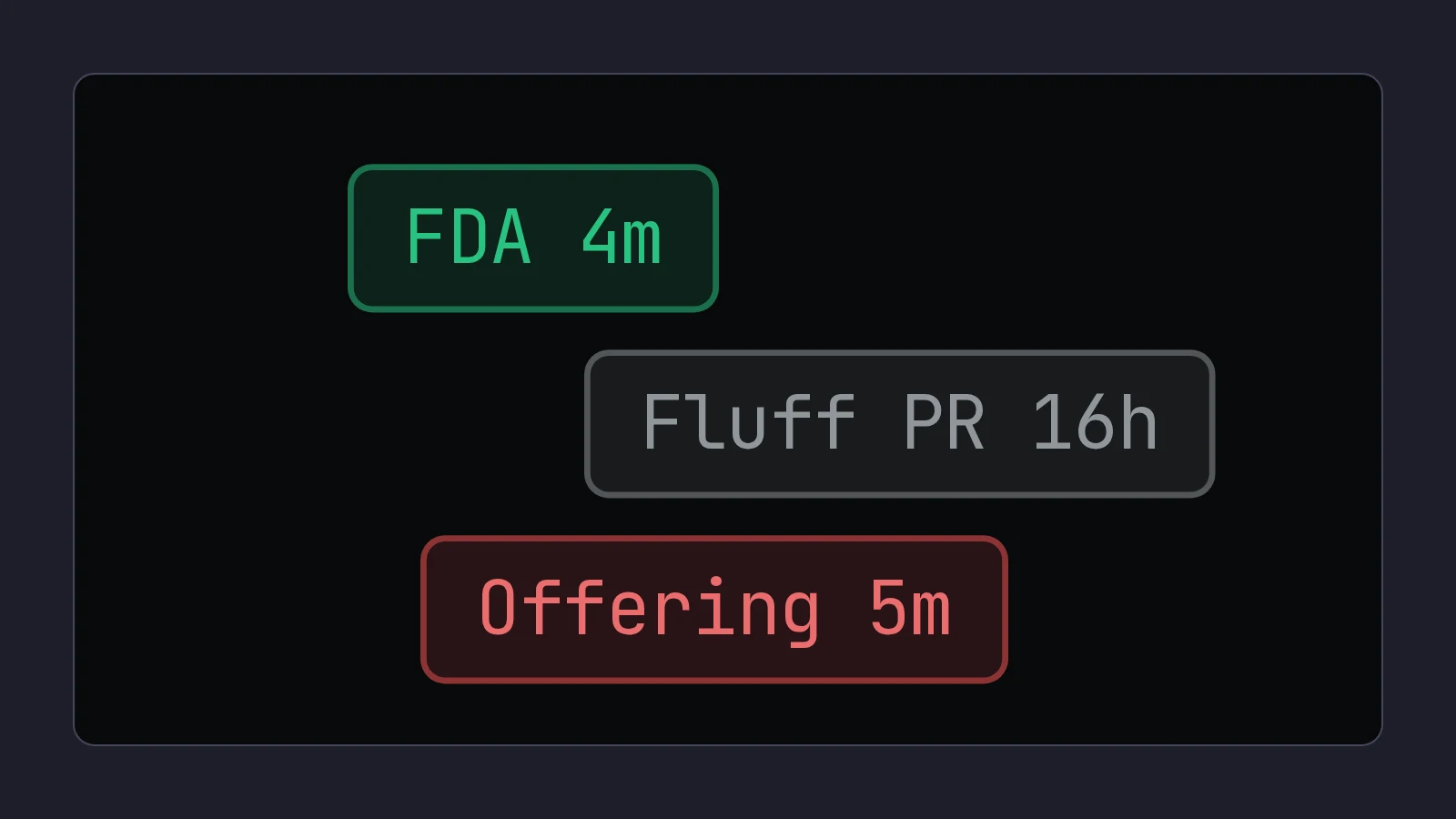
Scalpel grades every headline from the news providers on your IBKR account by kind (FDA, trial data, deal, earnings, M&A, hype, offering and more) and strength, from None to Explosive. The strongest recent one becomes a chip on the scan row and the desk, such as FDA 4m or Deal 2h: the kind and the age. An offering is always red and never graded as good news, even when the same release announces an approval (catalyst grading).
Beside the catalyst sit the dilution chips, read from SEC EDGAR: Selling, Dilution and Can dilute say whether the company can sell stock into your move (intel chips). The dilution entry guard holds back your first buy press for 30 minutes after a financing filing or offering headline, so a buy needs a second press (dilution entry guard). There is no paid news feed: the headlines are the ones your IBKR account already has, and a keyword grader works without any extra key (set up intel).
Our intel video shows the chips on a live desk:
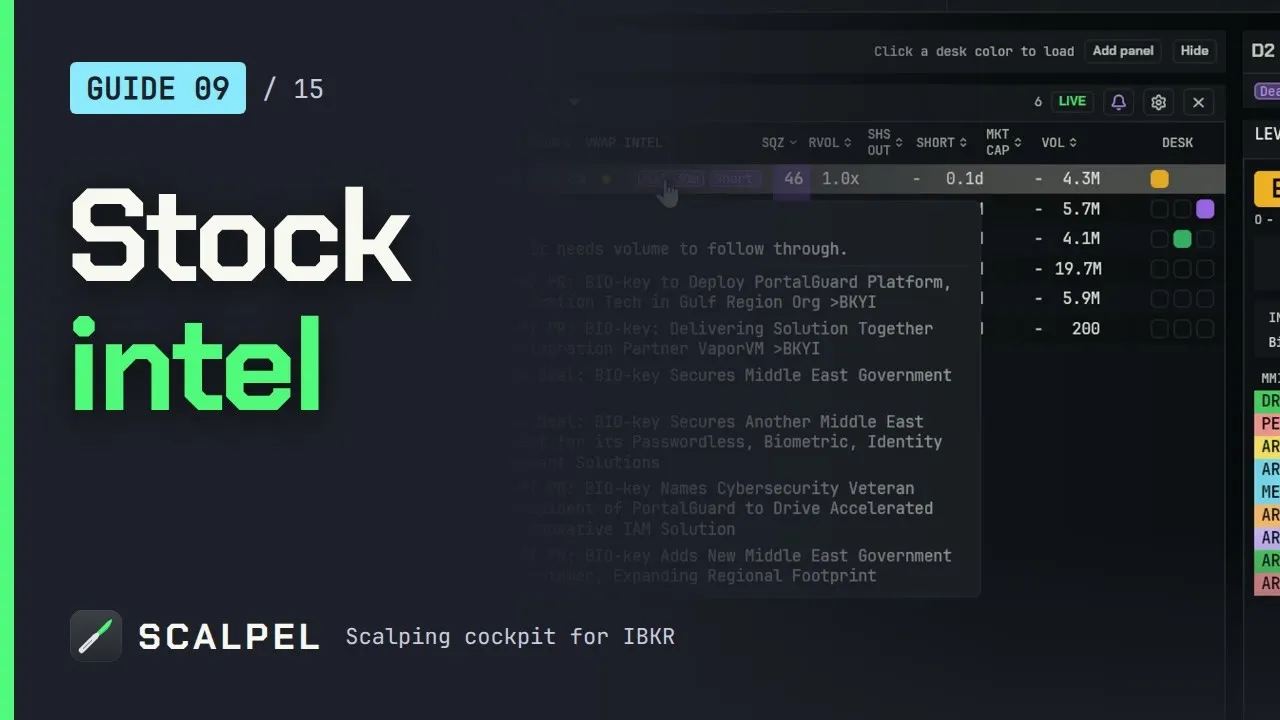
Paid news terminals will be ahead of IBKR's providers on some headlines. If shaving seconds off the news is your edge, a dedicated news service is the better tool; Scalpel's job is to put the read beside the order book, graded the same way every time.
Trading carries a significant risk of loss. Nothing here is financial advice. SEC, FDA and FINRA details checked on October 22, 2026.
Questions
- What is a catalyst in stocks?
- An event or headline that gives traders a reason to buy or sell a stock now, such as FDA news, trial data, earnings, a contract or a buyout. For day traders it usually means news from the last few hours.
- What are the best catalysts for day trading small caps?
- The strongest are FDA approvals, positive pivotal trial data, buyouts at a premium and contracts that are large next to the company's market value. Judge every headline against the company's size.
- Is an offering a bullish catalyst?
- Almost never for a day trader. An offering means the company is selling new shares, often to the people buying the spike, and it tends to cap the price. Treat it as a red flag even when the same release has good news.
- How fast does a company have to file an 8-K?
- Generally within four business days of the event that triggers it. The press release usually comes out first, so the filing can lag the headline by minutes or days.
- Why do stocks with no news fade?
- Without a reason to own the stock, buyers leave once the move stalls. Research on monthly returns found extreme price moves without public news tended to reverse, mainly in smaller, illiquid stocks.
Related guides
Guide 9.4Why is it moving? Catalyst gradingHow Scalpel grades each headline by kind and strength, from fluff to explosive, why an offering is never good news, and how news timing compares to EDGAR.Guide 9.1Turn on intelSet the SEC contact email and an optional OpenAI key so Scalpel reads filings, dilution, shares outstanding and news. What each source needs and costs.Guide 9.5Every intel chip, explainedEach intel chip on Scalpel's scan rows and desk strips, from Selling and Warrants near to FDA, Can't short and Short fee: what it means for a long trade.
Keep reading
- Momentum day trading: how small-cap momentum worksMomentum day trading explained: what makes small caps move, the shape of the day, entries, exits and risk, and what the research says about the odds.
- Momentum trading on Interactive Brokers: scanner setup for gappersInteractive Brokers momentum trading starts with the scanner: TWS settings for pre-market gappers, which scans to run, and how to live without a float filter.
- Small-cap momentum trading on Interactive Brokers: what you needSmall-cap momentum trading on Interactive Brokers: what the Warrior Trading review says, and how to get scanning, hotkeys, fixed risk and pre-market stops.
Practice in SIM, against the live book.A lifetime license, every update included, with a 7-day refund guarantee.Ask in DiscordGet Scalpel