The bid-ask spread on small caps: the cost you pay twice
By Scalpel Team. , updated . 9 min read.
In short
The bid-ask spread is the gap between the highest price a buyer is bidding and the lowest price a seller is asking. If you buy at the ask and sell at the bid, you pay the whole spread on every round trip: half on the way in and half on the way out, measured from the midpoint. On a small cap that cost is large: a 5 cent spread on a $2.45 stock is about 2% of the price before commissions, and about five times IBKR Pro's Fixed commission on the same trade. Measure the spread against your stop before you buy, and expect it to be widest in the pre-market.
The bid-ask spread is the one trading cost that never shows up on a statement. Commissions and fees are itemized; the spread is baked into your fill price, so most new day traders never add it up. On large caps that is fine, because the spread is usually a penny on a stock worth hundreds of dollars. On the $2 to $10 small caps that momentum traders scalp, it is often the biggest cost of the trade.
This post shows how to put a number on it: in cents, as a percent of the price, and in R against your stop. Rules and prices were checked on October 22, 2026.
What the bid-ask spread is
Every stock has two prices at any moment. The bid is the highest price someone is willing to pay right now. The ask (or offer) is the lowest price someone is willing to sell at. Together they are the inside bid and ask, and the spread is the difference between them.
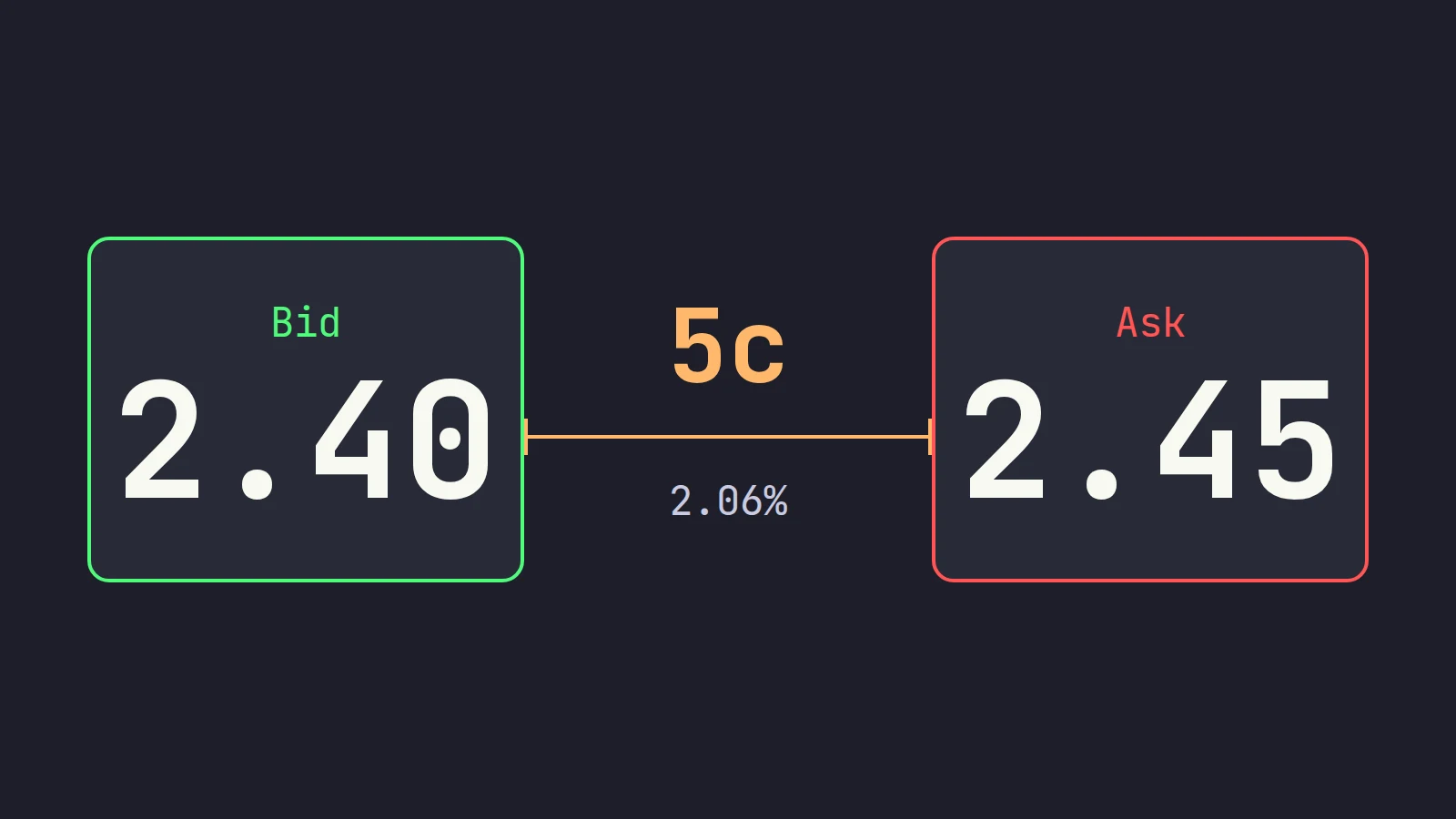
Take a fictional small cap, ABCD, quoted 2.40 bid and 2.45 ask:
- The spread is 2.45 - 2.40 = 5 cents.
- The midpoint, the fair middle of the market, is 2.425.
- As a percent of the midpoint, the spread is 0.05 / 2.425 = 2.06%.
Whoever is quoting sets the spread. In a busy large cap, many market makers, funds and algorithms compete for the best bid and offer, which squeezes the spread to the minimum tick. In a thin small cap only a handful of orders sit near the inside, so the gap stays wide. You can see exactly who is quoting where on Level 2; the pillar post on how to read Level 2 covers the whole book, and market maker IDs on Level 2 covers the labels on each row.
Why you pay the spread twice
Buy ABCD with a marketable order and you pay the ask: 2.45. That is 2.5 cents above the midpoint. The moment you own it, your position is worth what you could sell it for, which is the bid: 2.40. You are down 5 cents a share before the stock has moved at all.
To get out at breakeven, the bid has to climb to 2.45. If the spread stays 5 cents wide, that means the whole market, midpoint and all, must rise a full 5 cents just for you to scratch. Then when you do sell at the bid, you give up another 2.5 cents against the midpoint on the way out.
That is the sense in which you pay it twice: half the spread to get in, half to get out. Measured from the fair price, a round trip that crosses the spread both ways costs you the full spread every time, win or lose. Over 1,000 shares of ABCD, that is $50 per round trip.
The spread as a percent of price
A spread in cents means nothing until you divide it by the price. A penny on a $20 stock is a rounding error. A penny on a $1 stock is a full percent. Here is the spread as a rough percent of the share price:
| Share price | 1 cent spread | 5 cent spread | 10 cent spread |
|---|---|---|---|
| $1 | 1.00% | 5.00% | 10.00% |
| $2 | 0.50% | 2.50% | 5.00% |
| $5 | 0.20% | 1.00% | 2.00% |
| $10 | 0.10% | 0.50% | 1.00% |
| $20 | 0.05% | 0.25% | 0.50% |
The formula is (ask - bid) divided by the midpoint. Low-priced stocks get hit twice: wider spreads in cents, and each cent a bigger share of the price.
There is a floor. Under Regulation NMS Rule 612, stocks priced at $1.00 or more are quoted in whole cents, so the tightest possible spread is 1 cent. Under $1.00, quotes can go down to $0.0001 increments, which is why a sub-dollar stock can be quoted 0.4500 by 0.4520. The SEC amended Rule 612 in 2024 to allow a half-penny ($0.005) tick for stocks whose time-weighted average quoted spread is $0.015 or less, but on June 11, 2026 it extended the relief from that change to the first business day of November 2027. The half-penny tick is aimed at stocks that already trade a penny wide, so it would not narrow the small-cap spreads this post is about anyway.
Bid-ask spread in day trading: the cost in R
The most useful way to measure the spread is against your stop, in R, where 1R is what you lose if your stop is hit.
Say you buy ABCD at the 2.45 ask with a stop 10 cents lower at 2.35. Your risk is 10 cents a share, so 1R = 10 cents. The 5 cent spread is 0.5R. Half your risk budget is gone the moment you are filled, because you are marked at the bid.
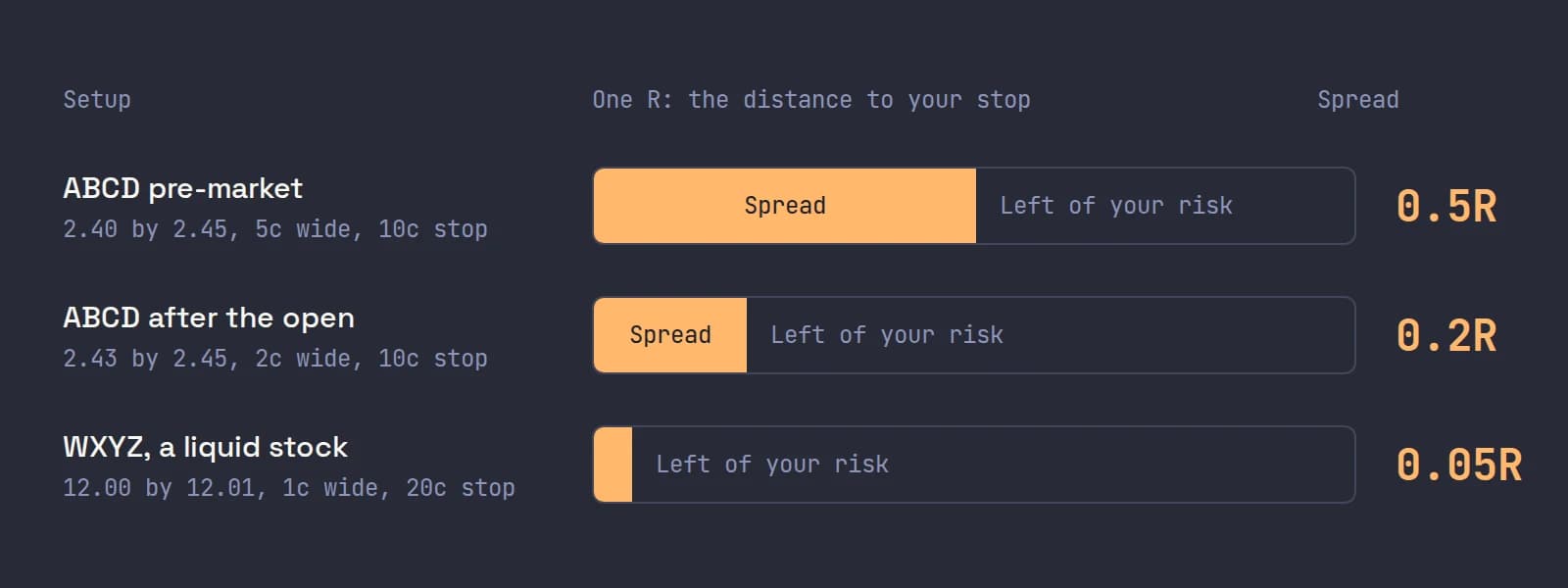
Compare three setups:
| Setup | Spread | Stop | Spread in R |
|---|---|---|---|
| ABCD in the pre-market, 2.40 by 2.45 | 5 cents | 10 cents | 0.5R |
| ABCD after the open, 2.43 by 2.45 | 2 cents | 10 cents | 0.2R |
| WXYZ, a liquid $12 stock, 12.00 by 12.01 | 1 cent | 20 cents | 0.05R |
The spread also affects how much you really lose when you are wrong. Your stop is a price on the chart, but you exit at the bid. If ABCD trades at 2.35 while the spread is still 5 cents wide, the bid may be 2.33 or lower, and a sell into a thin bid can go lower still. A planned 1R loss can become 1.2R or 1.3R. That is why we size from where we will actually get out, not from the stop line. Our position sizing guide shows how a risk-based preset turns a stop distance into a share count.
Our own rule of thumb: when the spread is more than about a quarter of the stop distance (0.25R), we either skip the trade or cut the size. A wide spread is survivable on a trade with a 3R target; it is a slow leak on a scalp aiming for 1R.
The spread against commissions
On a small cap, the spread usually dwarfs the commission. IBKR Pro's stock commissions on October 22, 2026 were:
| Plan | Per share | Minimum per order | Maximum per order |
|---|---|---|---|
| IBKR Pro Fixed | $0.005 | $1.00 | 1% of trade value |
| IBKR Pro Tiered (up to 300,000 shares a month) | $0.0035, plus exchange, clearing and regulatory fees | $0.35 | 1% of trade value |
For 1,000 shares of ABCD on Fixed, that is $5.00 to buy and $5.00 to sell: $10.00 a round trip. The 5 cent spread on the same 1,000 shares is $50.00. Choosing between Tiered and Fixed matters, but on a stock like ABCD, getting in and out at better prices matters about five times more. The commissions guide shows how Scalpel counts IBKR's fees in your P&L.
Spreads on small-cap stocks: why they are so wide
The spread is what quoters charge for standing ready to trade, and they widen it when that is risky:
- Few competing quotes. A stock with a few hundred shares at each level has little competition at the inside, so nobody is pushed to narrow it.
- Fast, jumpy prices. A small cap that can move 10% in a minute is dangerous to quote. Market makers protect themselves by quoting wider or smaller.
- News risk. Offerings, halts and headlines can gap a small cap in seconds. Anyone resting an order is exposed to that.
- Low price. As the table shows, even a minimum spread is a large percent of a $1 or $2 stock.
A spread that suddenly widens is information. If ABCD has been 2 cents wide all morning and jumps to 8, liquidity is leaving: someone pulled their quotes. That is a time to tighten up, not to add.
How the spread changes through the day
The spread is not fixed. It changes with the session:
- Pre-market (04:00 to 09:30 ET). The widest. The SEC's investor bulletin on after-hours trading says it plainly: "The reduced level of trading interest in extended-hours trading generally results in wider spreads between the bid and ask prices for a stock or no quotes at all." Fewer venues and fewer market makers are quoting, so a gapper can be 5, 10 or 20 cents wide.
- The open. Spreads usually tighten as the full market starts quoting, though the first minutes can be chaotic.
- After hours (16:00 to 20:00 ET). Back to extended-hours conditions: thinner and wider.
Most of the small-cap momentum trading this site is about happens in the pre-market, which is exactly when the spread costs the most.
What you actually pay vs the quoted spread
The quoted spread is the cost for a small order. Two things change what you really pay:
Your size. If ABCD shows 300 shares at 2.45 and you buy 1,000, the other 700 come from 2.46, 2.47 and higher. That is walking the book, and our post on Level 1 vs Level 2 works through an example. The effective spread for a big order is wider than the quote.
Your order type. A market order takes whatever is there. A marketable limit order takes what is there up to a cap, which is why most scalpers use one. A limit order resting inside a wide spread (say a bid at 2.42 when the market is 2.40 by 2.45) can save you part of the spread, at the cost of not getting filled when the stock runs. On a 1 cent spread there is nothing to improve on; on a 5 cent spread there is. For the full cost picture, see slippage in day trading.
Some orders also fill between the bid and ask, often off-exchange where no Level 2 shows them; see hidden orders and dark pools.
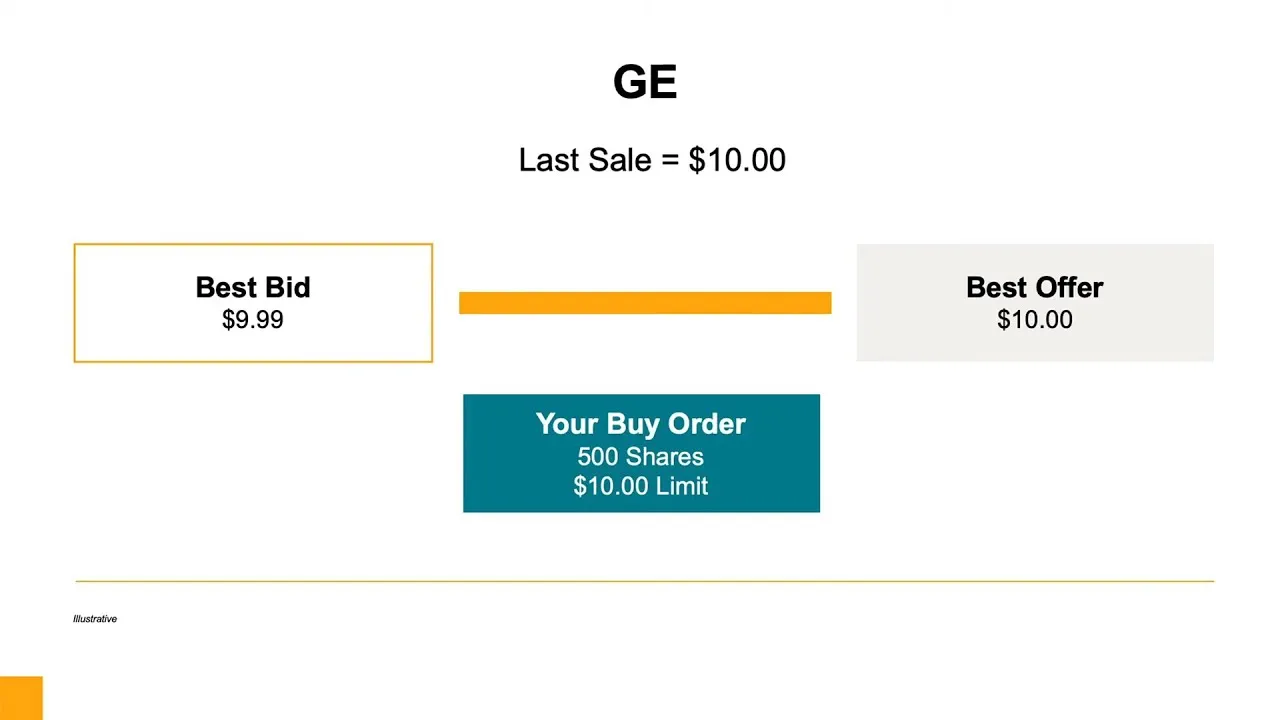
This short Interactive Brokers lesson, part of IEX's course on US market structure, follows one limit order from start to finish: half of it fills at the midpoint against hidden size and the rest at the quoted offer, which shows why the price you pay can differ from the quote.
A spread check before every entry
Read the spread in cents and percent
ABCD 2.40 by 2.45: 5 cents, about 2.1%.
Convert it to R
Divide the spread by your stop distance. 5 cents against a 10 cent stop is 0.5R. If it is over your limit, pass or size down.
Check the bid under you
Your exit is the bid. Add up the shares on the first few bid levels. If they are less than your position, a fast exit will walk down the book.
Watch whether it is widening or tightening
Narrowing as volume arrives is healthy. Widening is liquidity leaving.
Where Scalpel fits
Scalpel is a desktop day-trading cockpit for your own Interactive Brokers account, and it puts the spread arithmetic on screen. The summary bar above every Level 2 montage shows SPREAD in dollars and as a percent of the middle price, next to BEST BID and BEST ASK, so 2.40 by 2.45 reads as 0.05 and 2.06% without you doing the division.
A few other things in the app are built around the spread:
- Buys are marketable limits. A buy goes out at the ask plus your Buy offset (10 cents by default), so it fills against what is offered but never pays more than that cap (entries and fills).
- Exits that do not cross the spread. Besides selling at the bid, Ctrl+A offers half your position at the ask and Ctrl+S at the midpoint. On a wide spread that is a way to take profit without giving up the full spread on that half (scale out and flatten).
- The thin bid exit warning. Switch it on in the LEVEL 2 cog and, while you hold, Scalpel works out what selling everything into the visible bids would cost and warns at 0.6% or worse (read Level 2).
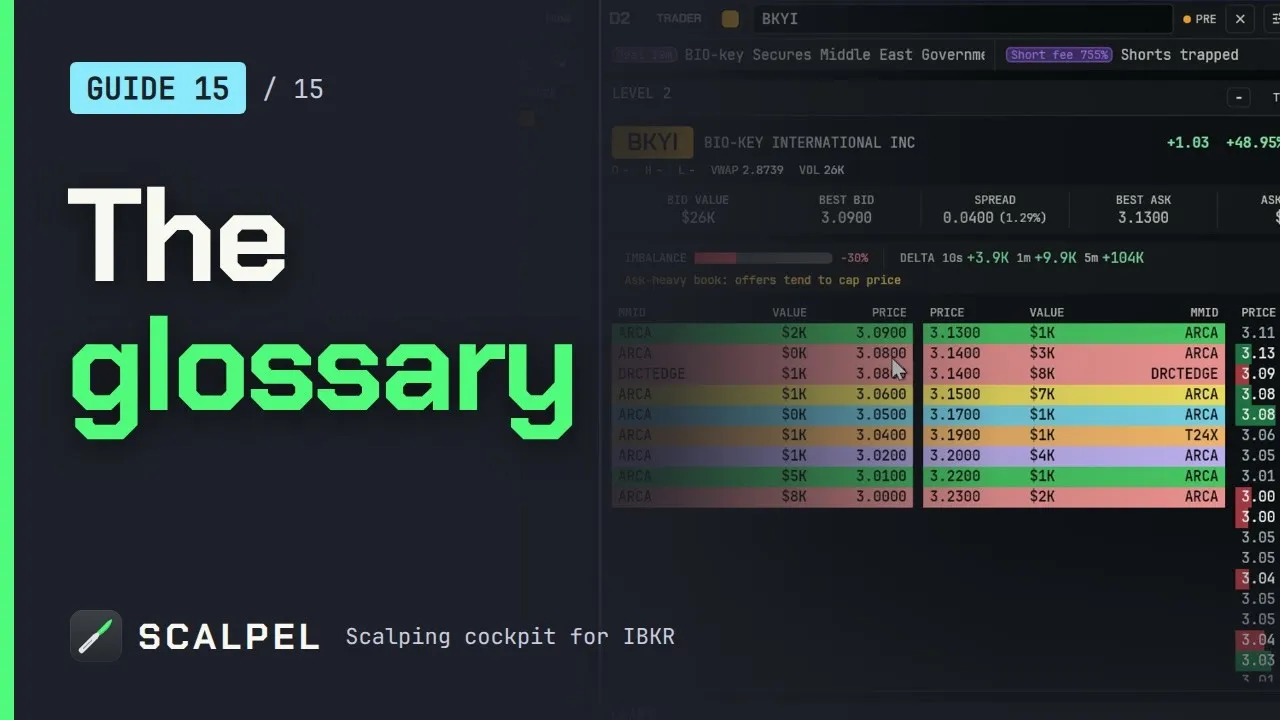
Our glossary video walks through the spread and the other terms on the Level 2 panel in under two minutes:
None of this makes the spread smaller; it makes it visible. Scalpel is long only, and its stops are watched by the app, not resting at IBKR, so they only work while Scalpel runs with a live feed.
Scalpel is independent and not affiliated with or endorsed by Interactive Brokers.
Trading carries a significant risk of loss. Nothing here is financial advice.
Questions
- What is the bid-ask spread in stocks?
- It is the difference between the highest price a buyer is bidding and the lowest price a seller is asking. A stock quoted 2.40 bid and 2.45 ask has a 5 cent spread.
- Why do I pay the bid-ask spread twice?
- When you buy at the ask you pay half the spread above the midpoint, and when you sell at the bid you give up half the spread below it. A round trip that crosses both ways costs the full spread, before commissions.
- How do you calculate the bid-ask spread as a percentage?
- Divide the spread by the midpoint price. A 5 cent spread on a stock quoted 2.40 by 2.45 is 0.05 divided by 2.425, about 2.06%.
- Why are spreads so wide on small cap stocks?
- Fewer orders compete at the inside, prices move fast, news can gap the stock, and a low share price makes even a 1 cent spread a large percent. Anyone quoting widens the spread to cover that risk.
- Are spreads wider in the pre-market?
- Usually, yes. Fewer traders and market makers are quoting outside regular hours, and the SEC warns that extended-hours trading generally brings wider spreads or no quotes at all.
- What is a good bid-ask spread for day trading?
- There is no single number. Compare the spread with your stop: a spread above about a quarter of your stop distance takes a large share of your risk before the trade starts.
Related guides
Guide 3.1How to read Level 2 in ScalpelRead Scalpel's DAS-style Level 2: bids left, asks right, optional colour bands per price, venues, spread, imbalance and delta, and reading players by behaviour.Guide 4.4Entries: marketable limits, offsets and partial fillsHow a Scalpel buy is priced and filled: the marketable limit, the buy offset, partial fills, and why a buy is refused when the market is closed or halted.Guide 4.5Scale out and flattenSell half, a quarter or the whole position at the bid, ask or mid, and flatten everything with Esc or Flatten All. What each exit does in SIM and in LIVE.
Keep reading
- How to read Level 2: a plain guide for day tradersHow to read Level 2 step by step: the spread, stacking and thinning, reading the book against the tape, what depth hides, and why pre-market books mislead.
- IBKR Level 2: which subscription, what it costs and how to read itIBKR Level 2 explained: which depth feeds to buy and what they cost today, the TWS limit on books at once, and how to read the book, pre-market included.
- Level 1 vs Level 2 market data: what the difference means for a tradeLevel 1 vs Level 2 market data: top of book vs depth, a worked example of what your size really costs, IBKR prices, and who actually needs Level 2.
Practice in SIM, against the live book.A lifetime license, every update included, with a 7-day refund guarantee.Ask in DiscordGet Scalpel