IBKR SmartRouting vs direct routing for day traders
By Scalpel Team. , updated . 10 min read.
In short
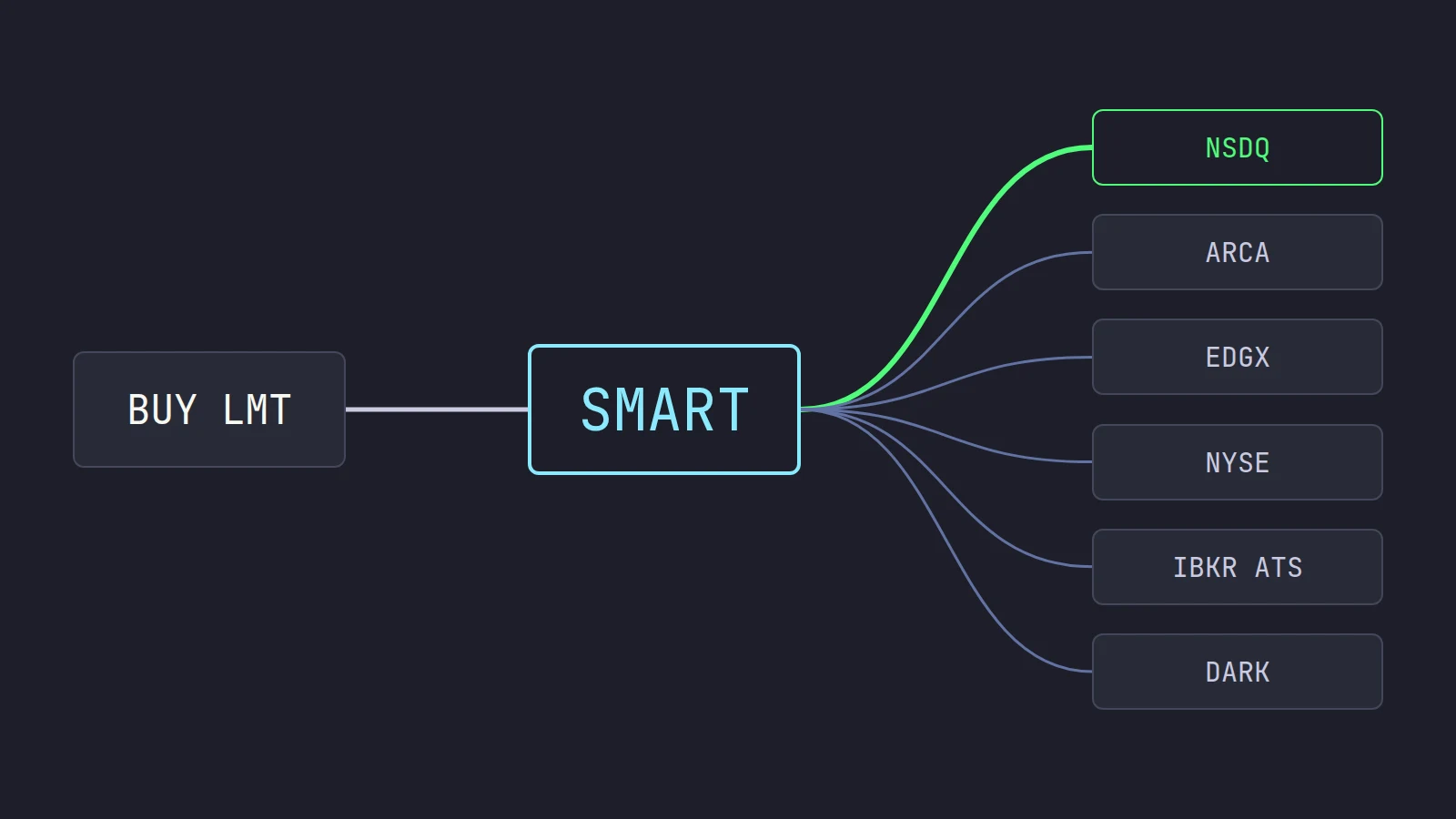
IBKR SmartRouting is Interactive Brokers' default order router: it looks across exchanges, its own ATS and eight dark pools for the best available price, weighs each venue's fee or rebate, and keeps re-routing any part of the order that has not filled. Direct routing sends the order to one venue you pick instead. For a small-cap scalper taking liquidity with marketable limits, SMART is the better choice almost every time; direct routing helps only for resting orders where you want a specific venue's queue or rebate, and through the API it costs $0.0075 a share instead of $0.0035.
IBKR smart routing is one of the reasons traders pick Interactive Brokers, and one of the least understood. DAS and other direct-access platforms train traders to pick a route for every order: ARCA for this, EDGX for that. IBKR Pro does the opposite by default and routes for you. The question for a day trader is whether that costs you anything, and when picking the venue yourself is worth it.
This post explains how SmartRouting decides, what IBKR's own routing report shows about where small-cap orders go, what direct routing costs, and the cases where it helps a scalper and where it hurts. Fees and figures checked on October 22, 2026. Scalpel is independent and not affiliated with or endorsed by Interactive Brokers.
How IBKR SmartRouting works
IBKR describes SmartRouting as searching "for the best available prices for stocks, options and combinations across exchanges and dark pools." Four details from that page matter to a day trader:
- It keeps working the order. IBKR says SmartRouting "never routes and forgets about your order. It continuously evaluates fast changing market conditions and dynamically re-routes all or parts of your order." If the venue you were routed to runs out of shares, the rest goes after the next best price.
- It includes dark pools. IBKR "includes eight dark pools in its SmartRouting logic" to look for hidden size that is not on any exchange's book. What that hidden size is, and why your Level 2 never shows it, is covered in our post on hidden orders and dark pools.
- It weighs fees. For a marketable order, when several exchanges show the same best price, SmartRouting "takes into account transaction costs along with the fee or rebate for taking/adding liquidity" in choosing where to send it.
- It only uses venues you are permitted on. Smart orders "can only be routed to the exchanges for which clients have active trading permissions."
IBKR also publishes a cost figure. Measured against each stock's daily VWAP, extended hours included, it says its clients' total trading cost for September 2026 was 0.012% of trade value, and 0.025% over the prior 12 months, commissions and regulatory fees included. That is IBKR's own measure across all its clients, most of whom are not small-cap scalpers, so treat it as a sign of the router's general quality rather than a forecast of your fills.
What IBKR's Rule 606 report shows
US brokers publish a quarterly Rule 606 report on where they route customers' orders. Its venue tables cover non-directed orders: the ones the broker routes on its own judgment rather than to a venue the customer chose. IBKR's report for the second quarter of 2026 splits stocks into S&P 500 names and everything else, which is where small caps live. For non-S&P 500 stocks in June 2026:
| Venue | Share of non-directed orders |
|---|---|
| Nasdaq | 27.88% |
| NYSE Arca | 17.11% |
| Cboe EDGX | 14.80% |
| NYSE | 8.04% |
| IBKR ATS | 7.78% |
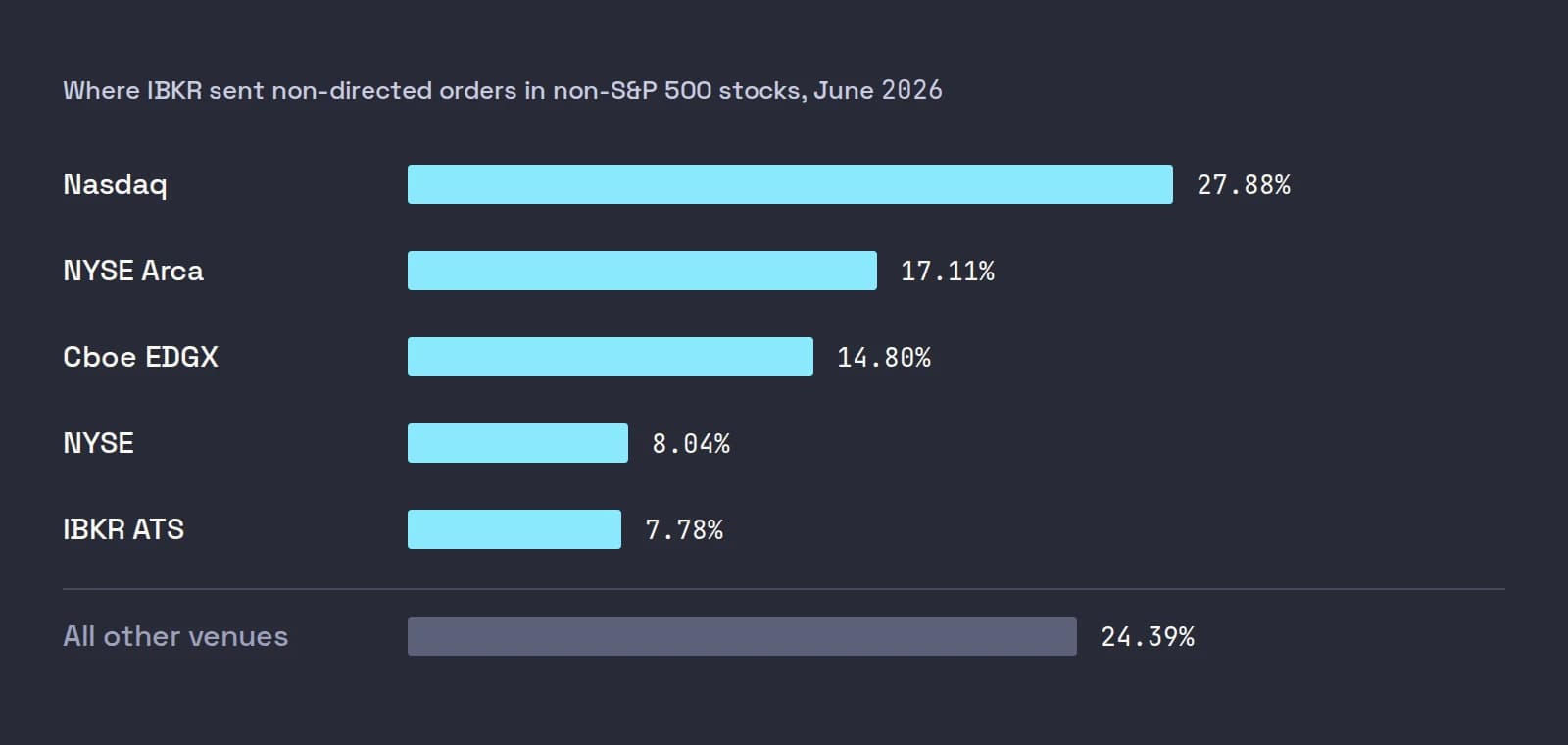
Three things stand out. First, the order mix: market orders were 0.35% of those non-directed orders, marketable limits 26.75% and resting limits 70.93%. Second, IBKR's own ATS, where IBKR matches client orders against each other or against liquidity providers, took 27.06% of the marketable limit orders, more than any exchange; IBKR says executions there "eliminate exchange fees, and may offer Price Improvement." Third, the money: on Nasdaq IBKR paid about 22.4 cents per hundred shares on marketable limit orders, the fee for taking liquidity, and received about 21.0 cents per hundred shares on resting limits, the rebate for adding it. That is the maker-taker model in one line.
Non-directed orders were 32.32% of IBKR's orders in those stocks that month. The rest were directed: the customer chose the venue.
Direct routing: what it is and how to do it
Direct routing means choosing the venue yourself. In TWS Mosaic you open Advanced in the order entry panel, click the Destination drop-down, expand Directed and pick an exchange; the order confirmation then shows your choice next to Routing. IBKR's lesson walks through it in under three minutes:
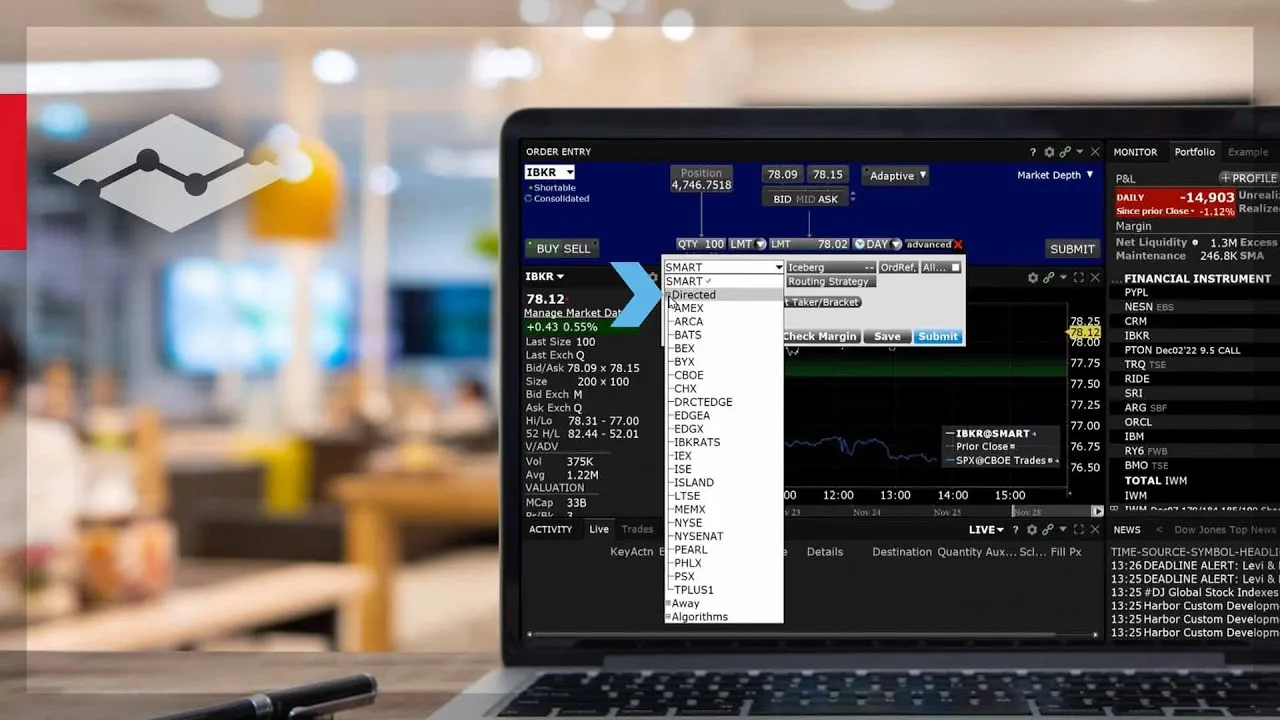
IBKR's own framing in that lesson is telling: it says SmartRouting "is likely to provide an investor with the best overall fill at the lowest overall execution cost", and gives two reasons to direct route anyway: investor preference, and liquidity or rebates.
Does IBKR give direct market access?
On IBKR Pro, yes, in the sense most traders mean: you can send a stock order straight to an exchange you name, as above, instead of letting SmartRouting choose. That is what DAS users call DMA, and it is the same choice.
Two limits are worth knowing. Every order still passes IBKR's own checks before it leaves for the exchange: buying power and margin, its price checks, and your TWS precautionary settings, which is why a directed order can be rejected without ever reaching the venue. And IBKR Lite works differently: its orders are normally sent to market makers that pay IBKR for the flow, as covered in IBKR Pro vs Lite.
Why IBKR fills differ by venue
Each exchange keeps its own book, so the same stock at the same moment can fill differently depending on where the order lands:
- Each venue has its own queue. Resting orders fill in price and time order per venue. A limit order at the bid can fill on one exchange while an identical order on another waits behind more size.
- Fees and rebates differ. Taking liquidity costs a fee and adding it can earn a rebate, at different rates per venue. On Tiered you see that difference on your bill; SmartRouting weighs it when several venues show the same best price.
- Some venues can improve the price. IBKR's ATS and the dark pools SmartRouting checks hold size that is not on any exchange's displayed book, and IBKR says executions on its ATS may get price improvement.
- Big orders split. A marketable order larger than the best venue's size takes what is there and is re-routed for the rest, so one order can come back as several fills on several venues at slightly different prices.
What direct routing costs
On IBKR Pro, the plan you are on changes the answer:
- Tiered charges $0.0035 a share for the first 300,000 shares a month, minimum $0.35, plus the exchange's fee or minus its rebate (IBKR commissions). IBKR's Nasdaq table lists $0.0030 a share to take liquidity and a $0.0013 rebate to add a displayed order in stocks at $1 and over (Nasdaq fees at IBKR).
- Fixed charges $0.005 a share, minimum $1.00, with most exchange fees built in.
- Direct-routed orders sent through the API are priced separately: $0.0075 a share, minimum $1.00, and "directed API orders cannot use the Tiered fee structure. Clients on the Tiered Fee Structure would be charged the Fixed rate" (IBKR alternate exchange commissions).
A worked example. You buy 1,000 shares of ABCD at $5 with a marketable limit, taking liquidity on Nasdaq:
| Route and plan | Commission | Exchange fee | Before clearing and regulatory fees |
|---|---|---|---|
| SMART, Tiered | $3.50 | $3.00 | $6.50 |
| SMART, Fixed | $5.00 | Included | $5.00 |
| Direct through an API app | $7.50 | Can be added | $7.50 or more |
Now the other side: you offer 1,000 shares at the ask on Nasdaq and a buyer takes them. On Tiered that is $3.50 commission less a $1.30 rebate, $2.20. IBKR adds a caution: Tiered clients "may or may not be eligible to receive direct credit for rebates", and it does not pass on the enhanced rebates it earns from volume tiers. Whether your trading suits Tiered at all is worked out in IBKR Tiered vs Fixed.
When direct routing helps a scalper
There are real cases, all of them for orders that rest on the book:
- Earning the rebate on resting offers. If you scale out with limit offers at the ask and they usually fill, directing them to a venue that pays a rebate for adding liquidity can lower your cost on Tiered, through TWS rather than an API app.
- Joining a specific queue. Exchanges fill resting orders in price and time order per venue. If you see on Level 2 that one venue has a short queue at your price, sending your offer there can put you nearer the front. This is a skill DAS traders practise; it rarely pays on IBKR's per-share pricing unless you trade size.
- Auctions. Opening and closing auctions run on the listing exchange, so some traders send their on-open and on-close orders there directly.
IBKR also gives Tiered clients a middle option: keep SMART but tell it where to send non-marketable orders. Its routing page lists four choices: the exchange with the highest rebate, the listing exchange, the highest-volume exchange that pays a rebate for adding, or the highest-volume exchange with the lowest fee for taking. You set them per order on the Misc tab of the order ticket, or as a default in the Smart Routing configuration.
When direct routing hurts
For the order a scalper sends most, a marketable limit to get in or out now, picking the venue yourself is a handicap:
- You bet on one book. A directed order goes to one exchange. If the shares you saw on Level 2 were on another venue, or vanish before your order arrives, a smart order goes after the next best price wherever it is. A directed order depends on that one exchange: it may route on under the exchange's own rules and fees, or rest unfilled.
- You cannot reach the ATS or the dark pools. IBKR says directed orders to its ATS that are marketable "will generally be rejected", and hidden liquidity is exactly what SMART looks for.
- It costs more through an API. At $0.0075 a share against $0.0035 on Tiered SMART, a 1,000 share round trip pays $15.00 in commission instead of $7.00.
- Chasing rebates can cost you fills. Battalio, Corwin and Jennings studied broker routing in "Can Brokers Have It All? On the Relation between Make-Take Fees and Limit Order Execution Quality" (Journal of Finance, 2016, doi:10.1111/jofi.12422). They found a negative relation between limit order execution quality and the rebate level of the venue. The venue that pays you the most to rest is often the one where your order fills least or last.
Our view: leave SMART on for every marketable order, and only direct-route resting orders once you have a reason you can measure.
The rule change to watch
Exchange take fees are capped by SEC Regulation NMS Rule 610. In September 2024 the SEC voted to lower the cap to $0.001 a share for quotes in stocks at $1 and over, and to require exchange fees and rebates to be knowable at the time of the trade (SEC fact sheet). In an order dated June 11, 2026, the SEC delayed compliance with the lower cap and the new tick sizes to the first business day of November 2027 (SEC Release 34-105656). If it takes effect, the gap between taking and adding liquidity narrows, and so does the case for routing around fees.
Where Scalpel fits
Scalpel trades from your own IBKR Pro account over the TWS API, and every LIVE order uses IBKR SmartRouting. There is no direct routing option, by design: the API direct-routed rate is more than double Tiered SMART commission, and a scalper's marketable limits are exactly the orders SMART handles best. Because the orders are smart-routed, they work on Tiered or Fixed, and Scalpel books the real commission IBKR reports for each fill (commissions).
Routing decides where an order goes; it does not decide whether a scalp is a good one. Scalpel's Level 2 shows every venue's row at each price, so you can see where the size is before you press:
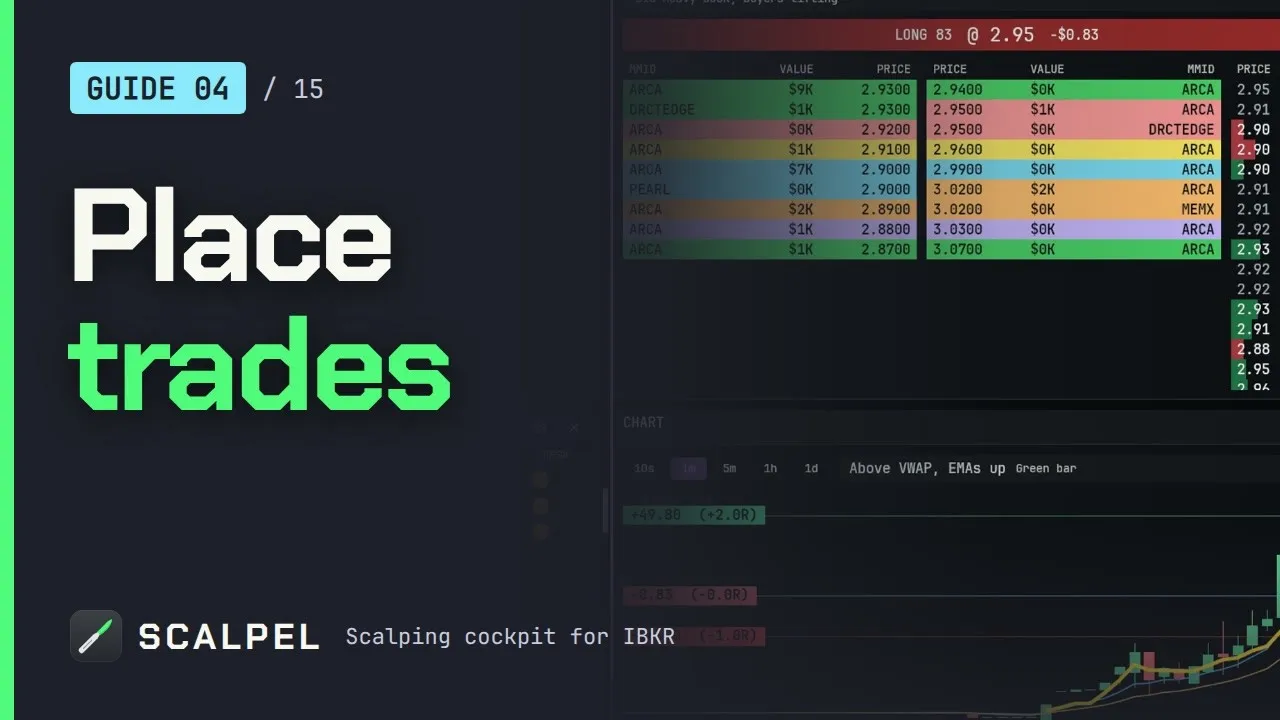
Buys go out as marketable limits at the ask plus your Buy offset, and SmartRouting looks for the shares across venues up to that cap (entries and fills). Our section video shows the entry and exit keys in use:
For how routing fits with the rest of the order kit, see our guide to day trading order types. For what routing can and cannot fix in your fills, slippage in day trading and marketable limit orders go further.
Trading carries a significant risk of loss. Nothing here is financial advice.
Questions
- What is IBKR SmartRouting?
- Interactive Brokers' default order router. It searches exchanges, IBKR's own ATS and eight dark pools for the best available price, considers each venue's fee or rebate, and keeps re-routing any unfilled part of the order.
- Is direct routing better than smart routing on IBKR?
- For marketable orders, usually not: a directed order sees one venue, cannot reach the dark pools, and costs 0.0075 dollars a share through the API. Direct routing can help on resting orders when you want a specific venue's queue or rebate.
- Does Interactive Brokers offer direct market access?
- On IBKR Pro, yes: you can direct an order to a named exchange instead of using SmartRouting. The order still passes IBKR's margin, price and precautionary checks first. IBKR Lite orders are normally sent to market makers that pay for the flow.
- How do I direct route an order in TWS?
- In the Mosaic order entry panel, open Advanced, click the Destination drop-down, expand Directed and choose the exchange. The order confirmation shows the venue next to Routing.
- Where does IBKR route small-cap orders?
- IBKR's Rule 606 report for June 2026 shows that its non-directed orders in non-S&P 500 stocks went mostly to Nasdaq (27.88%), NYSE Arca (17.11%), Cboe EDGX (14.80%), NYSE (8.04%) and IBKR's own ATS (7.78%).
- Can I get exchange rebates on IBKR?
- On the Tiered plan, exchange fees and rebates are passed through on many orders, but IBKR says clients may or may not be eligible for direct credit and it does not pass on enhanced volume rebates. Fixed pricing builds most exchange fees in instead.
Related guides
Guide 4.4Entries: marketable limits, offsets and partial fillsHow a Scalpel buy is priced and filled: the marketable limit, the buy offset, partial fills, and why a buy is refused when the market is closed or halted.Guide 6.3Commissions: pick your IBKR planMatch Scalpel's SIM fees to your Interactive Brokers plan: Pro Tiered, Pro Fixed, Lite or custom, plus exchange and clearing fees, and the FEE column.Guide 3.1How to read Level 2 in ScalpelRead Scalpel's DAS-style Level 2: bids left, asks right, optional colour bands per price, venues, spread, imbalance and delta, and reading players by behaviour.
Keep reading
- Day trading order types: what scalpers actually useDay trading order types: market, limit, marketable limit, stop, stop-limit and time in force, with a worked example and what scalpers really use on IBKR.
- Marketable limit order: the order type scalpers actually useA marketable limit order fills at once like a market order but caps your price. How it fills, how far through the ask to price it, and the TWS setup.
- Market order vs limit order in day trading: the small-cap costMarket order vs limit order in day trading small caps: what slippage costs in R on a thin book, why IBKR holds pre-market market orders, and what to use.
Practice in SIM, against the live book.A lifetime license, every update included, with a 7-day refund guarantee.Ask in DiscordGet Scalpel