Stop loss placement: where to put your stop when day trading
By Scalpel Team. , updated . 8 min read.
In short
Good stop loss placement in day trading means putting the stop where the trade idea is proven wrong: a few cents under a level the stock has respected, such as the low of the pullback you bought, VWAP, a whole or half dollar, or the low of the breakout candle. Not on the level, under it. Then size the position so that distance costs your fixed dollar risk. If the right stop is too far for your risk, buy fewer shares or skip the trade, and never widen a stop once you are in.
Most bad stops come from doing the steps in the wrong order. A trader decides they want 1,000 shares, decides they can afford to lose $100, and puts the stop 10 cents under the entry because that is what the arithmetic allows. The stock does not know any of that. A 10 cent stop on a stock that swings 15 cents a minute is a donation.
The right order is level first, size second. This post covers where the level is for the common day trading setups, how far under it to go, the alternatives when there is no clean level, and the one rule that matters more than placement. It is part of our pillar on day trading risk management. Scalpel is independent and not affiliated with or endorsed by Interactive Brokers.
Stop loss placement in day trading: the rule
A stop answers one question: at what price is my reason for this trade no longer true? If you bought a pullback because buyers defended 5.62, the trade is wrong when 5.62 breaks, not when you are down $100.
That gives three steps on every trade:
- Find the level that proves you wrong. The low of the pullback, VWAP, a round number, the breakout candle's low.
- Go a few cents under it. Enough to clear the spread and normal wicks.
- Size from the distance. Shares = dollar risk / (entry - stop), rounded down (position sizing for day trading).
If step 3 gives a share count too small to be worth it, the trade has too much risk for your plan. That is information, not a reason to move the stop.
The three kinds of stop
| Kind | Where it goes | Good for | The weakness |
|---|---|---|---|
| Structure (technical) stop | Under a chart level: pullback low, VWAP, round number, candle low | Setups with a clear level that defines the trade | Levels everyone can see attract everyone's stops |
| Volatility stop | A multiple of the average true range under the entry | Stocks with no clean level nearby, or as a floor under a structure stop | Ignores the chart; can sit in the middle of nothing |
| Max-loss stop | A fixed number of cents or percent under the entry | A hard cap on top of the other two | On its own, it has no link to why the trade should work |
Structure first, volatility as a check, a hard cap as a backstop. That is how we think about it.
Structure stops: where the level is
The pullback low
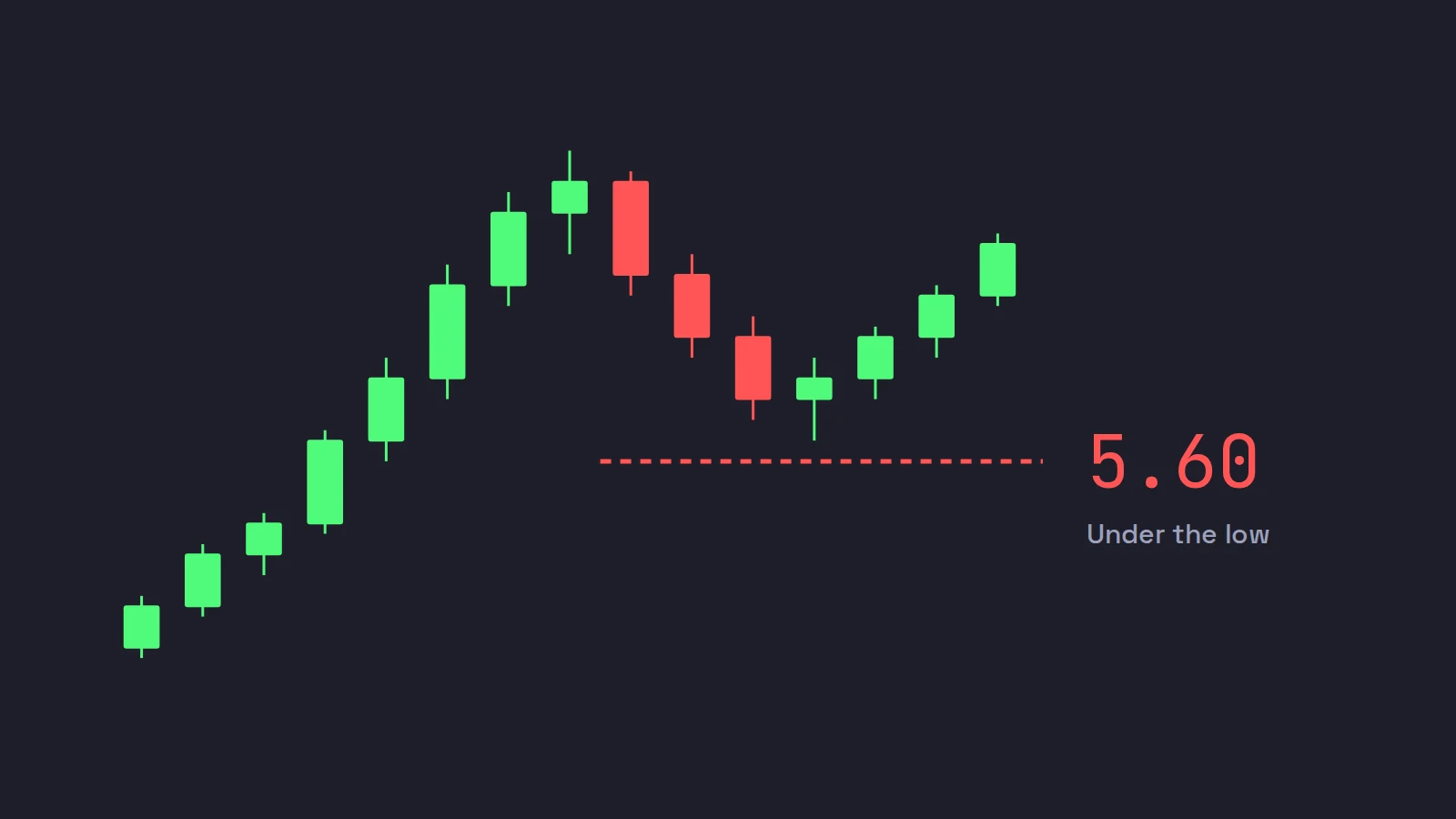
On a first pullback after a strong move, the low of the pullback is the cleanest stop there is. Buyers stepped in there; if price trades back through it, they have stopped defending it. Use the lowest wick of the pullback, not the lowest body. On a 1-minute chart a micro pullback gives a tighter version of the same thing.
VWAP
Momentum traders often treat VWAP as the line between a stock that is in play and one that is fading. If you bought because price held VWAP, a few cents under VWAP is your stop. VWAP moves through the day, so check where it is at the moment you enter, and remember it keeps rising on a strong stock. VWAP for day trading covers how traders use it.
Whole and half dollars
Round numbers act as levels because so many orders sit on them. They also attract stops, and the research says exactly where. Carol Osler studied 9,667 stop-loss and take-profit orders at a large foreign exchange dealing bank and found that stop-loss sell orders cluster just below round numbers, while take-profit orders cluster on them: 9.3% of take-profit orders were placed exactly at a 00 level, against 4.4% of stop-loss orders (Federal Reserve Bank of New York Staff Report 125, 2001; published in the Journal of Finance in 2003). Her data are currencies, not small caps, but the mechanism is the same. Stops bunched a cent under 6.00 turn a break of 6.00 into a burst of selling.
So for a long, a stop at 5.99 under a 6.00 level sits with the crowd, and if 6.00 breaks it fills in the rush. You have two honest choices: put it a little further, at 5.95 or 5.96 under the cluster, and size smaller for it; or accept the crowd stop and expect a worse fill. What does not work is a stop exactly at 6.00. Whole and half dollar levels covers why these numbers matter.
The breakout candle
On a breakout over a level, such as a break of the high of day, the stop goes under the low of the candle that broke out, or under the level itself if the candle was large. If the breakout fails and price falls back into the range, the idea is wrong.
How far under the level?
Far enough that normal noise does not touch it, close enough that a real break does. In practice, for a $2 to $10 small cap:
- Clear the spread. If the stock trades with a 3 cent spread, a stop 1 cent under the level can trigger on the bid flickering. Go at least the spread.
- Clear the wicks. Look at the last few candles on the level. If they wicked 2 to 4 cents through it and came back, your stop goes past that.
- Use a slice of ATR. A quarter to half of the 1-minute ATR under the level is a reasonable buffer on a jumpy stock.
The SEC's investor bulletin on stop, stop-limit and trailing stop orders names the risk directly: a stop "may be triggered by a short-term, intraday price move." The buffer is your defence against that.
Volatility stops: when there is no clean level
Sometimes the stock is mid-range, the last pullback was shallow, and nothing on the chart says "here." A volatility stop uses the average true range, how far the stock typically moves in one bar, to set the distance: 1.5 times the 1-minute ATR is a common starting point. With an 8 cent ATR that is 12 cents. A jumpy stock gets a wider stop and fewer shares, a quiet one a tighter stop and more. ATR stops and ATR position sizing has the formula and the multiples.
ATR is also a good sanity check on a structure stop. If the pullback low is 6 cents away and the 1-minute ATR is 15 cents, the level is inside the noise. Either wait for a better entry or use the wider stop.
A worked example: four candidate stops
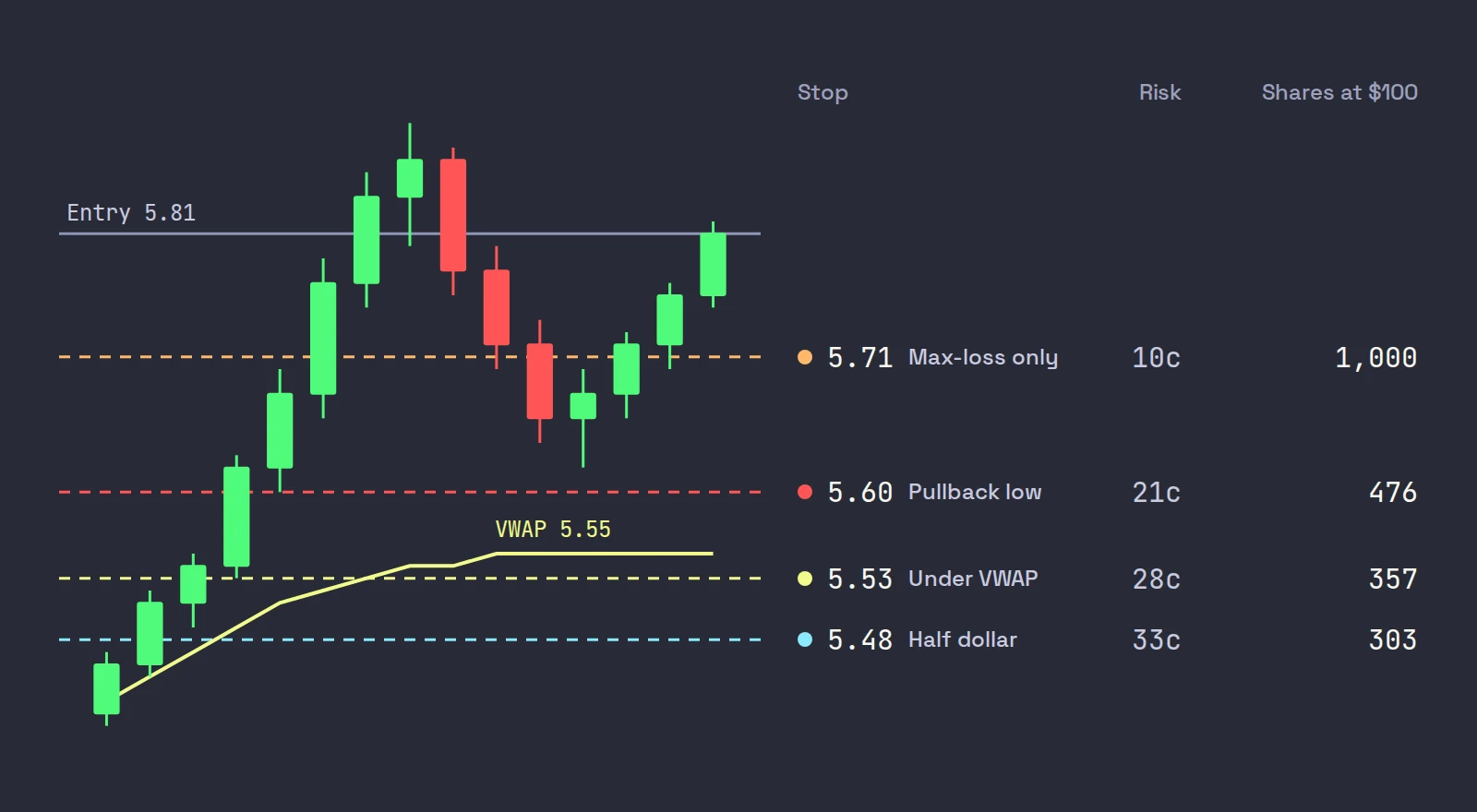
ABCD gapped up and ran to 5.90, pulled back to a low of 5.62 and is now breaking back over 5.80. You buy at the ask, 5.81, with $100 of risk. VWAP is at 5.55. The candidates:
| Stop | Where | Distance | Shares at $100 risk |
|---|---|---|---|
| Max-loss only | 10c under the entry, 5.71 | 10c | 1,000 |
| Pullback low | 2c under 5.62, at 5.60 | 21c | 476 |
| VWAP | 2c under 5.55, at 5.53 | 28c | 357 |
| Half dollar | 2c under 5.50, at 5.48 | 33c | 303 |
The 10 cent stop buys the most shares and has no reason to exist: 5.71 is in the middle of the pullback the stock just made. The pullback low is the level that defines this trade. If you want the trade to survive a deeper retest of VWAP, the VWAP stop costs you 119 shares of size. The loss at the stop is $100 in every row except the first, where it is $100 that you will very likely pay.
Never widen a stop
Moving a stop lower after you are in is the most expensive habit in day trading. The size was right for the old stop; with the new one, 1R is bigger than you planned, and the decision is made at the worst moment, while the trade is going against you.
It is also a very human habit. Terrance Odean's study of 10,000 brokerage accounts from 1987 to 1993 found that a stock up in value was more than 50 percent more likely to be sold on a given day than one that was down (Journal of Finance, 1998). Holding losers in the hope they come back is the default, which is why the rule has to be written down.
Two exceptions that are not widening:
- Selling part of the position. If a level breaks and you are unsure, selling half cuts the risk without moving the line.
- Tightening. Moving the stop up, to break-even or behind price with a trailing stop, only ever reduces risk.
Gaps, halts and the pre-market
A well-placed stop still only triggers an order. Below the stop is whatever the book holds. On a small cap that can be a gap of several levels, and if the stock hits a Limit Up-Limit Down band and stays there for 15 seconds, trading pauses for five minutes, as FINRA's guide to market volatility guardrails explains. It reopens at whatever price the auction finds, which can be far under your level.
Before 09:30 ET there is a second problem: exchanges take limit orders only, so a plain stop order at your broker does nothing. Why your stop loss did not trigger in the pre-market covers it, and stop-limit vs stop-market orders covers which order to use when. Placement decides where you are wrong; the order type decides how you get out.
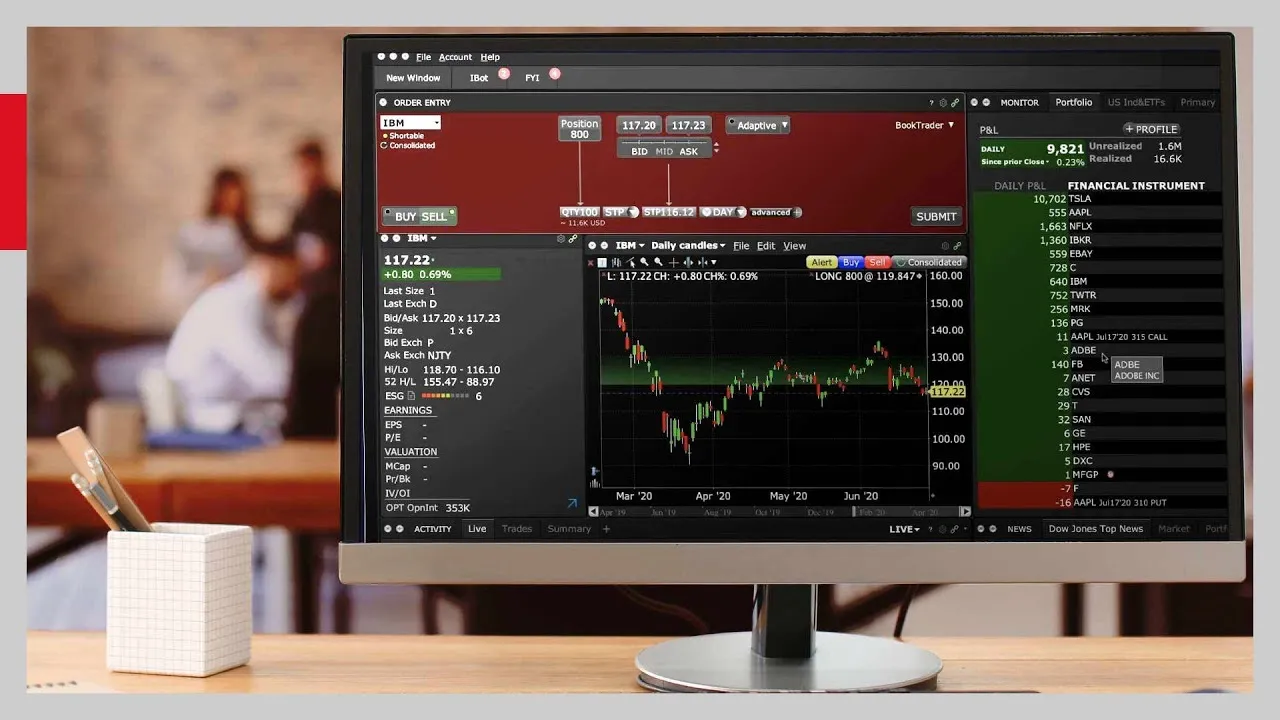
This Interactive Brokers lesson builds both orders in TWS Mosaic and spells out the trade-off: a stop can fill well away from its stop price, and a stop-limit may not fill at all.
Where Scalpel fits
Scalpel's stops live on the chart. Every entry arms a red working stop with a chip showing what it would cost in dollars and R, and you place it by dragging the line to the level: under the pullback low, under VWAP, a few cents under the round number. There is no order at the broker to modify, so the move is instant (drag stops and targets). This short video shows the stops and targets:
That chip is the never-widen rule made visible. R is fixed at the stop you entered with, so a stop dragged lower reads more than -1R before you let go.
Two of Scalpel's sizing presets set the stop for you. Risk (Low) puts it just under the lowest low of the last 20 one-minute candles and sizes to that distance, a structure stop. Risk (ATR) puts it 1.5 times the 1-minute ATR under the fill, a volatility stop (sizing presets, settings: stops).
The stops are app-monitored, not orders resting at IBKR. When price trades at or through the stop, Scalpel sends a sell limit 5 cents under the last trade, flagged for extended hours, so it works before the open too (how stops work). They only work while Scalpel runs with a live feed, and a gap can still fill well under your level. To protect gains once the trade works, see breakeven and trailing stops.
Trading carries a significant risk of loss. Nothing here is financial advice.
Questions
- Where should I put my stop loss when day trading?
- A few cents under the level that proves the trade wrong: the low of the pullback you bought, VWAP, a whole or half dollar, or the low of the breakout candle. Then size the position so that distance equals your fixed dollar risk.
- How far below support should a stop loss be?
- Far enough to clear the spread and the normal wicks through the level, often 2 to 5 cents on a $2 to $10 stock, or a quarter to half of the 1-minute ATR on a jumpy one.
- Should I put my stop loss at a round number?
- Not exactly on it. Stop-loss sell orders cluster just below round numbers, so a stop a cent under 6.00 fills in the rush when 6.00 breaks. Put it a little further below and size smaller, or expect a worse fill.
- Is a percentage stop loss good for day trading?
- As a cap, yes; as the only rule, no. A fixed 2% or 10 cents has no link to the chart, so it often sits inside normal noise. Use the chart level first and a percent or cents cap as a backstop.
- Should I ever move my stop loss lower?
- No. Moving a stop lower makes the trade risk more than you sized it for, and the decision is made under pressure. Sell part of the position instead, or take the stop and look for a new entry.
Related guides
Guide 5.1How Scalpel's stops workWhy Scalpel holds your stops in the app, not on the book: pre-market rules, the working stop, catastrophe net and take-profit, and what if Scalpel closes.Guide 5.2Move your stop and target on the chartDrag the stop or take-profit line (or its axis tag) on Scalpel's chart, add a target with the + TP handle, reset with a double-click, and know the limits.Guide 5.3Breakeven and trailing stopsMove the stop to breakeven with one key, trail it by your stop, cents, percent or 1-minute candle lows, and make both start by themselves at a set R.
Keep reading
- Day trading risk management: the rules that keep you tradingDay trading risk management in five rules: fixed risk per trade, sizing from the stop, a daily loss limit, exposure caps and the math of drawdowns.
- Why your stop loss did not trigger in the pre-market on IBKRIBKR stop loss pre-market: why a plain stop does nothing before 09:30, how a stop-limit gets jumped in a thin book, and the TWS settings that help.
- Position sizing for day trading: size every trade by riskPosition sizing for day trading: shares = dollar risk / stop distance. Worked examples, caps from buying power and liquidity, and fees in the size.
Practice in SIM, against the live book.A lifetime license, every update included, with a 7-day refund guarantee.Ask in DiscordGet Scalpel