Position sizing for day trading: size every trade by risk
By Scalpel Team. , updated . 8 min read.
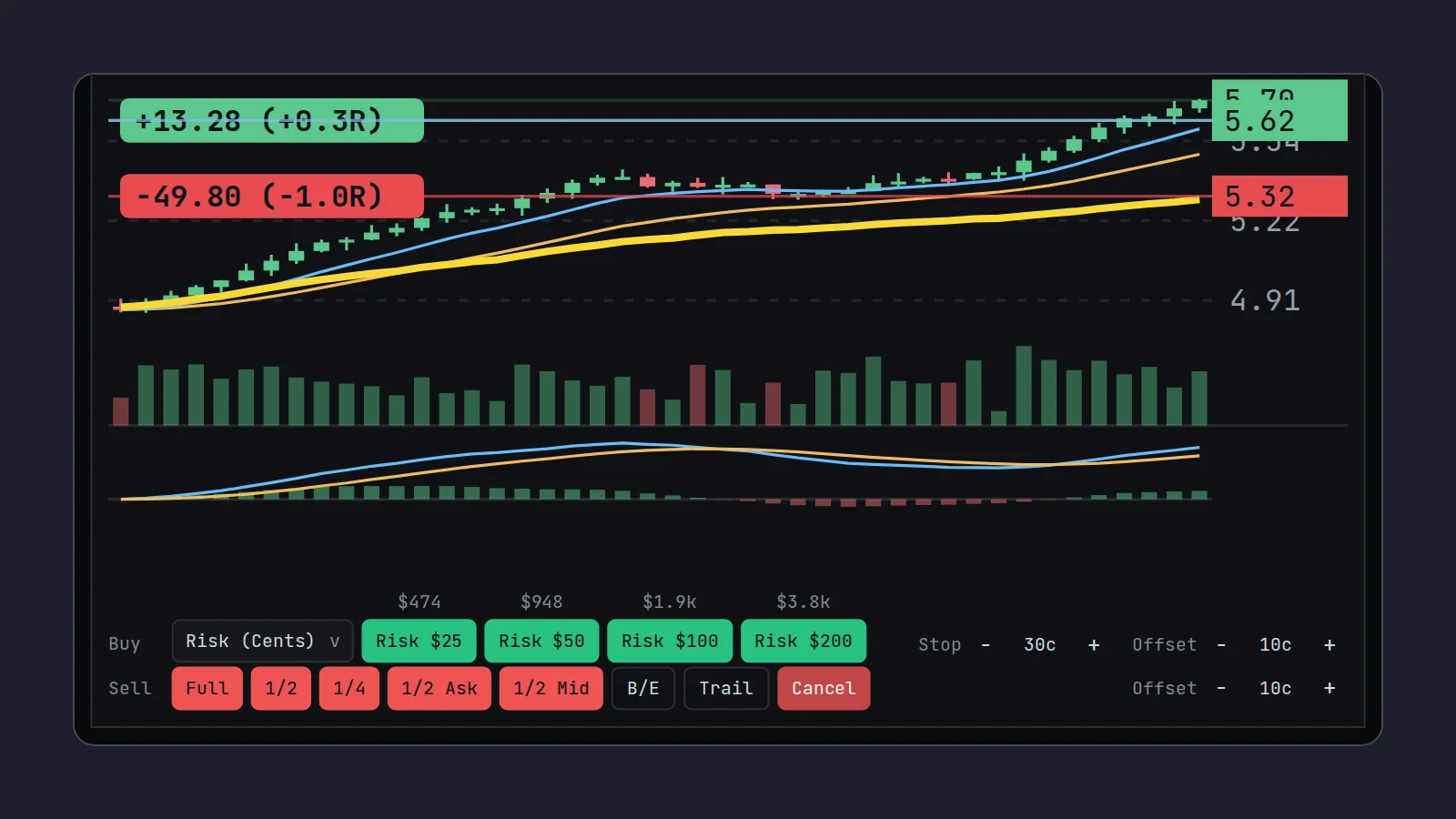
In short
Position sizing for day trading uses one formula: shares = the dollars you are willing to lose / the distance from your entry to your stop, rounded down. Risk $125 with a 26 cent stop and you buy 480 shares; with a 45 cent stop, 277. Then check the answer against three caps: your buying power, your largest allowed position, and what the bid can absorb if you need out. If a cap is smaller, buy fewer shares. Never tighten the stop to make the size fit.
Ask a new trader how big their position was and they usually answer in shares: "I took 500." That number says nothing about risk. 500 shares with a 10 cent stop risks $50; 500 shares with a 50 cent stop risks $250. Over a month of trades, that difference decides whether your results mean anything.
Sizing by risk turns it around. You fix the loss first and let the stop decide the shares. This post is the method, with the arithmetic, the caps that override it, and the costs that quietly change it. It is part of our pillar on day trading risk management. We build Scalpel, a cockpit for Interactive Brokers that sizes this way on every keypress, but everything here works with a calculator and TWS. Scalpel is independent and not affiliated with or endorsed by Interactive Brokers.
The position sizing formula for day trading
Shares = dollar risk / (entry price - stop price), rounded down to whole shares.
Three inputs, in this order:
- Dollar risk (1R). What you lose if the stop is hit. Many traders use 0.5% to 1% of the account; on a $25,000 account, $125 to $250. Pick it once and keep it fixed (R multiples).
- The stop. The price where your trade idea is wrong, set from the chart, not from the money (where to put your stop loss).
- The entry. The price you will actually pay, not the last trade. For a marketable buy, that is the ask plus whatever offset you add.
Rounding down matters. Rounding up means every trade risks a little more than 1R, and on a cheap stock with a tight stop "a little" can be dollars.
Worked examples: same risk, four stocks
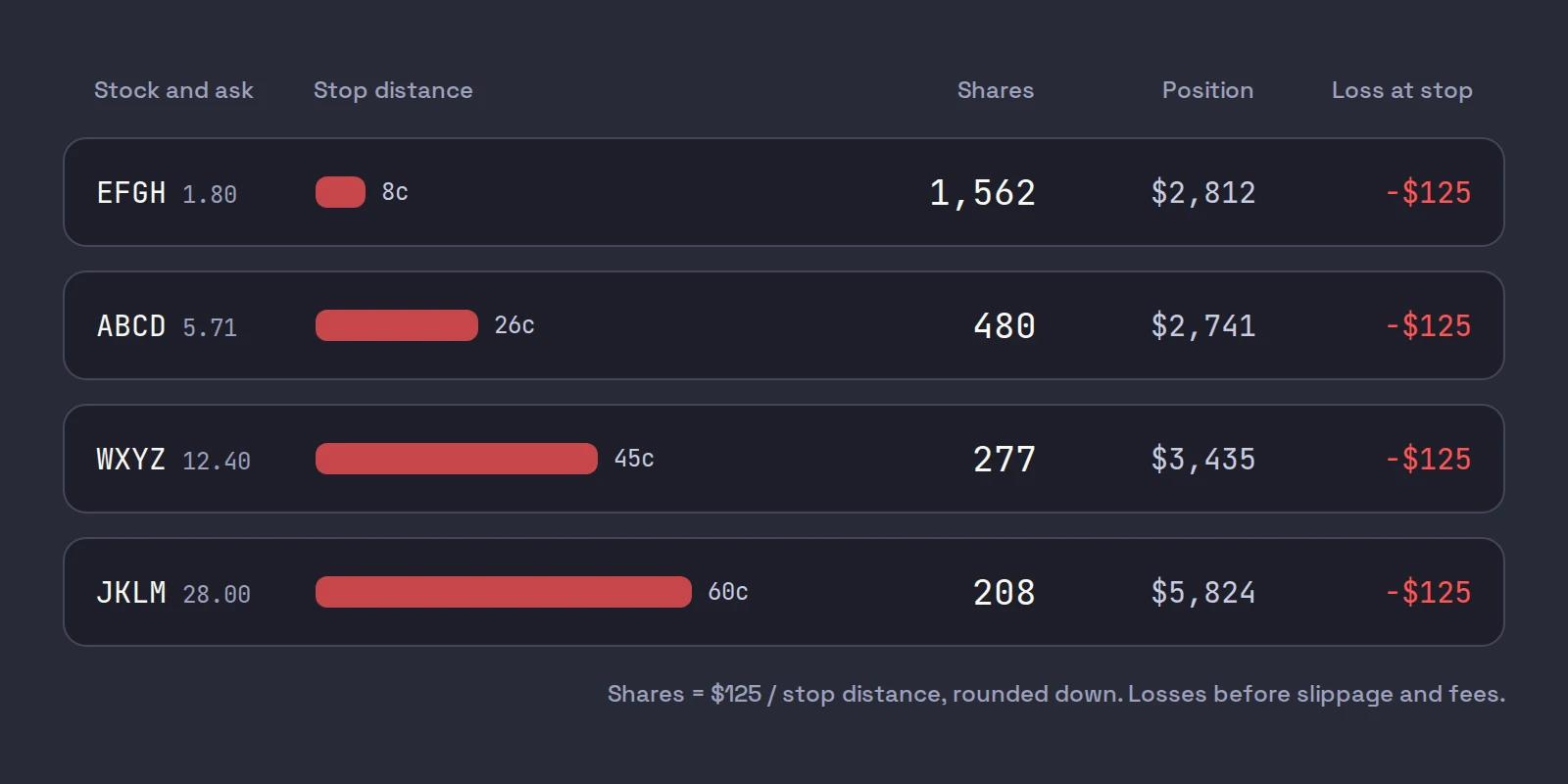
All at $125 risk:
| Stock | Ask | Stop distance | Shares | Position | Loss at the stop |
|---|---|---|---|---|---|
| ABCD | 5.71 | 26c (stop 5.45) | 480 | $2,741 | $124.80 |
| WXYZ | 12.40 | 45c | 277 | $3,435 | $124.65 |
| EFGH | 1.80 | 8c | 1,562 | $2,812 | $124.96 |
| JKLM | 28.00 | 60c | 208 | $5,824 | $124.80 |
The loss at the stop is the same on all four. Share counts range from 208 to 1,562, and the dollars tied up from about $2,700 to $5,800. That spread is the point: a fixed share count would have risked $16 on one of these and $125 on another.
How many shares to buy: check the caps
The formula gives the most you may buy. Three things can make the right answer smaller.
Buying power
You cannot buy more than your account can carry. In a cash account that is your settled cash. In a margin account, Regulation T sets the initial margin for a stock purchase at 50 percent of its value, and brokers can ask for more on volatile or low-priced stocks. A tight stop on a pricier stock hits this first: $125 at a 5 cent stop on a $28 stock is 2,500 shares, $70,000 of stock.
Margin raises what you can buy, not what you should. If the formula asks for more than about half your account in one small cap, the stop is probably too tight to be real.
Your own position cap
Set a dollar ceiling for any one stock and keep it below buying power. Our starting point is 60% to 80% of the account in a cash account, and no more than the account itself on margin. It catches the case above, and the fat-finger case where a typo in the risk or the stop asks for ten times the shares (fat-finger and position caps).
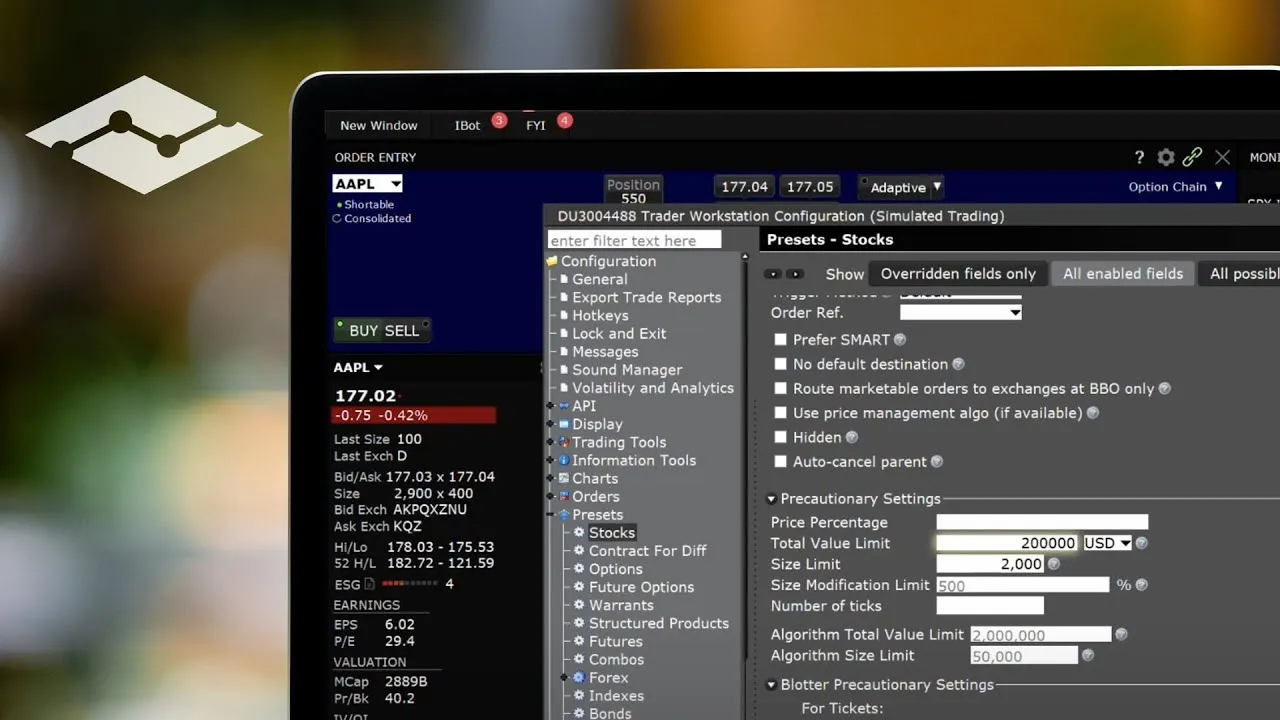
In TWS, the precautionary settings in order presets can hold that ceiling for you. This IBKR lesson shows where they are and how an order over your share or dollar limit is flagged before it transmits.
Liquidity: what the bid can absorb
This is the cap that most sizing guides skip. Your stop is only worth something if the shares can be sold near it. Look at EFGH's bids at the moment you would buy:
| Bid | Size |
|---|---|
| 1.79 | 400 |
| 1.78 | 600 |
| 1.77 | 300 |
| 1.75 | 1,000 |
The top three levels hold 1,300 shares. The formula says 1,562. If the stop fires and you sell everything at once, you take all three levels and part of 1.75, and the average exit is several cents under where you planned, on every share. Our rule of thumb: keep size at or under what the top three bid levels hold, and recheck it when the book thins out. Reading Level 2 covers what those levels mean and how fast they change.
Put slippage and fees in the size
A stop is a trigger, not a fill. On a fast small cap the exit often fills a cent or a few under the stop (slippage in day trading), and commissions come off both sides. Both scale with share count, so the cheapest, tightest-stop trades are hit hardest.
At Interactive Brokers, IBKR Pro Tiered charges USD 0.0035 a share with a USD 0.35 minimum per order, capped at 1% of trade value, plus exchange, clearing and regulatory fees. Fixed is USD 0.005 a share with a USD 1.00 minimum. Checked on October 22, 2026.
Take EFGH again: 1,562 shares on an 8 cent stop.
- Loss at the stop: $124.96.
- Two cents of slippage on the exit: $31.24.
- Tiered commission, $5.47 each way: $10.93 for the round trip, before exchange and clearing fees.
- Real loss: about $167, or 1.34R.
The fix is to size off the stop plus the slippage you expect. $125 / (0.08 + 0.02) = 1,250 shares. Now the stop-out costs $100, slippage $25 and commission $8.75 round trip: about $134, much closer to plan. On a $28 stock with a 60 cent stop, the same two cents barely register. The tighter the stop, the more this matters.
How big should 1R be?
The formula does not tell you how much to risk. Three ways to think about it:
- Percent of the account. 0.5% to 1% is the usual range, and it keeps a long losing streak survivable: ten 1% losers in a row cost about 9.6% of the account, ten 5% losers about 40%.
- Your daily limit. If your max daily loss is $400, 1R should be small enough that one bad trade, filled at twice the stop, does not take most of it.
- The Kelly ceiling. J. L. Kelly Jr.'s 1956 paper in the Bell System Technical Journal gives the bet size that maximizes long-run growth when you know your edge. For a win rate W and a payoff of b times the risk, it is W - (1 - W) / b. A method winning 40% at 2R gives 0.4 - 0.6 / 2 = 10% of the account per trade. Nobody sensible risks that: the formula assumes you know W and b exactly, and every trader's estimates are noisy. Risking more than the true Kelly fraction shrinks the account over time. Read it as a ceiling far above where you should be, not a target.
Stay small while you learn. Fernando Chague, Rodrigo De-Losso and Bruno Giovannetti found that among Brazilian futures day traders who persisted for at least 300 days, 97% lost money, and they found no evidence of learning by day trading (FGV EESP working paper 525, 2020). Small 1R is what lets you find out whether your method works without paying the full price for the answer. Day trading a small account goes further.
Common position sizing mistakes
- Sizing from the last price. In a fast stock the ask can be 5 to 10 cents above the last trade. Size from where you will fill.
- Tightening the stop to afford the shares. If the real stop is 30 cents and you want 1,000 shares, the answer is fewer shares, not a 12 cent stop that sits inside the noise.
- Widening the stop after the fill. The size was right for the old stop. Move it 10 cents lower on 480 shares and 1R just grew by $48.
- Adding without resizing. If you add to a winner, the whole position's loss at the current stop must still fit inside your plan.
- Ignoring the cap. The formula is a ceiling, not an order. Buying power, your position cap and the book all get a vote.
A position size calculator in four lines
Keep this on a card, or in a spreadsheet:
| Line | Example |
|---|---|
| Risk (R) | $125 |
| Stop distance plus expected slippage | 0.26 + 0.02 = 0.28 |
| Shares = R / distance, rounded down | 446 |
| Check: under buying power, your position cap and the top three bids? | $2,547 at 5.71: yes |
If the check fails, the share count comes down. Nothing else changes.
Where Scalpel fits
Scalpel does this arithmetic at the instant you press a buy key. Its Risk (Cents), Risk (ATR) and Risk (Low) presets take dollars of risk and work out the shares from the stop and the live ask, rounded down, so a $100 preset never risks more than $100 to the stop before slippage and fees. The small line above each buy button shows the dollar size that press would buy, so a size that is too big shows before you press (sizing presets, trade a fixed dollar risk). This short video shows the order bar and the presets:
What it does and does not do:
- The stop is armed from your fill. The shares are worked out when you press; the working stop is then set the same distance under the price you actually got.
- Caps refuse, they do not shrink. Fat-finger ($) and Max position ($) in Settings > Risk block an oversized order with a red toast, so a tight stop that asks for too many shares is refused, not trimmed (settings: sizing).
- It does not read the book for you. The liquidity check above is still your job.
- Stops are app-monitored, not orders resting at IBKR. They only work while Scalpel runs with a live feed, and no fill at the stop is guaranteed.
For volatility-based stops and the sizing that goes with them, see ATR stops and ATR position sizing. For how the size you pick interacts with your targets, see risk reward ratio.
Trading carries a significant risk of loss. Nothing here is financial advice.
Questions
- How do you calculate position size for day trading?
- Divide the dollars you are willing to lose by the distance from your entry to your stop, and round down. Risking $125 with a 26 cent stop gives 480 shares.
- How many shares should I buy as a day trader?
- As many as your dollar risk divided by your stop distance allows, and no more than your buying power, your position cap or the top few bid levels can carry. The share count changes with every stock; the dollar risk does not.
- What is the 1% rule for position sizing?
- Risk no more than 1% of the account on one trade. On a $25,000 account that is $250 at the stop. It limits the loss, not the position: the stop distance decides how many shares $250 buys.
- Should I include commissions in my position size?
- Yes on tight stops. Commission and slippage scale with shares, so a large share count on a small stop can turn a 1R loss into 1.3R or more. Sizing from the stop distance plus a cent or two of slippage fixes most of it.
- What is risk-based position sizing?
- Choosing the share count from a fixed dollar risk and the stop, so every trade loses about the same amount if it fails. The alternative, a fixed number of shares, lets the risk change from trade to trade.
Related guides
Guide 4.2Trade a fixed dollar risk with Risk (Cents)Risk the same dollars on every scalp: Scalpel works out the shares from your stop as you press. Set Risk (Cents), size your buttons and nudge the stop.Guide 4.1Sizing presets: shares, dollars or riskSet Scalpel's four buy presets to a share count, a dollar clip or a dollar risk from an ATR, swing low or cents stop, and see the size each press will buy.Guide 11.5Settings: SizingScalpel's Sizing tab: the four buy presets on Shift+1 to Shift+4, each a share count, dollar clip or dollar risk, with the default ladder and examples.
Keep reading
- Day trading risk management: the rules that keep you tradingDay trading risk management in five rules: fixed risk per trade, sizing from the stop, a daily loss limit, exposure caps and the math of drawdowns.
- Why your stop loss did not trigger in the pre-market on IBKRIBKR stop loss pre-market: why a plain stop does nothing before 09:30, how a stop-limit gets jumped in a thin book, and the TWS settings that help.
- Stop loss placement: where to put your stop when day tradingStop loss placement for day trading: under the pullback low, VWAP or a round number, sized to your risk. A worked example, and why never to widen.
Practice in SIM, against the live book.A lifetime license, every update included, with a 7-day refund guarantee.Ask in DiscordGet Scalpel