Level 1 vs Level 2 market data: what the difference means for a trade
By Scalpel Team. , updated . 7 min read.
In short
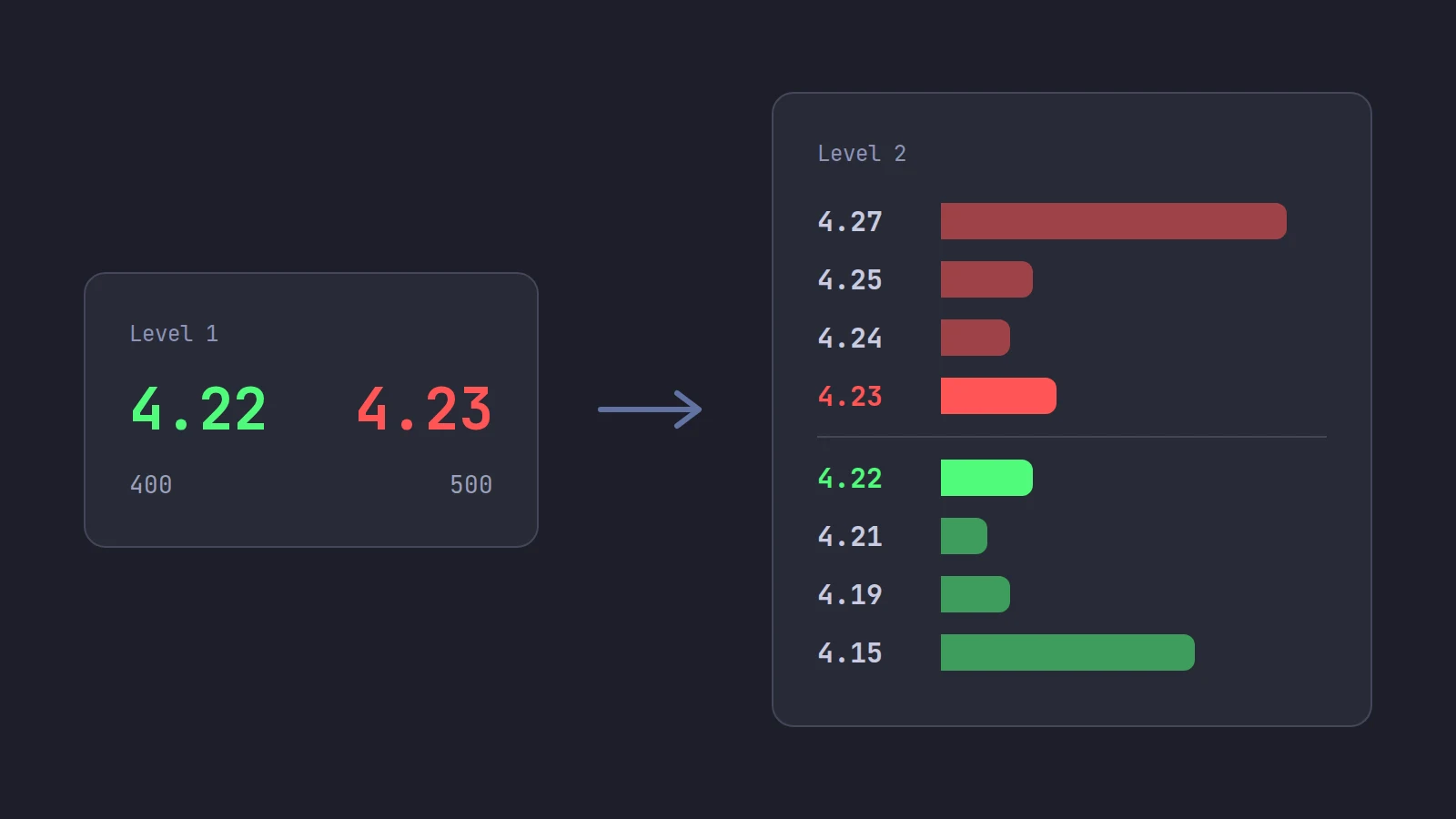
Level 1 vs Level 2 comes down to price versus quantity. Level 1 is the top of the book: the best bid, the best ask, their sizes, the last trade and volume, consolidated across all US exchanges into the national best bid and offer. Level 2 adds depth: every displayed order behind the best prices, with size and venue, on the exchanges you subscribe to. Level 1 tells you the price. Level 2 tells you how much stock is there and what it would cost to trade your size. Scalpers in thin small caps need both. Swing traders and investors in liquid stocks rarely need Level 2.
"Do I need Level 2?" is one of the first questions new day traders ask, usually right after a data subscription screen asks them to pay for it. The answer depends on what you trade and how big you trade it. This post sets out what each level contains, where it comes from, what the difference means for a real order, and who should pay for depth. We use Interactive Brokers' prices as the example because that is the broker Scalpel runs on. Prices were checked on October 22, 2026. Scalpel is independent and not affiliated with or endorsed by Interactive Brokers.
Level 1 vs Level 2 market data at a glance
| Level 1 | Level 2 | |
|---|---|---|
| What you see | Best bid and ask, their sizes, last trade, volume | Every displayed order at each price on each side, with size and venue |
| Where it comes from | The consolidated feeds (the SIPs), which combine every exchange | Each exchange's own depth feed, such as Nasdaq TotalView or NYSE ArcaBook |
| Coverage | The whole market's best prices | Only the exchanges you subscribe to |
| Question it answers | What is the price? | How much is there, and what does my size cost? |
| IBKR non-pro cost, per month | $4.50 add-on on top of the $10.00 snapshot bundle, which $30 in commissions waives | $16.50 for TotalView, $11.00 for ArcaBook, $8.00 for Cboe BZX |
What is Level 1 data?
Level 1 is the inside of the market. For each stock you get:
- Best bid and its size: the highest price anyone is showing to buy.
- Best ask (or offer) and its size: the lowest price anyone is showing to sell.
- Last price and size: the most recent trade.
- Volume, the day's high and low, and usually the change on the day.
In the US, the best bid and ask across every exchange together is the national best bid and offer, or NBBO. Interactive Brokers' market data page puts it plainly: consolidated data "shows the NBBO" and combines all exchanges, and for US stocks "the Consolidated Tapes A, B, and C provide the NBBO" (IBKR market data pricing). Brokers are required to show it: under the SEC's vendor display rule, Rule 603(c) of Regulation NMS, a broker that displays quotes where you can trade must also provide "a consolidated display" for that stock (17 CFR 242.603).
Free Level 1 is not always the real Level 1
IBKR gives every client free real-time streaming quotes from Cboe One and IEX. Its own page labels that data non-consolidated and explains that non-consolidated data "only provides data from some exchanges and does not show the NBBO". For an investor checking a price once a day, that is fine. For a scalper it is not: the best bid you see may not be the best bid in the market, and on a stock where most trading is on Nasdaq and NYSE Arca, the free quote can be a cent or more off the real inside.
IBKR also gives up to 100 free snapshot quotes a month: a real-time quote taken at the moment you enter an order, not a streaming one. That is not something you can scalp from either.
What Level 2 adds
Level 2, also called depth of book or market depth, lists the displayed limit orders behind the best prices: the next bids below the best bid and the next offers above the best ask, each with its size and the venue it rests on. How to read Level 2 walks through reading it step by step.
Two things about depth surprise new traders:
- It is sold one exchange at a time. Each Level 2 feed is one exchange's book. Nasdaq TotalView is Nasdaq's book, ArcaBook is NYSE Arca's. If you subscribe to two, your platform merges those two. Orders resting on any exchange you do not pay for are missing.
- It sits on top of Level 1. IBKR's depth feeds require live top-of-book data first. Depth without Level 1 does not stream.
Regulators have tried to change the first point. In December 2020 the SEC adopted rules to widen the consolidated data so it would include odd-lot quotes and "depth of book data": sizes at each of the next five prices below the national best bid and above the national best offer (SEC press release 2020-311). Whatever the timing of that change, the depth retail traders buy at IBKR today is still the exchange-by-exchange feeds in the table above.
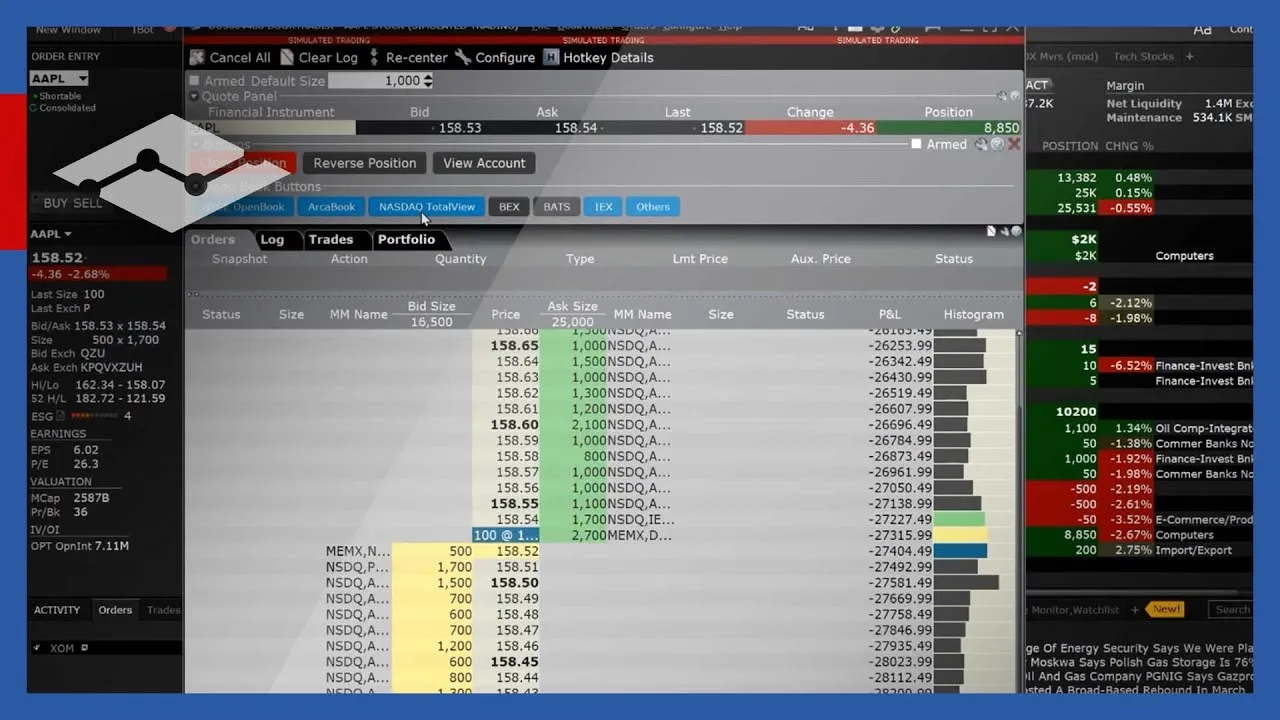
The IBKR lesson below shows BookTrader, where each Deep Book button adds one market center's depth to the price ladder. It is a clear picture of how depth is built up one exchange at a time.
What the difference means for a trade
Level 1 tells you the price for the first few hundred shares. Level 2 tells you the price for yours. Here is a worked example.
ABCD is quoted 4.22 bid, 4.23 ask. Level 1 shows 500 shares at the ask and 400 at the bid. You want 2,000 shares.
Level 2 shows the ask side as 500 at 4.23, 300 at 4.24, 400 at 4.25 and 1,500 at 4.27. A marketable buy for 2,000 shares takes:
| Price | Shares | Cost |
|---|---|---|
| 4.23 | 500 | $2,115 |
| 4.24 | 300 | $1,272 |
| 4.25 | 400 | $1,700 |
| 4.27 | 800 | $3,416 |
| Total | 2,000 | $8,503 (average 4.2515) |
You paid about 2.2 cents a share over the quoted ask, $43 on the order. Level 1 could not have told you that.
Now the exit. The bid side shows 400 at 4.22, 200 at 4.21, 300 at 4.19 and 1,100 at 4.15. Selling 2,000 shares at once fills 400 at 4.22, 200 at 4.21, 300 at 4.19 and 1,100 at 4.15, for $8,352, an average of 4.176: $88 under the quoted bid. If the price has not moved, the round trip costs $151, about 1.8% of the position, before commissions. On a 10-cent target that trade was close to break-even from the moment you entered.
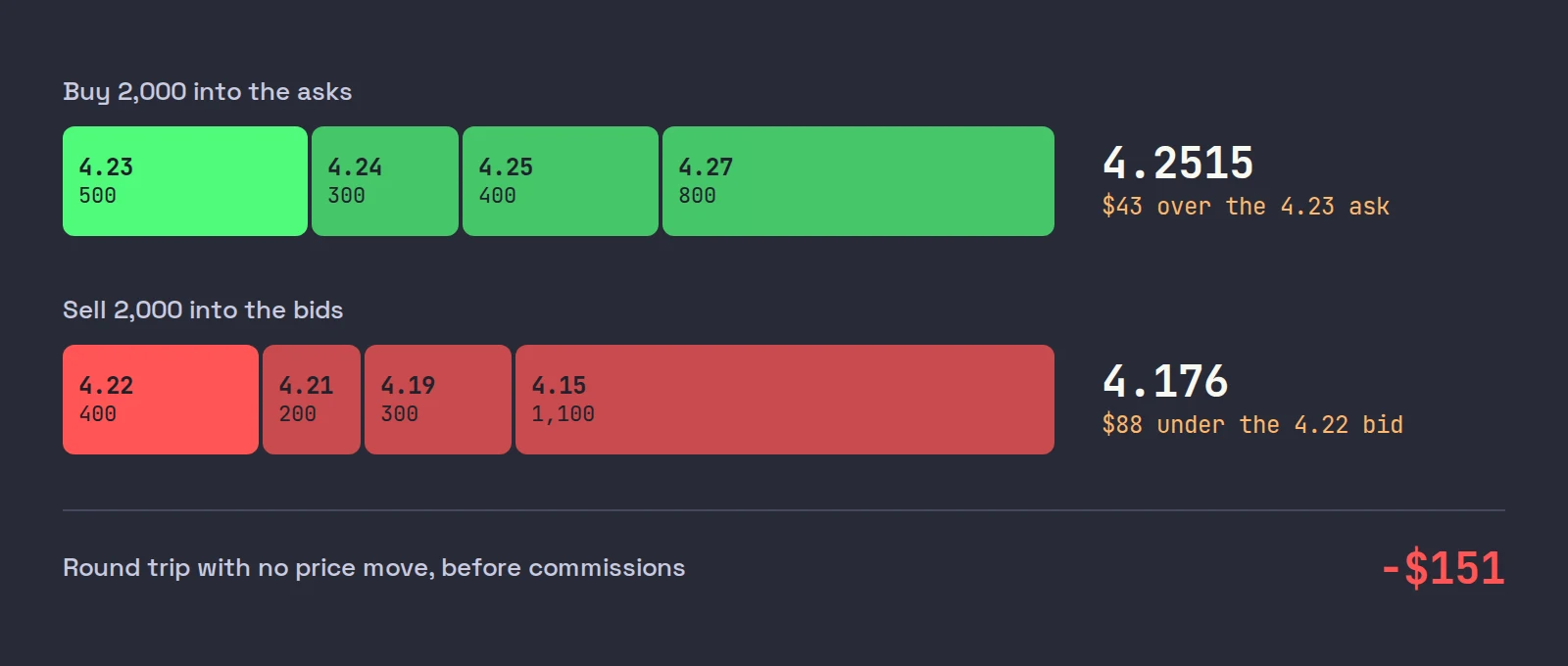
This is why depth matters most for size. On 200 shares, both sides fill at the inside and Level 1 tells you everything. On 2,000 shares of a thin small cap, the book is the trade. The general cost of crossing the spread is covered in the bid-ask spread on small caps, and slippage in day trading covers measuring the gap between the price you saw and the price you got.
Do I need Level 2?
Our view, by trading style:
| You trade | Level 2? | Why |
|---|---|---|
| Small-cap momentum, scalping, pre-market | Yes | Spreads are wide, books are thin, and your size is often bigger than the inside |
| Liquid large caps, intraday, a few hundred shares | Useful, not essential | One-cent spreads and deep books mean Level 1 is close to what you get |
| Swing trades held for days | Rarely | A few cents of entry cost is small against the move you are after |
| Long-term investing | No | Limit orders and Level 1 are enough |
Two honest caveats. First, Level 2 is not an edge by itself. It does not tell you which way the stock goes; it tells you what it costs to be wrong. Second, even full depth is a partial picture. In the SEC's figures for the first quarter of 2022, about 40% of US stock share volume was executed off-exchange, where no book shows it (SEC Release 34-96495). Hidden orders and dark pools covers that gap, and Nasdaq TotalView vs Level 2 covers whether one exchange's full book is worth the money.
Level 1 and Level 2 costs on IBKR
For a non-professional subscriber, from IBKR's market data pricing page on October 22, 2026:
| Subscription | Level | Per month |
|---|---|---|
| Cboe One and IEX streaming | Level 1, non-consolidated | Free |
| US Securities Snapshot and Futures Value Bundle | Snapshot Level 1 | $10.00, waived in a month with $30 in commissions |
| US Equity and Options Add-On Streaming Bundle | Streaming consolidated Level 1 | $4.50 |
| NASDAQ TotalView-OpenView | Level 1 and 2 | $16.50 |
| NYSE ArcaBook | Level 1 and 2 | $11.00 |
| Cboe BZX | Level 1 and 2 | $8.00 |
So live consolidated Level 1 costs $14.50 a month, or $4.50 once your commissions pass $30. Adding TotalView and ArcaBook brings the total to $42.00, or $32.00 with the waiver. The step-by-step subscription, the professional prices and the limit on how many depth books TWS shows at once are in IBKR Level 2. Whether you count as professional is the exchanges' definition, not IBKR's; professional vs non-professional market data explains the test.
Where Scalpel fits
Scalpel needs both levels. It reads live Level 1 for the quotes, the tape and the charts, and IBKR's Level 2 for the montage. Without depth, the book on each desk stays empty. Our guide to the IBKR market data you need lists the exact subscriptions, and the Level 2 guide explains the panel. Scalpel adds no data fees of its own: it uses your IBKR data plus free public sources.
What it adds on top of the raw book is the arithmetic from the worked example: the spread in cents and percent, the total size on each side, and an optional Thin bid exit warning that walks your position down the visible bids while you hold and warns when a full exit would cost 0.6% or more. Our short video shows the Level 2 panel and the tape in under two minutes.
The terms used here, such as Level 2, spread and slippage, are defined in the glossary.
Trading carries a significant risk of loss. Nothing here is financial advice.
Questions
- What is the difference between Level 1 and Level 2 data?
- Level 1 shows the best bid, the best ask, their sizes and the last trade, consolidated across all US exchanges. Level 2 shows the displayed orders behind those best prices, with size and venue, for each exchange you subscribe to.
- What is Level 1 market data?
- Top-of-book data: the national best bid and offer, the size at each, the last trade price and size, and volume. In the US it comes from the consolidated tapes, which combine every exchange.
- Do I need Level 2 for day trading?
- For scalping small caps, trading the pre-market or trading size, yes, because the book decides your fill price. For swing trading or investing in liquid stocks, Level 1 is usually enough.
- Is free Level 1 data on IBKR enough?
- Not for active trading. IBKR's free Cboe One and IEX quotes are non-consolidated: they cover some exchanges and do not show the national best bid and offer. Day traders usually add the streaming consolidated bundle.
- How much does Level 2 cost on Interactive Brokers?
- For non-professionals on October 22, 2026, Nasdaq TotalView-OpenView was $16.50 a month, NYSE ArcaBook $11.00 and Cboe BZX $8.00, on top of live Level 1 data. Check IBKR's market data pricing page for current prices.
Related guides
Guide 1.6The IBKR market data you need for Level 2The IBKR market data that gives Scalpel live quotes, Level 2 and the tape, with no third-party feed to pay for, and how delayed or missing data shows.Guide 3.1How to read Level 2 in ScalpelRead Scalpel's DAS-style Level 2: bids left, asks right, optional colour bands per price, venues, spread, imbalance and delta, and reading players by behaviour.Guide 15.1Day trading glossaryPlain definitions of the day trading and Scalpel terms used in these guides, from Level 2, VWAP and R multiples to float, borrow, dilution and LULD halts.
Keep reading
- How to read Level 2: a plain guide for day tradersHow to read Level 2 step by step: the spread, stacking and thinning, reading the book against the tape, what depth hides, and why pre-market books mislead.
- IBKR Level 2: which subscription, what it costs and how to read itIBKR Level 2 explained: which depth feeds to buy and what they cost today, the TWS limit on books at once, and how to read the book, pre-market included.
- How to read time and sales for day tradingHow to read time and sales: what each column means, the green, red and white colors, odd lots, condition codes, dark prints, and a worked read of the tape.
Practice in SIM, against the live book.A lifetime license, every update included, with a 7-day refund guarantee.Ask in DiscordGet Scalpel