IBKR non-professional subscriber: who qualifies and what it costs
By Scalpel Team. , updated . 7 min read.
In short
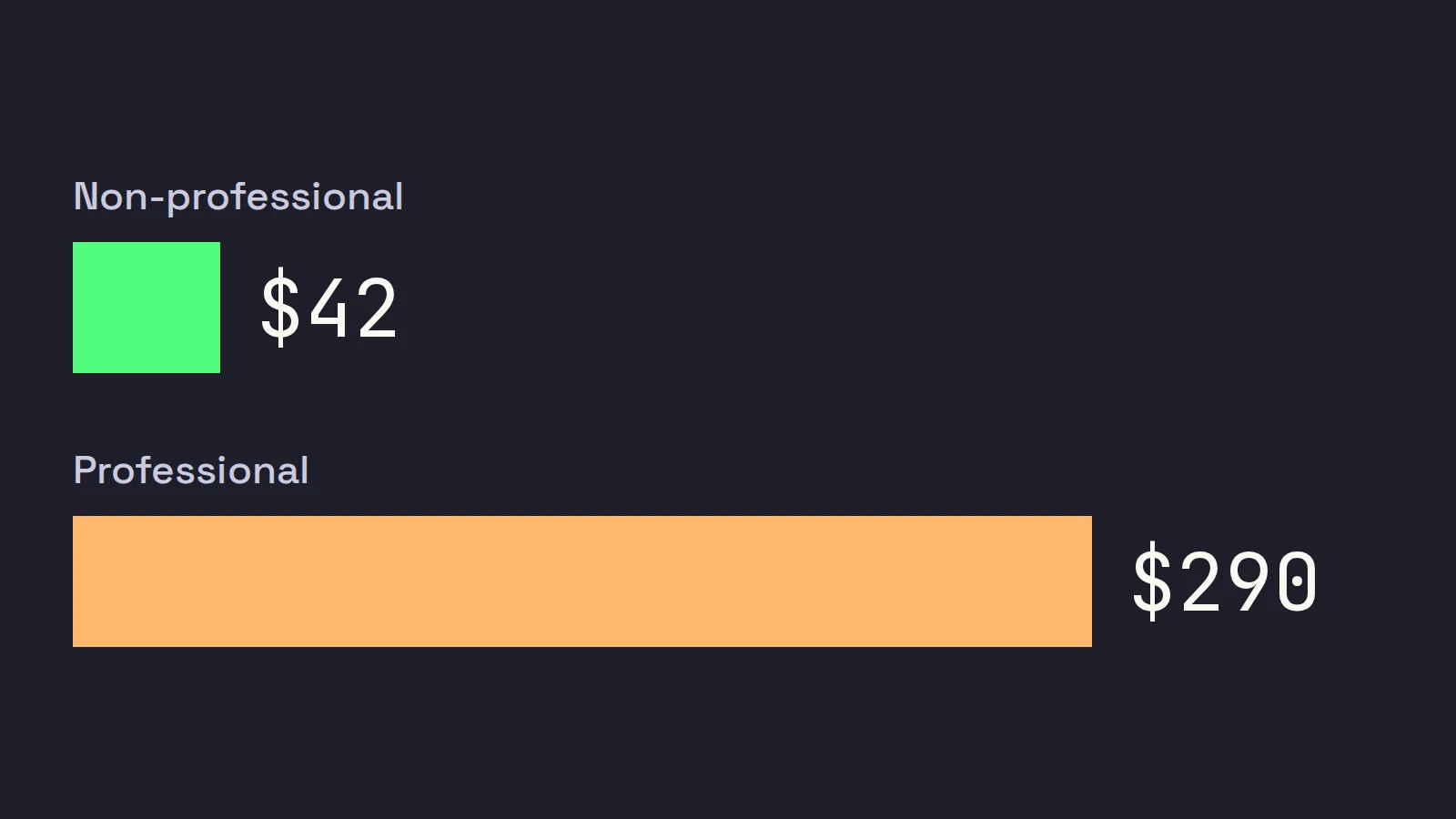
You count as an IBKR non-professional subscriber if you are a natural person, trading your own money in an account in your own name, using the data only for yourself, and you are not registered with a securities or futures regulator or acting as an investment adviser. Everyone else, including every company, LLC and investment club account, is professional, and IBKR treats every new user as professional until the non-professional questionnaire is approved. The difference is large: the usual US day trading set of data costs $42.00 a month non-professional and $290.00 professional.
The first time you subscribe to market data at Interactive Brokers, it asks a set of yes or no questions about who you are and how you use the data. The answers decide which price list you pay from, and the exchanges, not IBKR, write the rules. Getting it wrong in either direction costs money: answer "professional" by mistake and you overpay every month; claim non-professional when you are not, and the exchange can bill the professional rate back to your broker, which will reclassify you. This post covers the IBKR non-pro questionnaire, the exchange definitions behind it, the price difference with a worked example, entity accounts, and how to change your status. Prices and rules checked on October 22, 2026.
Scalpel is independent and not affiliated with or endorsed by Interactive Brokers.
What an IBKR non-professional subscriber is
IBKR's general rule: "By default, organizations such as corporations, limited liability companies, partnerships and any account where the data is used for more than personal investment purposes is deemed to be professional," and private persons may be professional if they are registered as a securities or investment adviser or act in a similar capacity (IBKR: professional vs non-professional).
The exchanges spell it out. The Consolidated Tape Association's policy for NYSE data defines a nonprofessional subscriber as "any natural person who receives market data solely for his/her personal, non-business use" and who is not a securities professional (CTA nonprofessional subscriber policy), meaning the person is:
- not registered or qualified with the SEC, the CFTC, any state securities agency, any securities exchange or association, or any commodities or futures market or association;
- not engaged as an investment adviser as defined in the Investment Advisers Act of 1940, registered or not; and
- not employed by a bank or other exempt organization to do work that would need registration elsewhere.
The same policy says someone working outside the US is a securities professional if they do the same job a US professional would.
Can a day trader be a non-professional subscriber?
Yes. The CTA policy has a section on exactly this: a day trader qualifies as nonprofessional if they are managing their own money and:
- do not help anyone else with investment decisions, and do not share profits;
- do not receive office space and equipment in exchange for work as a financial consultant to a firm; and
- have not entered a profit-sharing agreement with an organization.
The last point catches traders in funded or proprietary programs. If a firm gives you capital and you share the profits, you are trading under a profit-sharing agreement and the exchanges' definition does not let you claim non-professional rates for that activity. The same policy also says a "large trader" under SEC Rule 13h-1 keeps non-professional status as long as the other conditions are met: trading size alone does not make you professional.
The IBKR non-pro questionnaire, question by question
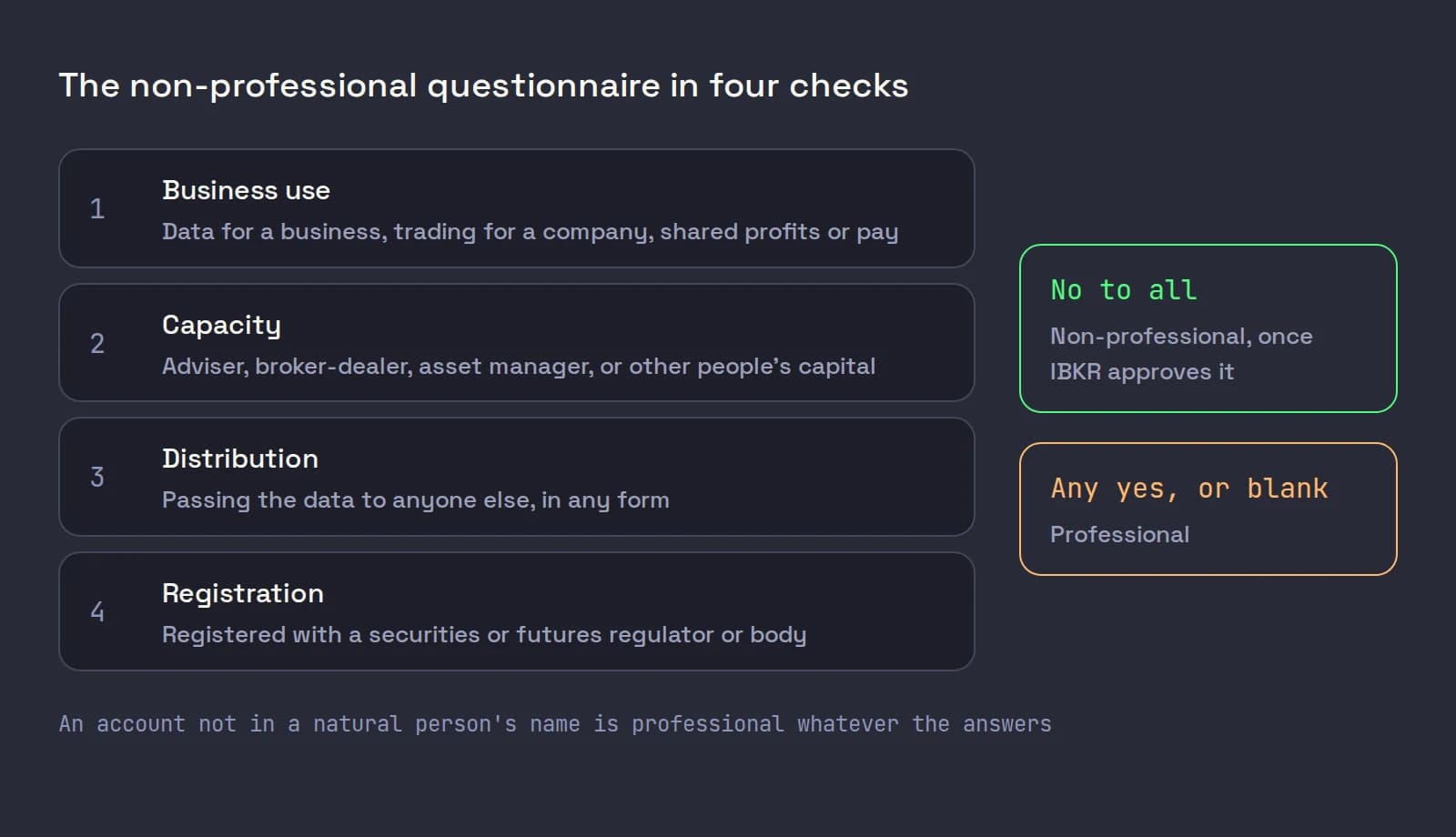
IBKR's guide to the questionnaire says the NYSE and most US exchanges require brokers to positively confirm each subscriber's status, so "without positively identifying customers as non-professional, the default market data status will be professional" (IBKR: market data non-professional questionnaire). Every question must be answered, and an incomplete or unclear answer leaves you professional. The questions fall into four groups:
| Group | What IBKR is asking | Non-professional answer |
|---|---|---|
| Commercial and business purposes | Do you receive data for a business, trade for a company, share trading profits or get paid for trading, or receive office space or equipment for trading? | No to all |
| Acting in a capacity | Are you an investment adviser, broker-dealer or asset manager, using data to manage your employer's assets, or trading anyone else's capital? | No to all |
| Distributing data | Do you pass the data to anyone else, in any form? | No |
| Registration | Are you registered or qualified as a securities or futures professional, or adviser, with any regulator or professional body? | No |
IBKR also says you must re-affirm the questionnaire every year for US exchange data (IBKR: market data access, professional vs non-professional), and its market data group reviews designations continuously. It lists the reasons a non-professional user gets moved back to professional: the questionnaire is outdated or missing, your employment information changed, or a review of third-party social media suggests you are professional (IBKR: why was my status changed to professional?). If you list yourself as a trader at a fund on a professional networking site, expect a question.
Interactive Brokers professional market data: the price difference
Here is the data set most US stock day traders run, at both rates, from IBKR's market data pricing page:
| Subscription | Non-professional, a month | Professional, a month |
|---|---|---|
| US Securities Snapshot and Futures Value Bundle (Professional US Securities Snapshot Bundle for professionals) | $10.00 | $10.00 |
| US Equity and Options Add-On Streaming Bundle | $4.50 | $125.00 |
| NASDAQ TotalView-OpenView (Level 2) | $16.50 | $90.00 |
| NYSE ArcaBook (Level 2) | $11.00 | $65.00 |
| Total | $42.00 | $290.00 |
A worked example. A trader sets up ABCD Trading LLC and opens the IBKR account in the company's name. Under the CTA policy an account in an organization's name is professional even if one person uses the data for personal trading, so the same four subscriptions cost $290.00 a month instead of $42.00. That is $248.00 a month, or $2,976 a year, before a single trade. If the company exists for tax reasons, put that number next to the tax benefit before you decide where the trading account lives.
Two other costs follow from the per-user billing. IBKR charges subscriptions for each user on the account that subscribes, so a second username for a second machine pays again. And none of it is pro-rated: subscribe on the 28th and you pay the month. Which subscriptions you need in the first place is covered in IBKR market data for day trading, and which depth feed is worth it in IBKR Level 2.
Entity, trust and joint accounts
IBKR's guidelines are stricter than many traders expect (IBKR: guidelines on market data subscriber classifications):
| Account | IBKR's classification |
|---|---|
| Individual, in your own name, personal use | Can be non-professional |
| Joint, with immediate family | Can be non-professional |
| Joint or individual used by a non-family third party | Professional |
| Any organization account: company, LLC, family office, small business, prop group, fund | Professional |
| Investment club, paid or unpaid | Professional |
| Trust with one natural-person trustee and family beneficiaries | Can be non-professional |
| Trust with more than one trustee, a company as trustee, or non-family beneficiaries | Professional |
For the trust rows, note IBKR is tighter than the CTA policy, which allows up to four unpaid trustees. At IBKR, what IBKR says is what you get. Retired professionals are a softer case: the CTA policy lets them qualify if they are listed as not registered with FINRA, but they must re-verify every six months.
How to change your market data subscriber status
Open the market data settings
Log in to Client Portal. Click the User menu (the head and shoulders icon), then Settings. Under User Settings, find Trading Platforms and select Market Data Subscriptions.
Open the questionnaire
Click the Configure (gear) icon on the subscriber status panel. IBKR's FAQ for registered users calls it the Non-Commercial Form; the questions are the same four groups as above.
Answer every question
Use the yes or no toggles for every question. An unanswered or unclear question means professional.
Wait for the review
IBKR reviews the answers against your account information and changes the status by hand if it approves. Do not subscribe at professional prices in the meantime unless you need the data that day, since nothing is pro-rated.
IBKR's own lesson on subscribing to market data walks through the Client Portal market data page, how subscriptions are billed, and how professional status changes the price, in about five minutes:

If you are registered with FINRA or another regulator but trade only your own money, IBKR has a separate route: its FAQ says a registered professional who uses the data for personal benefit can complete the Non-Commercial questionnaire, and some data vendors then allow retail pricing (IBKR: downgrading from professional). Its guidelines also say registered users are marked commercial "regardless of their employment status," so ask IBKR which feeds you would actually get at non-professional rates.
Your account type feeds into all of this, which is one more reason to think before you open in a company's name: see which IBKR account to open for day trading. How many symbols your subscriptions can stream at once is a separate limit, covered in IBKR market data lines. For the whole setup, see day trading on Interactive Brokers.
Where Scalpel fits
Scalpel uses the market data on your own IBKR username and nothing else: no separate feed and no charting subscription, so your subscriber status is the only thing that sets your data bill. A desk without live data says so in its header with DELAYED or NO DATA, and the usual causes are a missing subscription or a second session on the same username (fix delayed data). Scalpel connects through TWS or IB Gateway on the same computer (connect Scalpel to Interactive Brokers), and the getting-started video shows the whole first run:
Scalpel is long only and US stocks only, and its stops are app-monitored, so they only work while it runs with a live feed. Nothing in this post is legal advice; if your status is unclear, ask IBKR before you answer.
Trading carries a significant risk of loss. Nothing here is financial advice.
Questions
- Am I a professional or non-professional market data subscriber on IBKR?
- You are non-professional if you are a natural person trading your own money in your own name, use the data only for yourself, and are not registered with a securities or futures regulator or acting as an investment adviser. Company, LLC and investment club accounts are professional.
- Can a day trader be a non-professional subscriber?
- Yes. The exchanges' policy says a day trader managing their own money qualifies, as long as they do not advise others, share profits, receive office space for consulting work, or trade under a profit-sharing agreement with a firm.
- How much more does professional market data cost on IBKR?
- For the usual US day trading set, streaming quotes plus NASDAQ TotalView-OpenView and NYSE ArcaBook, IBKR lists $42.00 a month non-professional and $290.00 professional.
- Why did IBKR change my status to professional?
- IBKR says it happens when the non-professional questionnaire is outdated or missing, your employment information changed, or third-party social media suggests professional activity. The questionnaire must be re-affirmed every year.
- Is an LLC trading account professional for market data?
- Yes. Exchange policy and IBKR's guidelines classify any account not in a natural person's name as professional, even if one person uses the data for personal trading.
- How do I change my market data status to non-professional on IBKR?
- In Client Portal, open Settings, then Market Data Subscriptions under Trading Platforms, click the gear on the subscriber status panel, answer every question, and wait for IBKR's review.
Related guides
Guide 1.6The IBKR market data you need for Level 2The IBKR market data that gives Scalpel live quotes, Level 2 and the tape, with no third-party feed to pay for, and how delayed or missing data shows.Guide 1.4Connect Scalpel to Interactive BrokersRun TWS or IB Gateway, match the API port and watch Scalpel connect. Which program to use, the ports (7497, 7496, 4001) and what the link banner tells you.Guide 13.4Delayed data, NO DATA or STALE, or Depth unavailableA desk shows DELAYED, NO DATA or STALE, or a Depth unavailable toast: which market data subscription or IBKR limit causes each one and how to fix it.
Keep reading
- Day trading on Interactive Brokers: the complete setup (2026)Interactive Brokers day trading, set up end to end: 2026 margin rules, Level 2 data costs, TWS vs IB Gateway, hotkeys, Tiered vs Fixed and a checklist.
- Scalping on Interactive Brokers: can you, and how to set it upIs TWS good for scalping? IBKR's routing and fills are fine; TWS is the friction. What slows scalpers down and a step by step TWS scalping setup to fix it.
- A TWS day trading layout for scalpers: the Mosaic setupA TWS day trading setup step by step: Mosaic windows, color-linked groups, 1 and 5-minute charts, time and sales, saving the layout and settings for speed.
Practice in SIM, against the live book.A lifetime license, every update included, with a 7-day refund guarantee.Ask in DiscordGet Scalpel