Dark pool prints and hidden orders: what Level 2 does not show
By Scalpel Team. , updated . 8 min read.
In short
Level 2 shows only displayed orders on lit exchanges. Two big parts of the market never appear there before they trade: hidden and reserve orders resting on exchanges, and trades done off-exchange in dark pools and by wholesalers. Off-exchange trades are reported to a FINRA trade reporting facility within 10 seconds and then show up on the tape as dark pool prints. In September 2026, 50.63% of US share volume executed off-exchange, and in the second quarter of 2026 about 30% of the volume on exchanges executed against hidden orders. Most shares you see print on the tape were never on any book you could see.
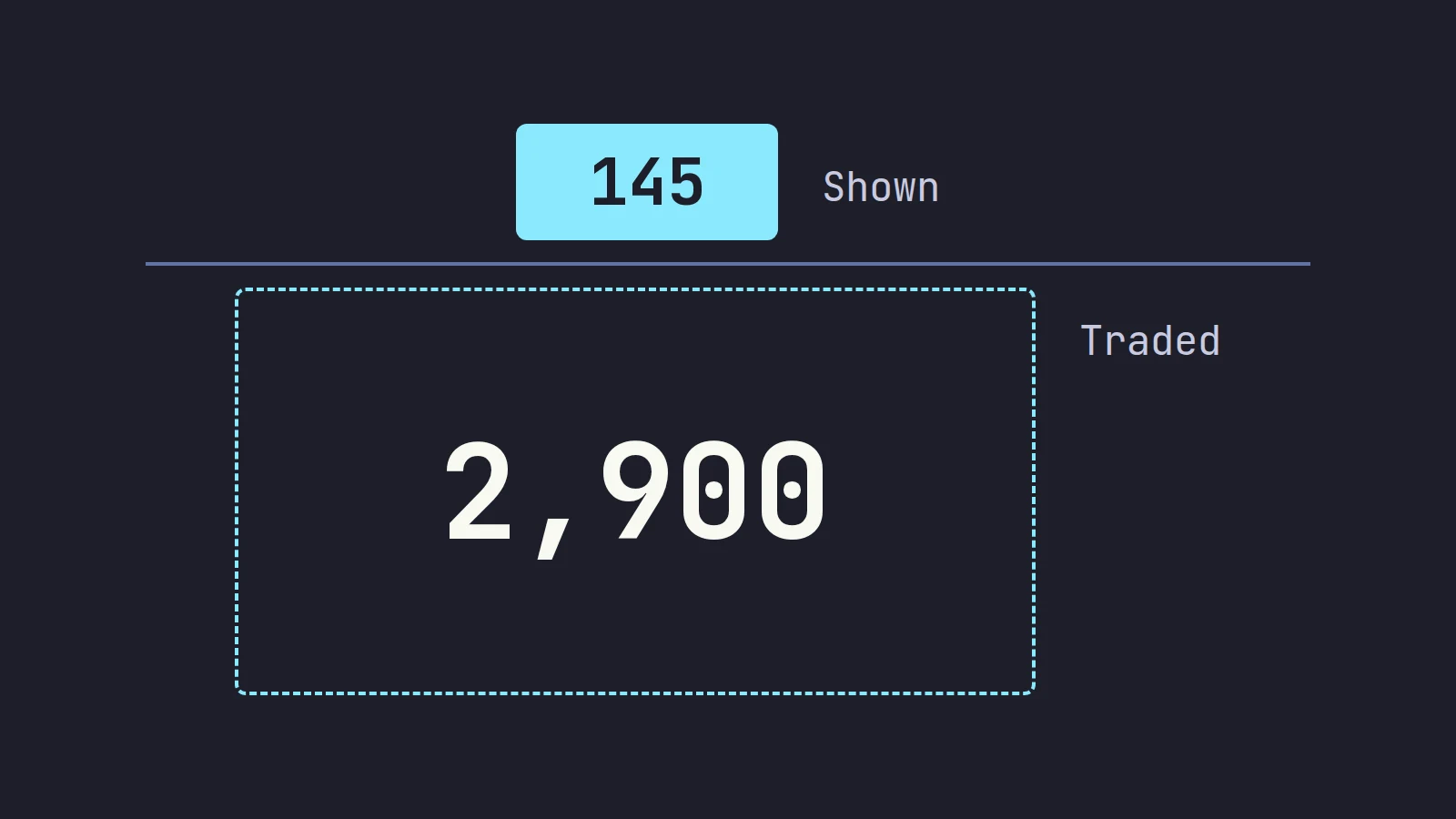
Watch a small cap long enough and you will see a trade that makes no sense against the book. A 20,000-share print at a price where Level 2 showed 300 shares. A print at 5.705 when the market is 5.70 by 5.71. Size hitting an offer over and over while the offer never shrinks. None of those are glitches. They are the parts of the market that Level 2 was never built to show.
This post covers where that hidden volume comes from, how big it is, how dark pool prints reach your tape, and what it means for reading the book. Figures were checked against the primary sources on October 22, 2026.
What Level 2 shows, and what it misses
A Level 2 screen shows displayed limit orders resting on lit exchanges: Nasdaq, NYSE Arca, the Cboe exchanges, IEX, MEMX and the rest, depending on which depth feeds you pay for. That leaves out three things:
- Hidden orders on exchanges. Orders that rest on an exchange's book but are not displayed, fully or partly.
- Dark pools. Alternative trading systems (ATSs) that match buyers and sellers without publishing a quote.
- Wholesalers. Firms that fill retail brokers' orders themselves, off any exchange.
All three show up on the tape once a trade happens. None shows up on the book before it. Our pillar post on how to read Level 2 covers what the visible book can tell you; this post is about the rest.
Off-exchange volume: how much never touches a book
Cboe publishes monthly share volume for every US venue in its historical market volume data. Off-exchange trades are the ones reported through FINRA's trade reporting facilities (TRFs). From that data:
| Period | Off-exchange share of US share volume |
|---|---|
| Full year 2025 | 50.61% |
| September 2026 | 50.63% |
| September 2026, Nasdaq-listed stocks only | 52.01% |
Roughly every second share traded in US stocks now trades away from the exchanges. Most of it does not come from dark pools in the movie sense. A large part is retail order flow: in its December 14, 2022 order competition proposal, the SEC said retail brokers "route more than 90 percent" of individual investors' marketable orders "to a small group of off-exchange dealers, known as wholesalers." When a retail trader buys 200 shares of a small cap on a commission-free app, the fill usually comes from a wholesaler's own inventory, not from anyone on your Level 2.
Dark pool prints: how off-exchange trades reach your tape
Every off-exchange trade in a US-listed stock has to be reported. Under FINRA Rule 6380A, a firm reports to the FINRA/Nasdaq TRF "as soon as practicable but no later than 10 seconds after execution," and pre-market trades between 04:00 and 09:30 ET carry a modifier to show they were done outside normal hours. The report goes out on the consolidated tape, and that is the dark pool print you see.
Three TRFs carry almost all of it. In Cboe's market share data they appear as FINRA / Nasdaq TRF Carteret (DQ), FINRA / NYSE TRF (DN) and FINRA / Nasdaq TRF Chicago (DB). In September 2026, the Carteret facility alone reported 47.55% of all US share volume.
What a dark pool print tells you, and what it does not:
- It already happened. The trade was matched away from the book and reported afterward. You are reading history, a few milliseconds to a few seconds old.
- It has no visible aggressor. Many off-exchange trades print between the bid and the ask, often at the midpoint. A print at 5.705 in a 5.70 by 5.71 market is neither a buyer lifting the offer nor a seller hitting the bid. Rule 612 sets the minimum increment for bids, offers and orders, not for trades, which is why sub-penny prices appear on the tape but never on the book.
- It does not say which dark pool. The print names the reporting facility, not the venue. FINRA publishes per-ATS volume by stock, but under Rule 6110 only as weekly totals, no earlier than two weeks after the week for the most active stocks and four weeks for the rest. Most small caps fall in the second group.
- A big print is not a signal of direction. A 50,000-share block at the midpoint had a buyer and a seller who both wanted it. Calling it "institutional buying" is a guess.
Our posts on time and sales and tape reading cover reading prints in general.
IEX, the exchange, made a short course on US market structure that IBKR hosts on IBKR Campus. This lesson explains exchanges, alternative trading systems and internalization in about six minutes, and it is the clearest neutral explanation of where off-exchange volume comes from:
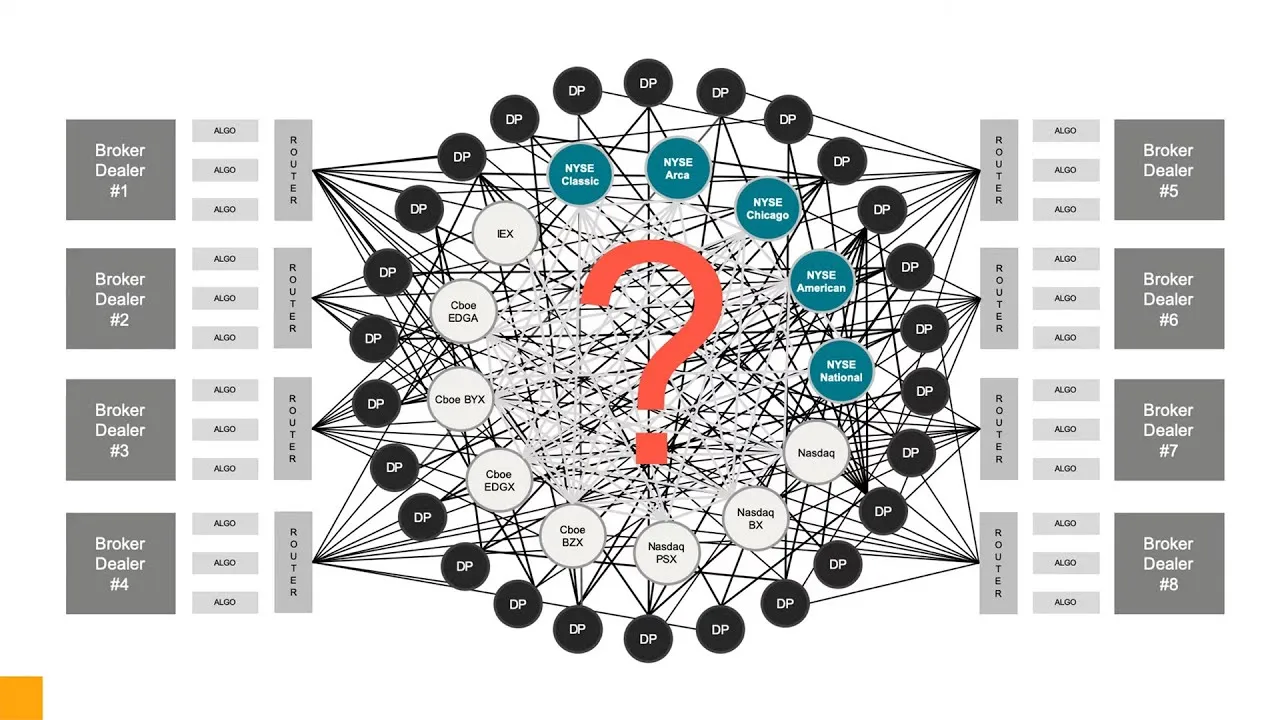
Your own broker may run one of these venues. Interactive Brokers operates IBKR ATS, where clients can post orders that are "eligible to trade against incoming SmartRouted orders that are marketable against them." How IBKR's router decides where your order goes is covered in our post on IBKR SmartRouting.
Hidden orders on Level 2: size on the book you cannot see
Even on lit exchanges, part of the book is invisible. Exchanges accept two kinds of orders that hide size:
- Hidden (non-displayed) orders. The whole order rests on the book without showing. IBKR's order type page describes the Hidden attribute as a way "to completely hide the submitted quantity from the market."
- Reserve or iceberg orders. Only part of the order shows. IBKR describes its Iceberg/Reserve attribute as "publicly displaying only a specified portion of the total order size." When the shown part fills, the exchange refills it from the hidden reserve.
How much volume executes against them? The SEC measures it from exchange feeds in its market structure metrics, and its methodology counts a hidden trade as "a marketable order matching an undisplayed, or hidden, resting order." Averaged over the trading days of April to June 2026, for stocks:
| Exchange volume executed against hidden orders, Q2 2026 | Share |
|---|---|
| All exchanges | 30.3% |
| Nasdaq | 29.0% |
| NYSE Arca | 28.7% |
So on the exchanges your Level 2 does show, close to a third of the volume traded against orders the book did not display.
Putting it together: how much of the tape Level 2 could have shown
Combine the two sources for a rough picture. They cover different periods, so treat it as an estimate:
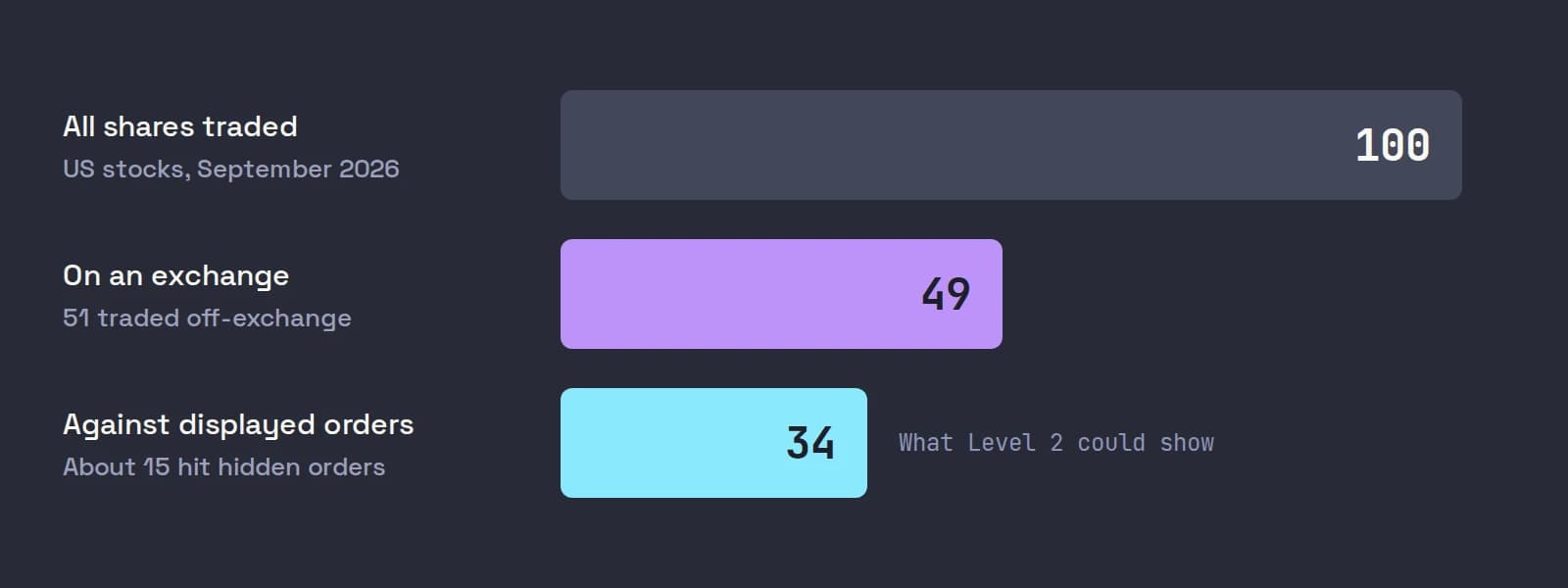
- Of every 100 shares traded in September 2026, about 51 traded off-exchange.
- Of the 49 that traded on exchanges, about 30%, so roughly 15, executed against hidden orders.
- That leaves roughly 34 shares out of 100 that executed against displayed orders, the only kind any Level 2 feed can show you in advance.
That is the honest scope of Level 2. It is a view of about a third of the trading, and of the part of the market that chose to be seen.
What to do with this as a day trader
- Treat the book as a sample. It shows who is willing to be seen, not everyone who is there. Size can appear from nowhere at a price, and it can be gone just as fast. Our post on spoofing on Level 2 covers size that is shown and pulled.
- Watch for prints that do not match the book. Far more stock trading at a price than was ever displayed there is the signature of an iceberg. That one you can see, because the displayed piece keeps refilling.
- Do not read direction into mid-price prints. A big trade between the bid and ask did not lift the offer or hit the bid. Weight the prints at the ask and at the bid.
- Do not lean on hidden buyers. A hidden buyer under your long is not a floor: once it is filled, nothing is left at that price.
- Expect more depth than you see, in both directions. A breakout can stall on a hidden seller, and a thin-looking bid can absorb more than it shows. Size so that being wrong about the book does not hurt.
Where Scalpel fits
Scalpel is a desktop day-trading cockpit for your own Interactive Brokers account. It cannot see dark pools or hidden orders either; no retail platform can. What it does is watch the tape against the book, which is the one place hidden size gives itself away.
When one venue's quote at one price keeps refilling while far more trades there than it ever showed, Scalpel marks the row with a layers icon and the read line says Hidden seller refilling at the offer or Hidden buyer refilling at the bid. The rule counts only lit prints, the trades on an exchange's displayed book, because off-exchange prints never touched the book and cannot refill it. The exact thresholds are in the iceberg orders guide.
On the tape, a print between the bid and ask is drawn grey and left out of the buy-minus-sell delta, so mid-price dark pool prints do not pass for buying or selling (read time and sales). The read the players guide covers the other footprints, and the Level 2 guide covers every number on the panel. Our section video shows the montage, the tape and the iceberg icon together:
Scalpel is long only, and its stops are watched by the app rather than resting at IBKR, so they only work while Scalpel runs with a live feed.
Scalpel is independent and not affiliated with or endorsed by Interactive Brokers, IEX, Cboe or FINRA.
Trading carries a significant risk of loss. Nothing here is financial advice.
Questions
- What are dark pool prints?
- Trades executed off-exchange, in a dark pool or by a wholesaler, and reported to a FINRA trade reporting facility. They appear on the consolidated tape after the trade, usually within 10 seconds, but they never appeared on any order book beforehand.
- How much stock volume trades off-exchange?
- About half. Cboe's market volume data shows 50.61% of US share volume executed off-exchange in 2025 and 50.63% in September 2026.
- Can you see hidden orders on Level 2?
- No. Hidden orders rest on an exchange without displaying, and reserve orders show only part of their size. You can only infer them from the tape, for example when far more trades at a price than the book ever showed there.
- Do dark pool prints show which way a stock will move?
- Not reliably. Many print between the bid and ask, so there is no clear buyer or seller pushing the price, and the print does not say which venue or firm traded. Treat a big block as information about volume, not direction.
- How fast are dark pool trades reported?
- FINRA Rule 6380A requires firms to report to the FINRA/Nasdaq trade reporting facility as soon as practicable and no later than 10 seconds after execution, including in the pre-market from 04:00 ET.
- How much exchange volume hits hidden orders?
- The SEC's market structure metrics show about 30% of stock volume on US exchanges executed against hidden, undisplayed orders on average from April to June 2026.
Related guides
Guide 3.2Spot iceberg orders on Level 2How Scalpel flags an iceberg: one venue refilling a small size while far more trades there, the exact rule behind the icon, and why it is not a floor.Guide 3.3Read the time and sales tapeRead the time and sales tape in Scalpel: prints coloured by who took liquidity, size bars, dollar values, the size filter, and the tape against Level 2.Guide 3.1How to read Level 2 in ScalpelRead Scalpel's DAS-style Level 2: bids left, asks right, optional colour bands per price, venues, spread, imbalance and delta, and reading players by behaviour.
Keep reading
- How to read Level 2: a plain guide for day tradersHow to read Level 2 step by step: the spread, stacking and thinning, reading the book against the tape, what depth hides, and why pre-market books mislead.
- IBKR Level 2: which subscription, what it costs and how to read itIBKR Level 2 explained: which depth feeds to buy and what they cost today, the TWS limit on books at once, and how to read the book, pre-market included.
- Level 1 vs Level 2 market data: what the difference means for a tradeLevel 1 vs Level 2 market data: top of book vs depth, a worked example of what your size really costs, IBKR prices, and who actually needs Level 2.
Practice in SIM, against the live book.A lifetime license, every update included, with a 7-day refund guarantee.Ask in DiscordGet Scalpel