IBKR Pro vs IBKR Lite for day trading
By Scalpel Team. , updated . 7 min read.
In short
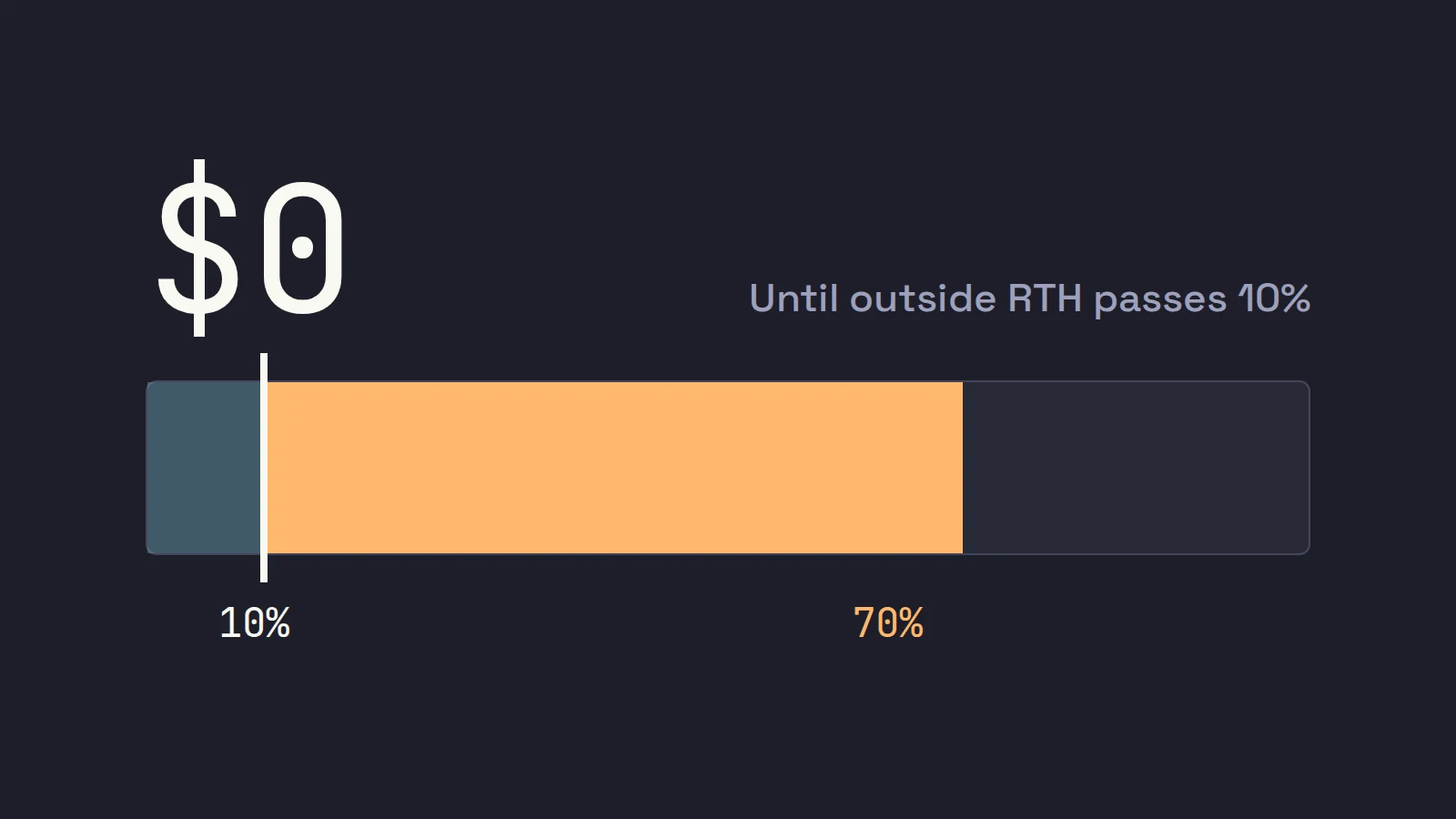
IBKR Pro vs Lite comes down to three things for a day trader. Lite charges $0 commission on US listed stocks, but its orders are normally sent to market makers that pay IBKR for the flow, its pre-market and sub-dollar trades are charged once they pass 10% of your monthly US stock volume, and IBKR says its API is not available on Lite. Pro charges per share, routes through SmartRouting with no payment for order flow, and works with every tool that connects to TWS or IB Gateway. If you trade often, trade the pre-market or use any third-party platform, open Pro.
Interactive Brokers sells two pricing plans for the same account. IBKR's own FAQ describes Lite as serving "the less active trader" and Pro as serving "the active trader," which is close to the whole answer. But the details matter, because on commissions alone Lite often looks cheaper even for a busy trader, and the costs that offset it are less visible. This post compares IBKR Pro and Lite for day trading, with a worked monthly cost example, what payment for order flow means on IBKR Lite, and how to switch. Prices and rules checked on October 22, 2026.
Scalpel is independent and not affiliated with or endorsed by Interactive Brokers.
IBKR Pro vs Lite at a glance
| IBKR Lite | IBKR Pro | |
|---|---|---|
| US listed stocks and ETFs | $0 commission | Fixed $0.005 a share, or Tiered from $0.0035 a share |
| Pre-market, after hours, auction and sub-$1 trades | Free while under 10% of monthly US stock volume, then the lesser of $0.005 a share or 1% of trade value | Same per-share price as any other trade |
| OTC stocks, warrants, overnight session | Charged at Fixed pricing | Fixed or Tiered |
| How orders are routed | Normally to market makers that pay IBKR for order flow | SmartRouting; IBKR has no payment for order flow arrangement for Pro |
| TWS | Yes | Yes |
| IBKR API (and every tool built on it) | Not available | Yes |
| Interest paid on cash | Benchmark minus 1.5% | Benchmark minus 0.5% |
| Margin loan rate | Benchmark plus 2.5% | From benchmark plus 1.5%, lower on larger loans |
| Who can open it | US residents: individual, joint, IRA and trusts of natural persons | All account types, worldwide |
Sources: IBKR's Lite and Pro comparison and IBKR's stock commissions page. IBKR adds that accounts with less than $100,000 net asset value earn interest at a proportionally reduced rate, on both plans.
Market data costs the same on both plans: subscriptions and their prices depend on your subscriber status, not your pricing plan. One quiet difference does follow from the commission line, though. IBKR sets your number of market data lines from the greater of 100, your monthly commissions divided by 8, or an equity formula, so a Lite account paying $0 in commissions stays on the default 100 lines unless it has more than $1 million of equity or buys Quote Booster packs.
IBKR Lite day trading: where the $0 stops
Lite's commission-free price has two edges a day trader hits.
The 10% rule. Trades from opening and closing auction orders, outside regular trading hours, and US listed stock fills under $1.00 are free only while their combined share volume stays at or under 10% of your monthly US stock volume. Past that, IBKR charges the lesser of $0.005 a share or 1% of trade value on those trades. IBKR also notes that a market order placed before 09:30 ET is treated as a market-on-open order and counts toward the threshold. A trader whose morning starts at 07:00 ET will cross 10% in the first week.
Non-retail flow. IBKR says Lite is meant for retail investors and "reserves the right to reject any IBKR Lite order or series of orders if IBKR determines the order(s) appear to show non-retail trading behavior," offering to resubmit them on Fixed pricing. IBKR does not publish where that line sits. We would not build a day trading routine on a plan that can refuse your order flow at a threshold you cannot see.
IBKR Lite payment for order flow, in numbers
Every broker that routes US stock orders publishes a quarterly Rule 606 report. IBKR's report for the second quarter of 2026 spells out the Lite arrangement: Lite orders "are normally routed to select over-the-counter market makers for handling," and those market makers pay IBKR (IBKR Rule 606 report, Q2 2026):
- On a marketable order, 12% of the spread between the national best bid and offer when the order arrived.
- On a non-marketable order, $0.27 per 100 shares at $1.00 and above, and $0.0027 per 100 shares below $1.00.
- Nothing for executions outside regular trading hours, or from opening and closing auction orders.
IBKR's own report names the trade-off: "A potential effect of these payments is reduced price improvement on executions received by IBKR-LITE clients, in proportion to the payment received by IBKR." For Pro order flow sent to the same market makers, the report says IBKR has no payment for order flow arrangement.
To put a size on it: a marketable buy of 500 ABCD with the stock quoted $4.00 by $4.02 has a 2 cent spread. The market maker pays IBKR 12% of $0.02, or $0.0024 a share, which is $1.20 on that order. That is what IBKR receives, not a fee on your statement, and how much of it comes out of your fill is not something anyone can see from the outside. Note the last bullet too: in the pre-market there is no payment, which is also where the 10% rule starts charging you.
How IBKR routes Pro orders, and when to route direct, is covered in IBKR SmartRouting vs direct routing.
A worked monthly cost example
A trader takes 10 round trips a day, 500 shares at about $4.00, over 20 trading days: 400 orders and 200,000 shares a month. Commissions only, before exchange, clearing and regulatory fees:
| Month | IBKR Lite | IBKR Pro Tiered | IBKR Pro Fixed |
|---|---|---|---|
| A: 5% of shares outside regular hours | $0 | $700 plus exchange and clearing fees | $1,000 |
| B: 70% of shares outside regular hours | $700 | $700 plus exchange and clearing fees | $1,000 |
The arithmetic. Fixed is $0.005 x 500 = $2.50 an order (above its $1.00 minimum), x 400 orders = $1,000, with exchange fees included. Tiered is 200,000 x $0.0035 = $700, with venue and clearing fees on top that depend on whether each order took or added liquidity (IBKR Tiered vs Fixed works those out). On Lite, month A stays under 10%, so it costs nothing. In month B, 140,000 pre-market shares x $0.005 = $700, because $0.005 is less than 1% of a $4.00 stock; the 60,000 regular-hours shares stay free.
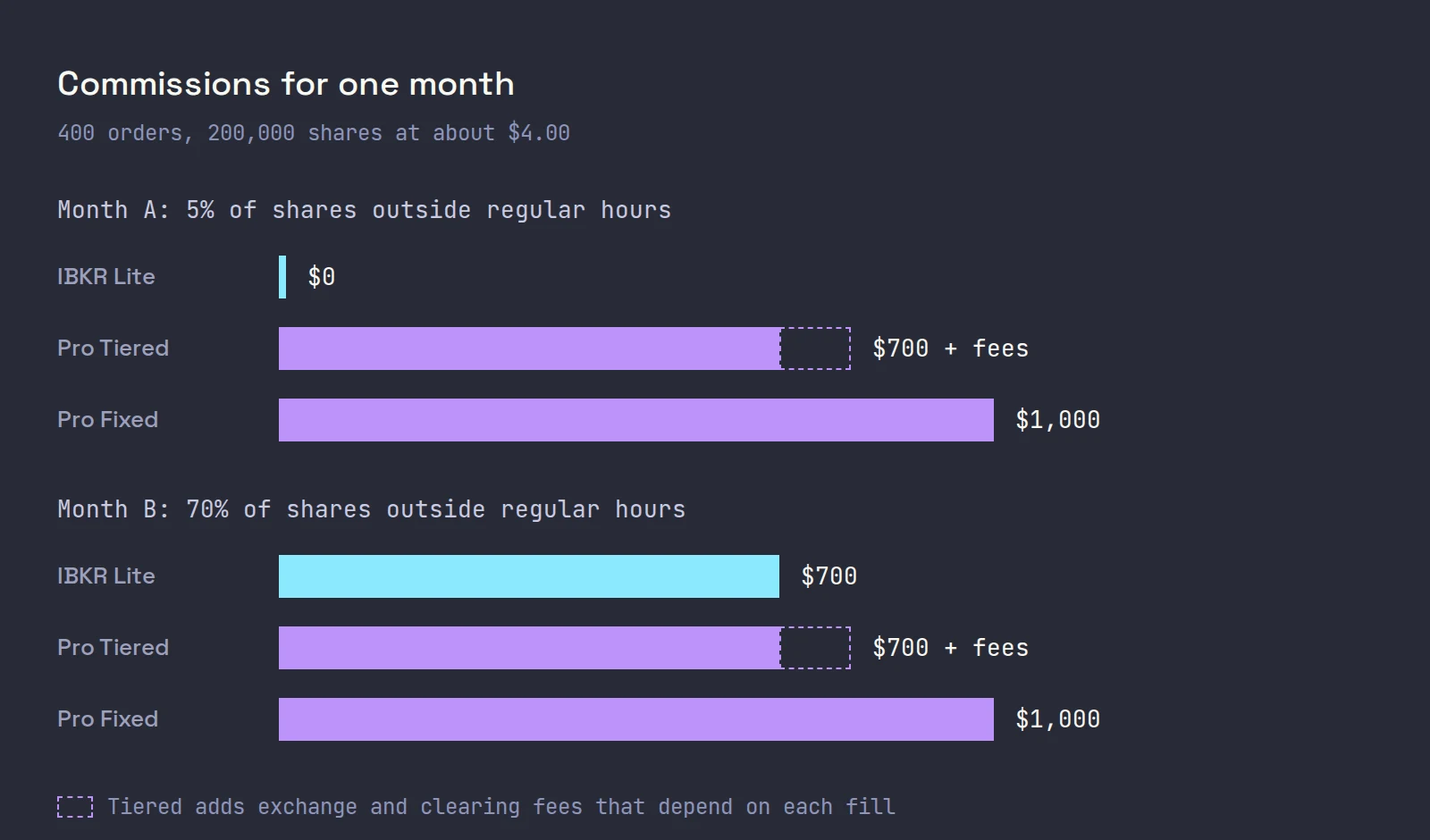
So on commission alone Lite never costs more than Pro Fixed's per-share rate, and a pre-market trader on Lite pays about what Tiered charges before fees. That is the honest result, and it is why the choice is not about the commission line. It is about what you lose on Lite: the API, Pro's routing, Tiered's lower rates as volume grows (IBKR's Tiered schedule drops to $0.002 a share above 300,000 shares a month) and certainty that your orders will be accepted.
IBKR Lite and the API
IBKR's FAQ is short: "The IBKR API is not available to IBKR Lite accounts." An order sent through the API on a Lite account comes back with "You are not allowed to trade on IBKR-LITE account" (IBKR: API with IBKR Lite). IBKR's API documentation also lists an IBKR Pro account as a requirement for receiving market data through the API.
That rules Lite out for any tool that connects to TWS or IB Gateway: trading front ends, journals that read your fills live, charting bridges and your own Python scripts. You can still run TWS itself on Lite. If you plan to enable the TWS API for anything, or think you might, start on Pro.
Which plan suits which trader
| You | Plan |
|---|---|
| Trade by hand in TWS, a few trades a week, mostly 09:30 to 16:00 ET | Lite is fine |
| Trade the pre-market most mornings | Pro: you will pay on Lite anyway, and the payment-free hours are exactly yours |
| Use any third-party platform or script | Pro: the API needs it |
| Trade size, or many times a day | Pro, usually Tiered, which rewards volume and adding liquidity |
| Live outside the US | Pro: Lite is for US residents |
The account type question (cash, margin or portfolio margin) is separate from the pricing plan; it is covered in which IBKR account to open for day trading. For the full setup around it, see day trading on Interactive Brokers.
How to switch from IBKR Lite to IBKR Pro
Open the pricing plan setting
In Client Portal, click the User menu (the head and shoulders icon), then Settings. Under Account Settings, in Account Configuration, click IBKR Pricing Plan.
Pick IBKR Pro
Select IBKR PRO, click CONTINUE and follow the prompts. IBKR's FAQ says your first three switches are processed overnight; after three, a new request is processed 90 days after your last one (IBKR: reclassifying Lite and Pro).
Re-enter your GTC orders
Any good-til-cancelled orders are cancelled when the account changes plan. Note them before you switch and place them again after.
Choose Fixed or Tiered
Once on Pro, pick Fixed or Tiered. If you are not sure, start on Tiered for small marketable orders and compare a month of your own fills.
Where Scalpel fits
Scalpel connects to your account through the TWS API, so by IBKR's rules it needs IBKR Pro. In SIM, set Settings > Risk > Commission plan to the plan your account is on, IBKR Pro Tiered or IBKR Pro Fixed, so your paper P&L carries the fees you will really pay (commissions in Scalpel). The getting-started video shows the connection to TWS or IB Gateway and a first trade in SIM:
The connection itself is covered in connect Scalpel to Interactive Brokers. Scalpel is long only and trades US stocks; its stops are app-monitored, not resting at IBKR, and only work while it runs with a live feed.
Trading carries a significant risk of loss. Nothing here is financial advice.
Questions
- Is IBKR Pro or Lite better for day trading?
- For most day traders, Pro. Lite is commission-free on US listed stocks, but it routes to market makers that pay for order flow, charges pre-market trades once they pass 10% of your monthly volume, and does not allow the API. IBKR itself describes Lite as for the less active trader.
- Does IBKR Lite use payment for order flow?
- Yes. IBKR's Rule 606 report says Lite orders are normally routed to over-the-counter market makers that pay IBKR 12% of the quoted spread on marketable orders and $0.27 per 100 shares on non-marketable orders at $1 and above. There is no such payment for Pro.
- Can I use the API or third-party platforms with IBKR Lite?
- No. IBKR says the API is not available to IBKR Lite accounts, and API orders on Lite are refused. TWS itself works on Lite.
- Is pre-market trading free on IBKR Lite?
- Only while outside-regular-hours, auction and sub-dollar trades stay at or under 10% of your monthly US stock volume. Past that, IBKR charges the lesser of $0.005 a share or 1% of trade value on those trades.
- How do I switch from IBKR Lite to Pro?
- In Client Portal, open Settings, then IBKR Pricing Plan under Account Configuration, choose IBKR PRO and continue. The first three switches process overnight, and good-til-cancelled orders are cancelled when the plan changes.
Related guides
Guide 6.3Commissions: pick your IBKR planMatch Scalpel's SIM fees to your Interactive Brokers plan: Pro Tiered, Pro Fixed, Lite or custom, plus exchange and clearing fees, and the FEE column.Guide 1.4Connect Scalpel to Interactive BrokersRun TWS or IB Gateway, match the API port and watch Scalpel connect. Which program to use, the ports (7497, 7496, 4001) and what the link banner tells you.Guide 1.5Enable the API in TWS and IB GatewayTurn on Enable ActiveX and Socket Clients in TWS or IB Gateway, set the socket port, allow 127.0.0.1 and switch off read-only API so Scalpel can trade.
Keep reading
- Day trading on Interactive Brokers: the complete setup (2026)Interactive Brokers day trading, set up end to end: 2026 margin rules, Level 2 data costs, TWS vs IB Gateway, hotkeys, Tiered vs Fixed and a checklist.
- Scalping on Interactive Brokers: can you, and how to set it upIs TWS good for scalping? IBKR's routing and fills are fine; TWS is the friction. What slows scalpers down and a step by step TWS scalping setup to fix it.
- A TWS day trading layout for scalpers: the Mosaic setupA TWS day trading setup step by step: Mosaic windows, color-linked groups, 1 and 5-minute charts, time and sales, saving the layout and settings for speed.
Practice in SIM, against the live book.A lifetime license, every update included, with a 7-day refund guarantee.Ask in DiscordGet Scalpel