The best time of day to day trade momentum stocks
By Scalpel Team. , updated . 7 min read.
In short
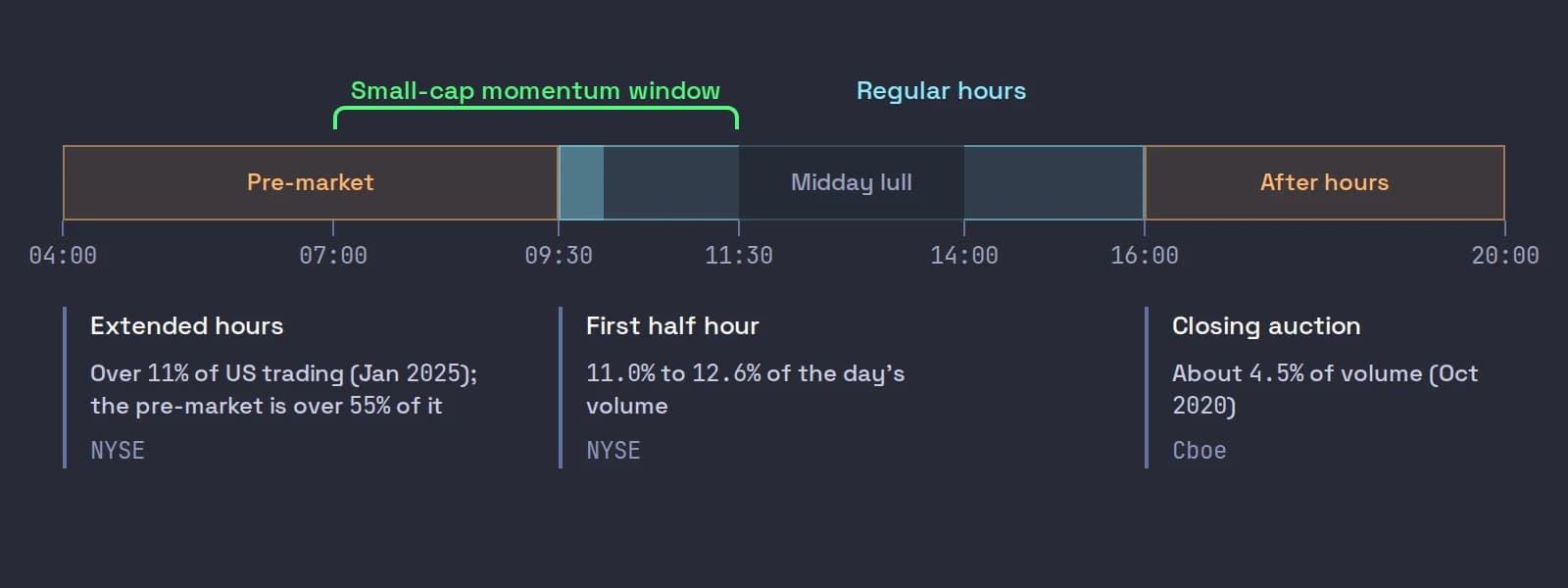
For small-cap momentum stocks, the best time to day trade is usually the late pre-market and the first 60 to 90 minutes after the 09:30 ET open, when news-driven stocks have the most volume and the cleanest moves. US trading volume is U-shaped, heavy at the open and the close and light at midday: NYSE data puts the first half hour alone at 11.0% to 12.6% of the day's volume. Midday, roughly 11:30 to 14:00 ET, is the hardest window for momentum, and the volume that returns late in the day is mostly large-cap and index flow, not small-cap runners.
Ask ten momentum traders when they trade and most will give a version of the same answer: early. The reason is not superstition. Volume, news and volatility all cluster at the start of the day, and momentum needs all three. This post looks at what exchange data and published research say about the shape of the trading day, then goes window by window through the day for a small-cap trader, from the 04:00 ET pre-market open to the after-hours session.
All times are New York time. The data below describes the whole US market, which large caps dominate; where small caps behave differently, we say so. This is one post in our momentum day trading cluster.
Why the best time to day trade follows volume
A day trader needs two things from the market: movement, so a trade can work in minutes, and liquidity, so you can get in and out near the price you see. Both follow volume, and volume is not spread evenly across the day.
- The open is heavy. NYSE's quantitative research team reported in its analysis of post-opening auction trading that the first half hour, 09:30 to 10:00, accounts for 11.0% to 12.6% of total volume, not counting the opening auction itself. A plain 30-minute slice of a 390-minute session would be 7.7%.
- The close is heavy too. Cboe found that in October 2020 the closing auction alone made up about 4.5% of total market volume, and that each exchange saw a spike near the close almost five times greater than continuous trading volumes through the rest of the session (Cboe: the impact closing auctions have on volumes).
- The middle is light. Between those two peaks volume sags, which is where the "U-shape" name comes from.
The open and the close are also linked. Studying S&P 500 ETF data from 1993 to 2013, Gao, Han, Li and Zhou (2018, Journal of Financial Economics) found that the market's return in the first half hour, measured from the previous close, predicts its return in the last half hour, and that the effect is stronger on high-volume and more volatile days. That is a market-wide finding about index funds, not a small-cap trading signal, but it fits the broader picture: the open is where the day's information gets priced.
The pre-market: where small-cap momentum starts
For small caps, the U-shape has a front porch. Many momentum stocks move on news that comes out before the open, and their first big move often happens between 04:00 and 09:30.
The pre-market has also grown. NYSE research found that extended-hours trading made up over 11% of all US equity trading in January 2025, up from just over 5% in Q1 2019, and that in Q1 2025 the pre-market accounted for over 55% of the shares traded in extended hours (NYSE: a new normal in off-hours trading). The same piece notes that trading before 07:00 has grown to over 28% of pre-market volume, and that pre-market trading skews to cheaper stocks: a pre-market VWAP of $18 in early 2025, against $46 for the regular session.
That last number matters for small-cap traders. The pre-market is where lower-priced stocks get a large share of the attention, and it is also where the rules are different. The SEC's investor bulletin on extended-hours trading lists the risks: lower liquidity, larger quote spreads, greater price swings for thinly traded stocks, and the warning that many brokers accept only limit orders. It also notes that some volatility mechanisms may be limited or not available outside regular hours.
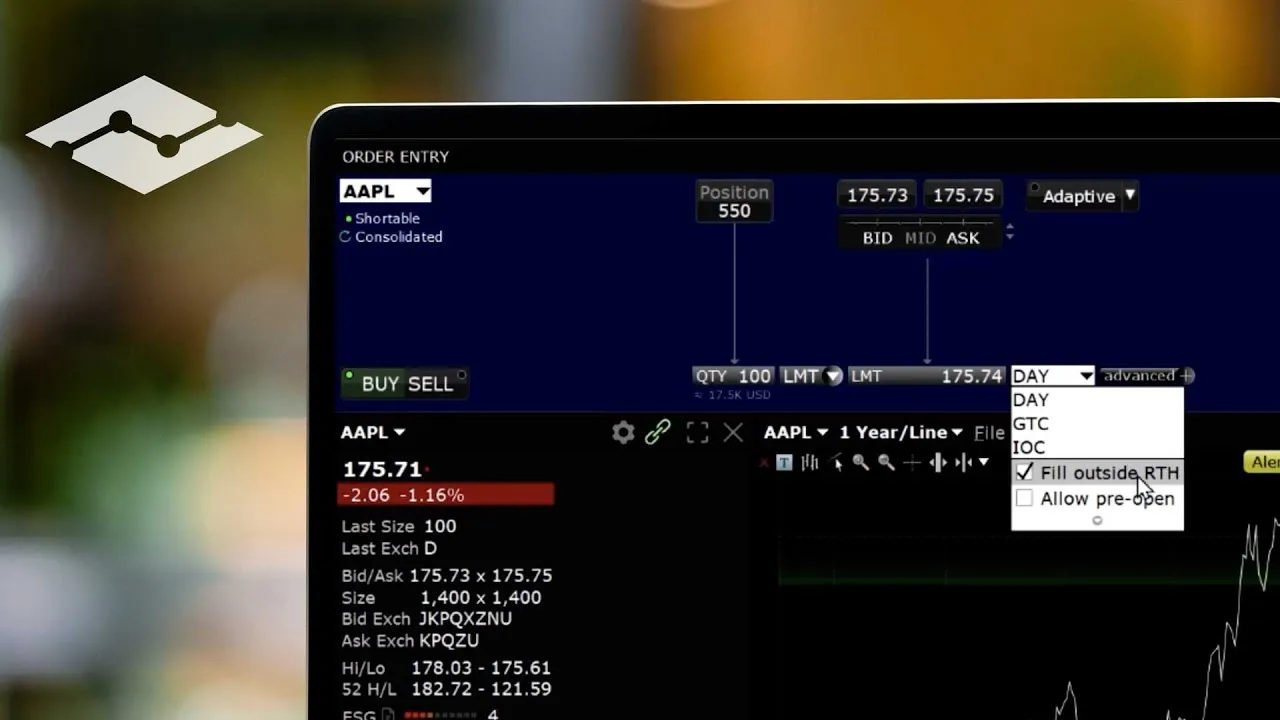
This Interactive Brokers lesson shows how to let TWS orders work outside regular trading hours, by default or per order, which you need before you place a single pre-market trade.
For the IBKR session times and order rules in detail, see our post on IBKR extended hours trading, and for finding the stocks, how to find pre-market gappers.
Best time of day to trade stocks, window by window
| Window (ET) | What usually happens | For small-cap momentum |
|---|---|---|
| 04:00 to 07:00 | Early news, thin books, wide spreads | Watch and build the list. Trade small, if at all |
| 07:00 to 09:30 | Pre-market volume builds on the day's gappers | The first real window. Many traders' best setups form here |
| 09:30 to 10:00 | The open: the heaviest half hour, the most volatile | Fast and dangerous. Gap and go entries, and the biggest losses |
| 10:00 to 11:30 | Volume still high, first pullbacks and new highs | The second window: continuation setups on stocks still in play |
| 11:30 to 14:00 | The midday lull: light volume, choppy ranges | The hardest window. Many momentum traders stop here |
| 14:00 to 16:00 | Volume returns into the close and the closing auction | Mostly large-cap and index flow. Occasional late small-cap runs |
| 16:00 to 20:00 | After hours: earnings and late news | Thin. Stocks for tomorrow's watchlist more than for trading |
The open, 09:30 to 10:00
The first half hour has the most volume and the widest swings. For a stock that gapped up on news, it is where the gap and go happens or fails. It is also when the limit up-limit down rules start: FINRA's LULD explainer says the plan applies from 09:30 to 16:00, and a stock above $3 that is not in the S&P 500 or Russell 1000 gets a band 10% either side of its average price over the preceding five minutes. Sit at the edge for 15 seconds and trading pauses for five minutes. Small-cap runners can halt more than once in a fast open, so know what a halt does to your orders before you trade one (LULD trading halts).
Mid-morning, 10:00 to 11:30
If a stock is still in play after the open, this is when the cleaner continuation setups appear: the first pullback after the opening push, and high of day breakouts on stocks that held their gains. Volume is lower than at the open but usually still well above the midday level.
The midday lull, 11:30 to 14:00
This is where the U bottoms out. Moves are smaller, ranges get choppy, and a breakout has fewer buyers behind it. Momentum setups that look the same as the morning's fail more often because the follow-through is not there. Our honest view: if you are learning, stop trading by late morning. The losses that turn a green morning red tend to happen here, out of boredom.
The last two hours, 14:00 to 16:00
Volume comes back, but much of it is portfolio and index trading heading into the closing auction, which favors large caps. Some small caps do run late on afternoon news. One rule changes here: FINRA notes that from 15:35 to 16:00 the LULD bands double for S&P 500 and Russell 1000 stocks and for other stocks priced at or below $3, so a cheap stock can swing further before it pauses.
When to day trade: build your own answer
Published data describes the market. Your best time depends on your setups, your schedule and, more than anything, your results. Three habits answer the question for you:
- Log the time of every trade. After 50 or 100 trades, group your net results by hour. Look for the window that pays and the one that gives it back.
- Set a stop time as well as a stop loss. Decide the hour you stop trading before the day starts, and keep it.
- Pair it with a daily loss limit. A limit stops a bad day; a stop time stops a slow one (daily loss limit).
None of this makes the style easy. Momentum trading at the open is fast and most people who try it lose money; trading the best hour of the day does not change that on its own.
Where Scalpel fits
Scalpel is a keyboard-first desktop cockpit for your own IBKR account, built first for the pre-market. A few parts of it are about time:
- The clock in the header shows New York time and the session: Pre-market, Regular hours, After-hours or Closed.
- Voice callouts mark the day: "Pre-market is open. Good luck!" at 04:00, "Mid-morning open." at 07:00, "The market is open. Good luck out there!" at 09:30, and "The market is closed. Nice work today!" at 16:00 (voice callouts).
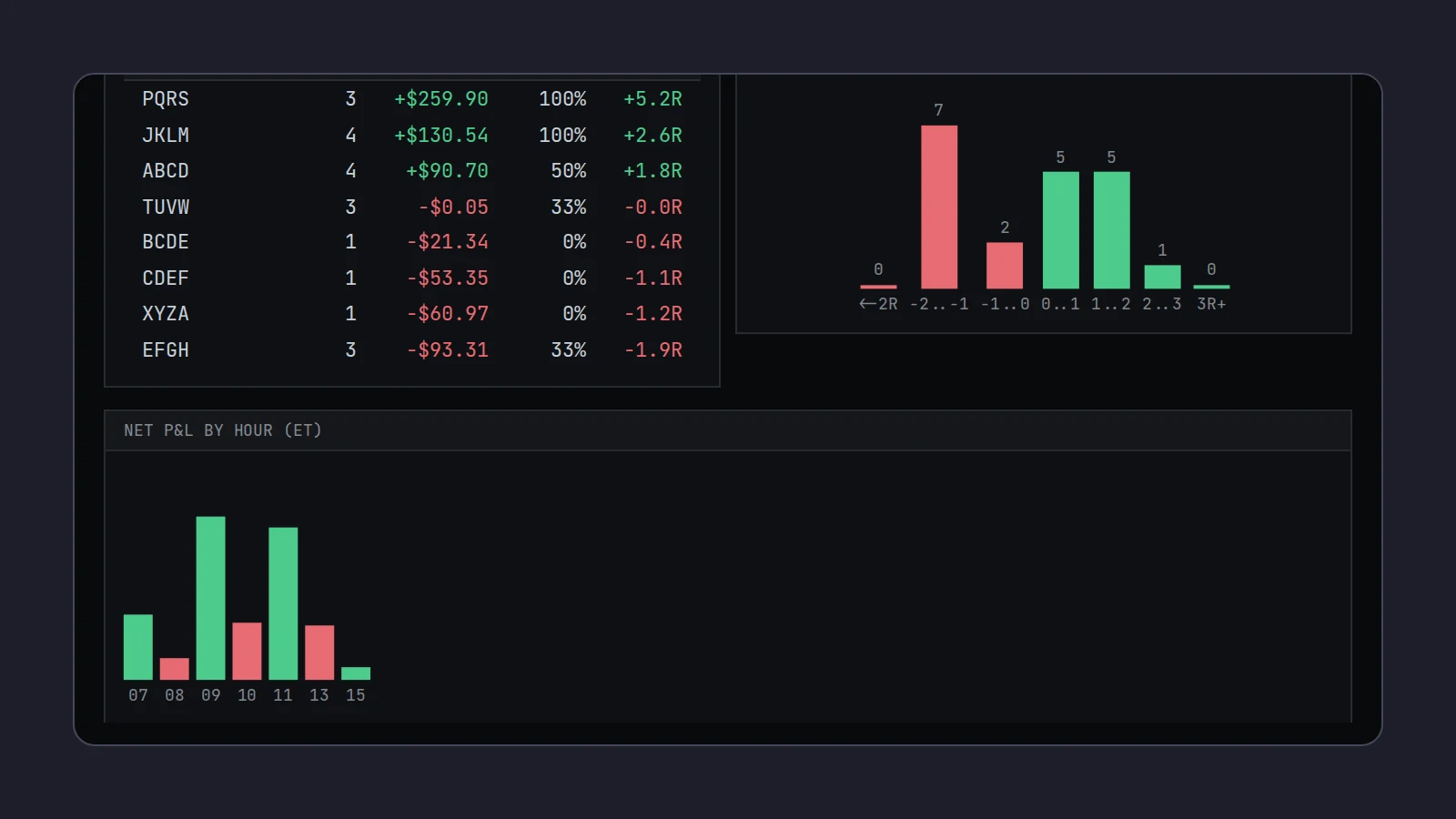
- Analytics, Breakdowns shows NET P&L BY HOUR (ET) from your own closed trades, SIM and LIVE kept apart, so you can see which hour pays and which one gives it back (analytics).
- The daily loss limit blocks new entries once the day's loss reaches it, so a bad midday session cannot grow.
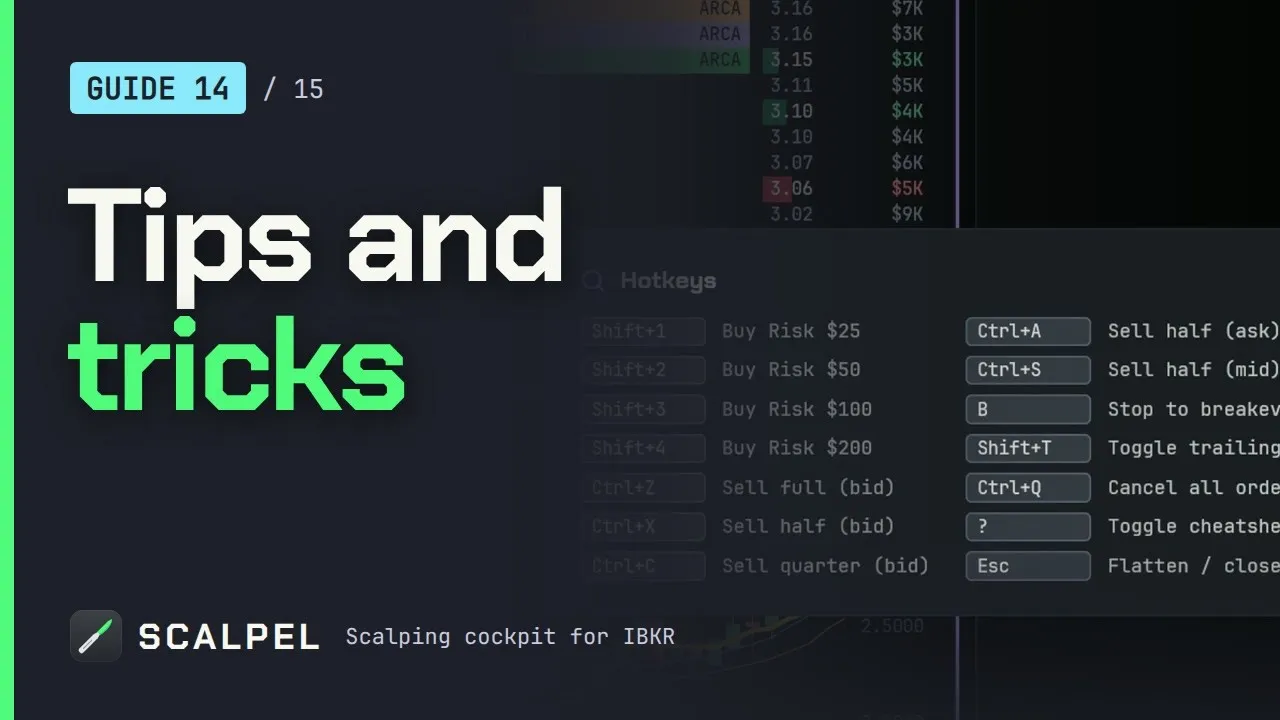
Our tips and tricks video covers small habits like these that make a trading day easier to run.
The pre-market routine turns the early windows into a step-by-step morning, and pre-market scanning covers which scans fill before 09:30. Scalpel's orders are blocked while the US market is closed, before 04:00 and after 20:00 ET, and its stops are watched by the app, so they work only while it runs with a live feed.
Trading carries a significant risk of loss. Nothing here is financial advice.
Questions
- What is the best time to day trade stocks?
- For momentum stocks, usually the late pre-market and the first 60 to 90 minutes after the 09:30 ET open, when volume and volatility are highest. NYSE data puts the first half hour at 11.0% to 12.6% of the day's volume.
- Why is midday trading slow?
- US volume is U-shaped: heavy at the open and the close, light in the middle of the day. With fewer participants, moves are smaller and breakouts have less follow-through, which makes momentum setups fail more often.
- Is the pre-market a good time to day trade?
- It is where many small-cap momentum moves start, because news often comes out before the open. It also has thinner books, wider spreads and limit orders only at many brokers, so it carries extra risk.
- What time does the stock market open for day trading?
- Regular trading runs from 09:30 to 16:00 ET. Extended-hours sessions on venues such as Nasdaq run from 04:00 to 09:30 and from 16:00 to 20:00 ET, and some brokers, including IBKR, also offer an overnight session.
- Should I trade the last hour of the day?
- Volume returns into the close, but much of it is index and portfolio trading in large caps. Small-cap momentum traders often have their best results in the morning and treat late-day trades with more caution.
- How do I find my own best time to trade?
- Record the time of every trade and group your net results by hour after 50 to 100 trades. Keep trading the windows that pay and set a stop time for the ones that do not.
Related guides
Guide 14.2A pre-market routine with ScalpelA step-by-step routine from 04:00 ET to the open: connect, scan for gappers, check dilution and borrow, load your desks and set your risk before the bell.Guide 8.3Scan the pre-marketScan pre-market movers from 04:00 ET in Scalpel: what the gainers, volume spike and gap scans show before the open, gap and go, and what changes at 09:30.Guide 7.1Set a daily loss limit (the kill-switch)Set a max daily loss in Scalpel: when your P&L hits it, new entries stop, a RISK LOCK banner shows, and it can flatten everything. How to resume trading.
Keep reading
- Momentum day trading: how small-cap momentum worksMomentum day trading explained: what makes small caps move, the shape of the day, entries, exits and risk, and what the research says about the odds.
- Momentum trading on Interactive Brokers: scanner setup for gappersInteractive Brokers momentum trading starts with the scanner: TWS settings for pre-market gappers, which scans to run, and how to live without a float filter.
- Small-cap momentum trading on Interactive Brokers: what you needSmall-cap momentum trading on Interactive Brokers: what the Warrior Trading review says, and how to get scanning, hotkeys, fixed risk and pre-market stops.
Practice in SIM, against the live book.A lifetime license, every update included, with a 7-day refund guarantee.Ask in DiscordGet Scalpel