Market maker IDs on Level 2: NSDQ, ARCA, EDGX and who they are
By Scalpel Team. , updated . 7 min read.
In short
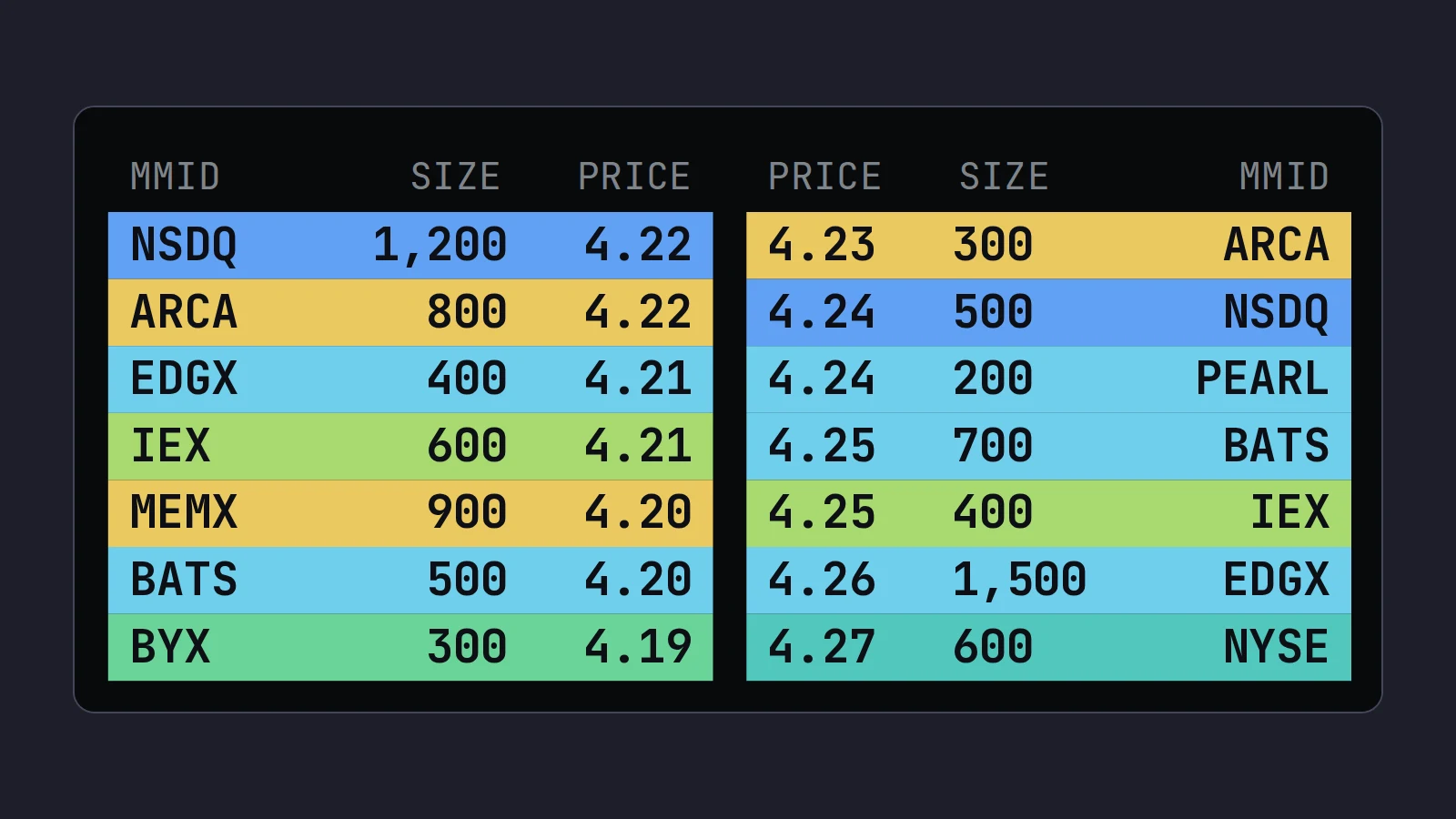
The four-letter codes beside each row on Level 2 are market maker IDs, more precisely market participant IDs, often called MMIDs or MPIDs. On most modern books, including Interactive Brokers' SMART depth, they name the venue an order rests on, not the firm behind it: NSDQ is Nasdaq, ARCA is NYSE Arca, EDGX, BATS and BYX are Cboe exchanges, plus IEX, MEMX and NYSE. A firm's own ID only shows on books that carry attribution, such as Nasdaq TotalView, and only for orders the firm chooses to attribute. The wholesalers that execute most retail orders mostly do not post on the book at all. Read what an order does, not the label.
Old trading books tell you to "watch the market makers" on Level 2, follow the "ax", and notice when a big firm steps aside. That advice comes from a time when Nasdaq Level II really was a screen of dealers quoting under their own names. Today's book is mostly exchanges quoting anonymous orders, and the codes mean something different. This post covers what each code means, the list you will actually see, why Interactive Brokers shows venues, and what you can and cannot infer from them.
Facts were checked on October 22, 2026. Scalpel is independent and not affiliated with or endorsed by Interactive Brokers, Nasdaq, NYSE or Cboe.
What a market maker ID on Level 2 is
A market participant identifier (MPID) is a short code that identifies a firm or a venue in US market data and trade reporting. On a Level 2 screen it sits in the column usually labeled MMID (market maker ID), on every row, beside the size and price.
Two kinds of thing can sit in that column:
- A venue code, such as NSDQ or ARCA: the exchange whose book the order is on. One row is that exchange's displayed size at that price, which may be many traders' orders added together.
- A firm code: a broker-dealer that has attributed its quote. Nasdaq's TotalView-ITCH feed has two separate messages for new orders: one with no MPID attribution and one with a four-character attribution field naming the "Nasdaq Market participant identifier associated with the entered order" (Nasdaq TotalView-ITCH specification). Attribution is the firm's choice, and most orders are not attributed.
So the same column can mean "this exchange" or "this firm", depending on the feed and the platform. On most retail screens today it means the exchange.
The MMID list: codes you will see on Level 2
These are the codes we see on Interactive Brokers' SMART depth for US small caps, with the exchange each one stands for. The names come from the SEC's list of registered national securities exchanges, which also records each exchange's former names.
| Code | Venue | Group |
|---|---|---|
| NSDQ | The Nasdaq Stock Market | Nasdaq |
| ARCA | NYSE Arca | NYSE |
| NYSE | New York Stock Exchange | NYSE |
| BATS | Cboe BZX Exchange (formerly Bats BZX) | Cboe |
| BYX | Cboe BYX Exchange (formerly Bats BYX) | Cboe |
| EDGX | Cboe EDGX Exchange | Cboe |
| IEX | Investors Exchange | IEX |
| MEMX | MEMX | MEMX |
| PEARL | MIAX Pearl's equities market | MIAX |
| OVERNIGHT | Interactive Brokers' overnight session, not an exchange | IBKR |
Other stock exchanges on the SEC's list include Cboe EDGA, Nasdaq Texas (formerly Nasdaq BX), NYSE American, NYSE National, NYSE Texas (formerly NYSE Chicago), the Long-Term Stock Exchange, 24X and the Texas Stock Exchange. In all, the SEC lists 29 registered national securities exchanges, several of them options-only. Platforms spell codes differently, and you may see IBKR's own routing names, such as DRCTEDGE, so check your platform's exchange list when a code is new to you.
OVERNIGHT deserves a note. Interactive Brokers runs an overnight session for more than 10,000 US stocks and ETFs from 20:00 to 03:50 ET (IBKR overnight trading). Quotes from it can appear in IBKR's depth outside regular hours. They are not on any exchange's book.
Who the real market makers are now
If the codes are mostly exchanges, where did the market makers go? Two places.
Some quote on the exchanges, anonymously. Electronic market makers post bids and offers through exchange books like everyone else. Their orders show as NSDQ or ARCA rows, indistinguishable from a fund's order or a day trader's.
Most retail flow goes to wholesalers, off the book. In December 2022, the SEC wrote that "retail brokers route more than 90 percent of marketable orders of individual investors to a small group of off-exchange dealers, known as wholesalers", which "typically execute these orders internally" (SEC fact sheet, proposed order competition rule). In the same release, the SEC's table of share volume for the first quarter of 2022 shows how the market splits (SEC Release 34-96495, Table 1):
| Type of venue | Number | Share of all NMS stock volume |
|---|---|---|
| Exchanges | 16 | 59.7% |
| Wholesalers | 6 | 23.9% |
| Alternative trading systems (ATSs) | 32 | 10.2% |
| Other broker-dealers | 232 | 6.3% |
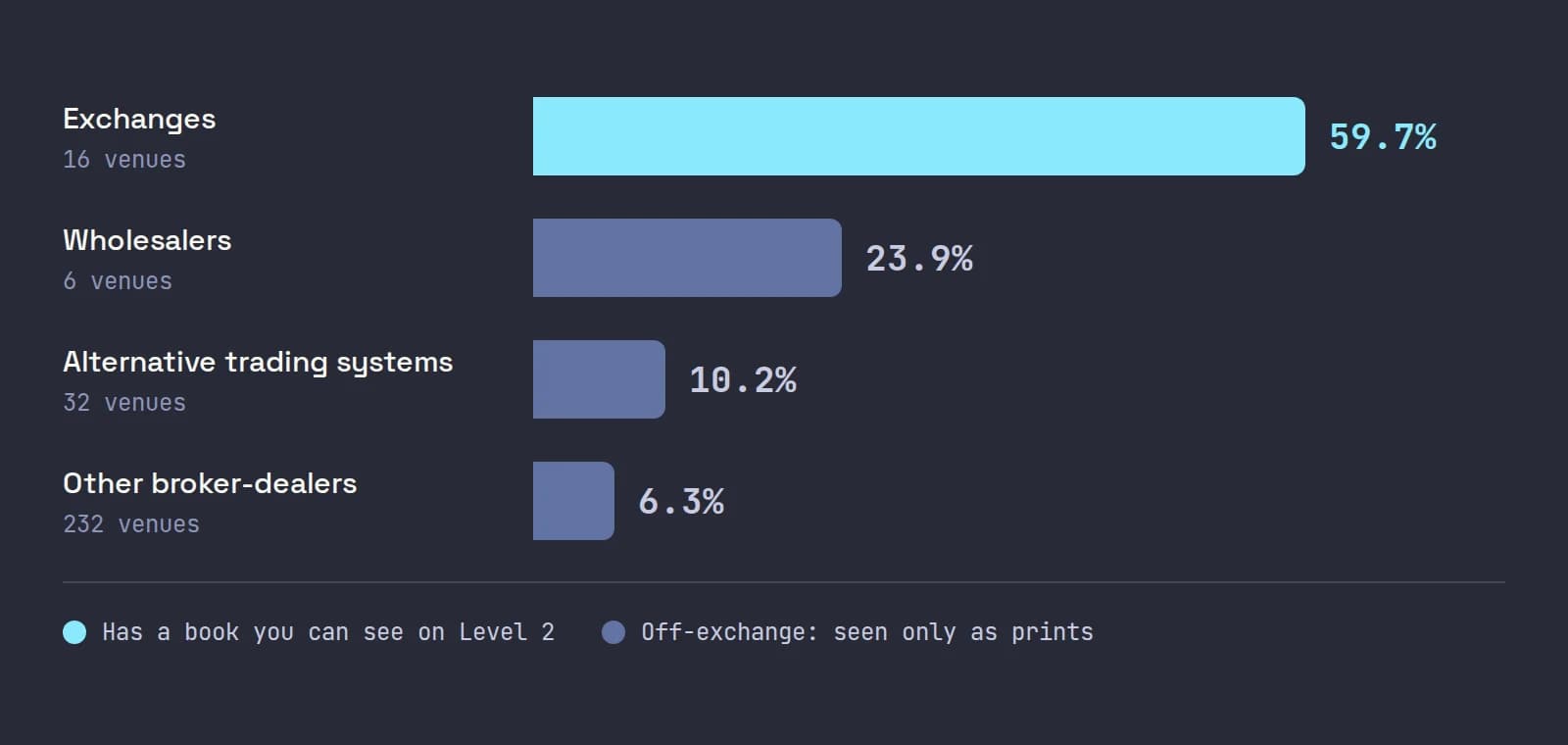
That is the real answer to "where are the market makers on Level 2?" About a quarter of all share volume in that quarter went through six wholesalers that you will never see as a row on a book. Their trades reach the tape as off-exchange prints, reported to FINRA, after they happen. Hidden orders and dark pools covers that volume, and how to read time and sales covers how those prints look.
Why IBKR's Level 2 shows venues, not firms
Interactive Brokers' depth can arrive two ways, and the API documentation spells out the difference (TWS API: market depth):
- Exchange depth. When you request one exchange's book, the market maker field depends on that exchange. IBKR's example: "ARCA only has ARCA itself as a Market Maker", while "with NASDAQ market maker information is provided, so the market maker MPID will be relayed back."
- SMART depth. When you request aggregated depth across exchanges, "the marketMaker field will indicate the exchange from which the quote originates. Otherwise it indicates the MPID of a market maker."
Most traders, and most trading apps built on IBKR, use SMART depth because it merges every venue you subscribe to into one ladder. That is why the column says NSDQ, ARCA and EDGX rather than firm names. The same documentation adds that odd lot orders are not included in IBKR's market depth.
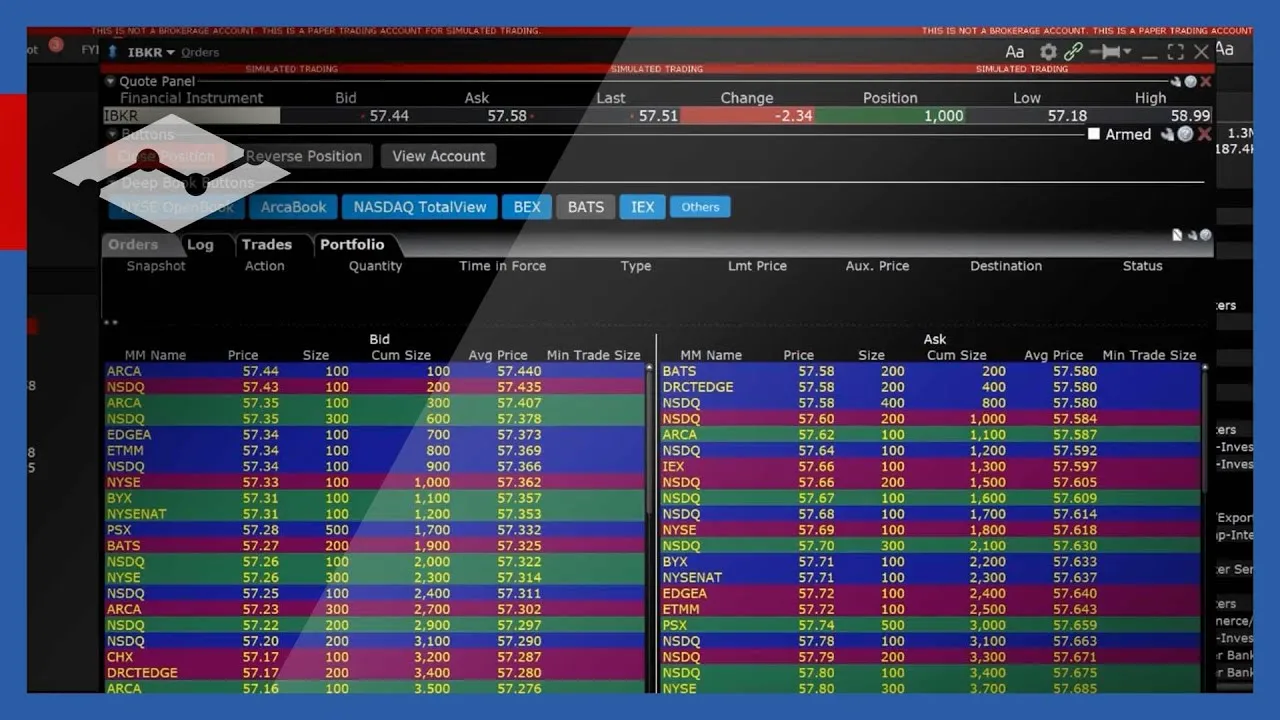
In TWS, Market Depth Trader's Deep Book buttons add each exchange's Level II rows, and the Others button adds Level 1 data from exchanges that do not offer deep data or that you do not subscribe to (IBKR Guides: Market Depth Trader). IBKR's own lesson on the window is worth watching if you read depth in TWS: it shows the Deep Book buttons and how each exchange's rows join the book.
What you can and cannot infer from a market maker ID
| The read | Can you rely on it? | Why |
|---|---|---|
| "ARCA is bidding 5,000, so a big buyer is at ARCA" | No | A row is the venue's total displayed size at that price, possibly many orders |
| "The same venue keeps refilling 200 shares while thousands trade there" | Yes, as a pattern | That is how a reserve (iceberg) order looks, whoever owns it |
| "NSDQ just pulled 6,000 as price came near" | Yes, as a fact about the book | Size that leaves before it trades was never willing to trade there |
| "This market maker is holding the stock down" | No | You cannot see who placed an exchange order, and a firm may be on several venues at once |
| "Two NSDQ rows at different prices are the same trader" | No | Different orders on the same exchange share the code |
| "No market makers are quoting yet" in the pre-market | Partly | Fewer venues and participants quote before the open, so the book is genuinely thinner |
The useful reads are all about behavior: refills, size that vanishes, bids stepping up, which side the tape is hitting. The label tells you where to look. It does not tell you who. How to read Level 2 covers those behaviors step by step, and spoofing on Level 2 covers size placed only to be seen.
Does Nasdaq TotalView show market maker IDs?
Partly. TotalView is Nasdaq's full order book, and it is the one widely sold feed that carries firm attribution, on the orders and quotes that firms choose to attribute. If seeing those IDs matters to you, you need TotalView itself, displayed by a platform that shows its attribution, rather than an aggregated SMART ladder. Whether that is worth paying for is covered in Nasdaq TotalView vs Level 2, and IBKR's prices for each depth feed are in IBKR Level 2.
Our view: for scalping small caps, firm IDs add little. Attributed quotes are a minority, wholesalers do not post, and the behavior of size at a price tells you more than the name next to it.
Where Scalpel fits
Scalpel draws IBKR's SMART depth as a montage, so its MMID column shows the venue for every row, the same codes as the table above. It does not, and cannot, show which firm placed an order. What it does is make venue behavior easier to follow. Set Coloring to By venue in the LEVEL 2 cog and every venue keeps one color, so you can follow one exchange's quote as it moves and refills. A venue that keeps refilling the same price while far more trades there gets a layers icon. The reading the players guide shows each footprint as it looks on the montage, and the Level 2 guide explains the venue codes and the panel. Terms used here are in the glossary under MMID and venue.
Our short video walks through the montage, the tape and the read line.
If you build your own tools on the IBKR API, Level 2 through the TWS API covers the SMART depth request in detail.
Trading carries a significant risk of loss. Nothing here is financial advice.
Questions
- What does MMID mean on Level 2?
- Market maker ID: the code beside each row showing who is quoting. On most modern books, including Interactive Brokers' SMART depth, it is the exchange the order rests on, such as NSDQ or ARCA, not the firm that placed it.
- What does NSDQ mean on Level 2?
- NSDQ is The Nasdaq Stock Market. A row labeled NSDQ is the displayed size at that price on Nasdaq's book, which may be one order or many from different traders.
- What is ARCA on Level 2?
- ARCA is NYSE Arca, an all-electronic stock exchange in the NYSE group. A row labeled ARCA is the displayed size at that price on NYSE Arca's book.
- What are EDGX and BATS on Level 2?
- Both are Cboe stock exchanges. BATS is the code for Cboe BZX Exchange, formerly Bats BZX, and EDGX is Cboe EDGX Exchange. BYX is a third Cboe exchange.
- Can you see market makers on Interactive Brokers Level 2?
- Mostly no. IBKR's SMART depth labels each row with the exchange. Firm IDs appear only on Nasdaq quotes that firms choose to attribute, when you view Nasdaq's own depth, and most quotes are not attributed.
- Do market makers manipulate Level 2?
- Displayed size can be placed and pulled at will, and spoofing, placing orders you intend to cancel to mislead, is illegal. But you cannot see who placed an exchange order, so read what size does rather than blaming a named firm.
Related guides
Guide 3.7Read the players on Level 2: venues, refills and sizeRead who is doing what on Scalpel's DAS-style montage: venues refilling a price, big size that holds or vanishes, bids stepping up, and the honest limits.Guide 3.1How to read Level 2 in ScalpelRead Scalpel's DAS-style Level 2: bids left, asks right, optional colour bands per price, venues, spread, imbalance and delta, and reading players by behaviour.Guide 15.1Day trading glossaryPlain definitions of the day trading and Scalpel terms used in these guides, from Level 2, VWAP and R multiples to float, borrow, dilution and LULD halts.
Keep reading
- How to read Level 2: a plain guide for day tradersHow to read Level 2 step by step: the spread, stacking and thinning, reading the book against the tape, what depth hides, and why pre-market books mislead.
- IBKR Level 2: which subscription, what it costs and how to read itIBKR Level 2 explained: which depth feeds to buy and what they cost today, the TWS limit on books at once, and how to read the book, pre-market included.
- Level 1 vs Level 2 market data: what the difference means for a tradeLevel 1 vs Level 2 market data: top of book vs depth, a worked example of what your size really costs, IBKR prices, and who actually needs Level 2.
Practice in SIM, against the live book.A lifetime license, every update included, with a 7-day refund guarantee.Ask in DiscordGet Scalpel