Best broker for day trading small caps: a checklist
By Scalpel Team. , updated . 9 min read.
In short
The best broker for day trading small caps is the one that passes eight checks for the way you trade: fills from 04:00 ET on stocks outside the big indexes, routing you can read in its Rule 606 report (and choose, if you care), Level 2 at a price you will pay, hotkeys that send limit orders outside regular hours, borrow if you short, a total cost at your volume that counts execution as well as commission, rules that fit your account size, and an API if you want other tools. No broker wins every row, so score them against your own style rather than a ranking.
Most "best broker for day trading" lists rank brokers by commission, app ratings and sign-up bonuses. For small caps, those are the wrong measures. A $2 stock that gaps 60% at 06:30 ET on news is a different trading problem from a large cap at 11:00: thinner books, wider spreads, most of the move before the open, and hard-to-borrow shares if you want the other side. The broker either handles those conditions or it does not, whatever it charges.
So this is a checklist, not a ranking. For each criterion we explain why it matters for small caps, what a good answer looks like, and where to check it, with Interactive Brokers, Webull and Schwab as worked examples because they are the three our readers ask about. We build on Interactive Brokers, so weigh our view with that in mind. Rules, fees and hours were checked on October 22, 2026. Scalpel is independent and not affiliated with or endorsed by any broker named here.
What matters in the best broker for day trading small caps
| Criterion | The question to ask |
|---|---|
| 1. Pre-market access | Can I get a fill at 04:00 ET in a stock outside the S&P 500? |
| 2. Routing and execution | Who does my order go to, and can I choose? |
| 3. Level 2 | What does consolidated quotes plus Nasdaq depth cost me a month? |
| 4. Hotkeys | Can one key send a priced limit order, outside regular hours, with no confirmation? |
| 5. Costs at your volume | What does a month of my trading cost, including execution? |
| 6. Short locates | If I short, can I borrow low-float names, and at what fee? |
| 7. Account rules | Does the broker still count day trades on a small margin account? |
| 8. API | Can I connect the tools I want? |
1. Pre-market access from 04:00 ET
Small-cap momentum starts early, and the data says the early hours are no longer quiet. NYSE's research on off-hours trading counted six US equity exchanges open at 04:00 ET by mid-2025, found that "more than 30% of the pre-market volume trades before 7am," and that almost 8 of every 10 non-S&P 500 shares traded in NYSE Arca's pre-market had a retail trader on one side.
A good answer: fills from 04:00 ET on any listed stock. The trap: a "24/5 trading" headline that only covers index names. Schwab's session hours page makes pre-market orders eligible from 7:00 a.m. ET, and its 24-hour session covers S&P 500, Nasdaq 100 and Dow 30 stocks and over 600 ETFs, so most small caps start at 07:00 there. Interactive Brokers and Webull both trade from 04:00.
Also ask what a stop order does in those hours. Exchanges accept limit orders only outside regular hours, so a plain stop cannot protect a pre-market position at most brokers (pre-market stops explains the options).
2. Order routing and execution quality
Every US broker publishes a quarterly Rule 606 report: where its customers' orders went, and what it was paid. For small caps, read the table for non-S&P 500 stocks.
The three brokers in our examples show the range:
- IBKR Pro routes with SmartRouting or to an exchange you name, and its Q2 2026 report says there is no payment for order flow on Pro orders. IBKR Lite orders go to market makers who pay 12% of the quoted spread on marketable orders.
- Webull's Q2 2026 report shows wholesalers paying 13% of the spread on marketable orders in regular hours.
- Schwab's Q2 2026 report lists $0.001 a share or less on marketable orders and $0.0006 or less in extended hours.
Does it matter? A study that sent 85,000 simultaneous market orders through six accounts at five brokers found average round-trip execution costs from 0.07% to 0.46% of the trade, excluding commissions, and found that differences in payment for order flow did not explain the gap (Schwarz, Barber, Huang, Jorion and Odean, Journal of Finance, 2025). In other words, the same order can cost very different amounts at different brokers, and the fee schedule will not tell you which.
Find the report
Look for "order routing" or "Rule 606" in the broker's disclosures. Many are also hosted by FINRA or by a vendor, as the links above show. Use the latest quarter.
Open the non-S&P 500 table for one month
Each quarter has a table per month for S&P 500 stocks, non-S&P 500 stocks and options. Small caps are in the second.
Read the venue list
Market makers (Citadel Securities, Virtu, Jane Street, Hudson River Trading) are wholesalers. Exchanges appear by name (Nasdaq, NYSE Arca, Cboe EDGX). A list dominated by wholesalers means most of your orders never reach an exchange first.
Read the material aspects
Under the tables, each venue has a paragraph with the payment terms: a share of the spread, a rate per share, or "no payment for order flow." That is where the numbers above come from.
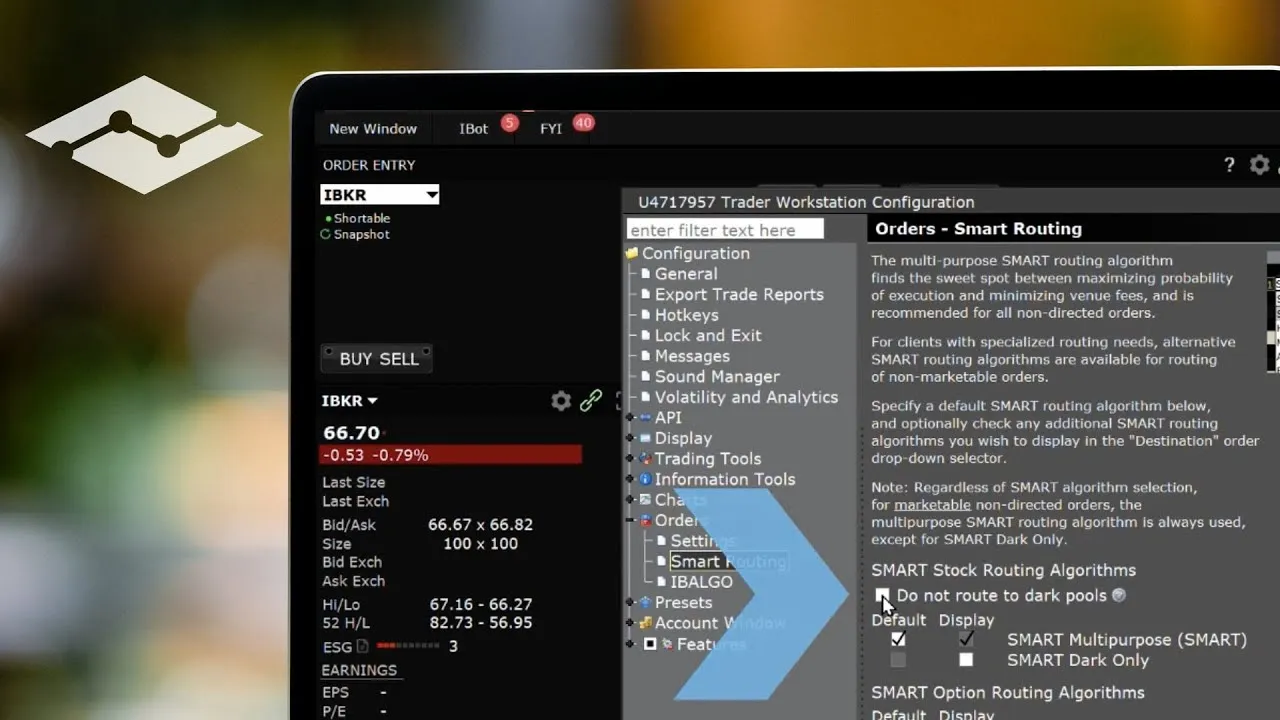
Routing choice is the other half. If you scalp thin books, being able to post on a specific exchange or route around a slow one can matter; IBKR SmartRouting covers how IBKR's router decides. IBKR's video on TWS routing settings shows the controls a Pro account has.
3. Level 2 you will actually pay for
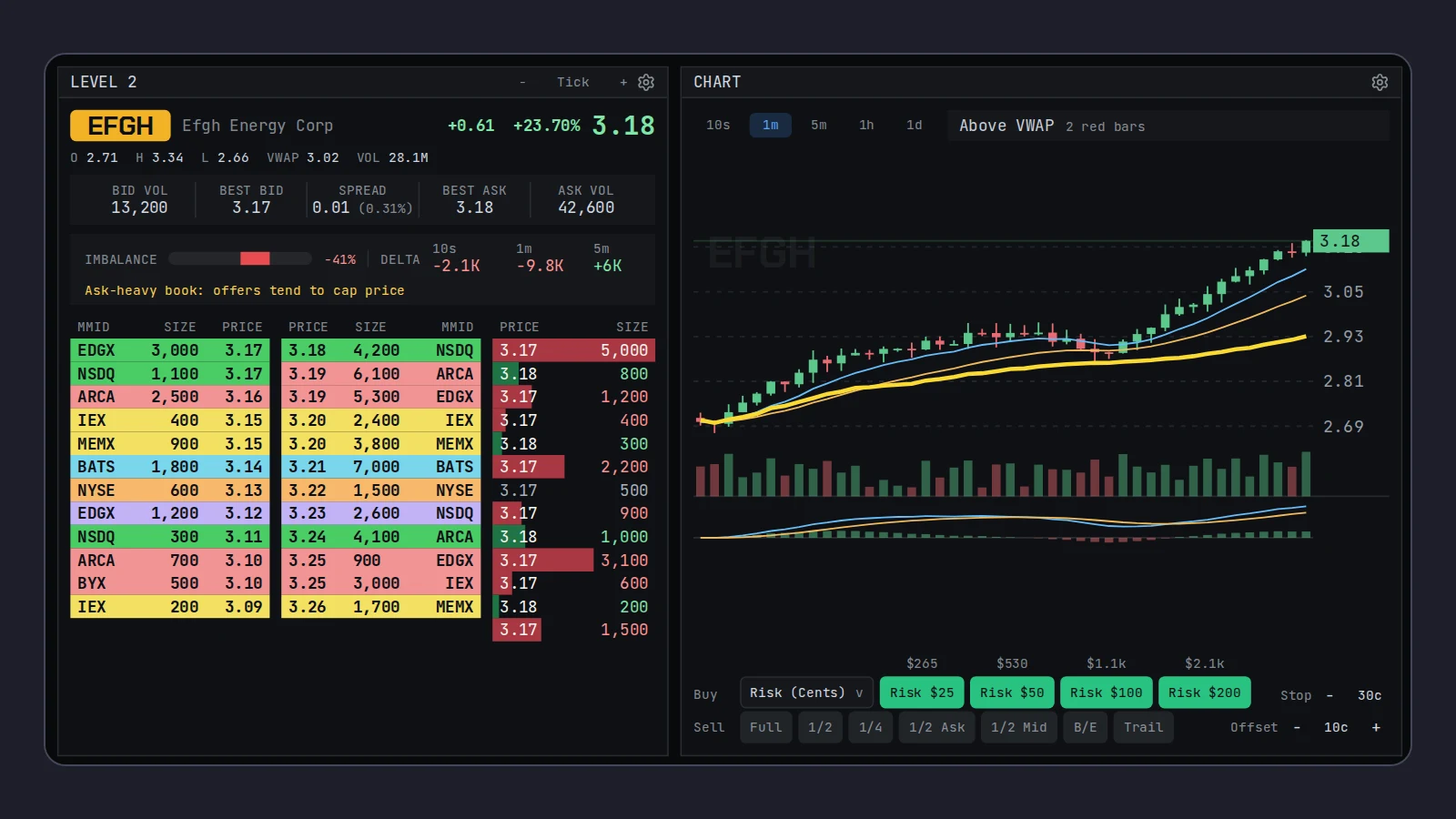
Small caps are traded off the book: who is on the bid, how thick the ask is, whether size refills. You want consolidated quotes (every exchange's best bid and offer) plus at least Nasdaq depth, and NYSE Arca depth helps on low-priced names.
Prices for a non-professional, as checked on October 22, 2026:
| Consolidated quotes | Nasdaq TotalView | |
|---|---|---|
| Interactive Brokers | $10.00 bundle (waived with $30 of commissions) + $4.50 | $16.50 |
| Webull | $9.99 (free tier is Nasdaq Basic only) | $2.99 |
| Schwab | No retail fee listed on its pricing page | Free with 30+ trades a quarter, otherwise a quarterly fee |
IBKR is the most expensive here, at about $21 a month for an active trader. Check also whether the "free" quotes are consolidated: a single exchange's quote can sit a few cents away from the real best price in a fast stock. IBKR market data for day trading lists the IBKR feeds a scalper needs.
4. Hotkeys that work before the open
A small-cap entry has to be fast and priced: a limit at the ask plus a few cents, so it fills in a moving market without paying any price. Before 09:30 that same key also needs the extended-hours flag, because a market order will be refused. Check four things:
- Can a key send a limit priced off the ask or bid with an offset? TWS can. Thinkorswim's default Active Trader keys are Buy @mkt and Sell @mkt. Webull's hotkey guide does not say, so test it.
- Can it fill outside regular hours? In TWS this is a setting on the key's order preset.
- Does it transmit with no confirmation? Every dialog is a second of price.
- Can it size the trade? In shares at least; by dollar risk is better, and few broker platforms do it.
If the broker's own keys fall short, a front end such as DAS Trader Pro or Scalpel may close the gap, which brings in criterion 8.
5. Costs at your volume
Price a month of your own trading, not a single trade. One round trip in ABCD at $4.00, 1,000 shares a side ($4,000 of stock), costs this in commission (IBKR's stock commissions, Webull's fee schedule, Schwab's pricing):
| Plan | Commission, buy and sell |
|---|---|
| IBKR Pro Fixed ($0.005 a share) | $10.00 |
| IBKR Pro Tiered ($0.0035 a share) | $7.00, plus $0.40 clearing and any exchange fees |
| Webull, Schwab, IBKR Lite | $0 |
Now apply the execution range from the study above to the same $4,000: 0.07% is $2.80 and 0.46% is $18.40. The gap between the best and worst execution, $15.60, is larger than IBKR Fixed's whole commission on the trade.
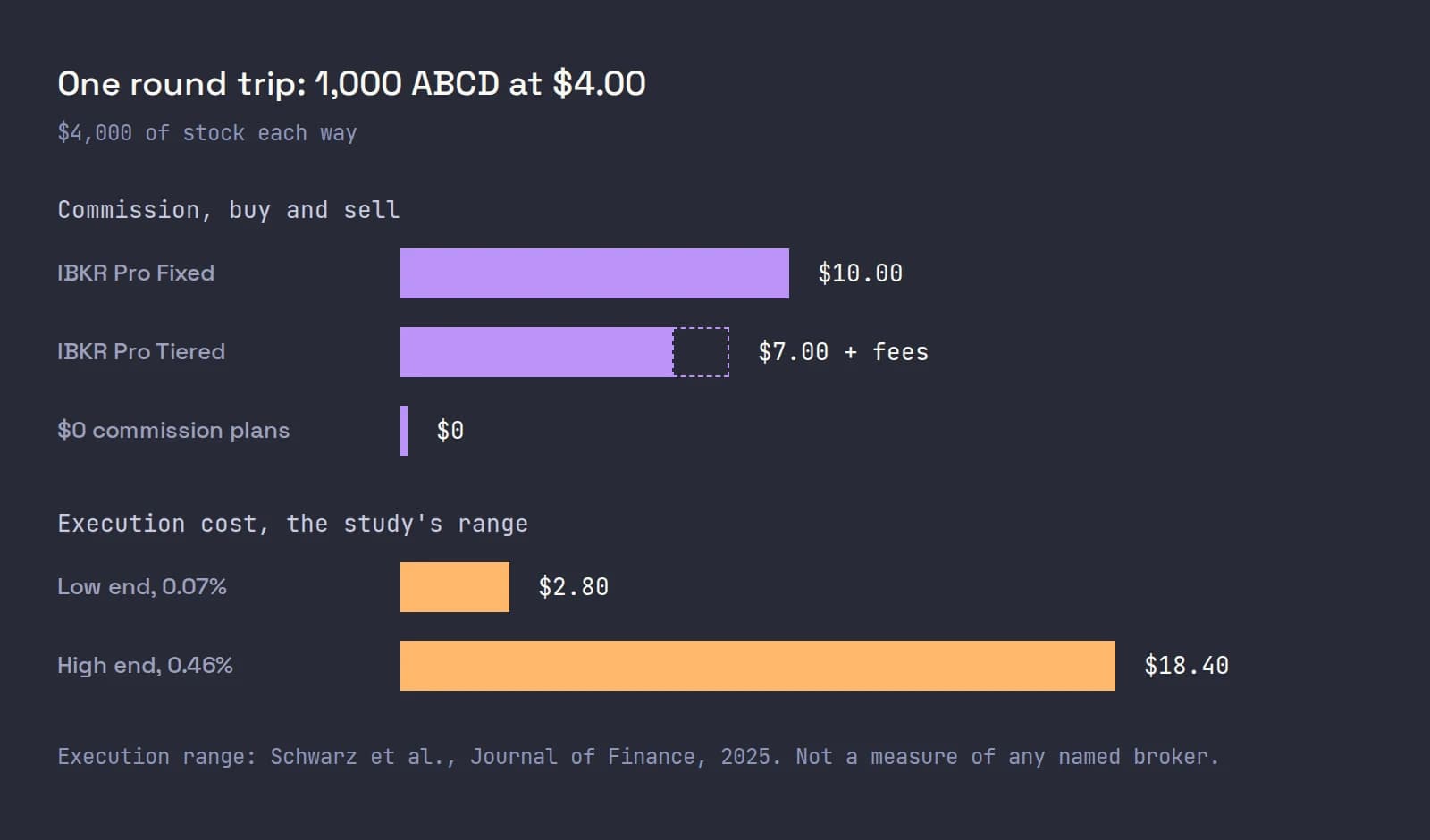
We are not saying any named broker sits at either end of that range: the study measured market orders, it does not tell you how a broker handles small caps before the open, and nobody publishes that number for you. The point is that commission is the cost you can see, and execution can be the larger one. Two details also change the sum on small caps: IBKR Fixed caps a trade at 1% of its value, which helps on sub-dollar stocks, and IBKR Lite charges for pre-market and sub-dollar trades once they pass 10% of your monthly volume. The cost of day trading adds up the rest: data, platform, borrow and taxes.
6. Short locates, if you short
Low-float small caps are often hard to borrow, and borrow can disappear mid-move. If you short, check whether the broker shows availability before you trade, what the fee is, and whether you can locate shares. IBKR publishes borrow fees and a real-time availability search on its short sale cost page. Webull's short selling page sets a minimum maintenance of $5 per share on shorts, so shorting a $3 stock ties up more than the position's value. Some direct-access platforms add a locate window at brokers that support it (DAS Trader vs Interactive Brokers).
If you trade long only, skip this row entirely.
7. Account size and day trading rules
FINRA replaced the pattern day trader rule on June 4, 2026, but firms have until October 20, 2027 to switch (FINRA Regulatory Notice 26-10), so the broker decides when a small account is freed. Schwab says it stopped counting day trades on June 8, 2026 (Schwab); Webull's day trading rules page still describes the three-trade limit for margin accounts under $25,000. Ask the broker directly which rules your account is on today.
8. An API, if you want other tools
If you want a different front end, a journal that reads fills live or your own scripts, the broker needs an API that those tools support. Interactive Brokers has a long list of third-party trading tools built on its API, and its third-party FAQ says they need a funded IBKR Pro account. Webull has an OpenAPI and Schwab a Trader API, both with order entry. Day trading software for Interactive Brokers lists the front ends for IBKR.
The checklist, filled in
| Interactive Brokers | Webull | Schwab | |
|---|---|---|---|
| Pre-market fills from | 04:00 ET | 04:00 ET | 07:00 ET for most stocks |
| Payment for order flow | None on Pro | Yes | Yes |
| Choose your route | Yes, on Pro | No documented option | No documented option for stocks |
| TotalView, non-professional | $16.50 + level 1 | $2.99 | Free if active |
| Hotkey sends a priced limit outside RTH | Yes (TWS) | Test it | Not with the defaults |
| Commission | Per share on Pro | $0 | $0 |
| Day trades counted on small margin accounts | Check your account | Yes, as of October 22, 2026 | No, since June 8, 2026 |
| API with third-party trading tools | Yes, IBKR Pro | OpenAPI | Trader API |
Read it against your own style. A regular-hours trader with a small account may score Schwab highest. A low-volume trader who wants cheap depth may score Webull highest. A pre-market scalper who wants routing control and third-party tools will usually land on IBKR Pro. The head-to-head detail is in Interactive Brokers vs Webull and Interactive Brokers vs Schwab.
Where Scalpel fits
Scalpel is a desk for the IBKR answer to this checklist: it runs only on Interactive Brokers, through TWS or IB Gateway on your own IBKR Pro account. It is long only by design, so criterion 6 does not apply (why Scalpel is long only), and it covers criteria 3 and 4 on top of IBKR's data: a Level 2 montage per symbol, hotkey buys priced as a marketable limit at the ask plus your offset, sized by shares, dollars or risk.
For the pre-market, its stops are watched by the app and exit with a limit order flagged for extended hours, which a plain broker stop cannot do before 09:30. They are not resting orders at IBKR, they only work while Scalpel runs with a live feed, and no fill is guaranteed.
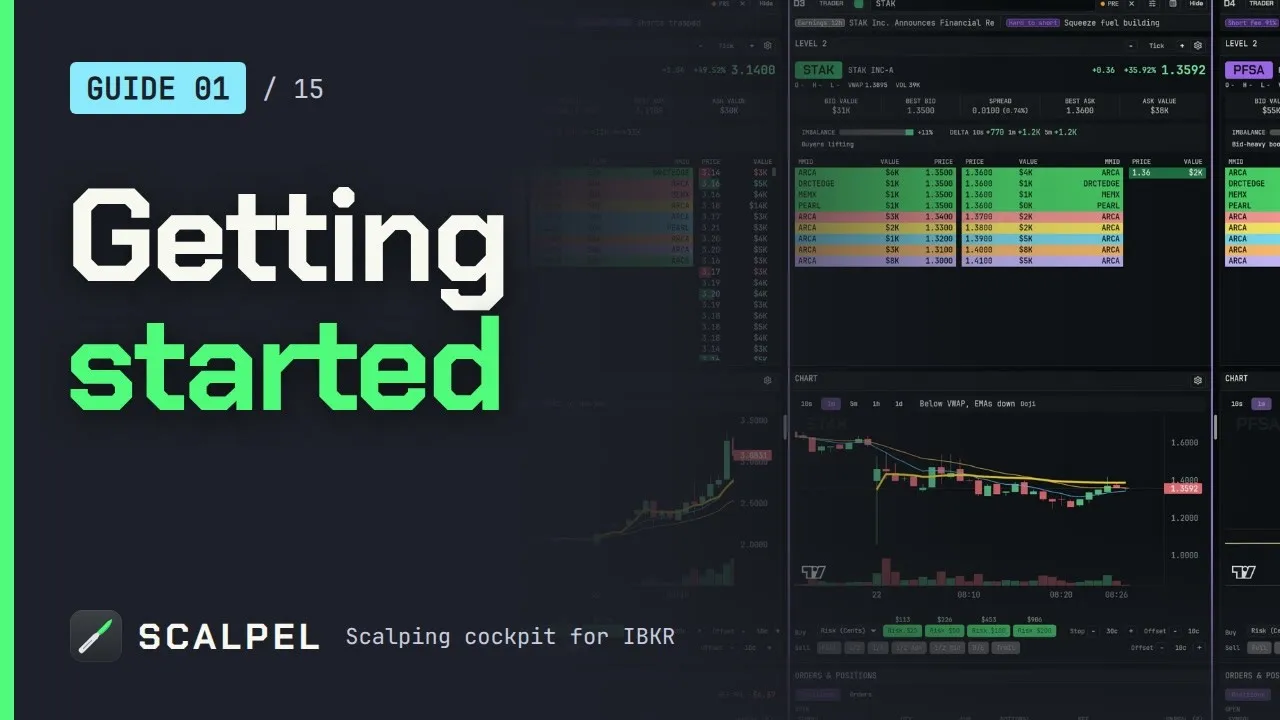
You can try all of it in SIM against the live book with IBKR commissions before you place a real order (paper trading in Scalpel). Our getting started video shows the connection and the first desk.
Trading carries a significant risk of loss. Nothing here is financial advice.
Questions
- What is the best broker for day trading small caps?
- The one that fills from 04:00 ET on stocks outside the big indexes, shows its routing in a Rule 606 report, sells Level 2 at a price you will pay, has hotkeys that send limit orders outside regular hours, and costs least at your volume including execution. No broker wins every criterion, so score them against your own style.
- Which brokers allow pre-market trading at 4 am?
- Interactive Brokers and Webull both trade from 04:00 ET, as checked on October 22, 2026. Schwab executes pre-market orders from 07:00 ET, except for the index stocks and ETFs in its 24-hour session.
- Does payment for order flow matter for day traders?
- It can. A Journal of Finance study of 85,000 simultaneous market orders found round-trip execution costs from 0.07% to 0.46% across brokers, excluding commissions. A broker's Rule 606 report shows where your orders go and what the broker is paid.
- Is a $0 commission broker cheaper for day trading?
- On commission, yes. But execution quality can cost more than commission on a fast small cap, and data, borrow and platform fees add up. Price a month of your own trading, not one trade.
- Do I need Level 2 to day trade small caps?
- Most small-cap day traders use it, because thin books move fast and the size on the bid and ask matters. Check what consolidated quotes plus Nasdaq TotalView cost at each broker: from free at Schwab for active traders to about $21 a month at IBKR.
Related guides
Guide 1.6The IBKR market data you need for Level 2The IBKR market data that gives Scalpel live quotes, Level 2 and the tape, with no third-party feed to pay for, and how delayed or missing data shows.Guide 5.5Stops in the pre-market: why they cannot sit on the bookUS exchanges take only limit orders before 09:30, so a plain stop cannot guard a pre-market trade. How Scalpel's app stops fill the gap, and their limits.Guide 7.3Why Scalpel is long-onlyScalpel is long-only by design: every sell is capped to the shares you hold, so a double press never puts you short. No shorts, futures, options or crypto.
Keep reading
- IBKR trading platforms: day trading software for Interactive BrokersIBKR trading platforms compared for day trading: TWS, IBKR Desktop and third-party software like DAS, TradingView and Sierra Chart, with prices and setup.
- TradingView Interactive Brokers integration: data, orders, limitsTradingView Interactive Brokers integration explained: how to connect, which IBKR data shows in TradingView, orders, hotkeys and the limits for scalpers.
- A day trading computer setup: specs, monitors and internetA day trading computer setup that does not stall: IBKR's TWS specs, how much RAM, monitors and placement, wired internet, a UPS and a backup connection.
Practice in SIM, against the live book.A lifetime license, every update included, with a 7-day refund guarantee.Ask in DiscordGet Scalpel