Interactive Brokers vs Schwab thinkorswim for day trading
By Scalpel Team. , updated . 9 min read.
In short
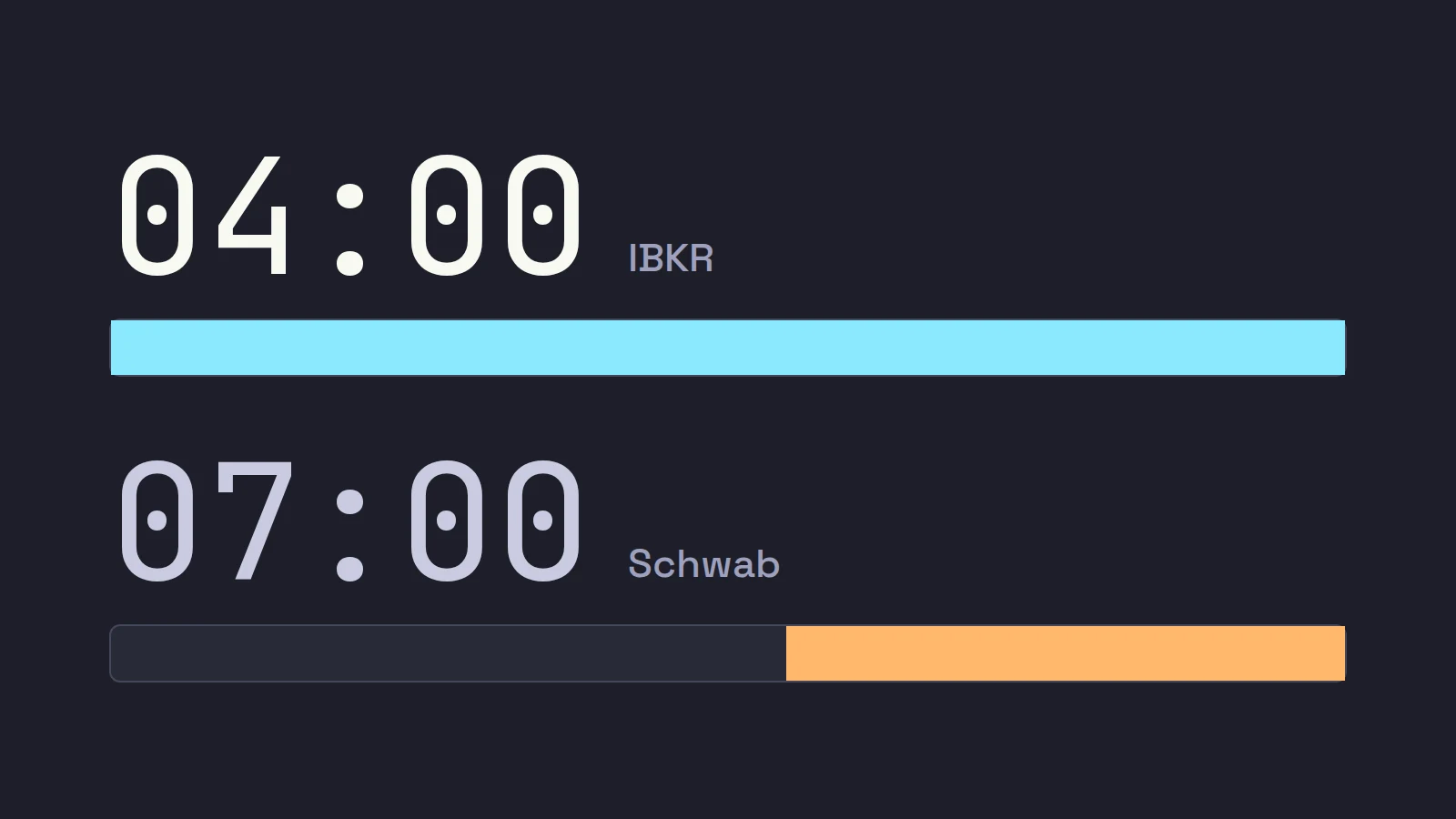
Interactive Brokers vs Schwab for small-cap day trading turns on one fact: Schwab executes pre-market orders from 07:00 ET for most stocks, while IBKR trades from 04:00 ET. Schwab charges $0 commission, gives Nasdaq TotalView free to active traders and has the friendlier platform in thinkorswim; it is paid for order flow and its default hotkeys send market orders. IBKR Pro charges per share but takes no payment for Pro orders, lets you choose a route and has hotkeys that can send limit orders outside regular hours. For pre-market small caps, IBKR; for regular-hours trading with a polished platform, Schwab is a strong choice.
Interactive Brokers vs Schwab is really a comparison of two desktop platforms as much as two brokers: Trader Workstation (TWS) against thinkorswim, which Schwab took over with TD Ameritrade. Both are free, both are deep, and both will serve a day trader. For a trader who lives in small caps before the open, a few specific differences decide it, and the first one is the clock.
We build a trading tool on the IBKR API, so weigh our view accordingly; the sections below say plainly where Schwab is the better pick. Hours, fees, routing data and features were checked on October 22, 2026, on each broker's own pages and in their Rule 606 reports. Scalpel is independent and not affiliated with or endorsed by Interactive Brokers or Charles Schwab.
Interactive Brokers vs Schwab at a glance
| Interactive Brokers (IBKR Pro, TWS) | Schwab (thinkorswim) | |
|---|---|---|
| US stock commission | $0.005 a share Fixed ($1.00 minimum), or $0.0035 Tiered plus fees | $0 online |
| Earliest pre-market fill, most small caps | 04:00 ET | 07:00 ET |
| 24-hour trading | 10,000+ stocks and ETFs overnight | S&P 500, Nasdaq 100, Dow 30 and 600+ ETFs |
| Payment for order flow | None on Pro | Yes, per share |
| Choose your route | Yes | No documented option for stocks |
| Nasdaq TotalView | $16.50 a month on top of level 1 data | Free if you meet an activity test |
| Default order hotkeys | Configurable order type, price and offset | Buy and sell at market |
| Day trade counting | FINRA's phase-in: check your account | Stopped on June 8, 2026 |
| API for your own tools | TWS API, IBKR Pro only | Schwab Trader API |
Sources for each row are linked in the sections below.
Pre-market hours: 04:00 against 07:00
This is the difference that matters most for small caps. Schwab's session hours page says pre-market orders placed between 8:05 p.m. the previous day and 9:25 a.m. ET "will be eligible for execution between 7:00 a.m. and 9:25 a.m. ET." Its round-the-clock session is for a fixed list: thinkorswim's desktop page says you can trade "all stocks in the S&P 500, NASDAQ 100, Dow 30, and over 600 popular ETFs, 24 hours a day, 5 days a week." A $3 small cap gapping on news is in none of those.
IBKR runs a pre-market from 04:00 ET, after an overnight session that its overnight trading page says covers more than 10,000 US stocks and ETFs.
Three hours would not matter if nothing traded in them. It does. NYSE's research on off-hours trading in the second quarter of 2025 found that "more than 30% of the pre-market volume trades before 7am," that the pre-market made up 7.1% of all US share volume that quarter, and that almost 8 of every 10 non-S&P 500 shares traded in NYSE Arca's pre-market had a retail trader on one side.
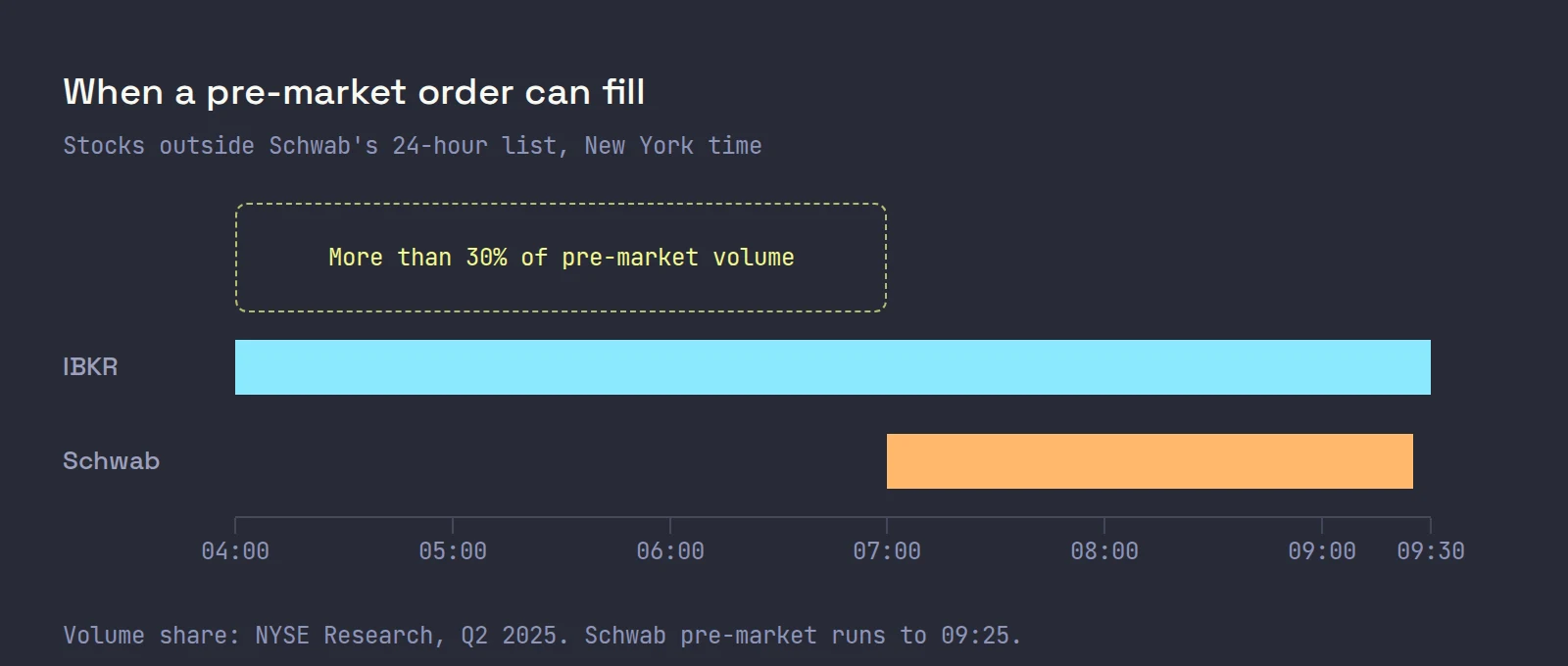
A worked case. News on ABCD crosses at 06:12 ET and the stock trades from $2.40 to $3.10 by 06:45 on heavy volume. On IBKR you can buy the first pullback at 06:20. On Schwab, a pre-market order you send at 06:20 cannot fill before 07:00, by which time the first move and often the second are over. If your style is the early gapper, that alone decides it. If you only trade from 09:30, it does not matter at all.
Outside regular hours, both brokers accept limit orders only. IBKR extended hours trading covers how to set orders up for the pre-market in TWS.
Commissions and order routing
Schwab's pricing page lists $0 online equity trades. IBKR Pro charges per share on its stock commissions page: $0.005 Fixed with a $1.00 minimum, or $0.0035 Tiered for the first 300,000 shares a month plus exchange and clearing fees. For a scalper trading 1,000 shares of a $4 stock 10 round trips a day, that is 400 orders a month: $2,000 on Fixed, about $1,250 plus fees on Tiered, and $0 at Schwab. On commission, Schwab wins, and by a lot.
What Schwab is paid instead is in its Rule 606 report for the second quarter of 2026:
- "For marketable orders the payment rate is $0.001 per share or less, for non-marketable orders the rate is $0.0033 per share or less, and for extended hours orders the rate is $0.0006 per share or less."
- In April 2026, 33.92% of Schwab's non-directed orders in stocks outside the S&P 500 went to Citadel Securities, 21.29% to Hudson River Trading and 13.67% to Virtu.
So on a 1,000-share marketable order, the wholesaler pays Schwab up to $1.00. IBKR's Q2 2026 report says IBKR has no payment for order flow arrangement for IBKR Pro orders; its $0 Lite plan is paid, at 12% of the quoted spread on marketable orders.
A wholesaler can still fill you at or inside the best quote, so payment for order flow does not mean a worse fill on any given trade. It does mean the broker has a revenue line tied to where it sends you. IBKR Pro also lets you send an order to a named exchange instead of SmartRouting; we found no way to direct a stock order to a chosen venue in thinkorswim. Whether that matters depends on how thin the books you trade are.
Thinkorswim vs TWS for day trading: hotkeys and the ladder
Both platforms have a click-to-trade price ladder (Active Trader in thinkorswim, BookTrader in TWS), Level 2 and hotkeys. The hotkeys are where they part.
Thinkorswim. The keyboard shortcuts manual lists the Active Trader hot keys and their defaults: Buy @mkt Alt+B, Sell @mkt Alt+S, Flat Position Alt+F, Reverse Position Alt+R and Auto Send on/off Alt+A, plus three zoom keys. The Active Trader category "is turned off by default"; you enable it on the Hot keys tab of the User Setup window, and custom combinations use Ctrl or Alt as the base key. The two order keys are market orders, and Schwab accepts only limit orders in extended hours, so out of the box they are regular-session tools. Pre-market, you trade by clicking the ladder with a limit order.
TWS. A TWS hotkey carries its own order settings: order type, a limit priced off the ask or bid with an offset, the outside-regular-hours flag, and instant transmit with no confirmation. That is what a pre-market scalper needs from a key, and it is why TWS is worth its learning curve for this style. IBKR's own video walks through creating and configuring them in Global Configuration.
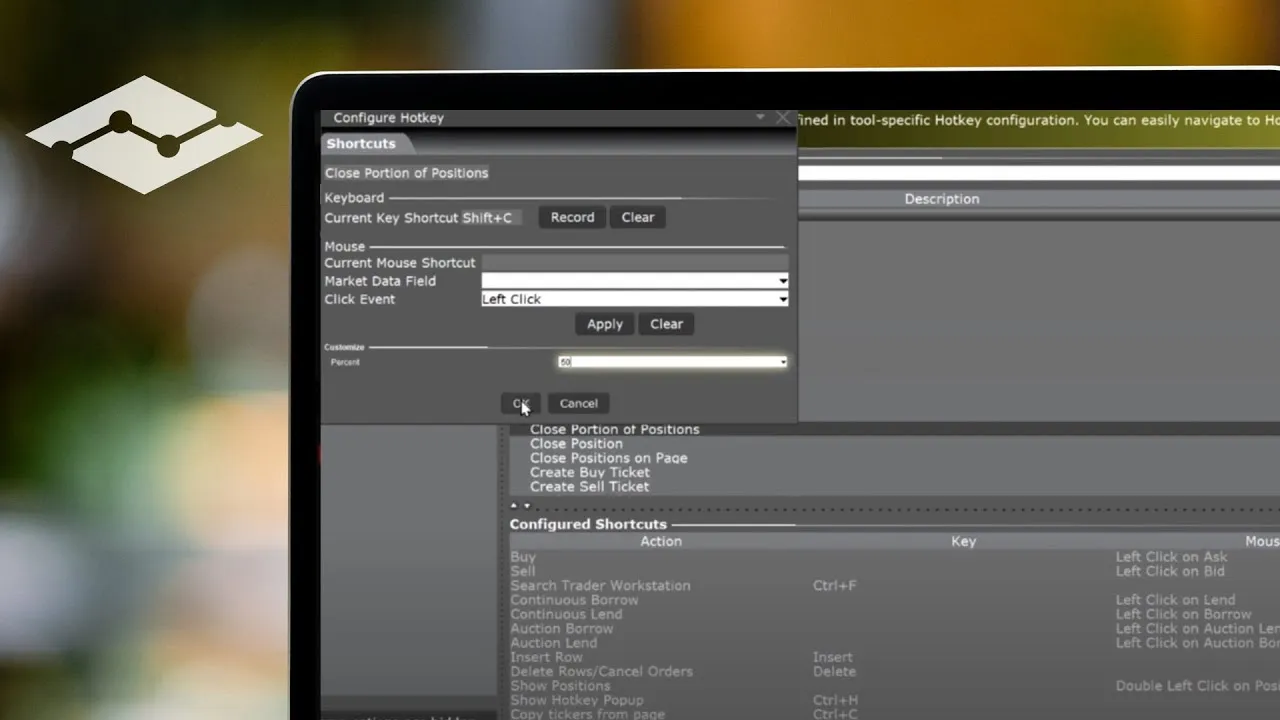
TWS hotkeys for day trading gives a complete working set. Fairly, thinkorswim is the more pleasant program to learn and to chart in, with thinkScript for custom studies and scans, and many traders find TWS cluttered by comparison (Scalpel vs TWS is our take on that).
Level 2 and market data
Thinkorswim's Level II gadget switches between three books: Level II, NASDAQ Full Book and BATS/EDGE Full Book. Schwab's paperMoney page says NASDAQ TotalView is free for non-professional clients who made 120 or more equity or options trades in the last 12 months, or 30 or more in the current or previous quarter, or who keep $1 million or more at Schwab. Anyone else pays a quarterly fee that the page does not state.
On IBKR, as listed on its market data pricing page, a non-professional pays $10.00 for the US Securities Snapshot and Futures Value Bundle (waived in any month with $30 of commissions), $4.50 for the US Equity and Options Add-On Streaming Bundle and $16.50 for NASDAQ TotalView-OpenView: $31.00 a month, or $21.00 with the waiver. An active day trader passes Schwab's 30-trade test easily, so Schwab's depth is effectively free and IBKR's costs about $21 a month. Schwab wins this row. Which IBKR feeds you need is in IBKR market data for day trading.
Day trading rules and intraday margin
FINRA's new intraday margin rule took effect on June 4, 2026, with a phase-in to October 20, 2027 (FINRA Regulatory Notice 26-10). Schwab moved early. Its article on the change says that "as of June 8, Schwab no longer counts day trades in margin accounts," that accounts formerly flagged as PDT with under $25,000 had the flag removed, and that it would introduce Intraday Margin Buying Power on July 13 for margin accounts with at least $2,000, at a 25% requirement, which "can provide up to four times the buying power intraday." Positions opened with it must be closed by 8 p.m. ET.
If you have a small margin account, that is a real point for Schwab. On IBKR, check which rules your own account is on before you size a small account for day trading, and ask IBKR if it is not clear.
APIs and third-party tools
Both brokers offer an API for your own account. Schwab's Trader API connects thinkorswim's market data, account information and order entry for stocks, options and ETFs to outside applications, through Schwab's Developer Portal. IBKR's TWS API serves a long list of trading tools, and IBKR's third-party FAQ says they need "a funded IBKR PRO account." Some platforms work with both brokers: DAS Trader Pro lists Schwab and Interactive Brokers among its brokers (DAS Trader vs Interactive Brokers). The full list of front ends for IBKR is in day trading software for Interactive Brokers.
When Schwab is the better choice
- You trade during regular hours. If you never trade before 09:30 ET, the 07:00 start costs you nothing, and $0 commission is a large saving at any volume.
- You want free Level 2 and a polished platform. Thirty trades a quarter gets you TotalView, and thinkorswim's charts, scans and thinkScript are excellent.
- You have a small margin account today. Schwab stopped counting day trades on June 8, 2026.
- You want branches, banking and one brokerage relationship. Schwab is a full-service firm with all of that in one place.
When Interactive Brokers is the better choice
- You trade small caps before 07:00 ET. IBKR fills from 04:00 on thousands of names Schwab cannot trade until 07:00.
- You want hotkeys that send limit orders outside regular hours with a price offset and no confirmation.
- You want no payment for order flow and a choice of route, on IBKR Pro.
- You want to use IBKR-only tools such as Scalpel, or the wide set of API tools built for TWS.
For the same comparison against the app-first broker, see Interactive Brokers vs Webull, and for a broker-neutral checklist, the best broker for day trading small caps.
Where Scalpel fits
Scalpel runs only on Interactive Brokers, so it is an answer to the IBKR side of this comparison, not to Schwab. It connects to your own IBKR Pro account through TWS or IB Gateway (connect Interactive Brokers) and is built for the gap this post describes: long-only small-cap scalping, pre-market first.
Its keys do what thinkorswim's defaults do not. Shift+1 to Shift+4 buy with your four presets as a marketable limit at the ask plus your offset, Ctrl+Z sells the whole position at the bid, Ctrl+X sells half, and every key is rebindable and fires with no confirmation (Scalpel hotkeys).
Its stops are watched by the app and exit with a limit order flagged for extended hours, so they can act in the pre-market where a plain stop cannot (pre-market stops). The trade-off: they are not resting orders at IBKR and only work while Scalpel runs with a live feed. Our two-minute getting started video shows the connection and the first desk.
Trading carries a significant risk of loss. Nothing here is financial advice.
Questions
- Is Interactive Brokers or Schwab better for day trading?
- For small caps in the pre-market, IBKR, because it fills from 04:00 ET while Schwab executes most stocks from 07:00 ET. For regular-hours trading, Schwab's $0 commission, free TotalView for active traders and thinkorswim platform make it a strong choice.
- What time does Schwab pre-market trading start?
- Schwab says pre-market orders are eligible for execution from 7:00 a.m. to 9:25 a.m. ET. Its 24-hour session covers S&P 500, Nasdaq 100 and Dow 30 stocks and over 600 ETFs, not most small caps.
- Is thinkorswim better than TWS for day trading?
- Thinkorswim is easier to learn and stronger for charting and custom scans. TWS hotkeys are more configurable: a key can send a limit order priced off the ask with an offset, flagged for extended hours, with no confirmation. Thinkorswim's default order hotkeys send market orders.
- Does Schwab get paid for order flow?
- Yes. Schwab's Q2 2026 Rule 606 report lists payments of $0.001 per share or less on marketable orders, $0.0033 or less on non-marketable orders and $0.0006 or less in extended hours. IBKR takes no such payment for IBKR Pro orders.
- Is Level 2 free on thinkorswim?
- Nasdaq TotalView is free for non-professionals with 120 or more trades in 12 months, 30 or more in the current or previous quarter, or $1 million at Schwab. Others pay a quarterly fee. On IBKR, TotalView is $16.50 a month on top of level 1 data.
Related guides
Guide 4.3Hotkeys: the defaults and how to change themEvery Scalpel hotkey and its default: buys, scale-outs, breakeven, trailing and cancel, each with a spoken confirmation. Esc's rules and how to rebind.Guide 1.6The IBKR market data you need for Level 2The IBKR market data that gives Scalpel live quotes, Level 2 and the tape, with no third-party feed to pay for, and how delayed or missing data shows.Guide 5.5Stops in the pre-market: why they cannot sit on the bookUS exchanges take only limit orders before 09:30, so a plain stop cannot guard a pre-market trade. How Scalpel's app stops fill the gap, and their limits.
Keep reading
- IBKR trading platforms: day trading software for Interactive BrokersIBKR trading platforms compared for day trading: TWS, IBKR Desktop and third-party software like DAS, TradingView and Sierra Chart, with prices and setup.
- TradingView Interactive Brokers integration: data, orders, limitsTradingView Interactive Brokers integration explained: how to connect, which IBKR data shows in TradingView, orders, hotkeys and the limits for scalpers.
- A day trading computer setup: specs, monitors and internetA day trading computer setup that does not stall: IBKR's TWS specs, how much RAM, monitors and placement, wired internet, a UPS and a backup connection.
Practice in SIM, against the live book.A lifetime license, every update included, with a 7-day refund guarantee.Ask in DiscordGet Scalpel