Which IBKR account for day trading: cash, margin or portfolio margin
By Scalpel Team. , updated . 9 min read.
In short
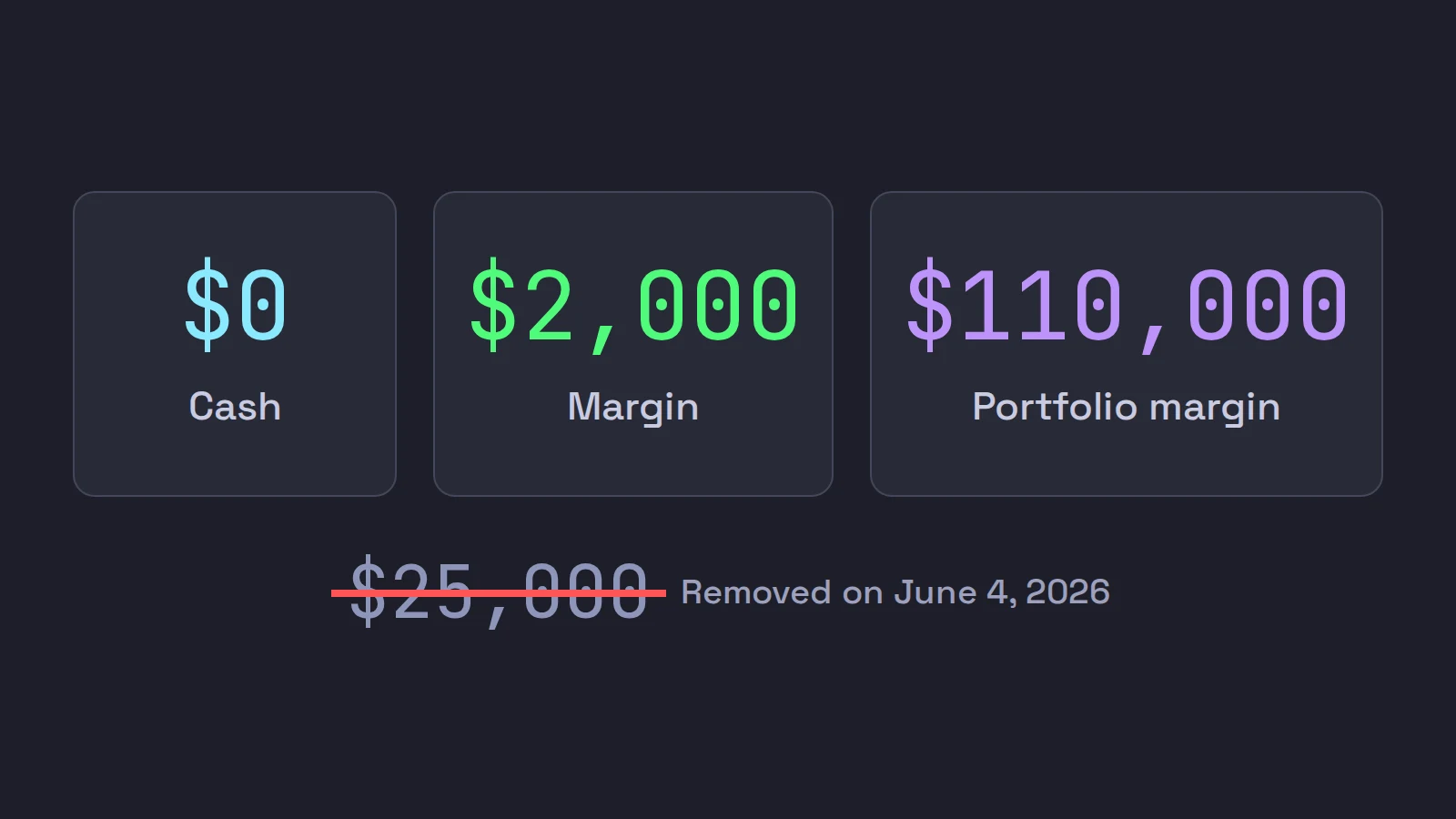
For most people, the best IBKR account for day trading is an individual margin account on IBKR Pro, funded with at least $2,000. Since June 4, 2026 there is no $25,000 pattern day trader minimum and no day trade count, though IBKR may keep an account on the old rules until October 20, 2027. A cash account can day trade, but only with settled money, and IBKR puts a 90-day restriction on an account that sells a stock bought with unsettled funds before it settles. Portfolio margin needs $110,000 to open and does little for a long-only stock scalper.
Interactive Brokers asks three questions when you open an account, and day traders tend to rush all three: who owns the account, whether it can borrow, and which pricing plan it runs on. The answers decide how often you can trade the same money in a day, what happens when you make a mistake, and whether the tools you want will even connect. This post goes through the choices in order, with the minimums, the rules that changed in June 2026, and a decision table by account size. Rules and minimums checked on October 22, 2026.
Scalpel is independent and not affiliated with or endorsed by Interactive Brokers.
The best IBKR account for day trading, by account size
| Your account | Open this | Why |
|---|---|---|
| Under $2,000 | Cash, IBKR Pro | Margin needs $2,000. Trade only settled cash, and plan for slower turnover |
| $2,000 to $25,000 | Margin, IBKR Pro | Proceeds are usable the same day; the old three-trade cap is gone once IBKR moves your account to the new rules |
| $25,000 to $110,000 | Margin, IBKR Pro | The same account; nothing new unlocks for a stock day trader |
| Over $110,000 | Margin, or portfolio margin if you also hold hedged options | Risk-based margin pays off on diversified, hedged books, not on single small caps |
Two choices sit outside the table. Open the account in your own name, not a company's, unless you have a reason to: an entity account makes you a professional market data subscriber, which multiplies your data bill (professional vs non-professional market data on IBKR). And pick IBKR Pro, because IBKR says its API is not available to IBKR Lite accounts (IBKR Pro vs IBKR Lite).
IBKR account types: the three choices you make
"Account type" means three different things at IBKR, and the application asks for each:
| Choice | Options | What it decides for a day trader |
|---|---|---|
| Who owns it | Individual, joint, retirement, trust, company and more | Your market data price (entities pay professional rates) and whether margin is allowed |
| How it pays for trades | Cash, margin (Reg T), portfolio margin | Whether you can reuse sale proceeds the same day, and which day trading rules apply |
| Pricing plan | IBKR Pro (Fixed or Tiered), IBKR Lite | Commissions, routing, and whether the API works |
The rest of this post is about the middle row, because it is the one that changes how you trade. IBKR's own FAQ gives the minimums: no minimum deposit for a cash account, $2,000 for a margin account, and $110,000 for portfolio margin (IBKR: minimum deposit).
Interactive Brokers cash vs margin account
IBKR puts the difference in one sentence: cash accounts buy with the settled cash in the account, margin accounts can buy with unsettled cash, and a cash account cannot borrow from IBKR. For a day trader the settlement part matters more than the borrowing.
How a cash account limits day trading
US stocks settle one business day after the trade. The SEC moved the standard cycle from T+2 to T+1 on May 28, 2024 (SEC investor bulletin on T+1). So money you get from a sale today is not settled until tomorrow.
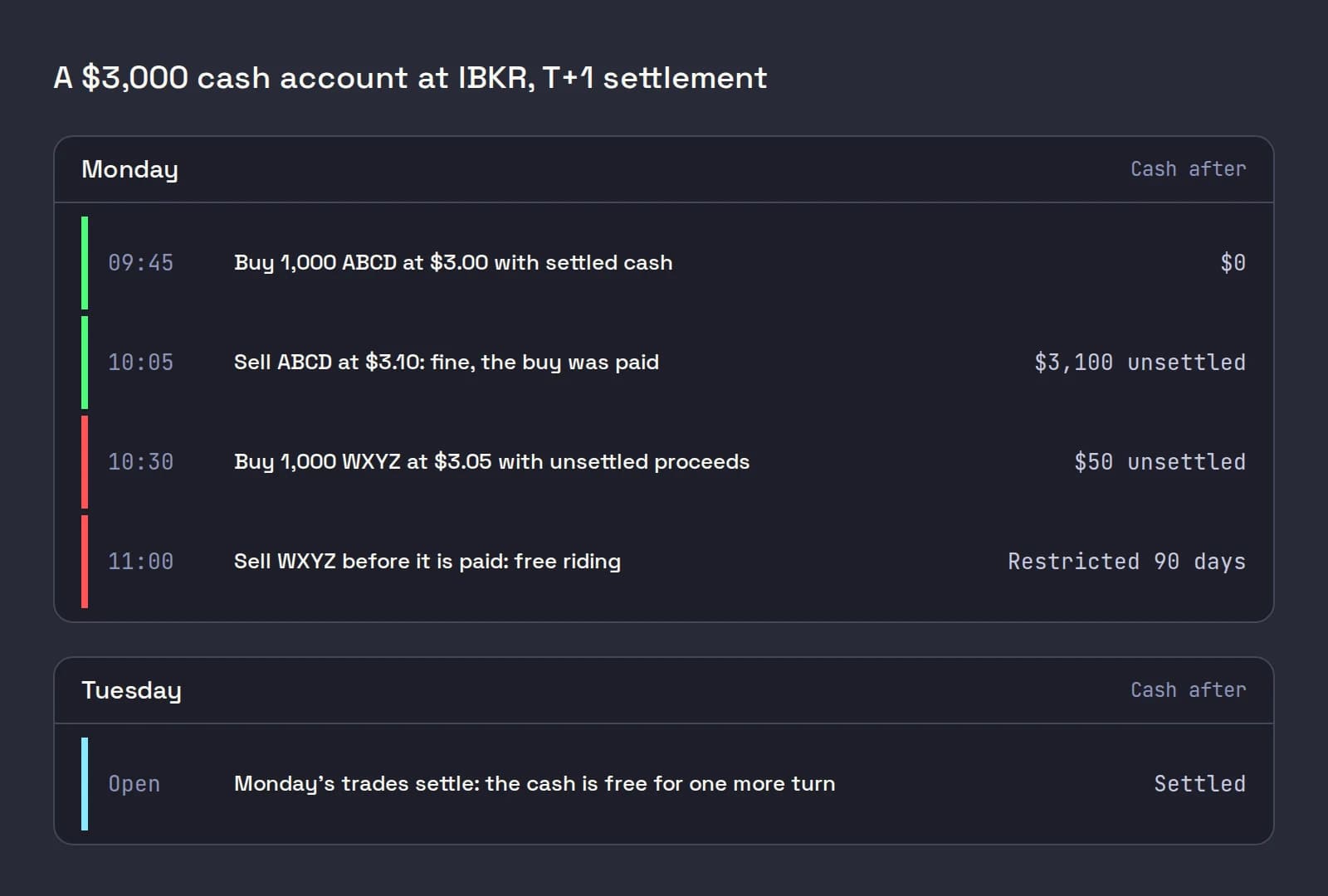
In a cash account, IBKR's rule is that a purchase must be paid for with settled money before you sell it. Its end-of-day check flags a position closed before its purchase settled, when that purchase was paid with unsettled funds, as free riding, and the account goes into a "Cash Up Front" restriction for 90 days, buying only with fully settled funds (IBKR: free riding rule).
A worked example with $3,000 of settled cash on Monday:
- 09:45 ET: buy 1,000 ABCD at $3.00 with the settled $3,000. Sell at $3.10 at 10:05 ET. That is fine: the buy was paid with settled cash. You now have $3,100, all of it unsettled until Tuesday.
- 10:30 ET: buy 1,000 WXYZ at $3.05 with that unsettled $3,100, and sell it at 11:00 ET. This is the trade IBKR's examples describe: a stock bought with unsettled proceeds and sold before you paid for it with settled money. The account is restricted for 90 days.
So in practice a cash account gets one turn of its settled cash per day. A $3,000 cash account can put $3,000 to work on Monday, and the proceeds are free again on Tuesday. IBKR's real-time credit check helps: the Available Funds figure is your fully settled cash after a closing trade, so if it shows zero, the next buy would use unsettled money.
The upside of a cash account is real, though. It cannot borrow, so it can never lose more than you put in, and it was never under the pattern day trader rule. If you trade one or two setups a day, settled cash may be all you need. The full rules, good faith violations included, are in day trading in a cash account.
What a margin account changes
A margin account can trade with unsettled funds, so the same $3,000 can go in and out of ten stocks before lunch. It can also borrow, which is the part to respect. IBKR's FAQ says the minimum equity is $2,000 "to trade with leverage or execute short sales" (IBKR: minimum equity after the PDT change).
You do not have to borrow just because you can. If you keep your total position value at or below your cash, a margin account behaves like a cash account that settles instantly, and none of the margin rules below ever bite. That is how we would run a small account.
Day trading on margin after the June 2026 rule change
FINRA's amendments to Rule 4210 took effect on June 4, 2026. They replace the old day trading margin rules "in their entirety", including the day trade count behind the pattern day trader label and the $25,000 minimum equity, with intraday margin standards (FINRA Regulatory Notice 26-10). Firms that need more time may phase the change in until October 20, 2027, so an IBKR account can still be on the old rules for a while. If TWS still shows a day trades left count, yours is.
What replaced the count is a check on how far below maintenance margin you went during the day. IBKR defines an intraday margin deficit (IMD) as "the largest maintenance margin deficiency with respect to any excess liquidity reducing transaction in a margin account during a given trading day." In plain words: if a buy took you past what your equity can carry, even for a minute, you owe that shortfall, even if you were flat by the close.
The numbers that matter, from FINRA's notice and IBKR's FAQ on satisfying an intraday margin deficit:
| Rule | Detail |
|---|---|
| How a deficit is met | Net deposits, or a rise in excess liquidity, from the end of the day it happened |
| Small deficits | Deficits no larger than the lesser of 5% of the account's equity or $1,000 do not count toward a pattern of unmet deficits |
| Restriction | A practice of unmet deficits, with one still open after the fifth business day, means 90 calendar days with no new debit balances or short positions |
| Expiry | A deficit stays outstanding until met or until the close of the 15th business day after it |
Maintenance margin itself did not change. The full mechanics, with a worked intraday example, are in the PDT rule change on Interactive Brokers and intraday margin on IBKR.
If you want to see how IBKR thinks about margin before you pick, its Traders' Academy lesson is a short, clear walk through rules-based Reg T margin and risk-based portfolio margin, the two margin types it offers:

Portfolio margin for day trading: who it is for
Portfolio margin is IBKR's risk-based margin: instead of a fixed percentage per position, it stress-tests the whole account and sets the requirement from the worst result. IBKR asks for $110,000 to start and requires at least $100,000 of equity to keep trading on margin (IBKR: risk based margin considerations).
It shines when positions offset each other, such as stock hedged with puts. A long-only small-cap scalper has nothing to offset. IBKR's list of risk-based checks includes a separate stress test for small-cap stocks, a charge for positions that are large against average daily volume, and a concentration charge on the two riskiest positions. A book of one or two volatile small caps is exactly what those tests are built to catch, so the requirement is often no lower than Reg T. If you are below $110,000, or you only trade stocks long, skip it.
Pro, not Lite
IBKR Lite has $0 commissions on US listed stocks, but IBKR's FAQ is plain: "The IBKR API is not available to IBKR Lite accounts," and an API order on a Lite account is refused (IBKR: API with IBKR Lite). Any tool that connects to TWS or IB Gateway, from a trading journal to a cockpit, needs Pro. Lite also gets charged on pre-market trades once they pass 10% of your monthly volume. The cost math is in IBKR Pro vs IBKR Lite, and Pro's two plans are compared in IBKR Tiered vs Fixed.
How to open or change your account type
Open an individual account
Apply on interactivebrokers.com as an individual, in your own name. Choose margin if you have $2,000 or more and want to reuse proceeds the same day; choose cash if you want borrowing to be impossible. Pick IBKR Pro as the pricing plan.
Or upgrade cash to margin later
In Client Portal, open the User menu (the head and shoulders icon), then Manage Account, and in Configuration click the gear next to Account Type. IBKR says its Risk and Compliance teams review the request and approval typically takes 24 to 48 hours. If you recently went from margin to cash, there is a 30-day wait before margin is allowed again.
Check which day trading rules apply
Ask IBKR whether your account is on the intraday margin rules yet, or watch for a day trades left count in TWS. Until it moves, the old three day trades in five business days limit still applies to a margin account under $25,000.
Answer the market data questionnaire honestly
Before you subscribe to data, IBKR asks whether you are a non-professional subscriber. Your account owner type feeds straight into this, which is one more reason to open in your own name. Then add live data and depth: IBKR market data for day trading.
If you live outside the US, your IBKR entity may differ and so may the rules: see day trading US stocks from outside the US. For the full setup after the account, from data to hotkeys, see day trading on Interactive Brokers.
Where Scalpel fits
Scalpel connects to your own IBKR account through TWS or IB Gateway with the API on, so it needs an IBKR Pro account; cash and margin both work. It does not change your account's rules, but it can stop you from borrowing by accident. Set Max position ($) in Settings > Risk below your cash and no single stock can grow past it, adds included; the guide to settings for a small account has a worked $5,000 example, and the fat-finger and position caps guide explains both limits.
SIM, Scalpel's paper mode, books to a paper cash account that starts at $25,000. Set SIM start ($) to the size of the account you will really open, so you practice with sizes you can actually trade (paper trading in SIM). The getting-started video shows the connection and a first SIM trade:
Scalpel is long only and US stocks only, and its stops are watched by the app, not resting at IBKR, so they only work while it runs with a live feed. Connecting is covered in connect Scalpel to Interactive Brokers.
Trading carries a significant risk of loss, and trading on margin can lose more than you deposit. Nothing here is financial advice.
Questions
- Which Interactive Brokers account is best for day trading?
- For most people, an individual margin account on IBKR Pro with at least $2,000. It can reuse sale proceeds the same day, and Pro gives you API access for third-party tools. A cash account works too, but only with settled money.
- Can I day trade in an IBKR cash account?
- Yes, with settled cash. US stock trades settle the next business day, and IBKR restricts a cash account for 90 days if it sells a stock bought with unsettled funds before that purchase settles. In practice you get one turn of your settled cash per day.
- Do I still need $25,000 to day trade on Interactive Brokers?
- No. FINRA removed the pattern day trader rule and its $25,000 minimum on June 4, 2026. IBKR's minimum to trade on margin is $2,000. Firms may phase the change in until October 20, 2027, so check whether your account has moved to the new rules.
- What is the minimum to open an IBKR margin account?
- IBKR lists $2,000, or the non-USD equivalent, for a margin account, no minimum for a cash account, and $110,000 for portfolio margin.
- Is portfolio margin worth it for day trading?
- Rarely for a long-only stock day trader. It needs $110,000 to open and $100,000 to keep, and its stress tests target concentrated small-cap positions. It pays off mainly on hedged books with options.
- Can I switch from a cash to a margin account at IBKR?
- Yes. In Client Portal, open Manage Account, then the Account Type setting under Configuration. IBKR says approval typically takes 24 to 48 hours, and there is a 30-day wait if you recently moved from margin to cash.
Related guides
Guide 14.4Settings for a small accountSettings that suit a small account: risk-based presets, tight caps, a daily loss limit you will respect, the right commission plan, and what to watch for.Guide 1.4Connect Scalpel to Interactive BrokersRun TWS or IB Gateway, match the API port and watch Scalpel connect. Which program to use, the ports (7497, 7496, 4001) and what the link banner tells you.Guide 6.1Paper trading with SIMSIM fills your orders against the live Level 2 book, with partial fills, slippage and commissions. How it works, its paper ledger, and how to reset it.
Keep reading
- Day trading on Interactive Brokers: the complete setup (2026)Interactive Brokers day trading, set up end to end: 2026 margin rules, Level 2 data costs, TWS vs IB Gateway, hotkeys, Tiered vs Fixed and a checklist.
- Scalping on Interactive Brokers: can you, and how to set it upIs TWS good for scalping? IBKR's routing and fills are fine; TWS is the friction. What slows scalpers down and a step by step TWS scalping setup to fix it.
- A TWS day trading layout for scalpers: the Mosaic setupA TWS day trading setup step by step: Mosaic windows, color-linked groups, 1 and 5-minute charts, time and sales, saving the layout and settings for speed.
Practice in SIM, against the live book.A lifetime license, every update included, with a 7-day refund guarantee.Ask in DiscordGet Scalpel