Day trading US stocks from the UK and Europe with Interactive Brokers
By Scalpel Team. , updated . 9 min read.
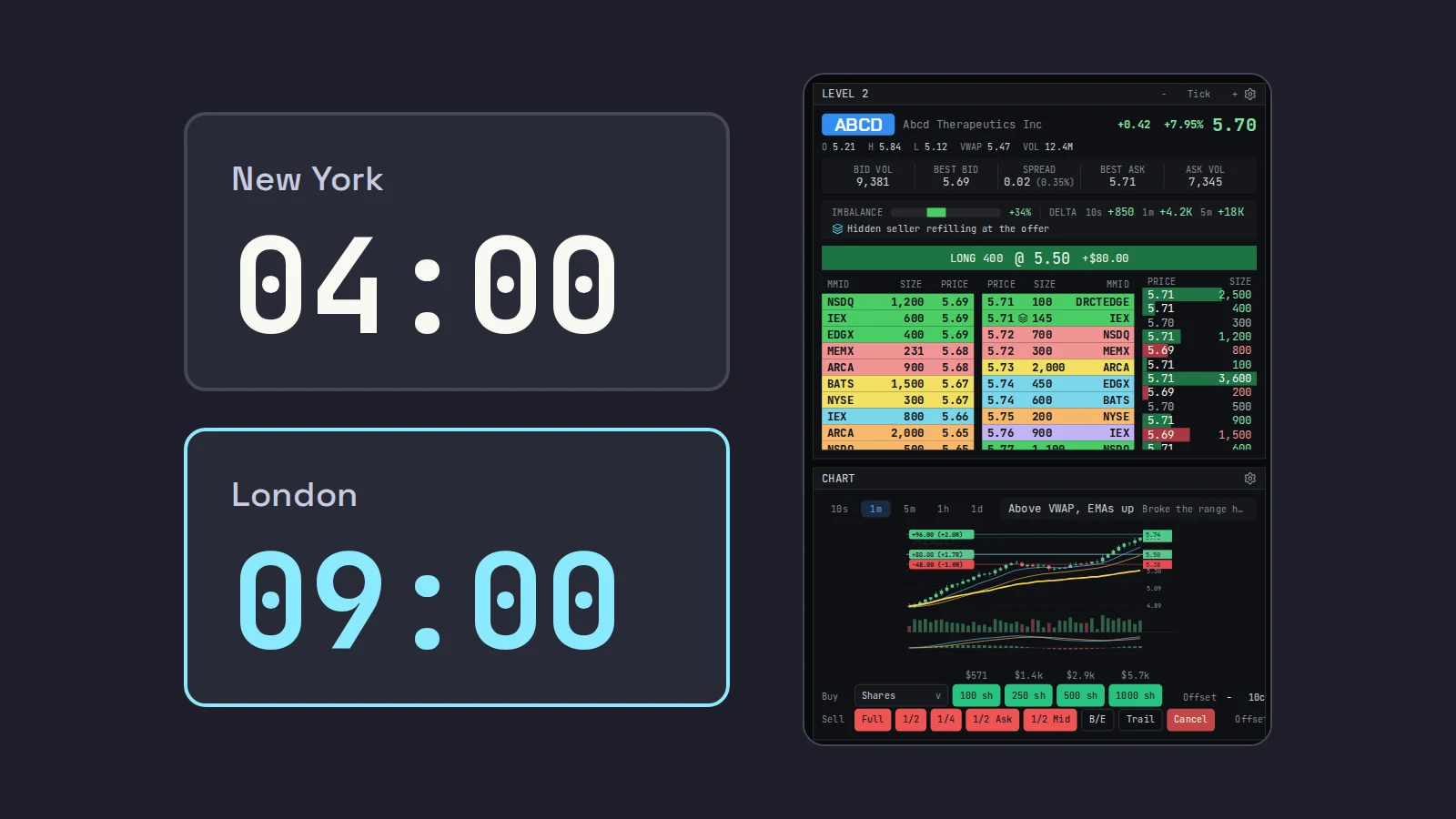
In short
Day trading US stocks from the UK, or from anywhere outside the US, works on Interactive Brokers much as it does for an American: same TWS, same data, same US exchanges. The differences are around the trade. You open with your local IBKR company, file a W-8BEN so the US treats you as a non-resident (US trading gains are then generally not taxed by the US, dividends are withheld at 30% or a lower treaty rate), you pay tax at home, you convert currency, and the pre-market starts at 09:00 in London. This is general information, not tax or legal advice.
Traders in London, Dublin or Berlin have good reasons to trade US stocks: the US market has the volume and the momentum names, and its session lines up with a European afternoon. The trading itself is no different from New York. What is different is which company holds your account, how the US taxes you, how your home country taxes you, what currency your money sits in and what time your alarm goes off.
This post uses the UK as the main worked case and the EU as the second, because those are the questions we know best: the company that sells Scalpel is registered in England and Wales. Rules, fees and rates below were checked on October 22, 2026. This is general information, not tax or legal advice: for your own return, talk to a tax adviser who knows both countries. Scalpel is independent and not affiliated with or endorsed by Interactive Brokers.
Can you day trade US stocks from the UK?
Yes. IBKR accepts clients in most countries, and from the UK or the EU you get the same platforms (TWS, IB Gateway, IBKR Desktop), the same SMART routing to US exchanges and the same per-share commissions as a US client. You can trade the US pre-market, regular hours and after-hours, and third-party tools connect through the same TWS API, provided the account is on IBKR Pro (IBKR Pro vs Lite).
Where you live decides which IBKR company opens your account, and you do not choose it:
| You live in | IBKR company | Regulator |
|---|---|---|
| The United Kingdom | Interactive Brokers (U.K.) Limited | Financial Conduct Authority, firm reference 208159 |
| Most of the EU | Interactive Brokers Ireland Limited | Central Bank of Ireland, reference C423427 |
| The United States, and countries IBKR serves from the US | Interactive Brokers LLC | SEC, FINRA, CFTC |
Each company has its own client agreement, investor protection terms and disclosures. Read the ones you are given at sign-up rather than assuming they match a US account. Choosing the account type itself is covered in which IBKR account to open for day trading.
Form W-8BEN and US tax for non-residents
Form W-8BEN is the form that tells a US payer, here your broker, that you are not a US person. You give it to the broker before any US income is paid, and you never send it to the IRS: the IRS instructions say to "give it to the person who is requesting it from you".
What the IRS says about it, from the Form W-8BEN instructions:
- Without it, you can be withheld at 30%. Failure to provide the form "may lead to withholding at the foreign-person withholding rate of 30% or the backup withholding rate".
- It lasts about three years. A W-8BEN generally stays in effect from the day you sign it until "the last day of the third succeeding calendar year", unless your circumstances change. Signed on any day in 2026, it runs to December 31, 2029. Moving to the US, or out of the country whose treaty you claimed, is a change of circumstances.
- It is where you claim a treaty rate. Line 10 claims a reduced rate on income such as dividends, if your country has a tax treaty with the US.
Trading gains: generally no US tax
For a day trader, the important rule is in IRS Publication 519. If trading stocks for your own account through a US broker is your only US business activity, "you are not engaged in a trade or business in the United States". Capital gains of a non-resident that are not connected with a US business are only taxed by the US under the 183-day rule: if you were in the United States for 183 days or more during the tax year, your net US capital gains are taxed at 30% or a lower treaty rate. For someone who lives and trades in London, that means the US generally takes nothing from trading profits.
Dividends: withheld at source
Dividends from US companies are different: they are US-source income and are withheld before they reach you. The default is 30%. Under the income tax treaties with the UK, Ireland and Germany, the general rate on dividends paid by US companies is 15%, according to the IRS treaty rate table. A day trader is rarely holding at the record date, but a stock you keep overnight can pay one. On a USD 200 dividend, a valid W-8BEN claiming the UK treaty means USD 30 withheld instead of USD 60.
Paying tax at home: the UK as the worked case
Not paying US tax on gains does not mean not paying tax. Your home country taxes them.
In the UK, the first question is whether HMRC sees your trading as a trade or not. HMRC's own manual on share dealing by individuals says that for individuals, share transactions that do not amount to investment are "speculative transactions falling short of trading, unless there are particular factors which take the case out of the norm", and are dealt with under Capital Gains Tax. So HMRC's starting point for an individual is Capital Gains Tax, not income tax. Whether your own case is out of the norm is a question for an adviser.
For gains on or after 6 April 2026, the CGT rates are 18% for the part that falls within the basic rate band and 24% above it, after the annual tax-free allowance.
The rule day traders most often get wrong is matching. HMRC's HS284 helpsheet sets the order in which shares you sell are matched with shares you bought: first shares bought on the same day, then shares bought in the 30 days after the sale, then your pooled holding. For a day trader most trades match on the same day, which keeps them simple. The 30-day rule matters when you sell a stock at a loss and buy it again within the next 30 days: the loss is matched against the new purchase, not your older shares. Keep IBKR's trade reports, because a year of scalping can mean hundreds of disposals to report, each worked out in pounds while the trades were in dollars.
In the EU, each country has its own rules for capital gains on foreign shares, and some withhold or report automatically through local brokers in ways an Irish IBKR account may not. The US side above is the same; the home side is not. Check your own country's tax authority before your first trade, not after your first good month.
Base currency and currency conversion
You can keep the account in pounds or euros and still trade US stocks, but every US trade is in dollars. Our view is to convert in lumps, not trade by trade, because a conversion has a minimum fee.
IBKR's spot currency commissions are 0.20 basis points of the trade value for most traders, with a minimum of USD 2.00 per order. A worked example at an illustrative rate of 1.30 dollars to the pound:
| Conversion | Trade value | 0.20 bp of it | You pay |
|---|---|---|---|
| GBP 10,000 to USD, once | USD 13,000 | USD 0.26 | USD 2.00 (the minimum) |
| GBP 500 to USD, twenty times | USD 650 each | USD 0.013 each | USD 40.00 (twenty minimums) |
The fee is tiny on one large conversion and adds up fast on many small ones. In a margin account, buying US shares with no dollars in the account can leave a negative dollar balance, which is a loan with interest, so check your balances by currency in TWS's account window.
Commissions are charged in dollars at the same per-share rates as for US clients: on IBKR Pro Fixed, USD 0.005 a share with a USD 1.00 minimum, and on Tiered, from USD 0.0035 a share plus exchange and clearing fees. How the two plans compare for a scalper, and how fees enter your P&L, is in commissions.
Time zones: the pre-market is your morning
US market hours are set in New York time (ET). For most of the year London is five hours ahead and Central Europe six:
| Session | New York (ET) | London | Central Europe |
|---|---|---|---|
| Pre-market | 04:00 to 09:30 | 09:00 to 14:30 | 10:00 to 15:30 |
| Regular hours | 09:30 to 16:00 | 14:30 to 21:00 | 15:30 to 22:00 |
| After-hours | 16:00 to 20:00 | 21:00 to 01:00 | 22:00 to 02:00 |
The gap shrinks to four hours twice a year, because the US and Europe change their clocks on different Sundays. In 2026 the US moved forward on March 8 and moves back on November 1, while the UK moved forward on March 29 and moves back on October 25; most of Europe changes on the same Sundays as the UK. In those weeks the US open is at 13:30 in London and 14:30 in Central Europe. Put both sets of dates in your calendar: a trader who misses it is an hour late to the open, or an hour early to an empty pre-market.
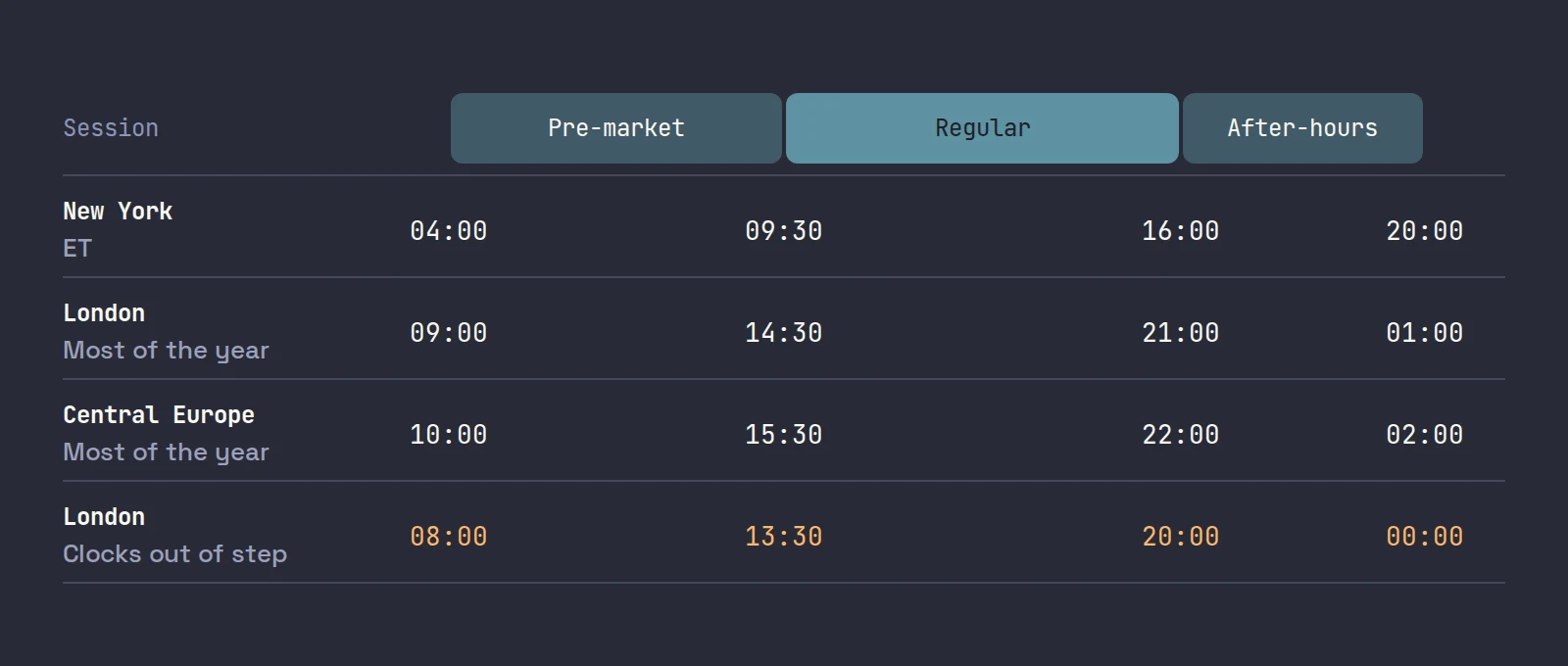
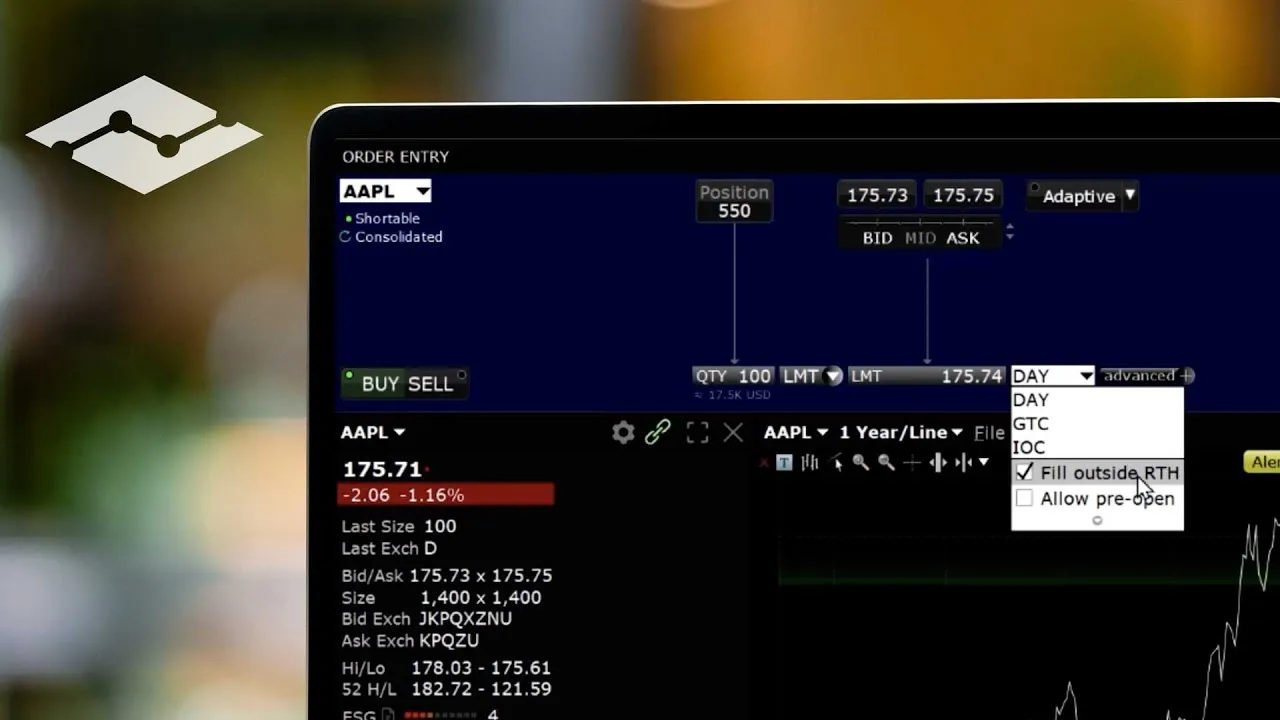
The upside is real: the whole US pre-market, where small-cap gappers do much of their moving, falls in a European working morning, with no 04:00 alarm. The catch is that outside regular hours exchanges accept limit orders only, so your orders must be allowed to fill outside regular trading hours. This IBKR video shows the TWS setting and how to check it on an order:
A resting stop order cannot protect a pre-market position for the same reason; why your stop did not trigger in the pre-market explains it.
The PDT rule and margin rules for non-US residents
The US pattern day trader rule, with its $25,000 minimum, was a FINRA margin rule, and FINRA replaced it with an intraday margin standard that took effect on June 4, 2026, with firms allowed to phase it in until October 20, 2027 (what changed). How that reaches an account at IBKR's UK or Irish company depends on how that account is carried, and we have not found an IBKR page that states it for each company.
What we checked: IBKR's margin page for UK residents trading US stocks lists a USD 2,000 minimum for margin accounts and does not mention a day trade count. If your TWS account window still shows a day trades left count, the old logic applies to your account for now; ask IBKR rather than guessing. A cash account avoids margin rules altogether but can only trade settled cash, and US stock trades settle one business day after the trade.
Market data from outside the US
For US market data, your subscriber status matters more than your country. As an individual trading your own money you are normally a non-professional subscriber, which is far cheaper; the questionnaire and what can change it are in professional vs non-professional market data. What a scalper needs, and what it costs, is in IBKR market data for day trading.
Where Scalpel fits
Scalpel is a keyboard-first desktop cockpit for your own IBKR account, and it works the same from London as from New York: it connects to TWS or IB Gateway on your computer, which can be logged in to an IBKR UK or Ireland account (connect Scalpel to Interactive Brokers). It runs on Windows 10 and 11 and on Macs with Apple silicon.
Two details help a trader abroad. The header clock is New York time with the session under it, whatever time zone your computer is set to, so the pre-market, regular hours and after-hours always read correctly, including in the weeks the clocks disagree.
And everything is in dollars: sizing presets, risk per trade, P&L and the commission plan in SIM, which matches IBKR's US stock pricing (commissions). If your account is small, the settings in small account setup matter more than where you live. Scalpel itself costs $299 once; if your card is in pounds or euros, your bank converts the charge.
Our getting started video shows the connection and the first session:
Scalpel is long only and trades US stocks. Its stops are watched by the app, not resting at IBKR, so they only work while Scalpel runs with a live feed. For the full setup from account to hotkeys, see day trading on Interactive Brokers.
This is general information, not tax or legal advice. Trading carries a significant risk of loss. Nothing here is financial advice.
Questions
- Can I day trade US stocks from the UK?
- Yes. UK residents can open an account with Interactive Brokers (U.K.) Limited and trade US stocks in the pre-market, regular hours and after-hours, with the same platforms and per-share commissions as US clients.
- Do non-US residents pay US tax on day trading profits?
- Generally no. IRS Publication 519 says trading stocks for your own account is not a US trade or business, and non-residents' capital gains are only taxed if they are in the US for 183 days or more in the year. Your home country taxes the gains instead. This is general information, not tax advice.
- What is the W-8BEN form on Interactive Brokers?
- It certifies to IBKR that you are not a US person and claims any treaty rate on US dividends. Without it you can be withheld at 30%. It generally lasts until the end of the third calendar year after you sign it.
- Does the PDT rule apply to non-US residents?
- FINRA replaced the pattern day trader rule with intraday margin standards from June 4, 2026, with a phase-in to October 2027. How IBKR applies the change depends on which company carries your account, so check your account window or ask IBKR.
- What time does the US pre-market open in the UK?
- At 09:00 UK time for most of the year, because the pre-market opens at 04:00 New York time. In the weeks when the US and UK clocks change on different Sundays it opens at 08:00 UK time, and the regular open moves from 14:30 to 13:30.
- How are US share day trading gains taxed in the UK?
- HMRC usually treats individual share dealing as falling short of a trade, so gains are taxed under Capital Gains Tax at 18% or 24% for gains from 6 April 2026, after the annual allowance. Shares bought and sold on the same day are matched together. Ask an adviser about your own case.
Related guides
Guide 14.4Settings for a small accountSettings that suit a small account: risk-based presets, tight caps, a daily loss limit you will respect, the right commission plan, and what to watch for.Guide 1.6The IBKR market data you need for Level 2The IBKR market data that gives Scalpel live quotes, Level 2 and the tape, with no third-party feed to pay for, and how delayed or missing data shows.Guide 6.3Commissions: pick your IBKR planMatch Scalpel's SIM fees to your Interactive Brokers plan: Pro Tiered, Pro Fixed, Lite or custom, plus exchange and clearing fees, and the FEE column.
Keep reading
- Day trading on Interactive Brokers: the complete setup (2026)Interactive Brokers day trading, set up end to end: 2026 margin rules, Level 2 data costs, TWS vs IB Gateway, hotkeys, Tiered vs Fixed and a checklist.
- Scalping on Interactive Brokers: can you, and how to set it upIs TWS good for scalping? IBKR's routing and fills are fine; TWS is the friction. What slows scalpers down and a step by step TWS scalping setup to fix it.
- A TWS day trading layout for scalpers: the Mosaic setupA TWS day trading setup step by step: Mosaic windows, color-linked groups, 1 and 5-minute charts, time and sales, saving the layout and settings for speed.
Practice in SIM, against the live book.A lifetime license, every update included, with a 7-day refund guarantee.Ask in DiscordGet Scalpel